WEE1 Target Evaluation Report 2026: Biology & R&D Strategy
Linda
Explore WEE1 target biology, clinical validation, drug competition, biomarker opportunities, IP considerations, and R&D strategy in this 2026 report.
Target evaluation report · Evidence cutoff: October 8, 2026
Noah AI-assisted biomedical research organizes public evidence on WEE1 biology, clinical validation, competitive programs, intellectual-property considerations, and R&D strategy.
Researchers review the source-linked evidence and its limitations. This report does not imply use of PatSnap MCP servers, proprietary PatSnap databases, or exhaustive pharmaceutical pipeline datasets.
Executive Summary
WEE1/WEE1_HUMAN (UniProt P30291) is the human G2/M checkpoint kinase that restrains CDK1 through Tyr-15 phosphorylation, providing a mechanistic basis for selectively exploiting replication stress and premature mitotic entry. Clinical validation is meaningful but not mature: randomized phase II ovarian evidence for adavosertib plus gemcitabine improved median PFS from 3.0 to 4.6 months (HR 0.55), at the cost of substantial hematologic toxicity. By contrast, CCNE1-amplified adavosertib data remain small and nonrandomized: ORR was 27% overall and 36% in the ovarian subgroup. Azenosertib is the most advanced active competitive program, with Cyclin E1-positive DENALI and an open randomized ASPENOVA Phase III registry program; no Phase III result should be inferred. Zedoresertib has early target-engagement and safety evidence, while APR-1051 remains first-in-human/early development without reported clinical efficacy. Recommendation: pursue selective, biomarker-led entry—especially functional Cyclin E1/CDK2 or replication-stress hypotheses—with explicit prospective assay validation, rather than broad unselected development.
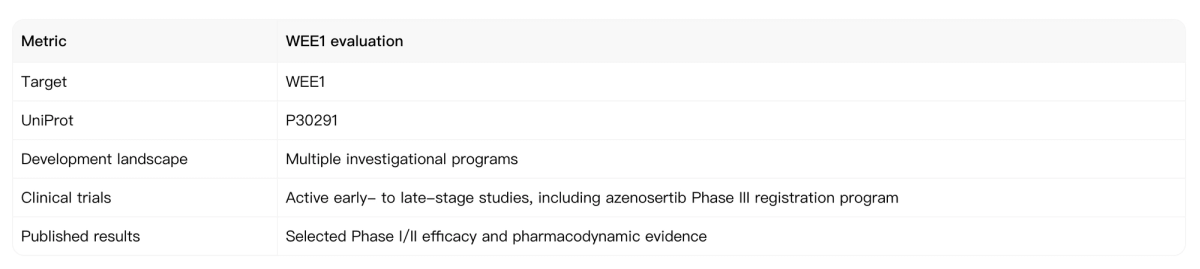
Target Attractiveness Snapshot
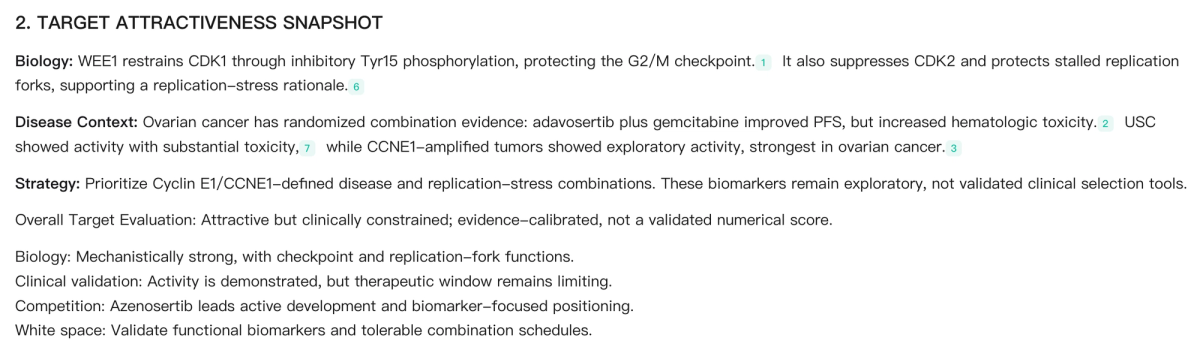
Biology and Disease Rationale
WEE1 is the G2/M checkpoint kinase that phosphorylates CDK1 on Tyr15, restraining cyclin-B–CDK1 activity and preventing premature mitotic entry. WEE1 also limits CDK2 activity during replication. In preclinical models, its inhibition increased CDK-driven replication stress, destabilized stalled replication forks through DNA2-mediated nascent-DNA degradation, and impaired completion of DNA synthesis before mitosis. This provides a rationale for combining WEE1 inhibition with platinum, gemcitabine, or other DNA-damage-response interventions, but fork protection remains a preclinical mechanism rather than a clinically validated biomarker.
CCNE1 amplification and Cyclin E1 expression are the leading exploratory selection hypotheses. In a small, biomarker-selected study of refractory CCNE1-amplified tumors, adavosertib produced a 27% ORR overall and 36% in the epithelial ovarian subgroup. Azenosertib preclinical work supports a broader Cyclin E1/CDK2-activation construct that may include protein overexpression and altered CDK2 regulation, rather than gene amplification alone. TP53 loss is mechanistically plausible because it weakens checkpoint control, but it is not sufficient as a standalone biomarker: the phase I TP53 subgroup difference was small and exploratory, while functional S-phase machinery, including CDK2, SKP2, and CUL1, may determine sensitivity beyond TP53 status.
Ovarian and uterine serous cancers remain the clearest disease contexts. Randomized ovarian evidence showed that adding adavosertib to gemcitabine improved median PFS from 3.0 to 4.6 months, although hematologic toxicity increased. In ADAGIO, single-agent adavosertib in recurrent uterine serous carcinoma produced a 26.0% ORR, median PFS of 2.8 months, and grade ≥3 treatment-related events in 60.6% of patients. These are clinical signals, not proof of a biomarker-defined dependency. The therapeutic window is further limited by gastrointestinal and hematologic toxicity, frequent dose interruptions, and a reported potential resistance route involving WEE1 mutation with compensatory PKMYT1 overexpression.
Validation and Clinical Competition
Evidence maturity is uneven. The strongest clinical evidence is a peer-reviewed randomized phase II study of adavosertib plus gemcitabine. Other efficacy signals are from small single-arm studies, while current competitor status is primarily supported by registry, company, conference, or abstract-level evidence. None of these investigational agents is approved. An open Phase III trial is not a successful Phase III result, and no reported study has established a validated predictive biomarker or a reliable class-wide therapeutic window.
| Clinical strategy | Evidence | R&D implication |
|---|---|---|
| Biomarker-selected monotherapy | In a single-arm phase II study of CCNE1-amplified refractory solid tumors, adavosertib produced an ORR of 27% overall and 36% in epithelial ovarian cancer. In the larger single-arm ADAGIO study in recurrent uterine serous carcinoma, ORR was 26.0%, with no validated molecular correlate; a trend involving CCNE1 amplification or Cyclin E1 expression remained exploratory. | These findings support an enrichment signal, not a validated companion diagnostic. Assay definition, threshold, and the distinction between CCNE1 amplification and Cyclin E1 protein or functional CDK2 activation require prospective validation. |
| Chemotherapy combinations | The peer-reviewed, randomized, double-blind phase II trial of adavosertib plus gemcitabine improved median PFS from 3.0 to 4.6 months (HR 0.55); grade ≥3 neutropenia occurred in 62% and thrombocytopenia in 31%. An earlier single-arm phase II carboplatin study in TP53-mutant, platinum-resistant ovarian cancer reported a 43% ORR. | This is human proof of activity, but with a substantial therapeutic-window burden. The randomized result is more informative than the earlier TP53-enriched single-arm signal; TP53 should not be treated as a proven predictive biomarker. |
| DDR-targeted combinations | Preclinical fork-protection and replication-stress biology supports WEE1 combinations with DNA-damaging or DDR-directed agents. In a conference-level/abstract early dose-escalation report, zedoresertib produced paired-skin-biopsy CDC2 target engagement at doses ≥200 mg; no objective responses were reported in the retrieved abstract, and grade 3 QT prolongation occurred at the highest tested dose. A carboplatin expansion reported preliminary disease control but frequent interruptions and dose reductions. | The mechanism is credible, but mature randomized evidence is required. Target engagement alone does not establish tumor efficacy, and preliminary disease control cannot be compared directly with adavosertib results across different schedules and populations. |
| Next-generation WEE1 inhibitors | Azenosertib is an active, orally optimized and selective WEE1 program and the most advanced apparent competitor in the retrieved landscape. Registry evidence identifies DENALI as an open study in Cyclin E1-positive, platinum-resistant ovarian cancer using intermittent 400- or 300-mg dosing, 5 days on/2 days off. ASPENOVA is an open randomized Phase III study versus investigator-choice chemotherapy restricted to Cyclin E1 protein-positive disease; no outcome is reported. APR-1051 is an open first-in-human Phase I/II biomarker-defined study with no clinical results; its tolerability positioning is based on company reporting, not comparative clinical evidence. | Azenosertib raises competitive pressure around intermittent dosing and Cyclin E1 selection, but the open Phase III trial is not a successful Phase III result. Registry, company, and conference evidence should remain separate from peer-reviewed randomized evidence. APR-1051 remains an early option rather than a clinically validated competitor. |
IP and Competitive Strategy
IP scope and limitation: This section summarizes publicly available patent-related disclosures and competitive-development signals. It is not a comprehensive patent landscape, patent claim analysis, or freedom-to-operate (FTO) assessment.
Publicly disclosed patent or chemistry information does not independently establish patent validity, enforceability, exclusivity, or freedom to operate. Any investment, licensing, or development decision requiring IP clearance should involve dedicated patent searches, jurisdiction-specific legal-status verification, claim analysis, and qualified legal review.
This section is for research and competitive-intelligence purposes only and does not constitute legal advice.
Azenosertib's public differentiation combines WEE1 selectivity, oral exposure, and medicinal-chemistry optimization with a potential composition-of-matter position; however, the retrieved chemistry evidence does not establish claim scope or superiority over competitors. Public disclosures also identify Cyclin E1-status selection, intermittent higher-dose scheduling, and combination concepts involving CDK4/6, HER2, or KRAS G12C inhibitors. These are public claim leads—not conclusions about enforceability, validity, exclusivity, or freedom to operate.
Against adavosertib, differentiation should therefore focus on assay-defined patient selection, Cyclin E1 status, exposure control, schedule, and tolerability—not simply another WEE1 label. Intermittent dosing may address the class's therapeutic-window constraint, but clinical superiority is unproven. A dedicated review of patent families, claims, prosecution, prior art, jurisdictions, and legal clearance is required before investment or partnering decisions.
Recommendation
WEE1 remains attractive for selective entry, not broad unselected solid-tumor development. Prioritize Cyclin E1/Cyclin E1-protein or CCNE1-defined ovarian and uterine-serous disease, plus carefully chosen replication-stress/DDR combinations supported by mechanism and clinical feasibility. Treat CCNE1 amplification, Cyclin E1 protein, CDK2 activation, TP53, and other signatures as hypotheses with different evidence levels—not validated biomarkers. Require harmonized assays and prospective comparator-based validation. Development should differentiate on schedule, therapeutic window, dose intensity, pCDK1/CDC2 target engagement, and combination tolerability. Competition is concentrated around azenosertib and Cyclin E1-positive ovarian cancer; advance only after reproducible biomarker performance and a clear benefit–risk case are demonstrated. IP clearance and current trial status also require explicit confirmation.
Bottom Line
WEE1 combines strong checkpoint and replication-stress biology with meaningful but uneven human validation. Competition is led by azenosertib, while the therapeutic window remains narrow. The defensible white space is biomarker- and schedule-led development with rigorous target engagement and combination selection—not an unselected class approach.
Evidence note: This article summarizes the supplied Noah AI research report and separates published clinical evidence from early, exploratory, registry, or company-reported findings. Trial status, patent scope and development decisions require review against the original sources.
Try Noah AI for Free
Use Noah AI to research target biology, evaluate clinical evidence, compare development programs, and build structured target evaluation reports.
Free credits are available, and no credit card is required to get started.