How to Turn a Biomedical Research Question into a Research Plan with AI
Linda
Learn how to turn a biomedical research question into an evidence-informed research plan with AI, including study design, endpoints, analysis, feasibility, and next steps.
A biomedical research question tells you what you want to learn. A research plan defines how you will generate evidence to answer it. The difficult part is turning a broad scientific question into a sequence of defensible design decisions without quietly inventing assumptions along the way.
This guide shows a practical AI-assisted workflow for turning a biomedical research question into an operational research plan—not a complete grant application or formal research proposal. The output focuses on study design, endpoints, analysis planning, feasibility, and unresolved decisions that require further evidence or expert review.
Testing note: We tested Noah AI directly. The workflow below is based on a real research-planning output generated from an evidence cutoff of September 1, 2026.
1. A Research Question Is Not Yet a Research Plan
A question such as “Does semaglutide reduce heavy drinking in AUD?” is scientifically interesting, but it is not operationally complete.
Before a protocol can be drafted, the team still has to decide:
- which population should be enrolled;
- whether the design should be randomized, pragmatic, or observational;
- what formulation and treatment duration should be tested;
- which endpoint should be primary;
- how obesity should be handled analytically;
- what data are needed for sample-size planning;
- how missing data and treatment discontinuation will be handled;
- what recruitment and safety risks could make the study infeasible.
The role of AI is not to hide those decisions inside a polished proposal. It is to make them explicit.
2. Start with a Research-Ready Question
The question used in this case was:
In treatment-seeking adults with moderate-to-severe AUD, does once-weekly subcutaneous semaglutide reduce heavy-drinking days compared with placebo, and does the treatment effect differ according to obesity status?
That framing already specifies the core population, intervention, comparator, clinical outcome, and effect modifier. It still leaves important protocol choices unresolved, including dose, treatment duration, obesity definition, heavy-drinking threshold, analysis window, and sample-size assumptions.
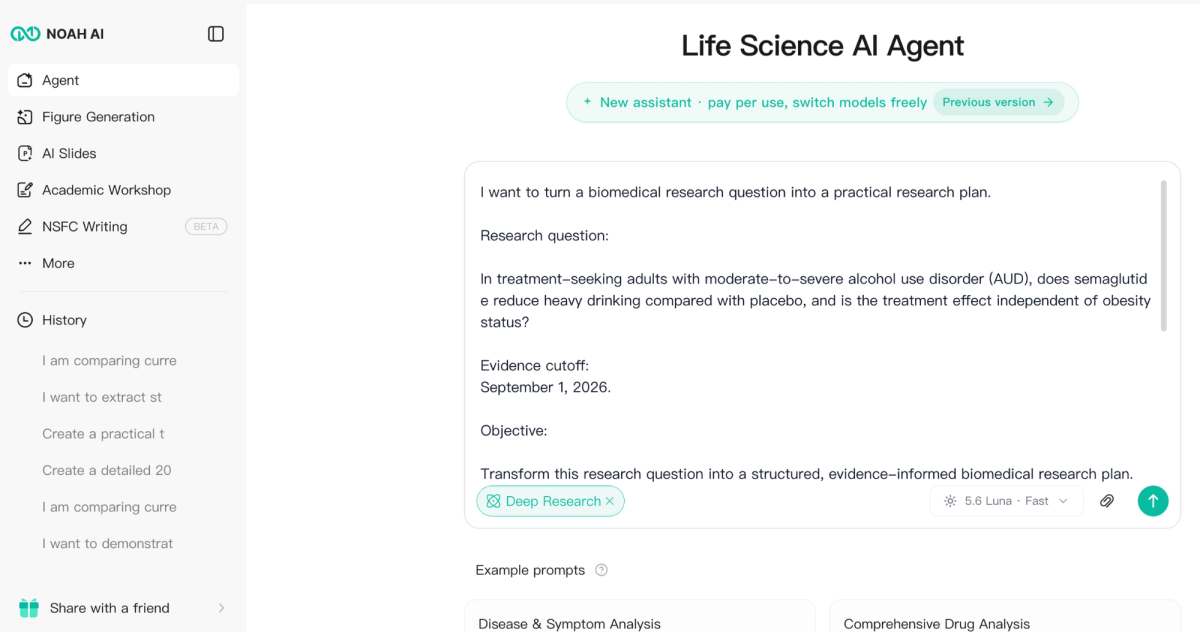
The prompt explicitly asked Noah not to write a generic grant proposal. Instead, it had to move through evidence, gap definition, design selection, endpoint planning, feasibility, and next actions.
3. Step 1: Establish What Is Already Known
A research plan should not begin with design choices. It should begin with the current evidence baseline.
In this case, available human evidence already suggested that GLP-1 receptor agonism can influence some alcohol-related outcomes, but the evidence was heterogeneous. Studies differed in route, treatment-seeking status, obesity selection, duration, behavioral co-treatment, and endpoint type.
That distinction matters because laboratory alcohol self-administration, naturalistic heavy-drinking days, craving, alcohol-related consequences, and hospitalization are not interchangeable outcomes.
4. Step 2: Define the Research Gap Precisely
The unresolved question was not simply whether semaglutide has any alcohol-related signal. Existing evidence already partially addressed that.
The more useful gap was whether injectable semaglutide improves a clinically meaningful drinking outcome in a broader treatment-seeking AUD population and whether the treatment effect differs by obesity status or is associated with weight loss.
| Research issue | Status | What remains unresolved |
|---|---|---|
| Semaglutide in treatment-seeking moderate-to-severe AUD | Partially addressed | Evidence exists, but route, population selection, treatment duration, and obesity criteria vary. |
| Effect in non-obese adults | Open | Positive longer-term injectable evidence is obesity-selected. |
| Obesity as an effect modifier | Uncertain | Existing subgroup signals do not establish a semaglutide treatment-by-obesity interaction. |
| Independence from weight loss | Open | Weight change may be a mediator and requires repeated measurement and explicit analysis. |
| Durability after discontinuation | Open | Existing studies do not establish persistence after treatment ends. |
This prevents the research plan from claiming novelty where the question has already been answered.
5. Step 3: Convert the Gap into a Testable Hypothesis
A useful hypothesis must map directly to a measurable endpoint.
The primary objective in this case was to estimate the randomized effect of semaglutide versus placebo on heavy-drinking days during the final treatment window and estimate whether that effect differs according to baseline obesity status.
That produces a testable primary hypothesis:
Semaglutide will produce a greater reduction in heavy-drinking days than placebo during the final treatment period.
Obesity-related heterogeneity can then be evaluated through a prespecified treatment-by-obesity interaction rather than by comparing whether one subgroup reaches statistical significance and another does not.
6. Step 4: Compare Candidate Study Designs Before Choosing One
This is one of the most important parts of turning a research question into a plan.
Instead of jumping directly to an RCT, Noah compared three candidate designs:
- multicenter double-blind placebo-controlled randomized trial;
- pragmatic randomized trial;
- prospective observational cohort.
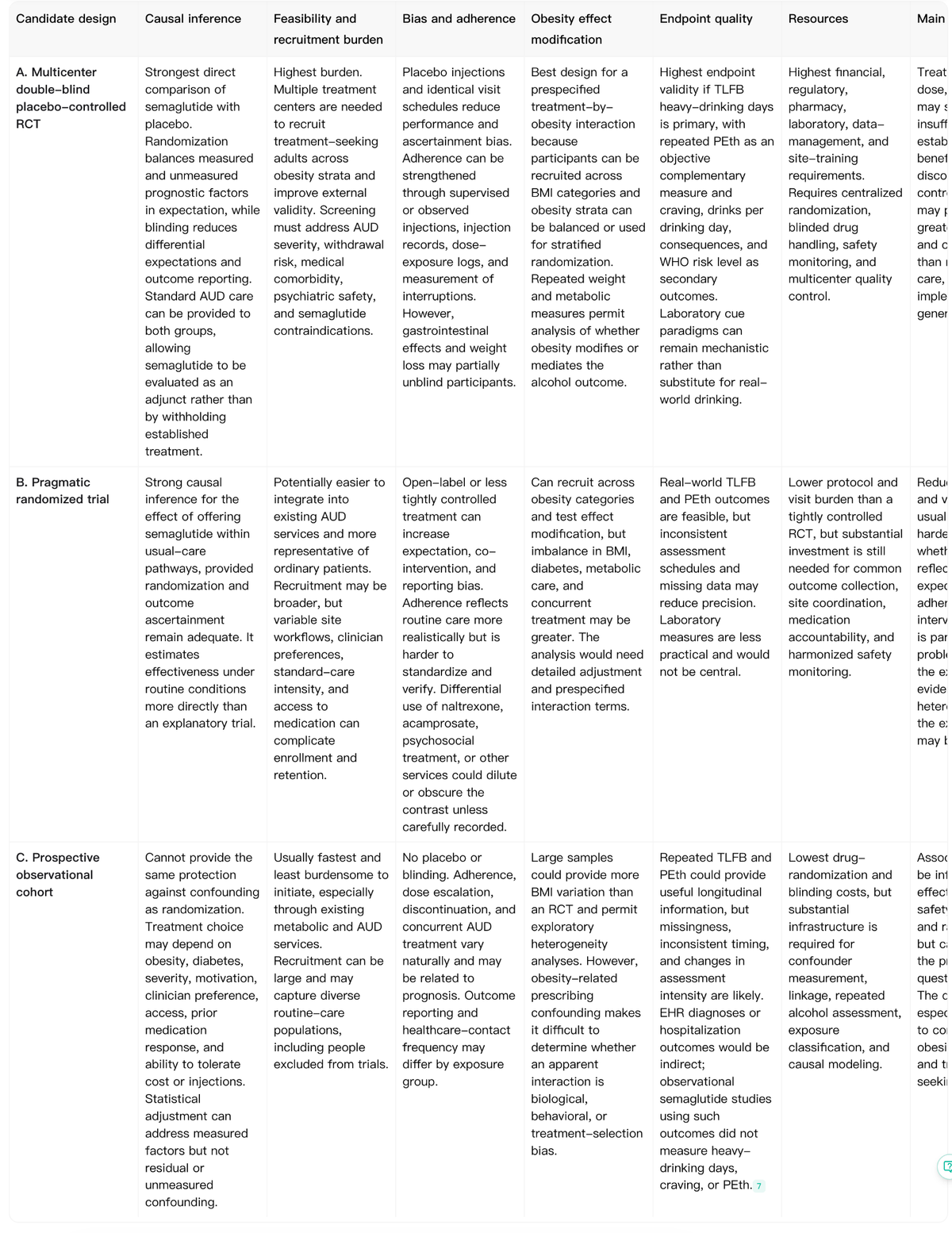
The multicenter double-blind placebo-controlled RCT was selected because the primary research question is causal: does semaglutide itself reduce heavy drinking compared with placebo?
A pragmatic randomized trial could better represent routine clinical care, but weaker control over adherence, background AUD treatment, and expectations could make a modest pharmacologic effect harder to interpret. An observational cohort would be easier to launch but would be especially vulnerable to confounding by obesity, diabetes, motivation, prescribing access, and concurrent care.
The point is not that RCTs are always the correct design. The correct design is the one that best answers the specific question while remaining feasible.
7. Step 5: Define the Study Population
The proposed target population was adults actively seeking treatment for DSM-5 moderate-to-severe AUD.
A key design decision was not to restrict enrollment to obesity. Instead, participants should be enrolled across BMI strata so the study can evaluate whether obesity modifies the treatment effect.
Eligibility should also preserve real clinical relevance. Stable common comorbidities should not be excluded automatically, while conditions that create clear safety problems, compromise endpoint validity, or require a higher level of withdrawal care need explicit protocol rules.
8. Step 6: Define Intervention and Comparator Without Pretending the Dose Is Settled
The research plan recommended injectable semaglutide as the principal candidate because the most directly relevant longer treatment evidence used a subcutaneous regimen.
But an important part of the output was what Noah did not claim. It did not present one AUD dose as established.
The route, target dose, escalation schedule, tolerated maintenance dose, treatment duration, and management of dose interruptions remain unresolved protocol decisions. Safety monitoring, tolerability, and discontinuation criteria also require further evaluation. The available evidence does not establish an optimal semaglutide regimen or a definitive safety profile for the proposed AUD population. Where evidence is insufficient, these elements should be labeled:
Requires assumption / pilot estimate.
The comparator should be matched placebo with equivalent clinical contact and background AUD care in both groups.
9. Step 7: Choose a Primary Endpoint That Answers the Research Question
The recommended primary endpoint was the change from baseline in the number of Timeline Follow-Back heavy-drinking days during the final 28 days of treatment.
That endpoint was prioritized because the research question is about clinically meaningful drinking behavior, not laboratory cue response alone.
Secondary and supportive outcomes can include:
- total alcohol consumption;
- drinks per drinking day;
- abstinent days;
- naturalistic alcohol craving;
- alcohol-related consequences;
- WHO drinking-risk level;
- repeated PEth;
- retention and actual dose exposure;
- weight and metabolic changes;
- safety and treatment discontinuation.
The endpoint hierarchy should remain disciplined. A long list of outcomes does not make a study stronger if none has a clear role.
10. Step 8: Separate Effect Modification from Mediation
This case includes an important methodological distinction.
Baseline obesity can be tested as an effect modifier: does the randomized semaglutide effect differ between participants with and without obesity?
Post-randomization weight change is different. Semaglutide may cause weight loss, and weight change may lie on the pathway between treatment and drinking outcomes. That makes it a potential mediator.
The primary efficacy model should therefore not simply adjust away post-randomization weight change. Exploratory mediation analyses can be performed separately, with appropriate assumptions and cautious interpretation.
11. Step 9: Plan Sample Size Inputs Before Calculating N
One of the easiest ways for AI to create false precision is to output a final sample size before the required inputs have been justified.
A defensible sample-size plan needs:
- the primary estimand and analysis scale;
- expected control-group trajectory;
- variance or count dispersion;
- minimum clinically important treatment difference;
- alpha and target power;
- attrition assumptions;
- expected obesity prevalence;
- the interaction effect that the study should be able to estimate.
These inputs remain planning assumptions until supported by reliable external data, pilot estimates, or formal feasibility assessments. The research plan should not present a definitive sample size or claim adequate power for the obesity interaction before those assumptions have been validated.
12. Step 10: Build a High-Level Statistical Analysis Strategy
The primary analysis should preserve randomization and estimate the treatment effect according to assigned group.
A longitudinal model can use repeated heavy-drinking-day assessments while adjusting for baseline outcome and prespecified stratification factors. The obesity interaction should be included explicitly if effect modification is part of the primary scientific question.
The plan should also predefine:
- the primary analysis population;
- missing-data handling;
- sensitivity analyses;
- treatment-by-obesity interaction;
- secondary endpoint hierarchy;
- multiplicity control;
- exploratory mediation analyses.
13. Step 11: Test Operational Feasibility
A scientifically elegant design can still fail operationally.
For this study, key feasibility questions include:
- Can enough treatment-seeking adults be recruited across obesity strata?
- Can participants remain in a 24–26-week injectable trial?
- Will gastrointestinal adverse effects compromise blinding?
- Can TLFB and PEth be collected consistently?
- Can background behavioral and pharmacologic AUD care be standardized or at least recorded?
- Can semaglutide dose exposure and interruptions be captured accurately?
These issues belong in the research plan before the protocol is finalized.
14. Step 12: Turn Everything into a Research Plan Decision Map
The final output should be short enough that a research team can see the major decisions, their evidence basis, unresolved uncertainty, and immediate next action in one place.
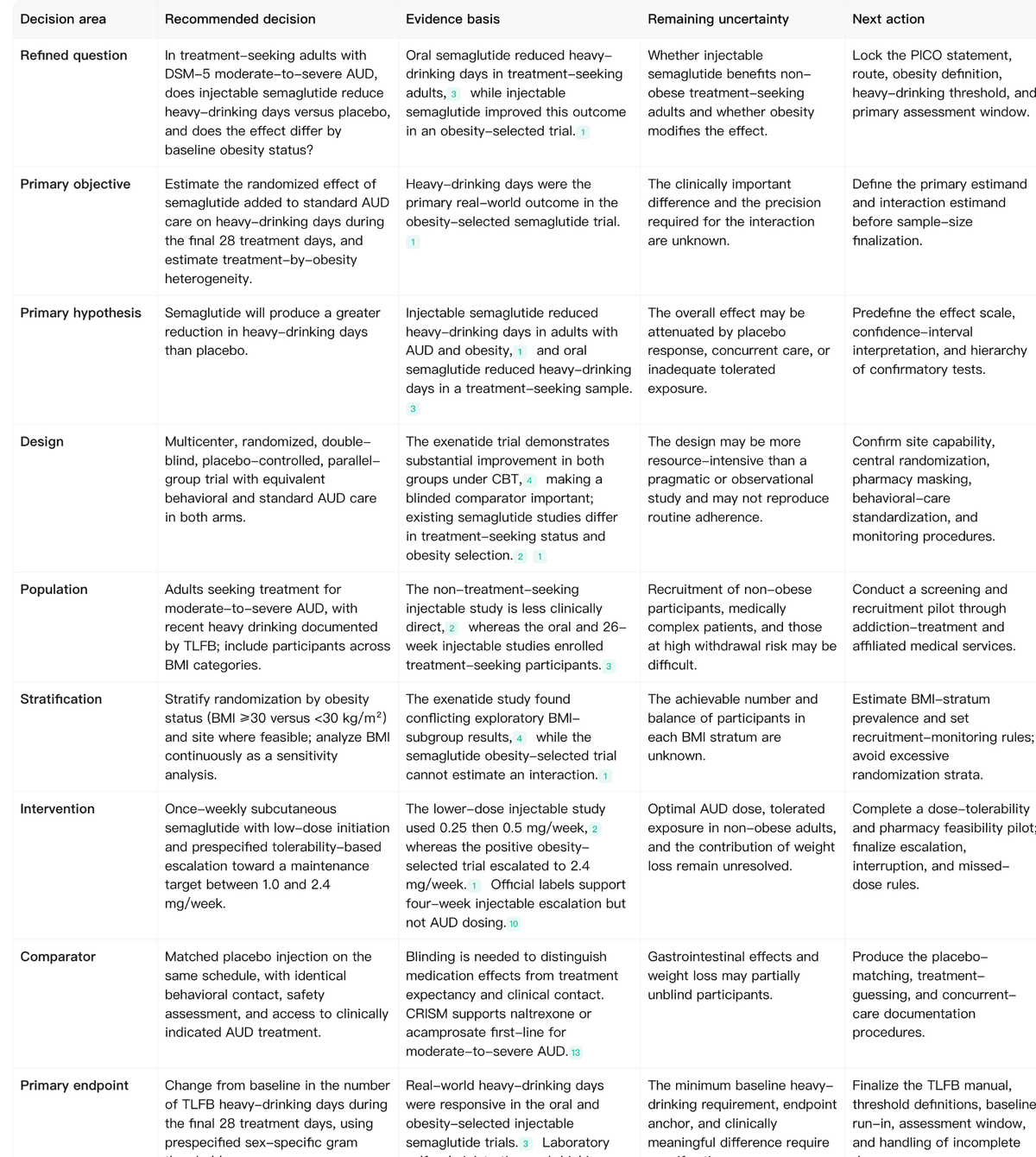
This format is more useful than a long proposal draft because it exposes what is still undecided.
For example:
- the study design can be selected while the final dose remains unresolved;
- the population can be defined while recruitment feasibility still needs pilot confirmation;
- the primary endpoint can be chosen while its clinically meaningful difference remains a planning input;
- obesity stratification can be prespecified while interaction power remains unknown.
Design an Evidence-Informed Research Plan with Noah AI
Use Noah AI to compare study designs, define endpoints, assess operational feasibility, and identify unresolved decisions that require further evidence before protocol development.
Build Your Operational Research Plan →
15. Research Plan vs Research Proposal
| Research plan | Research proposal |
|---|---|
| Focuses on decisions that define how the study will answer the question | Presents a persuasive, often formal document for approval, funding, or review |
| Can explicitly leave unresolved assumptions open | Usually requires a more finalized design narrative |
| Emphasizes design, endpoints, analysis, feasibility, and next actions | Often adds background, significance, resources, timelines, and institutional framing |
| Useful before protocol development | Usually follows substantial protocol and planning work |
AI can support both, but the sequence matters. A polished proposal should come after the key research-plan decisions are defensible.
16. Common Mistakes When Building a Biomedical Research Plan with AI
Starting with a Vague Research Question
If population, intervention, outcome, or timeframe are unclear, later design choices will also be unstable.
Choosing a Study Design Before Defining the Causal Question
A randomized trial is not automatically the right answer. The design should follow the inference the study needs to support.
Using Too Many Primary Endpoints
A research plan should identify one primary question and a coherent endpoint hierarchy.
Inventing Sample Size Inputs
If effect size, variance, attrition, or subgroup prevalence are unknown, mark them as assumptions requiring pilot or external data.
Confusing Subgroup Significance with Effect Modification
A significant result in one subgroup and a nonsignificant result in another does not establish heterogeneity. The interaction itself must be estimated.
Adjusting for a Post-Treatment Mediator in the Primary Model
Weight loss after randomization may be part of the treatment pathway and should not simply be adjusted away in the main causal analysis.
Ignoring Recruitment and Retention
A design that cannot recruit or retain the target population is not an executable research plan.
Letting AI Turn Uncertainty into False Precision
Unresolved dosing, effect-size, feasibility, and operational assumptions should remain visible until evidence supports a final decision.
17. A Simple Research-Planning Framework
A practical sequence is:
- Clarify the research question.
- Map what is already known.
- Validate the remaining evidence gap.
- Specify the objective and hypothesis.
- Compare candidate designs.
- Define population, intervention, comparator, and endpoints.
- Plan analysis and sample-size inputs.
- Stress-test feasibility and study risks.
- Convert remaining uncertainty into next actions.
The key principle is that every major study choice should come from one of four places: existing evidence, the research objective, a feasibility constraint, or an explicitly unresolved assumption.
18. Related Research Guides
- Best AI Tools for Turning Research Questions into Evidence Tables (2026)
- Best AI Tools for PubMed Literature Review (2026)
- How to Search PubMed with AI: A Step-by-Step Guide
- How to Find Sources for a Research Paper with AI: A Medical Literature Workflow
- PubMed Search with AI: How Life Science Professionals Find and Analyze Biomedical Evidence Faster
19. FAQ
Can AI turn a research question into a research plan?
Yes. AI can help refine the question, map the evidence baseline, identify the remaining gap, compare candidate study designs, define endpoints, structure an analysis framework, and expose unresolved assumptions that need pilot data or expert decisions.
Should AI choose the final study design automatically?
No. A useful workflow compares design options against the scientific question, bias risk, feasibility, recruitment, outcome quality, and resource burden. The final design should follow those trade-offs.
Can AI calculate the sample size?
AI can help identify the inputs needed for a power calculation, but it should not invent a final sample size when treatment-effect, variance, attrition, prevalence, or interaction assumptions are unsupported.
What is the difference between effect modification and mediation?
Effect modification asks whether the treatment effect differs according to a baseline characteristic such as obesity. Mediation asks whether a post-treatment change, such as weight loss, lies on the pathway through which treatment affects the outcome.
What should the final research plan contain?
At minimum: a refined question, evidence gap, objective, hypothesis, study design, population, intervention, comparator, primary and secondary endpoints, analysis strategy, sample-size inputs, feasibility risks, unresolved assumptions, and immediate next actions.
20. Final Takeaway
A research question tells you what you want to know. A research plan defines how you will generate evidence to answer it.
The most useful AI research-planning workflow does not jump directly from a question to a finished proposal. It exposes the decisions in between.
In this semaglutide and AUD case, the question led to a validated evidence gap, a causal randomized design, recruitment across obesity strata, a real-world heavy-drinking endpoint, an explicit treatment-by-obesity interaction, and a list of sample-size and operational assumptions that still require confirmation.
That is what makes the plan useful: it separates decisions that can already be justified from decisions that still need data.
Turn Your Research Question into an Actionable Study Plan
Structure your research question into design options, primary and secondary endpoints, sample-size assumptions, feasibility risks, and next steps. Keep unresolved decisions visible rather than presenting a premature final proposal.
Free to use · Free credits included · No credit card required