TROP2 Target Evaluation Report 2026: Biology, Validation, Competition and R&D Strategy
Linda
A 2026 TROP2 target evaluation report covering biology, disease context, clinical competition, Phase III evidence, biomarker opportunities, and R&D strategy.
Evaluating TROP2 now requires more than confirming that the target is druggable. The key question is whether a new program can differentiate on ADC design, therapeutic window, biomarker strategy, disease context, resistance biology, or treatment sequencing.
This report uses a structured Noah AI workflow to connect TROP2 biology with disease context, clinical competition, pivotal trials, evidence maturity, biomarker opportunity, and practical R&D actions. The evidence cutoff is September 10, 2026.
1. TROP2 Target Evaluation Dashboard
The dashboard provides the fastest way to separate target validation from actual competitive attractiveness. TROP2 is clearly validated as an ADC target, but it is not a universal predictive biomarker: broad expression does not automatically identify the patients who derive the greatest relative benefit.
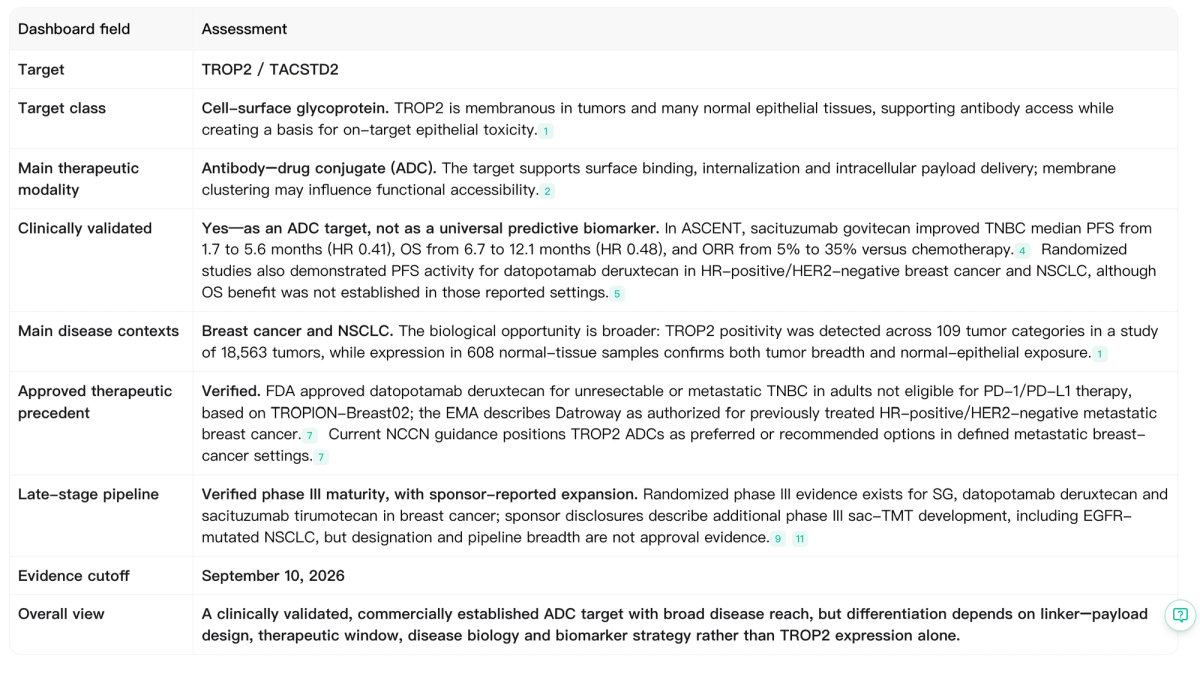
The most defensible interpretation is selective rather than universal: TROP2 has strong clinical validation in breast cancer, while NSCLC shows more context-dependent results. Differentiation is therefore likely to come from molecular design, disease selection, functional biomarkers, safety, and sequencing rather than simple target ownership.
2. One-Screen Recommendation
TROP2 should not be treated as an invitation to reproduce existing topoisomerase-I ADCs. A new entrant needs a clinically testable reason to win.
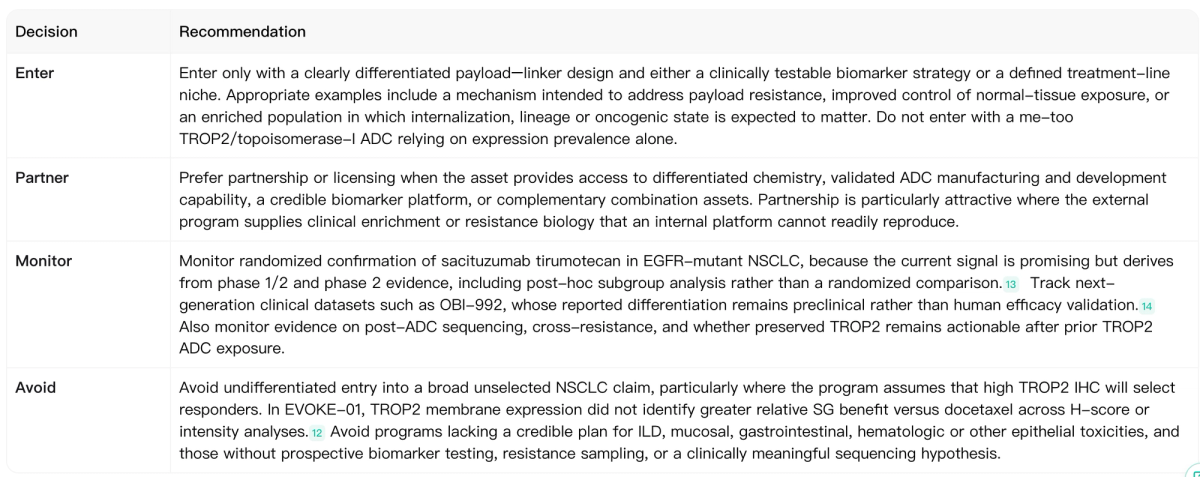
Practical read: monitor by default; enter selectively or partner for differentiation. The competitive moat is more likely to come from chemistry, patient selection, and sequencing evidence than from TROP2 expression alone.
3. Biology Module: Why TROP2 Is Attractive
TROP2 is a broadly expressed epithelial cell-surface glycoprotein that supports antibody binding, internalization, and intracellular payload delivery. That makes it a credible ADC target. The biology, however, is more complex than a simple "high expression equals response" model.
| Biology signal | Evidence interpretation | R&D implication |
|---|---|---|
| Tumor expression and breadth | TROP2 is broadly expressed across many epithelial tumor types. | Supports multi-tumor development, but prevalence alone is not a predictive biomarker. |
| Cell-surface accessibility | Membrane localization supports antibody access; membrane organization may differ between tumor and normal tissue. | Functional membrane biology may matter more than bulk RNA expression. |
| Internalization | TROP2-directed ADCs can internalize and release intracellular payload. | Internalization and trafficking should be measured directly where possible. |
| Normal-tissue expression | TROP2 is also present in normal epithelial tissues. | Therapeutic-window optimization is central; mucosal, cutaneous, and other epithelial toxicities are not secondary details. |
| Predictive biomarker value | Clinical activity validates the target, but expression level alone has not consistently predicted relative benefit. | Prospective biomarker-development work is still required. |
| Resistance | Antigen loss, altered antigen biology, and payload-target resistance can emerge. | Longitudinal sampling and resistance monitoring should be built into development. |
4. Disease-Context Module
Breast cancer is the clearest clinical anchor for TROP2-directed ADCs. NSCLC is more heterogeneous: broad unselected development has produced mixed outcomes, while more specific histologic or oncogenic-state hypotheses may offer a better development path.
| Disease | Clinical-development signal | Why it matters |
|---|---|---|
| Breast cancer | Randomized evidence supports TROP2 ADC activity in late-line TNBC and HR-positive/HER2-negative metastatic disease, with additional first-line regulatory precedent in a defined TNBC population. | Breast cancer provides the strongest target-validation anchor, while sequencing and direct ADC-to-ADC differentiation remain unresolved. |
| NSCLC | Randomized evidence is more mixed, with stronger signals in nonsquamous disease than squamous disease. EGFR-mutant disease offers a more focused enrichment hypothesis for next-generation programs. | Broad antigen-prevalence strategies are less defensible than histology- or biology-defined development. |
5. Clinical Competition Module
The leading TROP2 assets no longer compete on whether the target can deliver a cytotoxic payload. They compete on treatment setting, linker–payload architecture, therapeutic window, disease selection, biomarker logic, and activity after prior ADC exposure.
| Asset | Development position | Competitive interpretation |
|---|---|---|
| Sacituzumab govitecan | Established randomized and regulatory benchmark in metastatic breast cancer. | Sets a high bar for efficacy in TNBC, while hematologic toxicity and sequencing after prior TROP2 ADC remain important differentiation questions. |
| Datopotamab deruxtecan | Randomized and regulatory evidence in breast cancer; continued NSCLC development. | Demonstrates expansion beyond late-line TNBC, but benefit is setting-dependent and safety liabilities such as stomatitis, ocular toxicity, and ILD remain strategically important. |
| Sacituzumab tirumotecan | Late-stage / Phase III with randomized late-line TNBC evidence and additional NSCLC development. | Distinct linker–payload architecture and encouraging evidence make it a major next-generation competitor, but cross-trial superiority over established ADCs is not proven. |
| OBI-992 | Early clinical development with differentiation still largely supported by preclinical evidence. | Illustrates the chemistry-led differentiation thesis required for entry, but human comparative advantage remains unvalidated. |
6. Selected Trial Landscape
The selected trials show how the field is moving from broad target validation toward more selective disease and treatment-context hypotheses.
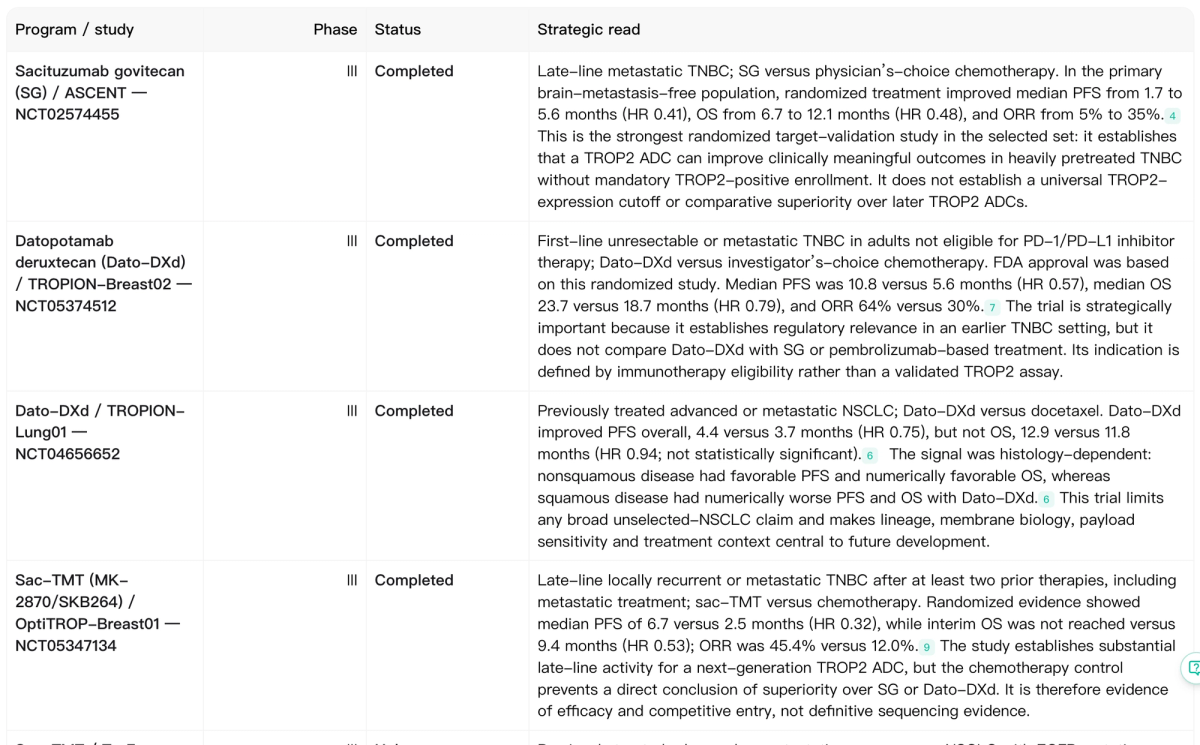
These trials should not be read as a cross-trial ranking. Populations, treatment lines, comparators, histologies, eligibility rules, and follow-up differ. The main value of the trial map is to define which clinical hypotheses have been validated and which still require randomized confirmation.
7. Result Evidence Module
Evidence maturity differs materially across the field. Sacituzumab govitecan has strong randomized Phase III validation in TNBC. Datopotamab deruxtecan has randomized, peer-reviewed and regulatory evidence in breast cancer, with more qualified results in NSCLC. Sacituzumab tirumotecan has randomized late-line TNBC evidence and encouraging but nonrandomized EGFR-mutant NSCLC data. OBI-992 remains primarily an early-development hypothesis.
| Asset | Evidence maturity | Interpretation |
|---|---|---|
| Sacituzumab govitecan | Randomized Phase III; peer-reviewed clinical evidence | Strong human validation of TROP2-directed ADC treatment in late-line TNBC; does not establish a universal TROP2 IHC threshold. |
| Datopotamab deruxtecan | Randomized Phase III; peer-reviewed and regulatory evidence | Validated across breast-cancer settings with more qualified NSCLC outcomes; evidence does not establish superiority over other TROP2 ADCs. |
| Sacituzumab tirumotecan | Randomized Phase III TNBC; early-to-mid clinical NSCLC evidence | Supports competitive entry and biomarker-enriched development, but randomized confirmation is still needed in EGFR-mutant NSCLC. |
| OBI-992 | Early clinical / preclinical differentiation evidence | Useful for hypothesis generation; not sufficient to claim a superior therapeutic window or efficacy profile. |
8. Attractiveness Scorecard
TROP2 is attractive only under a selective development thesis. Biology and clinical validation are strong, but competitive whitespace is narrower in broad unselected settings.
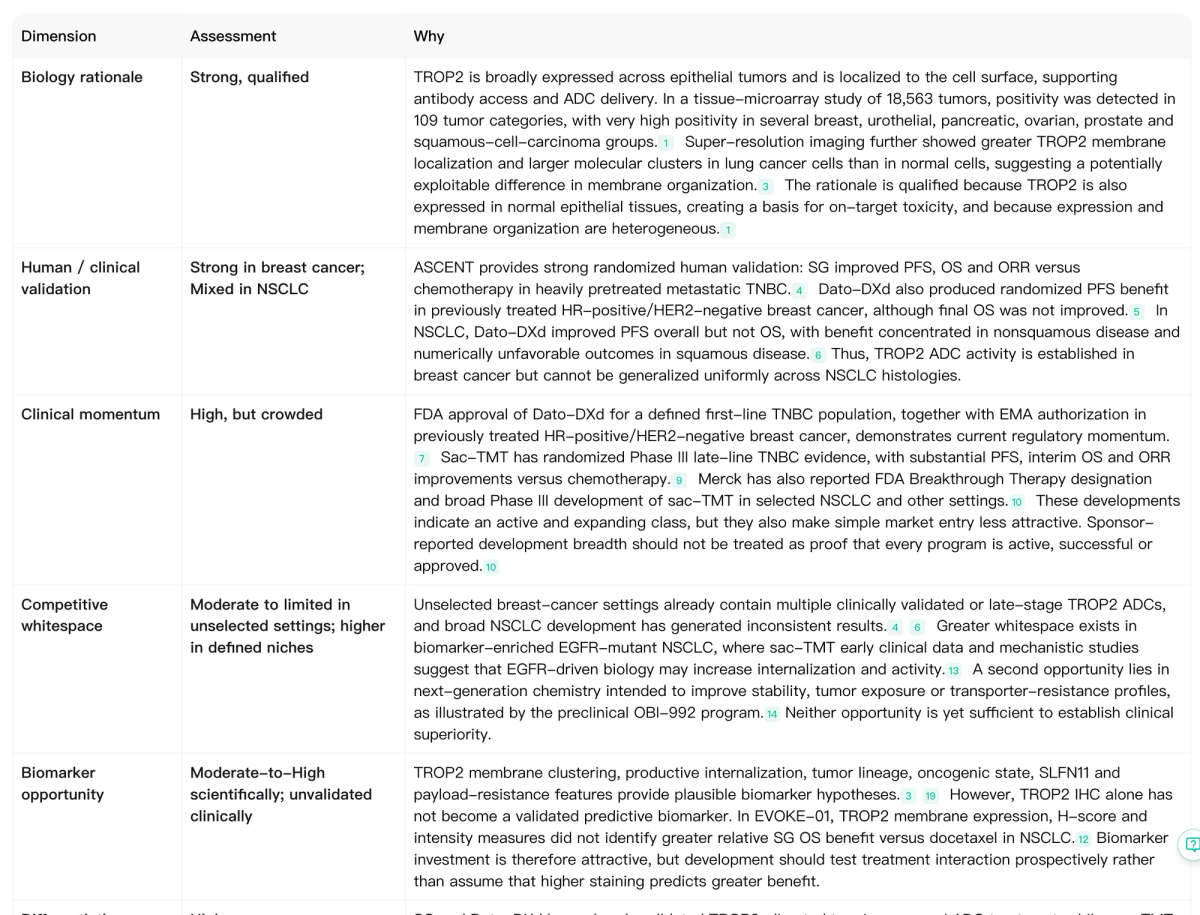
The overall implication is selective entry or partnership rather than indiscriminate expansion. A new program should be tied to a specific unmet need such as improved tolerability, a functional biomarker, activity after prior TROP2 ADC exposure, or a chemistry-based solution to payload resistance.
Try Noah AI for Free
Use Noah AI to search, compare, and analyze biomedical evidence with AI-powered research workflows. Free credits are available, and no credit card is required to get started.
9. Clinical Development Map
The development strategy should move from broad target validation toward context-specific proof of differentiation.
| Lane | Opportunity | Risk | Action |
|---|---|---|---|
| Breast cancer | Strong randomized and regulatory anchor across several treatment settings. | No direct proof of superiority among ADCs; sequencing after prior TROP2 ADC remains unclear. | Use clinically relevant comparators and define prior-ADC exposure explicitly. |
| NSCLC | Nonsquamous and EGFR-mutant populations offer more focused hypotheses. | Broad unselected development has produced mixed or negative outcomes. | Use prespecified histology and biomarker strategies and require randomized confirmation. |
| Biomarker-selected populations | Functional membrane biology, internalization, oncogenic state, and payload-sensitivity markers may enrich response. | Assay standardization and predictive validation remain unresolved. | Validate biomarkers prospectively and longitudinally. |
| Next-generation ADC design | Payload, linker, DAR, bystander effect, stability, and transporter biology may create differentiation. | Preclinical differences may not translate into human benefit. | Link construct design to prespecified clinical PK, exposure, efficacy, and toxicity hypotheses. |
| Combination strategies | Mechanistically justified combinations may extend activity or address resistance. | Overlapping toxicity can narrow the therapeutic window. | Use safety-led, mechanism-confirming trials with clear stopping rules. |
10. How Noah Changes the Workflow
Noah AI can turn target evaluation from a series of disconnected searches into a structured research workflow while keeping source interpretation and final judgment with the analyst.
| Traditional target research | Noah AI workflow |
|---|---|
| Researchers search literature, trial registries, regulatory websites, and sponsor materials separately. | Noah helps organize related biomedical concepts and evidence sources into one research flow. |
| Trial aliases, development codes, and indication-specific programs must be manually reconciled. | Noah can structure trial records by asset, indication, phase, comparator, endpoint, and identifier. |
| Evidence types are often mixed in spreadsheets or notes. | Noah can separate randomized peer-reviewed evidence, regulatory evidence, registry information, sponsor disclosures, and preclinical findings. |
| Cross-asset comparisons often mix incompatible populations and endpoints. | Noah can normalize comparison fields and flag where direct comparison is not valid. |
| Updating a report requires repeating searches and manually replacing outdated facts. | Noah can help rerun the same structured workflow against a defined evidence cutoff and preserve what changed. |
The strongest use of Noah in target evaluation is as an evidence-navigation and synthesis layer: it reduces repetitive retrieval and formatting work, makes evidence provenance clearer, and exposes the uncertainties that actually determine an R&D decision.
Build a Source-Linked Target Evaluation with Noah AI
Use Noah AI to build a source-linked target evaluation covering target biology, disease context, clinical validation, competitive assets, pivotal evidence, biomarker opportunities, and R&D strategy.
Compare where the evidence is strong, where differentiation remains possible, and which uncertainties still matter before making a development decision.
Free to use · Free credits included · No credit card required
Build a Target Evaluation with Noah AI →
Related Research Guides
- Best AI Tools for PubMed Literature Review (2026)
- Best AI Tools for Research Evidence Tables (2026)
- Best AI Tools for Clinical Trial Results Analysis (2026)
- PubMed Search with AI
This article is for research and competitive-intelligence workflows. It does not provide medical, regulatory, legal, or investment advice.