Similar Products to Scite for Source-Traceable Medical Research (2026)
Linda
Compare seven products similar to Scite for source-traceable medical research, citation checking, evidence tables, literature reviews, and cited research reports.
The problem behind "similar products to Scite"
Scite is designed around citation context: helping researchers see how later papers cite and discuss earlier research. But source-traceable medical research can involve additional tasks, including finding relevant studies, separating similar but non-identical endpoints, extracting trial characteristics, and building a cited synthesis that can be checked against the original sources.
These distinctions matter in medical evidence review. Hospitalization for heart failure is not necessarily equivalent to a composite cardiovascular endpoint. A type 2 diabetes cardiovascular-outcomes trial is also different from a dedicated heart-failure trial.
The products in this comparison therefore address different parts of the research workflow: citation context, literature discovery, screening, extraction, PDF analysis, systematic-review management, or structured evidence synthesis.
Quick answer
Noah AI can turn a medical research question into a structured evidence table and a cited research draft that researchers can review against the underlying sources.
Scite focuses on citation context. Elicit focuses on literature screening and structured extraction. Covidence supports formal systematic-review workflows. Consensus, SciSpace, ResearchRabbit, and Semantic Scholar address other parts of discovery, reading, and evidence review.
If your workflow starts with a medical question and you want a structured, source-linked draft for human review, Noah is one option to evaluate.
Where Scite fits in the research workflow
Scite is built around citation-context analysis. Its Smart Citations help researchers examine how citation statements support, contrast with, or mention earlier work.
That is a different research task from extracting study population, sample size, follow-up, endpoint definitions, and effect estimates into a structured evidence table. Depending on the project, researchers may therefore combine citation-context tools with search, extraction, synthesis, or review-management tools.
Quick comparison
| Product | Primary workflow | Traceability approach |
|---|---|---|
| Noah AI | Medical question → structured cited draft | Structured outputs with sources for human verification |
| Elicit | Literature screening and extraction | Citations connected to extracted information |
| Consensus | Evidence-backed research answers | Answers linked to research papers |
| SciSpace | Paper and PDF analysis | Questions and explanations anchored to papers |
| Covidence | Formal systematic-review management | Reviewer decisions, exclusions, extraction, and audit workflow |
| ResearchRabbit | Literature and citation-network discovery | Connections between papers, authors, and citation networks |
| Semantic Scholar | Broad scholarly discovery | References, citations, and paper-level metadata |
Noah AI for source-traceable medical evidence workflows
Noah AI is designed for medical and life-science research workflows rather than as a general-purpose chatbot. Its research workflow can support movement from a medical question and source discovery toward structured, cited outputs that researchers can inspect and verify.
The case below tests one question a medical researcher could realistically assign: Do SGLT2 inhibitors reduce hospitalization for heart failure in adults with type 2 diabetes?
For related workflows, see how to use Noah for medical literature review and PubMed search with AI.
Why Noah fits this workflow
The points below reflect Noah's product positioning together with the live Agent run shown in this article.
- Medical-first workflow. Noah is designed around medical and life-science research rather than general-purpose conversation.
- Search and synthesis in one workflow. Researchers can move from source discovery toward structured synthesis without treating search and drafting as completely separate tasks.
- Starts from the research question. Agent accepts a natural-language medical research question. The live run below did not require a pre-built PMID list or uploaded PDF library.
- Structured, cited outputs. In this run, Agent returned both a structured evidence table and a cited synthesis.
- Designed for verification. The generated draft is intended to be checked against its underlying sources rather than treated as a final authority.
This article does not claim that every Noah query automatically produces the same table structure, that every endpoint will always be separated without being requested, or that extracted values are guaranteed to be complete.
What the live case asked Agent to produce
The question named the population, intervention, and endpoint and asked Agent for two main artifacts: a structured evidence table and a cited synthesis.
The requested fields were part of this specific prompt. They should not be interpreted as a fixed default layout for every Noah query.
Example prompt:
In adults with type 2 diabetes, do SGLT2 inhibitors reduce hospitalization for heart failure?
Review relevant randomized clinical trial evidence and create a structured evidence table.
For each relevant study, include:
- trial name
- study population
- sample size
- SGLT2 inhibitor
- comparator
- heart-failure hospitalization endpoint
- effect estimate
- PMID or other source identifier when available
- important limitations
Keep isolated hospitalization for heart failure separate from composite cardiovascular endpoints.
Then write a concise evidence synthesis with citations to the underlying sources. Clearly identify uncertainty, missing information, and points that require manual verification.
Run the same medical research prompt in Noah Agent
Noah AI can be used for free and includes free credits. No credit card is required to get started.
Run this prompt in Noah Agent →
What Noah actually returned
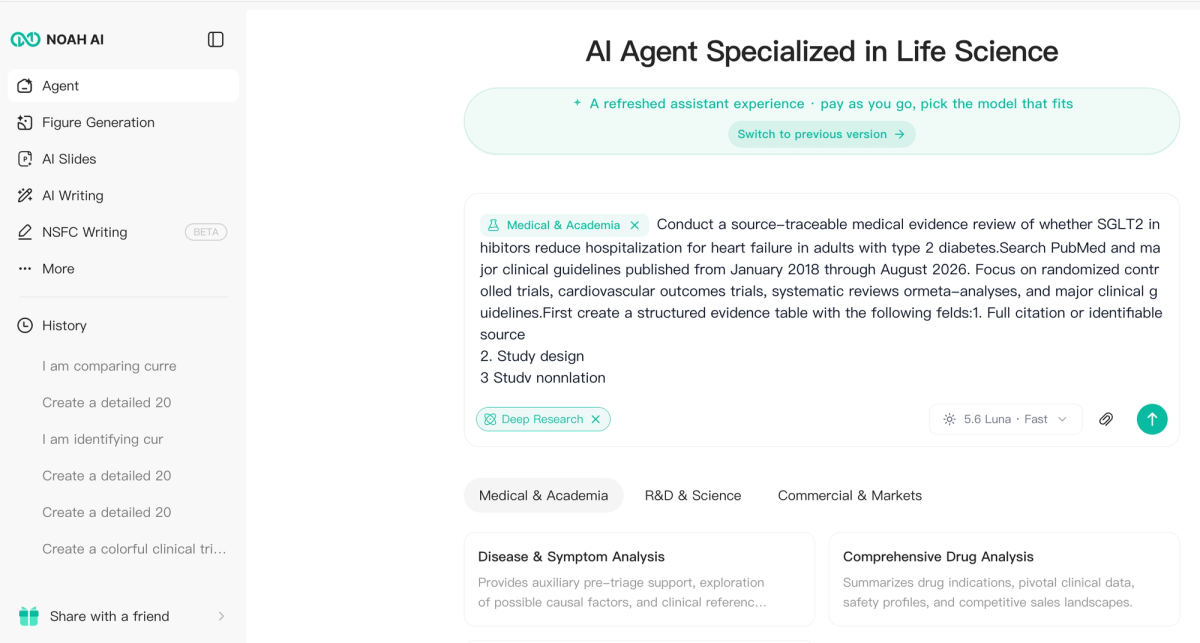
Figure 1. The live Noah AI Agent prompt for the SGLT2 inhibitor and heart-failure hospitalization review.
Agent mode was selected in the live product. The visible input states the SGLT2 inhibitor and heart-failure hospitalization question and requests a structured evidence table.
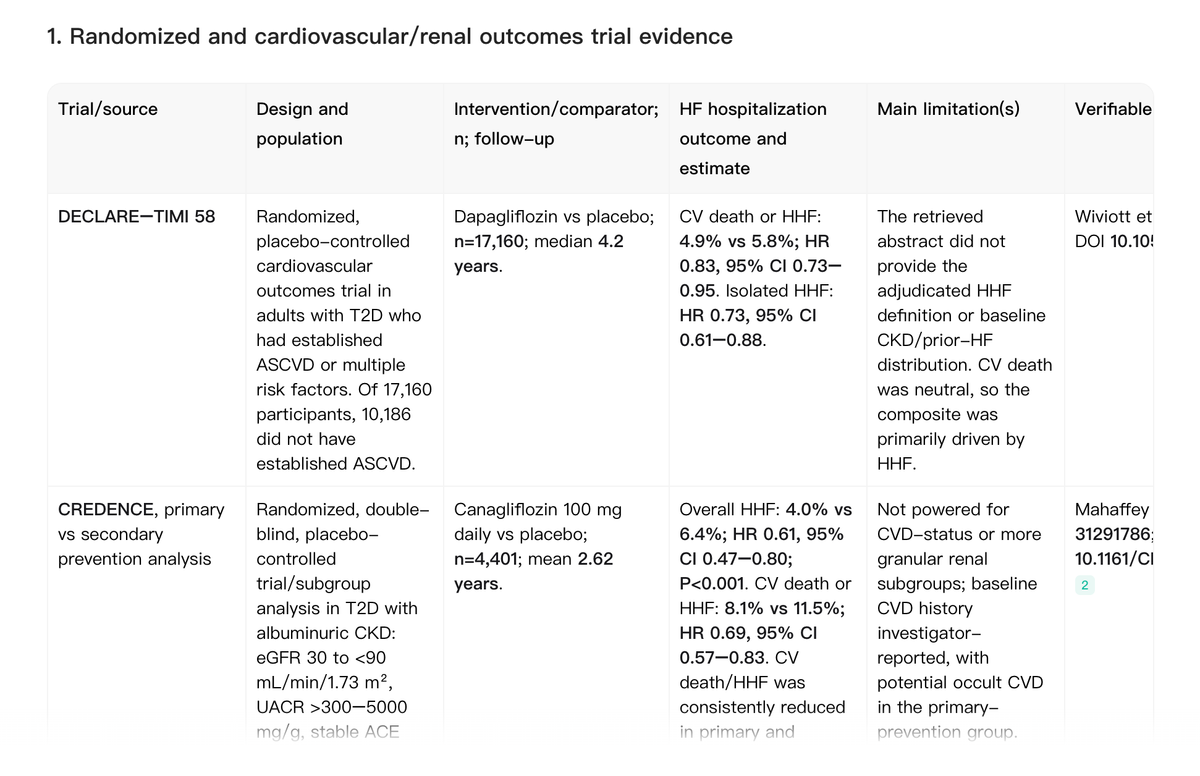
Figure 2. The structured evidence table generated by Noah AI from the same SGLT2 inhibitor research run.
The visible table includes rows for DECLARE–TIMI 58 (n=17,160; isolated HHF HR 0.73) and CREDENCE (n=4,401; HHF HR 0.61; PMID 31291786).
The identifier column is partially clipped in the visible product layout, so some source information is not fully visible in the screenshot.
This is what the live Agent run actually produced. The table placed trial population, sample size, endpoint-specific effect estimates, limitations, and available identifiers into one reviewable structure.
The example also illustrates why manual checking remains necessary. DECLARE's isolated-HHF estimate appears alongside a composite endpoint involving cardiovascular death or hospitalization for heart failure. The limitation fields indicate where an abstract did not provide a fully adjudicated definition.
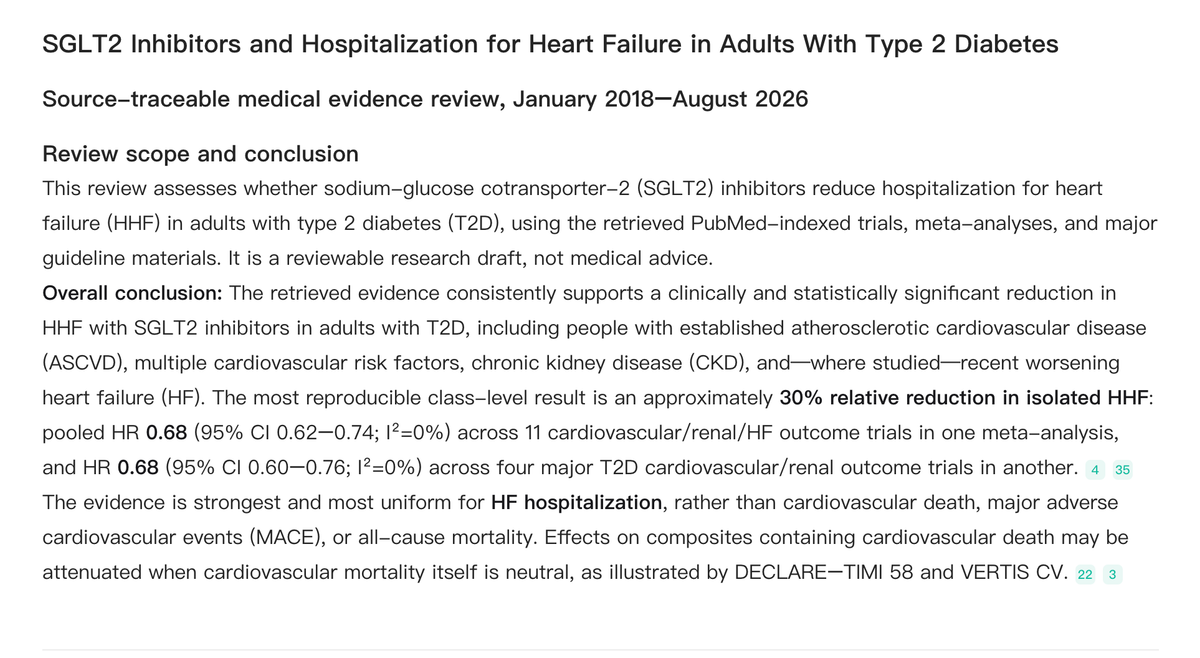
Figure 3. The final cited medical evidence synthesis generated from the same prompt, with claims connected to reviewable sources.
The same research run produced a report containing an overall synthesis and in-text source markers. The reference list appears further down in the generated report.
What this case shows — and what it does not
The conclusions below are limited to the live Noah run shown in this article and Noah's documented product positioning.
- Shown in this run: Agent took a medical research question and generated a structured, cited research draft.
- Shown in this run: the evidence table contained trial rows, sample sizes, endpoint-specific estimates, limitations, and at least one visible PMID.
- Shown in this run: the final report used in-text source markers and kept isolated hospitalization for heart failure distinct from a cardiovascular composite endpoint.
- Not established by this case: that every relevant SGLT2 trial was automatically captured, that every Noah query produces the same structure, or that the draft should be treated as a publication-ready systematic review.
Want to test the same workflow? Start with a medical question that clearly names the population, intervention, and endpoint.
Noah AI can be used for free, includes free credits, and requires no credit card to get started.
Try this workflow in Noah Agent →
Other products to consider
Elicit
Elicit focuses on literature screening and structured extraction, with citations connected to extracted information in its documented workflows.
This article did not run Elicit on the same SGLT2 question. The comparison here therefore describes its research workflow rather than presenting a head-to-head performance test against Noah.
Consensus
Consensus is designed around evidence-backed answers linked to research papers and includes workflows for medical and scientific questions.
It may fit researchers who want a fast first-pass view of the published literature before moving into deeper extraction, source checking, or synthesis.
SciSpace
SciSpace provides tools for reading, questioning, and working with scientific papers and PDFs. It may be relevant when the workflow centers on understanding or analyzing an existing set of papers.
Covidence
Covidence is designed for formal systematic-review workflows, including screening, reviewer decisions, exclusion reasons, extraction, and review-management processes.
It is particularly relevant when a project requires multiple reviewers and a structured review trail.
ResearchRabbit
ResearchRabbit focuses on literature discovery through citation, author, and related-paper networks.
It can be useful when researchers already have seed papers and want to expand the surrounding literature network.
Semantic Scholar
Semantic Scholar provides broad academic search together with paper metadata, references, citations, and other discovery signals.
It can support early-stage literature discovery and the process of identifying additional papers related to a research question.
These products address different stages of the research workflow. Only the Noah Agent case was directly demonstrated in this article, so researchers should evaluate the other products against their own tasks rather than treating the descriptions above as a controlled head-to-head test.
Which tool may fit which workflow?
- Medical question → structured cited draft: Noah AI Agent, followed by verification against the primary sources.
- Literature screening and structured extraction: Elicit.
- Evidence-backed research answers: Consensus.
- Working with papers and PDFs: SciSpace.
- Formal systematic-review management: Covidence.
- Citation-network exploration: ResearchRabbit.
- Broad scholarly discovery: Semantic Scholar.
- Citation-context analysis: Scite.
The appropriate tool depends on the output required, the stage of the research workflow, and the level of formal review or verification the project requires.
A short source-traceable workflow
- Define the population, intervention, comparator, and endpoint.
- Search PubMed and other relevant medical sources. See PubMed Search with AI for one workflow.
- Expand the search using citation networks when needed.
- Screen papers against explicit inclusion and exclusion criteria.
- Extract one structured row per study.
- Keep similar but non-identical endpoints separate.
- Check citation context when interpretation depends on how a result has been discussed or challenged in later literature.
- Synthesize the evidence without flattening meaningful differences in populations, endpoints, or study designs.
- Verify material numerical claims against the original paper or record.
- Save the prompt, date, sources, and relevant limitations with the research draft.
For additional source-discovery strategies, see how to find sources for a research paper with AI.
Build a source-traceable medical research draft with Noah AI
Start with one medical question that clearly defines the population, intervention, and endpoint.
Ask Noah Agent to organize relevant evidence into a structured table, generate a cited synthesis, identify limitations, and create a research draft that can be checked against the original sources.
Noah AI can be used for free. You receive free credits to start, and no credit card is required.
Start your research with Noah AI →
Final takeaway
Scite and Noah address different parts of a source-traceable research workflow. Scite focuses on citation context, while the Noah case tested here started with a medical question and produced a structured evidence table and cited synthesis for human review.
The live example shows what Noah Agent returned for one SGLT2 inhibitor question. It should not be interpreted as evidence that every query will generate the same structure or that other research products cannot support overlapping tasks.
The practical question is which workflow matches the research output you need. For researchers who want to move from a medical question toward a structured, cited draft in one workflow, Noah AI is one option to evaluate.
Important study characteristics, endpoint definitions, and numerical results should still be verified against the original source.
FAQ
Is there a free alternative to Scite?
Free access and pricing vary by product and may change over time. Some academic-search products offer free access, while other research platforms provide limited free usage, trials, or paid plans.
Noah AI can be used for free and includes free credits, with no credit card required to get started.
What is the difference between Scite and Elicit?
They focus on different research tasks. Scite is centered on citation context, while Elicit is positioned around literature screening, structured extraction, and research-review workflows.
Can AI tools verify medical citations automatically?
AI tools can reduce the time required to locate, organize, and inspect supporting sources, but human verification is still necessary.
A real PMID or citation can still be connected to the wrong endpoint, study population, effect estimate, or interpretation. Material claims should therefore be checked against the original source.
Should medical researchers use more than one research tool?
Different tools specialize in different parts of the workflow, including discovery, screening, extraction, citation-context analysis, evidence synthesis, PDF reading, and systematic-review management.
Depending on the project, researchers may use multiple tools rather than expecting one product to cover every research task.