Is There Enough Evidence to Study This Research Gap? A Feasibility Check with AI
Linda
Learn how to assess whether a biomedical research gap is feasible using AI, with a ctDNA in pancreatic cancer case covering evidence quality, study design, data access, and research readiness.
An interesting research gap is not automatically a feasible research project. Before committing time, budget, samples, or staff, researchers should establish whether the evidence needed to answer the question actually exists—and can be accessed, compared, and analyzed.
Worked example: Can postoperative or serial ctDNA testing guide adjuvant treatment decisions after resection of pancreatic ductal adenocarcinoma (PDAC)?
Key Takeaways
- Check feasibility before committing resources: the relevant population, design, outcomes, follow-up, and analytical data must be identifiable and usable.
- Publication volume is not evidence maturity. Many papers may still fail to answer the actual clinical question.
- Study design, data accessibility, longitudinal follow-up, and endpoint compatibility matter more than citation counts alone.
- AI can accelerate discovery, triage, and evidence organization, but the underlying studies still need human verification.
- The goal is not to force a "yes." A useful feasibility check may recommend proceeding, narrowing, redesigning, or collecting new data.
What Is a Research-Gap Feasibility Check?
A research-gap feasibility check is a preliminary assessment of whether a proposed question can realistically be investigated with the evidence and resources currently available. It asks whether the field contains relevant populations, measurable outcomes, suitable study designs, adequate follow-up, compatible methods, and accessible results.
The distinction is simple: an interesting gap identifies an unanswered question; a researchable gap is one for which a credible study or evidence-synthesis plan can actually be built.
Why Check Evidence Availability Before You Start
Early feasibility work can reveal problems that are difficult or expensive to solve later. The target population may not match the intended study, longitudinal follow-up may be missing, outcomes may not be comparable, or the apparent evidence base may consist mostly of abstracts, protocols, or inaccessible datasets.
These findings can improve the project rather than kill it. A broad question may be narrowed, an endpoint standardized, prospective data collection added, or a planned meta-analysis replaced with an evidence map or structured narrative review.
Key Challenges in Research-Gap Feasibility
The evidence may be scarce—or only apparently abundant
A large publication count can hide duplicate cohorts, protocol-only papers, case reports, outdated treatment contexts, adjacent questions, and inaccessible methods. The relevant unit is the usable evidence set, not the citation count.
Studies may not be comparable
Shared labels such as "recurrence," "response," or "MRD" do not guarantee that studies measured the same thing. Clinical, methodological, and statistical heterogeneity can prevent direct pooling even when the topic looks similar.
Time, access, and completeness can limit feasibility
Questions about recurrence, survival, treatment response, or natural history require repeated observations and adequate follow-up. A visible study record may still provide only an abstract, protocol, or registry entry rather than full methods and usable results.
How to Use Noah AI to Check Research Feasibility
Noah AI can help expand terminology, discover candidate studies, organize populations and designs, compare endpoints, and separate direct from adjacent evidence. It should be used as a candidate-evidence layer, not as evidence itself.
- Define the question and proposed gap.
- Search directly relevant evidence and expand terminology.
- Identify populations, study designs, and evidence type.
- Assess recency and evidence maturity.
- Locate prospective or longitudinal evidence where needed.
- Check whether required outcomes and biomarkers are actually reported.
- Record access limitations and missing methodological details.
- Summarize what exists, what is indirect, and what remains missing.
Learn more about Noah's evidence research workflow →
Step-by-Step Workflow
Step 1: Define the question precisely
For the worked PDAC case, define the population as patients with resected or otherwise localized pancreatic ductal adenocarcinoma treated with curative intent. The decision context is postoperative adjuvant therapy. The biomarker is postoperative or serial ctDNA/MRD testing.
The key comparison is standard clinician-selected adjuvant therapy versus ctDNA-informed escalation or de-escalation. Outcomes should include recurrence-free survival, overall survival, treatment toxicity, treatment completion, and molecular response.
Step 2: Search across the complete evidence pathway
Search prospective postoperative and MRD studies, serial ctDNA cohorts, adjuvant-treatment studies, recurrence and survival outcomes, and assay-methodology reports. Include trial registries, institutional trial pages, conference abstracts, and relevant reviews while recording whether each source is a completed study, interim report, protocol, abstract, or registry-only record.
Step 3: Build an evidence matrix
The evidence matrix is the core feasibility tool because it separates "evidence exists" from "evidence can answer the question." In the PDAC case, postoperative ctDNA has prognostic and monitoring support, but the evidence is heterogeneous in sampling, assay design, thresholds, and treatment context.
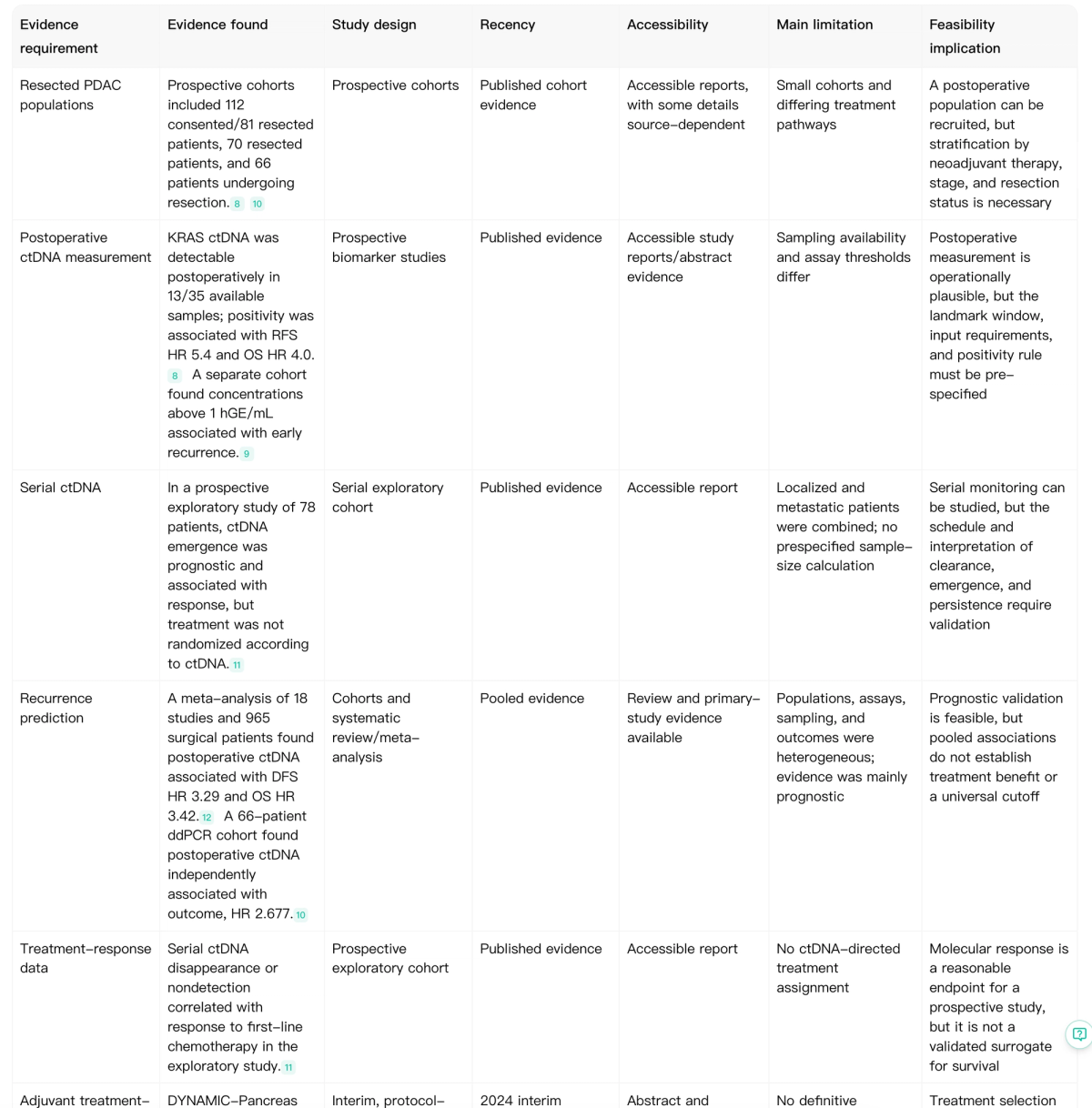
The most important distinction is between prognostic evidence and clinical-utility evidence. A biomarker may predict recurrence without proving that changing treatment according to the biomarker improves outcomes.
Step 4: Classify what is missing
No evidence
No retrieved study addresses the specified population, intervention, or endpoint.
Limited evidence
Studies exist but are small, exploratory, short-followed, or incomplete.
Indirect evidence
Evidence addresses prognosis or monitoring rather than the proposed treatment decision.
Heterogeneous evidence
Assays, thresholds, populations, or outcomes differ enough to limit comparison.
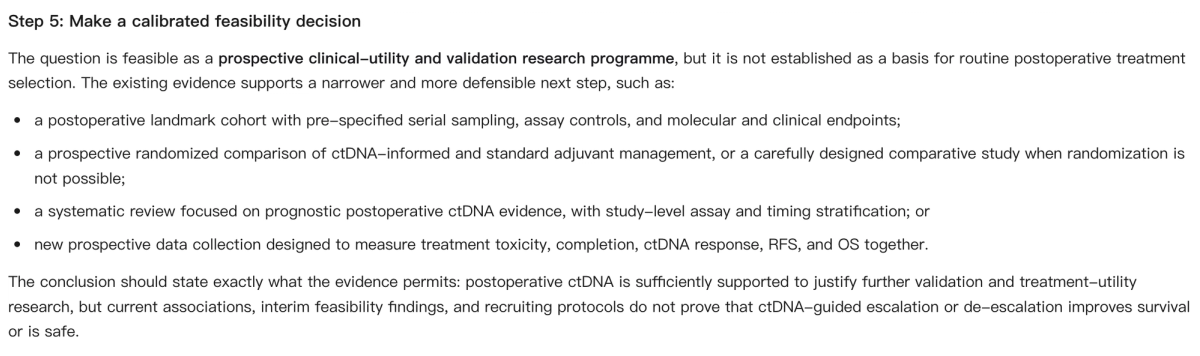
Step 5: Make a calibrated feasibility decision
Feasibility verdict: REFINE
The proposed PDAC research gap is scientifically relevant, but the question is not ready to proceed as a broadly defined evidence-synthesis project or as a routine-care treatment strategy.
Postoperative ctDNA has supporting prognostic evidence, but differences in assays, sampling schedules, treatment contexts, and endpoints limit direct comparability. Existing prognostic associations do not establish that ctDNA-guided adjuvant treatment improves patient outcomes.
Decision: REFINE — proceed with a more narrowly defined prospective clinical-utility study plan. Specify the patient population, ctDNA assay and sampling windows, treatment-decision rules, primary clinical endpoints, required data access, and follow-up before confirming operational feasibility.
GO would require a sufficiently defined question, appropriate design, accessible data or a realistic recruitment pathway, and adequate resources.
NOT READY would apply if the essential measurements, data access, patient population, or study design could not support a credible answer.
Try Noah AI for Free
Use Noah AI to search, compare, and analyze biomedical evidence with AI-powered research workflows. Free credits are available, and no credit card is required to get started.
Best Practices & Common Pitfalls
| Best practice | Common pitfall |
|---|---|
| Define the required population, design, comparator, outcomes, follow-up, and assay before searching. | Allowing the search results to redefine the question. |
| Search multiple evidence sources and distinguish completed results from protocols or abstracts. | Treating any related publication as proof that the original question is feasible. |
| Count unique studies or cohorts separately from publications. | Assuming many papers mean sufficient usable data. |
| Record exact assay definitions, thresholds, sampling windows, and outcome definitions. | Treating apparently similar endpoints as interchangeable. |
| Preserve uncertainty in the final judgement. | Turning a promising association into an established treatment recommendation. |
Manual vs. AI-Assisted Feasibility Checks
| Aspect | Manual Approach | AI-Assisted Approach |
|---|---|---|
| Literature discovery | Researchers search databases, registries, and supplementary sources. | AI can expand terms, rank candidate records, and surface potentially relevant sources. |
| Study screening | Reviewers inspect titles, abstracts, and full texts. | AI can support deduplication and prioritization, but final eligibility remains a human decision. |
| Evidence organization | Researchers build and maintain a study-level matrix. | AI can extract candidate fields and group records, but needs verification. |
| Gap identification | Researchers distinguish absent, limited, indirect, heterogeneous, and inaccessible evidence. | AI can cluster limitations and suggest apparent gaps that still require source checking. |
| Researcher verification | Required for all key findings. | Still required; AI changes the workflow, not accountability. |
Example Use Case / Walkthrough
Example 1: Oncology
Proposed gap: Can postoperative ctDNA guide adjuvant treatment after resection of localized PDAC?
What exists: prospective cohorts and pooled evidence support postoperative ctDNA as a prognostic and monitoring signal for recurrence and survival. Serial monitoring may also track molecular response.
What is missing: completed evidence that ctDNA-directed escalation, de-escalation, switching, stopping, or duration change improves disease-free or overall survival.
Feasibility and refinement: the question is suitable for prospective clinical-utility validation, but not yet for a routine-care recommendation. A stronger design would pre-specify sampling windows, assay controls, treatment rules, toxicity and completion endpoints, molecular response, DFS, OS, and adequate follow-up.
Example 2: Rare-Disease Research
A rare-disease biomarker may be biologically plausible while still lacking the repeated functional outcomes needed for a two-year prediction study. If longitudinal patient-level data are insufficient, the project may need a narrower endpoint, compatible registry linkage, prospective collection, or an evidence map instead of a predictive model.
Final Checklist for Research-Gap Feasibility
- Is the population clearly defined?
- Do directly relevant studies exist?
- Are the study designs appropriate for the intended question?
- Is the evidence recent enough?
- Is longitudinal follow-up available when required?
- Do outcomes and biomarkers match the question?
- Are full methods or datasets sufficiently accessible?
- Have heterogeneity, missingness, and bias been documented?
- Are major evidence gaps explicitly classified?
- Does the final feasibility decision state exactly what the evidence permits?
Conclusion & Next Steps
A useful research gap must be both scientifically interesting and practically researchable. In the PDAC example, postoperative ctDNA is sufficiently supported to justify further validation and treatment-utility research, but current associations and interim feasibility findings do not prove that ctDNA-guided treatment improves survival or is safe.
The appropriate next step is therefore not to overstate the evidence. It is to design the next study around the evidence that exists, the methodological problems already visible, and the specific clinical-utility gap that remains unresolved.
Final feasibility verdict: REFINE. There is enough evidence to justify developing a focused prospective research plan, but not enough directly comparable clinical-utility evidence to treat ctDNA-guided adjuvant therapy as validated. The next step is to refine the study question and verify data access, endpoint compatibility, assay feasibility, and recruitment requirements before a final GO decision.
Try Noah AI for Free
Use Noah AI to search, compare, and analyze biomedical evidence with AI-powered research workflows. Free credits are available, and no credit card is required to get started.
FAQs
What is a research-gap feasibility check?
It is a structured assessment of whether a proposed question can be answered with available populations, study designs, measurements, follow-up, data, and accessible results.
How do I know whether there is enough evidence for a research gap?
Build an evidence matrix that records the population, intervention or exposure, comparator, outcomes, timing, study design, follow-up, accessibility, methods, and limitations. Then distinguish direct evidence from adjacent, prognostic, protocol-level, or incomplete evidence.
Can AI determine whether a research gap is feasible?
No. AI can accelerate discovery, triage, and evidence organization, but researchers still need to verify study identity, extracted values, comparability, risk of bias, and citations.
Does a large publication count mean enough data exist?
No. Many publications may describe the same cohort, use incompatible populations or assays, or omit essential methods and follow-up. Count usable independent evidence, not citations alone.
What should I do if the evidence is insufficient?
Identify exactly what is missing, then narrow the question, collect prospective data, seek additional registries or grey literature, or change the synthesis method instead of inflating the conclusion.