Best Free Elicit Alternatives for Medical Literature Reviews (2026)
Linda
Compare Noah AI and Elicit as AI literature review tools for paper discovery, evidence tables, citations, source traceability, and biomedical evidence synthesis.
AI literature review tools are becoming part of everyday research workflows. But not every AI literature review generator is designed for the same task. Some tools are strongest at discovering papers and creating a quick screening table. Others are better suited for organizing biomedical evidence, preserving source traceability, and turning study findings into a cited synthesis.
This comparison looks at Noah AI and Elicit through a medical research workflow: a literature review on GLP-1 receptor agonists and cardiovascular risk reduction in patients with type 2 diabetes. The goal is not to decide which tool is universally “better.” Instead, the goal is to clarify where each tool fits in a real biomedical literature review process.
In our test, Elicit was useful for early-stage paper discovery and literature screening. It organized relevant studies into a paper table with source, relevance, study type, year, and summary fields. Noah AI was stronger when the workflow moved from finding papers to structuring evidence, comparing cardiovascular outcome trials, preserving citation markers, and producing a source-aware literature synthesis.
For researchers, medical affairs teams, and life science professionals, the practical takeaway is simple: Elicit can help you find and screen papers; Noah AI can help turn biomedical evidence into a cited, research-ready synthesis.
Quick Summary: Noah AI vs Elicit
| Comparison Area | Noah AI | Elicit |
|---|---|---|
| Best for | Biomedical evidence synthesis and cited research briefs | Paper discovery and literature screening |
| Workflow stage | Evidence organization, synthesis, and source-aware reporting | Early literature search and paper screening |
| Main strength | Turning biomedical evidence into structured, cited outputs | Building a paper table for fast screening and extraction |
| Evidence handling | Connects findings, outcomes, limitations, and source markers | Organizes papers with relevance, study type, year, and summaries |
| Best user | Life science teams, medical affairs, biopharma researchers, evidence teams | Researchers, students, and reviewers screening papers |
| Practical role | Synthesis engine for biomedical evidence workflows | Discovery and screening tool for literature review workflows |
Why AI Literature Review Needs More Than Paper Discovery
Many users search for an AI literature review generator because they want a faster way to summarize research papers. That is understandable. Literature review is time-consuming: researchers need to search databases, screen abstracts, identify study types, compare findings, and decide which sources deserve deeper review.
However, medical literature review is not only about generating text. A fluent summary can still be weak if it does not preserve the source context behind each claim. In biomedical research, the key question is not simply “What does the literature say?” It is also:
- · Which study type supports this point?
- · Is the evidence from a randomized trial, systematic review, meta-analysis, guideline, or observational study?
- · What population was studied?
- · What outcome was measured?
- · Are the results consistent across studies?
- · What limitations or safety signals should be preserved?
- · Can every major claim be traced back to a source?
This is why an AI literature review writer should not be evaluated only by how quickly it produces paragraphs. For medical research, the more important question is whether the tool helps researchers move from paper discovery to structured evidence and cited synthesis.
Elicit and Noah AI both support literature review workflows, but they emphasize different parts of the process. Elicit is especially useful when the researcher needs to find and screen papers. Noah AI is more useful when the task requires biomedical context, evidence tables, source traceability, limitations, and research-ready synthesis.
For broader background on biomedical literature search, readers can explore Noah AI’s guide on PubMed search with AI. For source discovery workflows, Noah AI’s guide on finding sources for a research paper with AI can also support the broader literature review process.
How We Tested Noah AI and Elicit
To compare Noah AI and Elicit fairly, we used the same research question:
Research question: What is the current evidence on GLP-1 receptor agonists for cardiovascular risk reduction in patients with type 2 diabetes?
This topic is suitable for a medical literature review because it requires more than a simple paper list. It involves randomized cardiovascular outcome trials, meta-analyses, study population differences, cardiovascular endpoints, kidney outcomes, heart failure outcomes, safety signals, and source verification.
We evaluated both tools using the following workflow criteria:
| Test Dimension | Why It Matters |
|---|---|
| Paper discovery | The tool should help identify relevant biomedical literature. |
| Literature screening | The tool should help prioritize studies by relevance, study type, and summary. |
| Evidence table | The tool should structure key findings instead of leaving them as scattered paragraphs. |
| Study type recognition | Medical evidence depends on whether the source is an RCT, review, meta-analysis, guideline, or observational study. |
| Citation traceability | Claims should remain connected to visible citation or source markers. |
| Cited synthesis | The tool should help turn evidence into a source-aware summary. |
| Evidence gaps and limitations | The output should preserve uncertainty, conflicting findings, and caveats. |
This is a workflow comparison, not a static feature checklist. Product interfaces and capabilities may change, so screenshots should be recaptured before publication if the product UI changes.
Noah AI Output: Evidence Table and Cited Literature Synthesis
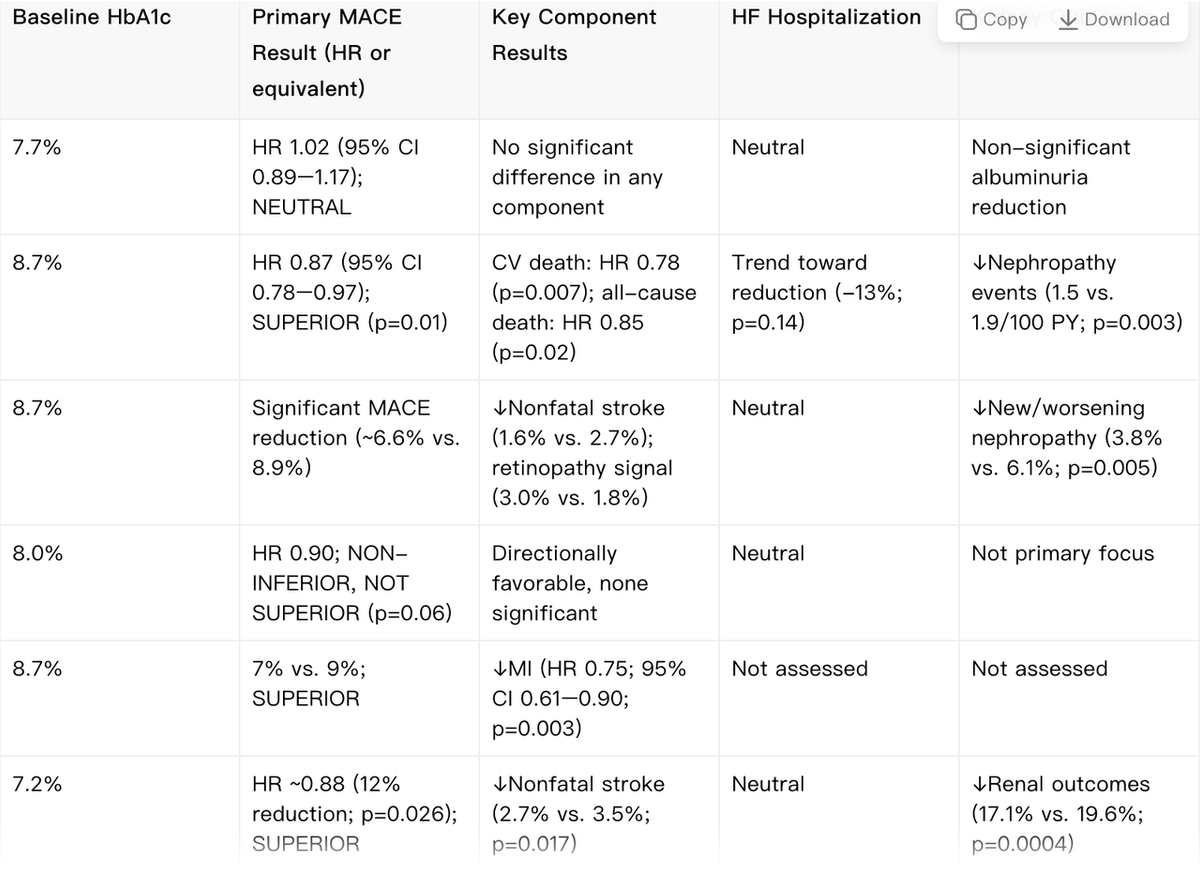
Noah AI is strongest when the literature review task moves beyond paper discovery. In this test, the most useful Noah output was not just a list of papers. It was a structured evidence table summarizing major cardiovascular outcome trials and organizing them by trial, GLP-1 receptor agonist, sample size, follow-up, baseline cardiovascular risk, primary MACE result, key component outcomes, heart failure hospitalization, and kidney outcomes.
This matters because biomedical literature review often fails in the middle step between “I found relevant papers” and “I can explain what the evidence means.” Noah AI supports that middle step by organizing trial-level evidence into a format that researchers can review, challenge, and refine.
Source Authority: Why Noah AI References Are TrustworthyAnother important difference is that Noah AI keeps the evidence connected to traceable biomedical sources. In medical literature review, the quality of the answer depends not only on whether the tool can summarize papers, but also on whether users can verify where each claim comes from.In the Noah AI workflow, references are not hidden behind the final narrative. Users can open the Reference tab and review the underlying sources used during the report generation process. These sources may include PubMed-indexed articles, clinical trial evidence, systematic reviews, meta-analyses, and guideline-related materials, depending on the research question.This is especially important for medical research because users need to check study type, publication source, PMID, author information, publication date, and whether the cited source actually supports the claim. For example, when reviewing GLP-1 receptor agonists and cardiovascular outcomes, Noah AI surfaces trial-level and review-level references that researchers can inspect before using the synthesis in a report.For medical researchers, this source transparency makes Noah AI more useful than a generic AI summary. The output is not only readable; it is connected to references that can be checked, challenged, and reused in a literature review workflow.
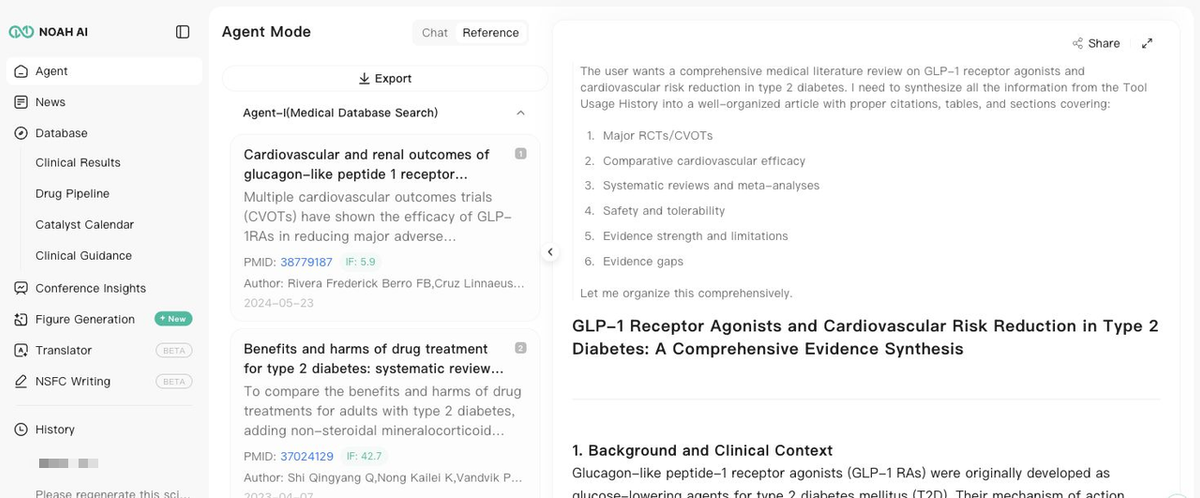
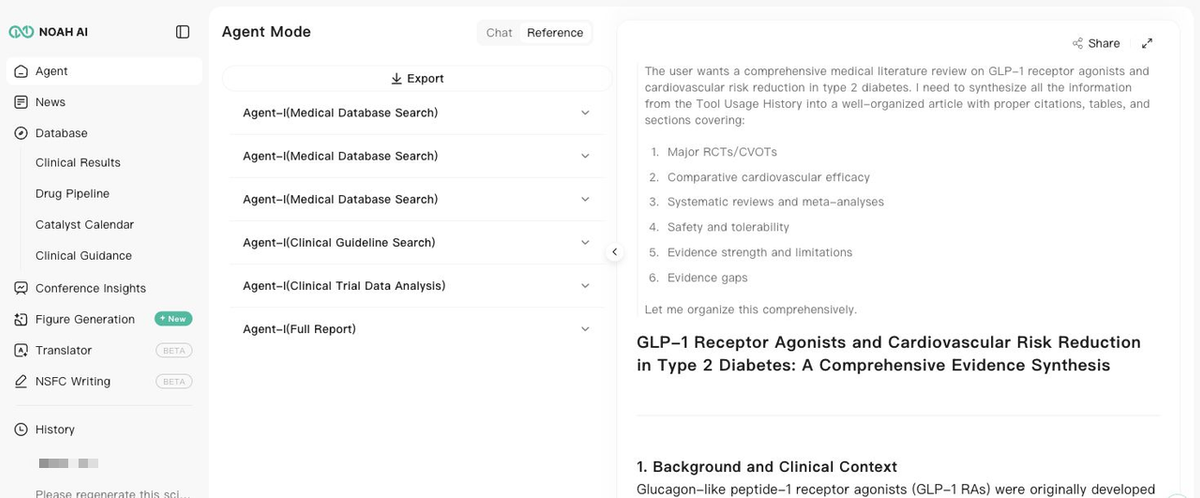
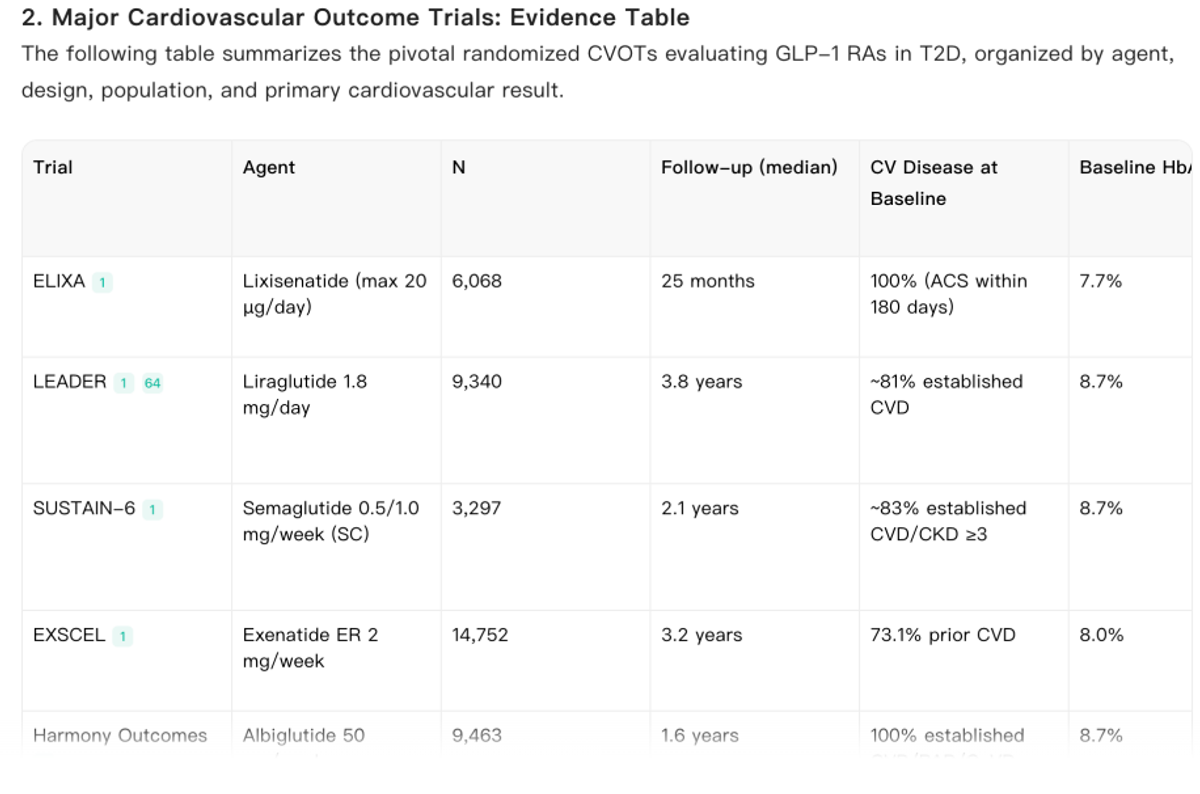
Because the Noah AI evidence table contains both trial design information and outcome-level evidence, we show it in two views. The first view highlights trial metadata, including agent, population size, follow-up duration, and baseline cardiovascular risk. This helps researchers quickly understand which studies are being compared.The second view focuses on outcome-level evidence, including primary MACE results, key component outcomes, heart failure hospitalization, and kidney outcome signals. This is the part of the workflow where Noah AI is most different from a simple paper table. It does not only show that a paper exists; it helps organize what the evidence says.
The third Noah output is the cited literature synthesis. This is where the evidence table is turned into a concise, source-aware interpretation. Instead of producing a generic paragraph, the synthesis summarizes the overall evidence pattern: which long-acting GLP-1 receptor agonists show cardiovascular benefit, where findings are weaker or neutral, and why differences across agents and trials matter.
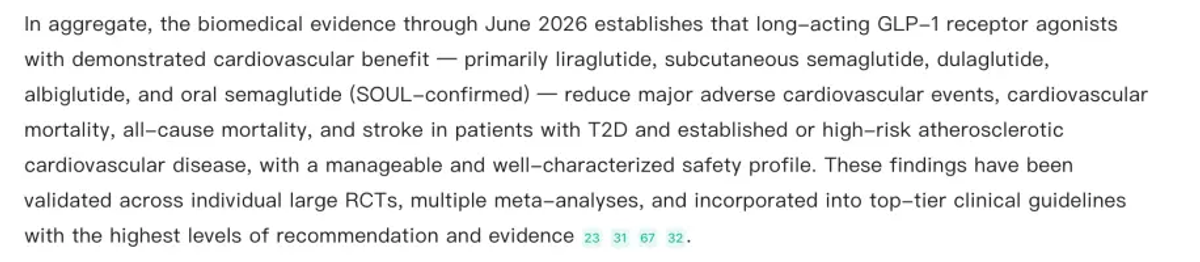
This type of output is useful for life science teams, medical affairs professionals, and biopharma researchers because it connects structured evidence with a readable research brief. The researcher still needs to verify every citation and check primary sources, but the workflow is closer to a research deliverable than a raw paper list.For a broader Noah workflow overview, see Noah AI’s tutorial for biopharma and medical research workflows. For a medical literature review workflow with Noah AI, see medical literature review with Noah AI.
Elicit Output: Paper Discovery and Literature Screening
Elicit is well suited for the early stage of a literature review. In our test, Elicit produced a paper table for the same GLP-1 cardiovascular outcomes question. The table showed relevant sources, relevance scores, study type, year, and summaries.This is valuable when researchers need to quickly understand the available literature. Instead of manually searching and opening papers one by one, Elicit helps create an initial paper pool and screening view. This is especially helpful for users who want to compare papers by relevance, publication year, and study type before deciding which sources deserve deeper review.
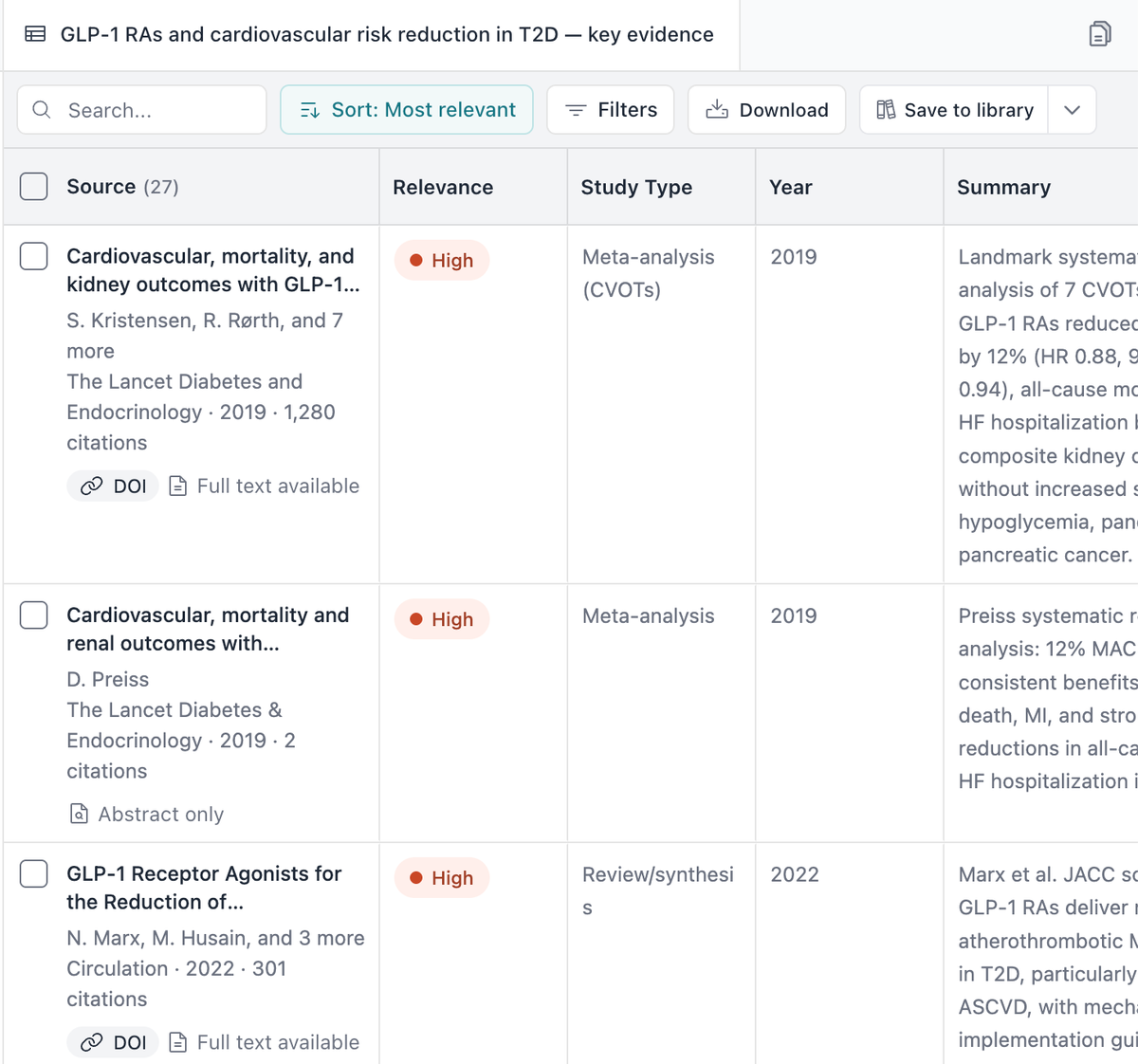
Elicit’s strength is clarity at the discovery stage. The paper table makes it easy to see which studies are likely relevant and which papers may be worth reading first. For systematic review-style workflows, this kind of screening table can save time during the initial literature review process.However, a paper table is not the same as a full evidence synthesis. After papers are discovered, researchers still need to verify the study design, extract key endpoints, compare findings across sources, identify limitations, and write a synthesis that preserves source context. This is where Noah AI and Elicit are best understood as complementary rather than interchangeable.
Side-by-Side Comparison: Noah AI vs Elicit
| Comparison Area | Noah AI | Elicit | Practical Takeaway |
|---|---|---|---|
| Best workflow stage | Evidence synthesis and research brief creation | Paper discovery and screening | Use Elicit to find papers; use Noah to synthesize biomedical evidence. |
| Paper discovery | Useful when tied to a biomedical research task | Strong fit | Elicit is strong for initial literature discovery. |
| Literature screening | Can help structure evidence after relevant sources are found | Strong fit for relevance and paper-level screening | Elicit is useful when the bottleneck is finding and sorting studies. |
| Evidence table | Strong fit for biomedical evidence organization | Supports paper-level table and extraction | Noah is stronger when evidence must connect to a research question. |
| Study type recognition | Useful in biomedical context and trial comparison | Useful in paper table fields | Both tools require manual verification of study design. |
| Citation traceability | Strong fit for source-aware outputs and cited synthesis | Shows source information and paper metadata | Both tools require the researcher to verify citations. |
| Cited synthesis | Strong fit | Less central than paper discovery | Noah is better for turning evidence into a research brief. |
| Evidence gaps and limitations | Strong fit when prompted clearly | Possible, but less central to the paper table view | Noah is better when caveats need to be preserved in the final output. |
| Best user | Life science teams, medical affairs, biopharma researchers, evidence teams | Researchers, students, and systematic review users screening papers | Choose based on whether the bottleneck is discovery or synthesis. |
When Should You Use Noah AI?
Use Noah AI when the literature review problem begins after the research question is already clear and the main challenge is evidence organization.
Noah AI is a strong fit when you need to:
- · Turn biomedical literature into an evidence table.
- · Compare studies by population, intervention, outcome, and key finding.
- · Preserve citation markers and source traceability.
- · Summarize evidence into a source-aware research brief.
- · Identify evidence gaps, limitations, and caveats.
- · Support medical affairs, biopharma, or life science research workflows.
- · Prepare a literature-backed summary that still needs expert verification.
For example, if a medical affairs team is reviewing cardiovascular outcomes for GLP-1 receptor agonists, the team may not only need a list of papers. They may need to compare CVOTs, identify which agents showed MACE benefit, understand where heart failure or kidney findings are weaker, and summarize the evidence in a team-ready format. Noah AI is better aligned with that synthesis stage.
Noah AI should not be treated as a replacement for scientific judgment, clinical decision-making, or manual citation verification. Its role is to help researchers organize and synthesize evidence more efficiently.
When Should You Use Elicit?
Use Elicit when the main bottleneck is discovering, screening, and sorting papers.
Elicit is a strong fit when you need to:
- · Start a literature review quickly.
- · Find relevant papers from a research question.
- · View papers in a table format.
- · Sort or screen by relevance, year, study type, or summary.
- · Build an initial paper pool for deeper review.
- · Support early-stage systematic review screening.
- · Explore a topic before deciding which sources to read in full.
For example, if a researcher is starting with a broad question about GLP-1 receptor agonists and cardiovascular outcomes, Elicit can help surface relevant studies and show them in a table. This is useful before deeper extraction or synthesis begins.
Elicit is not weak because it focuses on discovery. That is its value. The key is to understand what happens next. Once papers are identified, a researcher still needs to verify sources, extract outcomes, compare evidence, and synthesize findings responsibly.
Can You Use Noah AI and Elicit Together?
Yes. In many workflows, the best answer is not Noah AI or Elicit. A practical workflow may use both tools:
- Use Elicit to discover and screen relevant papers.
- Shortlist high-relevance studies, reviews, and trials.
- Use Noah AI to organize biomedical evidence into an evidence table.
- Use Noah AI to generate a cited literature synthesis or research brief.
- Manually verify citations, study design, endpoints, and conclusions.
- Revise the final output based on expert judgment and primary sources.
This combined workflow reflects how real literature review often works. Discovery and synthesis are different tasks. A paper discovery tool helps users find what exists. A source-aware biomedical synthesis workflow helps users understand what the evidence supports.
How to Use AI for Literature Review Without Losing Source Context
If you are using any AI literature review tool, the safest workflow is to keep source context visible throughout the process.
A reliable AI-assisted literature review should follow these steps:
- Define a focused research question.
- Search for relevant papers using trusted biomedical sources.
- Screen papers by title, abstract, study type, population, and outcome.
- Extract key findings into a structured evidence table.
- Keep citation or source markers attached to major claims.
- Separate evidence from interpretation.
- Identify conflicting findings and limitations.
- Verify every claim with primary sources.
- Use AI-generated synthesis as a draft, not a final authority.
This is especially important for medical research. AI can help organize information, but it cannot replace expert review, clinical judgment, or primary source verification.
Which Tool Is Better for Medical Research?
The answer depends on the workflow stage.
If the main problem is “I need to find relevant papers,” Elicit is a strong choice. Its paper table is useful for discovery, screening, and early extraction.
If the main problem is “I need to turn biomedical evidence into a structured and cited synthesis,” Noah AI is the stronger fit. Its evidence table and source-aware synthesis are better aligned with medical literature review outputs that need to be reviewed by research teams, medical affairs teams, or biopharma professionals.
For many researchers, the strongest workflow may be:
Elicit for paper discovery → Noah AI for biomedical evidence synthesis → researcher verification before publication or decision-making.
Final Takeaway
Noah AI and Elicit are not interchangeable tools. Elicit is especially useful for paper discovery, literature screening, and paper-level extraction. Noah AI is stronger when a medical literature review needs biomedical context, structured evidence tables, cited synthesis, source traceability, and research-ready outputs.
If you are looking for an AI literature review generator that simply helps you find papers, Elicit may be a strong starting point. If you need to move from scattered biomedical evidence to a source-aware synthesis, Noah AI is better suited to that later stage of the workflow.
The practical takeaway is simple:
Elicit helps researchers find and screen papers. Noah AI helps life science teams turn biomedical evidence into cited synthesis.
FAQ
Is Noah AI an Elicit alternative?
Noah AI can be an Elicit alternative for some biomedical evidence synthesis workflows, but the two tools are not identical. Elicit is stronger for paper discovery and screening, while Noah AI is stronger when the task requires source-aware biomedical synthesis, evidence tables, and research briefs.
What is the main difference between Noah AI and Elicit?
The main difference is workflow stage. Elicit helps users find and screen papers. Noah AI helps organize biomedical evidence and turn it into cited synthesis.
Is Elicit good for medical literature review?
Yes. Elicit is useful for discovering papers, viewing relevance, checking study type, reviewing publication year, and screening summaries in a paper table. It is especially helpful at the early stage of a literature review.
Which AI literature review tool is better for evidence synthesis?
For biomedical evidence synthesis, Noah AI is better suited when users need evidence tables, citation traceability, limitations, and research-ready synthesis. Elicit is stronger when the user needs to discover and screen papers.
Can I use Elicit and Noah AI together?
Yes. A practical workflow is to use Elicit for paper discovery and screening, then use Noah AI to organize evidence into a source-aware synthesis. Researchers should still verify all citations and study conclusions manually.
How do I use AI for literature review?
Start with a focused research question. Use AI to discover relevant papers, screen them by relevance and study type, extract key findings into an evidence table, preserve citation links, and synthesize findings with clear limitations. Always verify the final output with primary sources.
What is the best AI for literature reviews?
There is no single best AI for every literature review workflow. The best tool depends on the bottleneck. If you need paper discovery, Elicit is useful. If you need biomedical evidence synthesis and cited research briefs, Noah AI is a stronger fit.
Does this comparison provide medical advice?
No. This comparison is for research workflow education only. It does not provide medical advice, diagnosis, treatment recommendations, or endorsement of any tool for clinical decision-making. Always verify biomedical evidence with primary sources and qualified experts.
Medical and Research Disclaimer
This article is for research workflow education only and does not provide medical advice, diagnosis, or treatment recommendations. AI-generated outputs should not replace expert judgment, primary source review, clinical guidelines, or professional medical decision-making. Always verify biomedical evidence, citations, study designs, and conclusions with primary sources and qualified experts.