Nectin-4 Target Evaluation Report 2026: Biology, ADC Competition & R&D Strategy
Linda
Explore Nectin-4 biology, clinical validation, ADC competition, trial evidence, biomarker opportunities, and R&D strategy in this 2026 report.
Nectin-4 is a clinically validated antibody–drug conjugate (ADC) target, but clinical validation does not make every follow-on program attractive. The R&D question is where a new asset can differentiate on payload, therapeutic index, patient selection, resistance, or indication strategy.
This target evaluation uses a Noah AI-assisted research workflow to organize public evidence across biology, disease context, clinical competition, trials, biomarkers, and development decisions. It is a selected, decision-oriented analysis—not an exhaustive pipeline database. Evidence cutoff: 8 October 2026.
Scope and IP limitation: This report focuses on publicly available biological, clinical, competitive, and translational evidence. It does not include a systematic patent-landscape review, patent claim analysis, or freedom-to-operate assessment. Any future IP evaluation should use identified public patent records and separately verify relevant claims, jurisdictions, patent-family relationships, and legal status.
1. Nectin-4 Target Evaluation Dashboard
The dashboard establishes the basic target identity and clinical precedent. The key takeaway is selective attractiveness: the approved enfortumab vedotin (EV) franchise validates Nectin-4-directed payload delivery in urothelial cancer, while raising the benchmark for any new entrant.
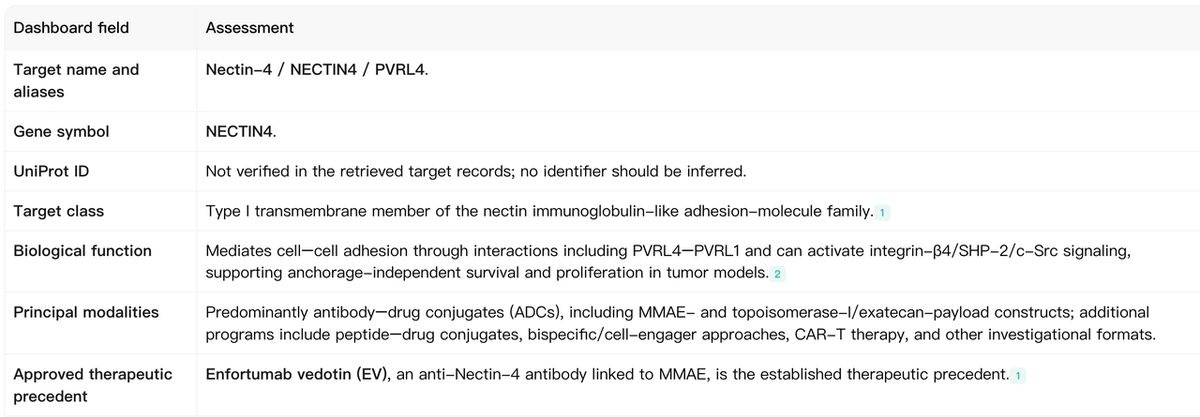
Additional dashboard context
| Dimension | Portfolio interpretation |
|---|---|
| Regulatory precedent | EV plus pembrolizumab has FDA traditional approval for locally advanced or metastatic urothelial carcinoma. EV monotherapy also has randomized post-platinum/post-checkpoint evidence. |
| Clinical validation | Strongest in urothelial carcinoma; target-expression-selected treatment has not been established as the approved standard. |
| Disease scope | Urothelial cancer is the anchor. Cervical cancer has earlier clinical signals; breast and other solid tumors remain more exploratory. |
| Differentiation variables | Alternative payload or linker, activity after EV, toxicity profile, membrane target accessibility, internalization, and biomarker selection. |
| Overall view | High attractiveness, selective entry only. A strong target with an increasingly competitive ADC landscape and important normal-tissue liabilities. |
2. One-Screen Recommendation
The recommended strategy is not to reproduce the approved EV profile. Entry should start with a specific, testable development advantage.
| Decision | Recommendation |
|---|---|
| Enter | Selectively enter with a credible advantage in payload, linker, internalization, dosing, post-EV activity, therapeutic index, or validated biomarker strategy. A conventional MMAE follow-on without meaningful differentiation faces a high bar. |
| Partner | Consider regional or platform-led partnerships when clinical datasets, assay know-how, manufacturing capabilities, and development rights strengthen a differentiated program. Verify the status and rights of 9MW2821, CRB-701, and other candidate assets. |
| Monitor | Follow larger prospective data for cervical cancer, next-generation topoisomerase-I ADCs, durability after prior EV, comparative safety, and resistance mechanisms. Distinguish company-reported signals from randomized evidence. |
| Avoid | Avoid broad-indication claims based on expression alone, unqualified cross-trial ORR rankings, or programs without a defensible safety, delivery, biomarker, or efficacy thesis. |
Overall recommendation: treat Nectin-4 as a high-value but high-bar target. Protect the established urothelial benchmark, examine cervical-cancer expansion carefully, and favor differentiation over simple target replication.
3. Biology Module: Why Nectin-4 Is Attractive
Nectin-4, encoded by NECTIN4/PVRL4, is a type I transmembrane adhesion molecule. Its tumor-cell surface localization permits antibody engagement, while its role in cell adhesion and signaling provides biological context beyond simple antigen expression. In preclinical models, PVRL4-mediated interactions have been associated with integrin-β4/SHP-2/c-Src signaling and anchorage-independent growth.
For ADC design, expression is only the starting point. Accessible membrane antigen, internalization, intracellular payload release, and expression in normal tissue also influence whether the construct has a useful therapeutic window. Preclinical anti-Nectin-4 ADC work demonstrated binding and tumor-model activity across several epithelial settings, but these results should not be mistaken for clinical efficacy in every Nectin-4-positive cancer.
| Biology signal | Evidence interpretation | R&D implication |
|---|---|---|
| Cell-surface target | Nectin-4 is an extracellularly accessible adhesion molecule. | Supports antibody or peptide-directed drug delivery. |
| Tumor biology | PVRL4 interactions and adhesion-associated signaling support a functional target rationale in preclinical models. | Mechanistic value is plausible; EV clinical activity may primarily reflect payload delivery. |
| Clinical tractability | EV provides regulatory and randomized clinical validation in urothelial carcinoma. | Druggability is established, but an approved comparator raises the efficacy and safety bar. |
| Biomarker heterogeneity | Total IHC staining and therapeutically accessible membranous expression are not interchangeable. | Validate assay, localization, cutoff, and sampling strategy rather than using expression alone. |
| NECTIN4 amplification | A retrospective EV-treated cohort found response enrichment with amplification; prospective validation is still needed. | Promising selection hypothesis, not a proven treatment requirement. |
| Normal-tissue expression | Nectin-4 is expressed in epithelial compartments including skin; EV carries important skin and other safety risks. | Improvement in therapeutic index is central to follow-on development. |
| Resistance | Expression loss and impaired internalization or trafficking may both limit ADC efficacy. | Examine target density and uptake, payload delivery, and response after prior EV. |
The primary biological uncertainty is how membrane density, amplification, internalization, and payload sensitivity jointly predict patient benefit. A positive tissue stain by itself does not establish that an ADC reaches its intracellular target or produces a clinically meaningful response.
4. Disease-Context Module
Nectin-4 opportunity depends heavily on the disease setting. Urothelial carcinoma offers approved-treatment and randomized-trial evidence; cervical cancer offers emerging but less mature signals. Other epithelial tumors require disease-specific validation.
| Disease | Evidence signal | Development implication |
|---|---|---|
| Urothelial carcinoma | In EV-302, EV plus pembrolizumab improved median PFS 12.5 vs 6.3 months and median OS 31.5 vs 16.1 months versus platinum-based chemotherapy. EV-301 also showed an OS advantage for EV monotherapy after platinum/checkpoint therapy. | Validated anchor and hardest competitive benchmark. New assets need a clear safety, post-EV, dosing, or differentiated-mechanism thesis. |
| Cervical cancer | Early 9MW2821 data reported confirmed ORR 32.08% (17/53) and median PFS 3.9 months in a selected, pretreated cohort. CRB-701 reported an approximately 34.4% ORR in second-line cervical cancer, based on company disclosures. | A credible expansion or partnering question, but not randomized validation and not evidence that Nectin-4-directed therapy is an established cervical standard. |
| Breast and other epithelial cancers | Nectin-4 expression and preclinical activity have been observed in several cancers; small exploratory biomarker-defined clinical subsets have been reported. | Consider carefully selected exploratory cohorts. Expression prevalence alone cannot justify pan-cancer efficacy claims. |
These figures should not be ranked across different cancers, treatment lines, patient-selection criteria, studies, or follow-up periods. The EV-302 randomized publication and EV-301 trial form a substantially higher-quality evidence base than single-arm early-development datasets.
5. Clinical Competition Module
Competition has shifted from proving that the target is druggable to showing why a new construct should be used over, after, or in combination with EV. Payload class, prior EV exposure, tolerability, and disease-specific development plans matter as much as nominal phase labels.
| Program | Modality / focus | Evidence and strategic read |
|---|---|---|
| Enfortumab vedotin (EV) | Antibody–MMAE ADC; urothelial carcinoma | Approved reference standard. Randomized EV-301 and EV-302 evidence makes clinical differentiation the central requirement for challengers. |
| 9MW2821 / bulumtatug fuvedotin | Antibody–MMAE ADC; cervical and other cancers | Reported single-arm cervical activity supports further evaluation. Later-stage trial designation and up-to-date enrollment status require registry verification. |
| CRB-701 / SYS6002 | Antibody–MMAE ADC; cervical / urothelial | Phase I/II evidence and company-reported activity; a separate Phase III urothelial study is registered or planned, not equivalent to completed Phase III efficacy evidence. |
| BT8009 / zelenectide pevedotin | Bicyclic peptide–MMAE conjugate | Distinct targeting format and early urothelial activity; referenced DURAVELO program records include closed studies. Do not present it as an active Phase III readout. |
| SHR-A2102 | Topoisomerase-I ADC | Early response signals, including after prior ADC exposure, make this a relevant payload-class differentiator; definitive randomized comparative evidence is not yet established in the supplied report. |
| LY4052031 | Camptothecin-98/topoisomerase-I ADC | Small early dataset suggests activity after prior EV. Exposure and CYP2D6-related safety questions require careful assessment. |
| LY4101174 / ETx-22 | Exatecan-related ADC | Preclinical low-expression rationale and early heavily pretreated clinical data; trial-status sources conflict and should be checked directly before treating it as active competition. |
Competitive whitespace lies more plausibly in effective treatment after EV, therapeutic-index improvement, alternative payloads or delivery formats, cervical-cancer expansion, and prospective biomarker enrichment than in another undifferentiated Nectin-4–MMAE program.
6. Selected Trial Landscape
Selected studies show the difference between mature clinical validation and early pipeline signals. Trial registry status, trial phase, and reported efficacy are separate questions.
| Program / study | Phase and evidence level | Key implication |
|---|---|---|
| EV-302 / KEYNOTE-A39 | Randomized Phase III; FDA-approved regimen | EV plus pembrolizumab versus chemotherapy in untreated advanced urothelial carcinoma; median OS 31.5 vs 16.1 months, PFS 12.5 vs 6.3 months. Establishes the first-line benchmark. |
| EV-301 | Randomized Phase III | EV monotherapy after platinum and checkpoint therapy; median OS 12.88 vs 8.97 months, PFS 5.55 vs 3.71 months versus chemotherapy. Establishes later-line comparative proof. |
| 9MW2821; NCT05216965 | Phase I/II; single-arm cervical cohort | Confirmed ORR 32.08% (17/53), median PFS 3.9 months; useful disease-expansion evidence, but no randomized comparator. |
| CRB-701; NCT06265727 | Phase I/II; early/company-reported | Dose optimization and expansion in solid tumors; reported cervical signals need confirmation of population, durability, and safety. |
| BT8009; DURAVELO-1 / NCT04561362 | Phase I/II; closed study with reported results | Peer-reviewed monotherapy analysis reported 38% ORR (8/21) in efficacy-evaluable urothelial patients; small and non-comparative. |
Additional registered or proposed studies, including programs involving 9MW2821 and SYS6002, may affect the future landscape. A planned or registered trial is evidence of a development strategy—not evidence that the tested treatment works or that recruitment is ongoing.
7. Result Evidence Module
The evidence hierarchy is clear: randomized EV studies anchor the target assessment, while the next wave is largely single-arm or early-phase. Preserve denominators, prior therapy, endpoint definitions, and evidence source before drawing strategic conclusions.
| Drug / evidence | Selected reported result | Interpretation |
|---|---|---|
| EV + pembrolizumab, EV-302 | Median OS 31.5 vs 16.1 months; PFS 12.5 vs 6.3 months versus platinum-based chemotherapy. | Randomized, regimen-level validation in untreated advanced urothelial cancer; not proof of NECTIN4-selected efficacy. |
| EV alone, EV-301 | Median OS 12.88 vs 8.97 months; PFS 5.55 vs 3.71 months. | Randomized later-line monotherapy benchmark, with meaningful safety considerations. |
| 9MW2821, cervical cohort | Confirmed ORR 32.08% (17/53); grade ≥3 treatment-related AEs 70.91% among 55 treated patients. | Disease-expansion signal accompanied by a material toxicity burden; non-randomized. |
| CRB-701, cervical subset | Company-reported ORR 34.4% at the referenced dose; response numerator not recovered in the source report. | Preliminary; response durability and comparative benefit remain uncertain. |
| BT8009, urothelial subset | Monotherapy ORR 38% (8/21) in the referenced efficacy-evaluable cohort. | Early clinical validation of a different delivery format, not head-to-head superiority. |
| SHR-A2102, urothelial cohort | Confirmed ORR 38.4% (28/73); 38.7% (12/31) after prior ADC exposure. | Post-ADC signal worth investigation; Phase I and non-randomized. |
| LY4052031, urothelial subset | ORR 48% (10/21) in selected early-dose cohorts. | Small initial signal; exposure, pharmacogenetics, and safety may materially shape the dose strategy. |
Three conclusions: (1) EV validates an actual treatment approach, not merely Nectin-4 expression. (2) Next-generation assets have credible but non-comparable signals. (3) missing randomized benefit, immature durability, inconsistent status reporting, and safety trade-offs are material investment uncertainties.
8. Attractiveness Scorecard
The first three dimensions—biology rationale, human validation, and clinical momentum—are summarized in the Noah output below. The remaining dimensions determine whether a new program is worth advancing.
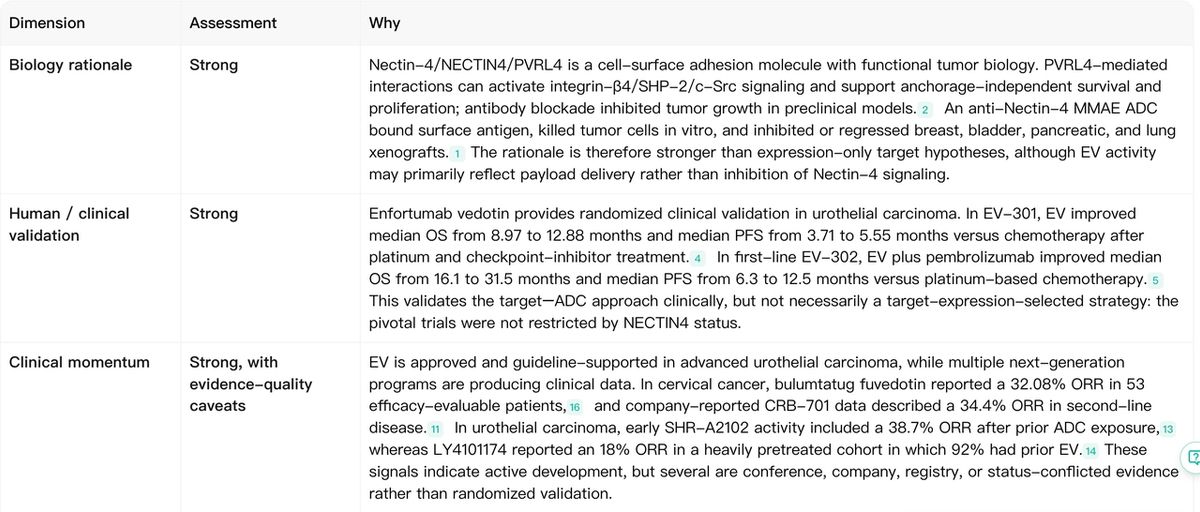
Remaining scorecard dimensions
| Dimension | Assessment | Why it matters |
|---|---|---|
| Competitive whitespace | Moderate | Clinically validated but crowded. Potential differentiation: post-EV efficacy, new payloads, better delivery, cervical cancer, and selected biomarkers. |
| Safety and therapeutic-window challenge | High challenge | Skin, neuropathy, metabolic, pulmonary, ocular, and payload-specific hematologic toxicities can constrain development. |
| Biomarker opportunity | Promising, unvalidated | NECTIN4 amplification and membranous target assays merit prospective testing; retrospective enrichment is not an established selection standard. |
| IP and differentiation burden | High challenge | Multiple binding and conjugate approaches imply licensing and FTO diligence needs. The evidence assembled here does not establish patent clearance or infringement. |
| Overall attractiveness | High, selective entry | Compelling clinical proof, but new candidates need a demonstrable edge on delivery, safety, patient selection, combinations, or post-EV activity. |
9. Clinical Development Map
A practical development plan should distinguish approved treatment precedent from plausible next-generation opportunities and speculative expansion lanes.
| Development lane | Opportunity | Principal risk | Suggested action |
|---|---|---|---|
| Advanced urothelial cancer | Validated indication and clear benchmark | EV-containing standard raises the efficacy and safety bar | Require direct differentiation against relevant standards; define post-EV strategy. |
| Cervical cancer | Emerging clinical signals and possible partnering path | Early, non-randomized evidence; variable selection criteria | Validate membrane-target assay and pursue disease-specific controlled studies. |
| Earlier-stage urothelial cancer | Potential movement into earlier treatment settings | Curative-intent setting lowers tolerance for toxicity | Define perioperative endpoints and strict safety criteria before extrapolating. |
| Alternative payloads / delivery | May address MMAE resistance or toxicity | New hematologic or other payload-specific liabilities | Compare exposure, uptake, response, durability, and adverse events. |
| Biomarker-defined cohorts | Amplification or membrane expression may enrich benefit | No validated cutoff and expression–uptake disconnect | Prospectively test assays, density, and internalization alongside clinical outcomes. |
| Post-EV resistance | Clear unmet differentiation question | Multiple possible resistance mechanisms | Include prior-EV cohorts and translational sampling at progression. |
| Other solid tumors | Broad biological expression and exploratory signals | Weak disease-specific clinical validation | Restrict expansion to evidence-backed, biomarker-informed trials. |
The most defensible strategy is to protect the urothelial benchmark, evaluate cervical cancer as a focused expansion opportunity, and reserve broader claims for disease-specific evidence rather than IHC positivity alone.
10. How Noah AI Changes the Workflow
In a traditional target assessment, analysts search target biology, regulatory documents, publications, registries, and company reports separately before building competition tables and a scorecard. A Noah AI-assisted workflow can help structure this evidence into a repeatable research process, while human experts remain responsible for checking source fidelity and deciding what to do.
| Target-evaluation task | Traditional approach | Noah AI-assisted research workflow |
|---|---|---|
| Biology and disease context | Search literature and extract mechanistic, clinical, and biomarker data manually. | Gather and organize source-linked findings by disease, assay, mechanism, and evidence maturity. |
| Asset and trial landscape | Copy programs, endpoints, phases, and statuses into separate sheets. | Assemble comparable evidence fields and flag incompatible populations or contradictory status claims. |
| Clinical results | Read publications and company releases one at a time; reconcile measures manually. | Structure outcomes and caveats while retaining denominators, comparator, data cutoff, and evidence type. |
| Scorecard and R&D strategy | Synthesize the report from notes and stakeholder interpretation. | Draft a reviewable evidence structure and strategy options for experts to verify and challenge. |
| Evidence refresh | Repeat searches and reconcile changes against a previous file. | Rerun a defined research question using a new evidence cutoff; a researcher verifies what changed. |
The value is not autonomous go/no-go decision-making. It is faster assembly of traceable, reviewable biomedical evidence, especially when different reports use inconsistent disease settings, trial statuses, assay definitions, or response measures. Learn more about Noah's human-in-the-loop research approach.
Conclusion
Nectin-4 remains a high-attractiveness target because the biology supports ADC delivery and randomized studies have established meaningful clinical benefit in urothelial carcinoma. The stronger question for R&D is whether a specific new program can improve therapeutic index, maintain activity after EV, define a clinically useful biomarker, or validate an additional indication.
This report supports research and competitive-intelligence discussion. It is not an exhaustive asset inventory, a freedom-to-operate opinion, or a substitute for clinical, regulatory, or investment judgment.
Try Noah AI for Free
Use Noah AI to search, compare, and analyze biomedical evidence with AI-assisted research workflows. Free credits are available, and no credit card is required.