How to Prepare an Evidence-Based Medical Affairs Briefing
Linda
Learn how Noah AI helps Medical Affairs and MSL teams prepare evidence-based briefings using medical literature, clinical trial data, guidelines, conference insights, and traceable references.
Medical Affairs teams are often responsible for turning complex medical evidence into clear, balanced, and useful briefing materials. These briefings may support internal strategy discussions, MSL preparation, KOL engagement, disease education, congress follow-up, competitive intelligence, or cross-functional alignment with commercial, clinical, and market access teams.The challenge is that medical briefing work rarely starts from a single document. Teams may need to review PubMed literature, clinical trial results, treatment guidelines, conference updates, drug pipeline data, regulatory materials, and emerging market signals. They also need to make sure that every claim can be traced back to reliable evidence.Noah AI is designed to support this evidence-first workflow. Instead of generating a generic summary from a short prompt, Noah AI helps Medical Affairs teams search professional sources, organize findings, compare evidence, build structured reports, and keep references visible for review. The result is not a final approved medical document, but a stronger evidence-based briefing draft that teams can review, refine, and adapt for their specific audience.
Why Medical Affairs Briefings Are Difficult to Prepare
Medical Affairs briefings need to be accurate, balanced, and context-aware. A useful briefing is not just a collection of bullet points. It needs to explain the current evidence landscape, identify the most relevant trials or publications, summarize guideline context, and highlight evidence gaps or controversies.This makes briefing preparation time-consuming. Teams often need to move between multiple tools, copy information into slides or documents, verify references manually, and rewrite technical evidence for different audiences.For Medical Affairs teams, the main problem is not only finding information. It is turning evidence into a structured and usable briefing.
How Noah AI Supports Medical Affairs Workflows
Noah AI can help Medical Affairs teams move from a research question to an evidence-backed briefing through a connected workflow. Users can start in Agent Mode with a medical or biopharma question, such as a disease landscape update, drug mechanism review, competitor evidence summary, congress follow-up, or KOL discussion preparation.For example, a team can ask Noah AI to prepare an evidence-based Medical Affairs briefing for MSL teams on GLP-1 receptor agonists in type 2 diabetes and cardiovascular risk reduction. The prompt can request disease background, key clinical evidence, guideline context, competitor landscape, key messages, evidence gaps, and traceable references.Noah AI can then break down the task, retrieve relevant information, organize the output, and generate a structured report. Because references stay visible, users can inspect the sources behind the synthesis before adapting the output for internal or external review workflows.
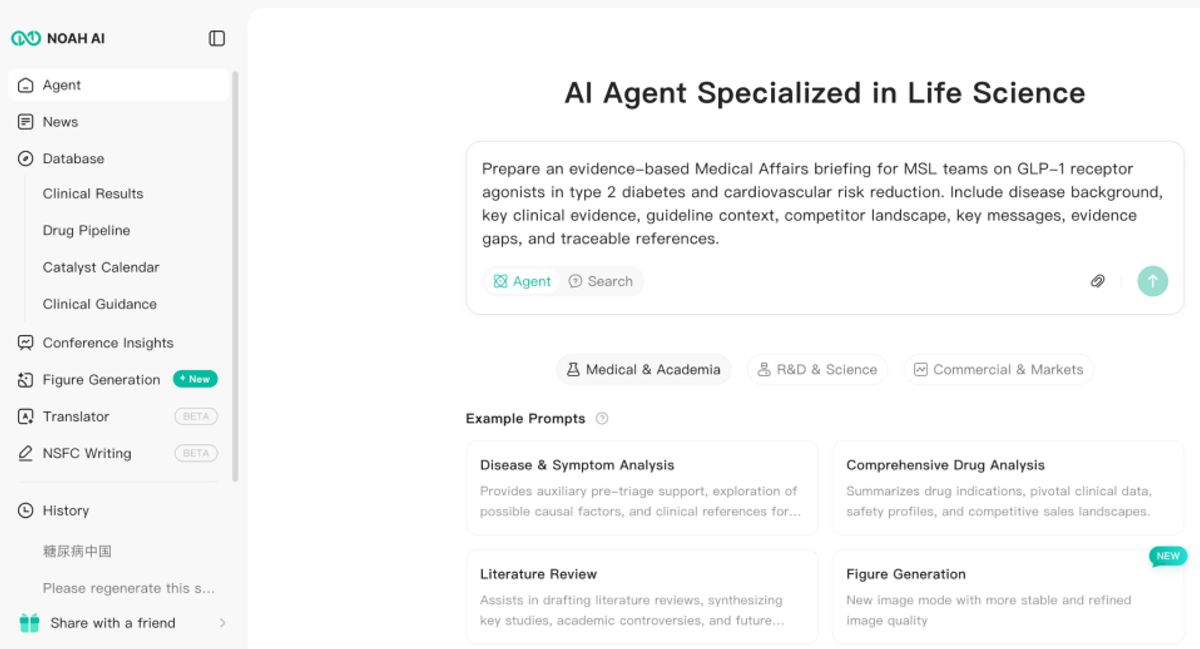
gure 1. Medical Affairs teams can start with a briefing question in Noah AI Agent Mode, such as preparing MSL materials on a disease area, drug class, or clinical evidence topic.
Common Medical Affairs Use Cases
| Use Case | What the Team Needs | How Noah AI Can Help |
|---|---|---|
| MSL pre-call briefing | Disease background, treatment landscape, key publications, KOL-relevant evidence | Summarize literature, guidelines, and clinical evidence into a structured briefing |
| Disease landscape update | Epidemiology, unmet needs, treatment options, evidence gaps | Build a disease overview with cited sources and key takeaways |
| Competitor evidence summary | Trial results, mechanisms, endpoints, safety signals, positioning | Compare evidence across drugs or programs |
| Congress follow-up | New abstracts, late-breaking data, expert discussions | Summarize conference insights and identify important updates |
| Internal medical training | Evidence-based teaching material for field or cross-functional teams | Convert complex evidence into clear briefing sections |
| Guideline update briefing | Changes in recommendations and their evidence basis | Summarize guideline-related information and supporting studies |
| Drug pipeline review | Competitor assets, development stage, trial design, key milestones | Organize pipeline information and clinical development context |
| Slide deck preparation | Report-to-presentation workflow | Turn structured reports into editable slide deck drafts |
From Evidence Search to Structured Briefing
A Medical Affairs briefing usually needs several layers of information. Noah AI can support these layers in one workflow by combining literature review, clinical evidence, guideline interpretation, regulatory context, pipeline information, and source traceability.
1. Medical Literature and Guideline Context
Medical Affairs teams often need to understand the latest publications and clinical guidance on a disease, drug class, mechanism, biomarker, or treatment strategy. Noah AI can help organize guideline and consensus sources into briefing-ready tables that explain why each source matters.
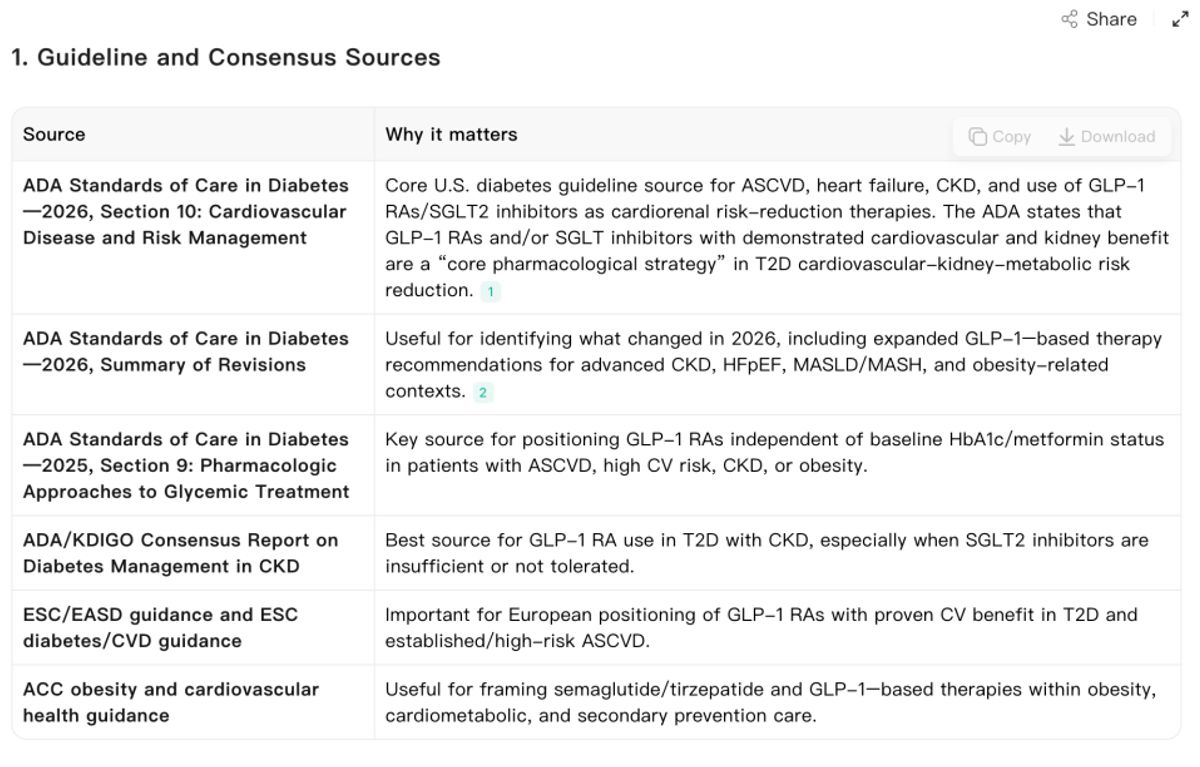
Figure 2. Noah AI can organize guideline and consensus sources into briefing-ready tables, helping Medical Affairs teams understand why each source matters.
2. Clinical, Regulatory, and Label Context
For drug-related briefings, teams often need more than publications. They may also need trial design, endpoints, safety signals, regulatory approvals, prescribing information, and regional label context. This is especially important when briefing teams on indication wording, fair-balance language, or approved use cases.
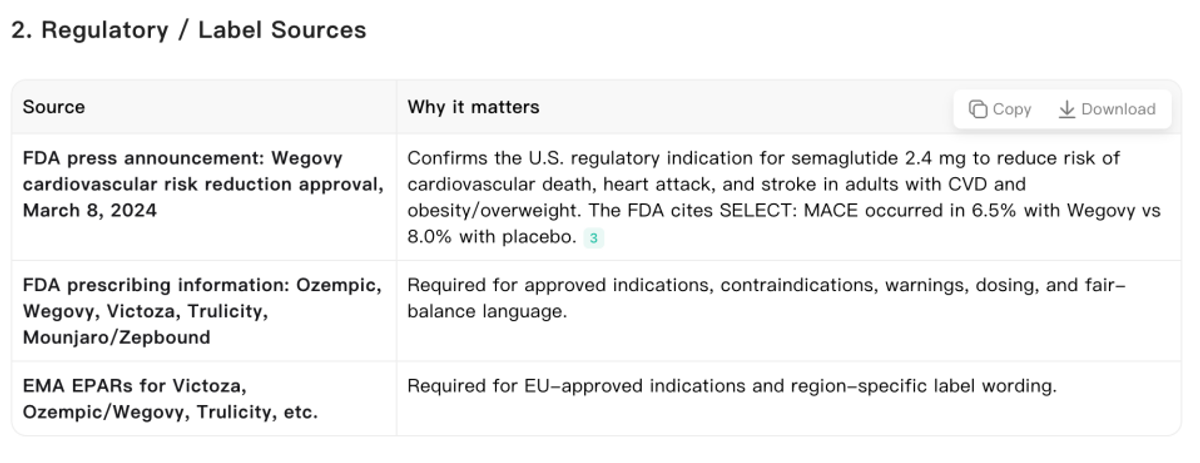
Figure 3. Noah AI can help Medical Affairs teams organize regulatory and label-related sources, including FDA and EMA materials, for evidence-based briefing preparation.
3. Conference, Pipeline, and Market Signals
Medical Affairs teams frequently monitor congress updates, new abstracts, late-breaking data, pipeline changes, and industry signals. Noah AI can help surface and organize these updates so teams can prepare timely internal briefings and cross-functional discussion materials.
Why Traceable References Matter for Medical Affairs
Medical Affairs teams operate in a high-trust environment. A briefing may be used to prepare field teams, support internal strategy, respond to scientific questions, or align cross-functional stakeholders. In all of these settings, source quality matters.
A general AI summary may sound fluent, but medical teams still need to know which paper supports a claim, whether the source is a primary study or guideline, what the publication date is, whether the population is relevant, and whether the evidence directly supports the conclusion.
Noah AI is useful because it keeps references visible and exportable in the References Overview. This allows Medical Affairs users to review, challenge, and refine the output before using it in a formal workflow.
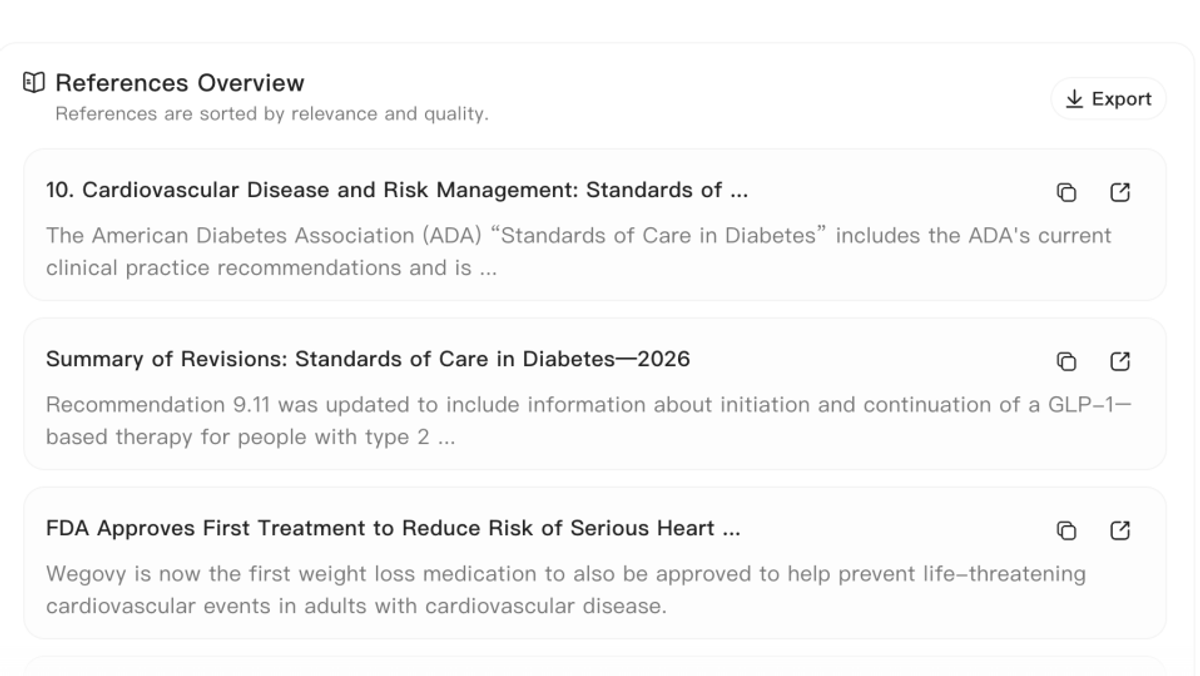
Figure 4. Noah AI keeps references visible and exportable so Medical Affairs teams can review the evidence behind briefing materials.
How Noah AI Can Help Turn Reports into Briefing Materials
After a structured report is generated, Medical Affairs teams often need to turn it into a format that can be shared. Noah AI can support this step by helping users create briefing-ready outputs, including structured reports, downloadable materials, and slide deck drafts.
For example, a team preparing a disease landscape briefing could use Noah AI to generate a report covering disease burden, treatment options, recent evidence, guideline context, regulatory considerations, and pipeline activity. The same report can then become the basis for an internal briefing deck or MSL preparation document.
This helps reduce the time spent moving information between tools and allows teams to focus more on message quality, evidence review, and strategic discussion.
When Should Medical Affairs Teams Use Noah AI?
Noah AI is most useful when the task requires professional medical context and evidence organization. It is especially relevant when teams need to prepare internal evidence briefings, summarize a disease or treatment landscape, review clinical trial results, compare competitor evidence, monitor congress data, build MSL pre-call preparation materials, create briefing decks from structured reports, or check references before using AI-generated content.
Noah AI should not replace medical, legal, regulatory, or compliance review. Instead, it can help teams create a stronger evidence-based draft that is easier to review and refine.
Final Takeaway
Medical Affairs teams need more than fast summaries. They need briefing materials that are structured, evidence-based, and connected to reliable sources.
Noah AI supports this workflow by helping teams search professional medical sources, organize evidence, synthesize findings, and keep references visible for review. For MSLs and Medical Affairs teams, this can shorten the time from question to briefing while improving the traceability of the final output.
Ready to turn medical evidence into structured briefing materials? Try Noah AI.
FAQ
What is a Medical Affairs briefing?
A Medical Affairs briefing is a structured document or presentation that summarizes scientific evidence for internal teams, MSLs, KOL discussions, disease education, clinical updates, or strategy planning.
Can Noah AI help MSL teams prepare for KOL meetings?
Yes. Noah AI can help MSL teams summarize disease background, recent literature, clinical trial evidence, guideline context, competitor information, and key discussion points before a KOL interaction.
Is Noah AI only for literature review?
No. Noah AI can support broader medical research workflows, including literature review, clinical trial analysis, drug pipeline tracking, guideline review, conference insight monitoring, regulatory context review, and briefing preparation.
Can Noah AI generate slide decks for Medical Affairs briefings?
Yes. Noah AI can help turn structured reports into editable slide deck drafts, which can then be reviewed and customized by the team.
Are Noah AI outputs ready for external medical use?
No. Noah AI outputs should be reviewed by qualified medical, legal, regulatory, and compliance teams before being used in external communications or formal decision-making.
Research and Compliance Disclaimer
This article is for research workflow education only. AI-generated briefing materials should be reviewed by qualified medical, legal, regulatory, and compliance teams before being used in external communication, clinical decision-making, promotional materials, or formal strategic decisions.