MASH Indication Strategy Report 2026: Epidemiology, Target Biology, Clinical Competition and Deal Outlook
Linda
A 2026 MASH indication strategy report covering epidemiology, fibrosis-stage opportunity, THR-beta vs FGF21, late-stage competition, deal activity and entry strategy.
Metabolic dysfunction-associated steatohepatitis (MASH) is no longer a simple first-in-class opportunity. Resmetirom and semaglutide have now established two distinct regulatory precedents in noncirrhotic MASH with moderate-to-advanced fibrosis (F2–F3). Resmetirom became the first FDA-approved MASH therapy in 2024 under accelerated approval based on histologic improvement in MASH and fibrosis, while semaglutide received an expanded MASH indication in 2025 under accelerated approval based on interim Phase 3 histologic evidence.
These approvals should not be treated as interchangeable validation events. Resmetirom provides direct regulatory validation for the THR-beta mechanism and a liver-directed oral treatment strategy, whereas semaglutide extends an established GLP-1 metabolic therapy into MASH on the basis of a separate clinical development program. Together, they confirm that the F2–F3 MASH market is now clinically and regulatorily validated, while increasing the differentiation burden for new entrants.
Fibrosis therefore remains a central clinical value driver, and large pharmaceutical transactions have intensified competition across THR-beta, FGF21, incretin, RNAi, and other mechanisms.
How this report was built: We used Noah AI Deep Research to reproduce a disease-to-target-to-pipeline-to-deal workflow. The analysis combines epidemiology, fibrosis-stage segmentation, target biology, major clinical programs, public transaction disclosures and strategic entry criteria rather than treating MASH as a generic disease overview.
Executive Summary
Strategic verdict: PRIORITIZE WITH DIFFERENTIATION GATES.
- Disease burden: MASH remains a large progressive cardiometabolic liver disease, but the relevant drug-development opportunity is concentrated in patients with clinically significant fibrosis rather than the entire MASLD population.
- Biology: THR-beta is regulatorily validated through resmetirom, while FGF21 has become one of the most active late-stage and transaction-heavy classes. There is no definitive head-to-head evidence establishing one mechanism as clinically superior.
- Competition: The U.S. market already includes approved F2-F3 therapies and multiple Phase 3 programs spanning FGF21, incretin/metabolic and other mechanisms. A me-too F2-F3 program has a high differentiation burden.
- Deal signal: Large transactions involving Akero, 89bio, Boston Pharmaceuticals and RNAi programs show continued strategic interest, but they also raise the bar for what a new entrant must demonstrate.
Bottom line: MASH remains attractive, but the opportunity has shifted from proving the disease is druggable to proving that a new therapy can deliver stronger fibrosis benefit, credible compensated-cirrhosis activity, chronic-use safety, better treatment experience, or a differentiated combination role.
1. Disease Background: Why MASH Matters
MASLD describes hepatic steatosis associated with cardiometabolic risk factors such as obesity, dysglycemia, hypertension or dyslipidemia. MASH is the progressive inflammatory form, characterized by steatohepatitis with hepatocyte injury and variable fibrosis.
The strategic issue is not liver fat alone. Fibrosis stage is much more closely tied to the risk of cirrhosis, decompensation and liver-related outcomes. That makes fibrosis-stage segmentation central to clinical development and commercial positioning.
| Stage | Clinical meaning | Strategic importance |
|---|---|---|
| F0-F1 | Steatosis or early fibrosis with lower near-term liver-event risk. | Large population, but lower treatment urgency and harder outcome-based development. |
| F2 | Clinically significant fibrosis. | Core initial drug-development population and part of the current approved market. |
| F3 | Bridging fibrosis without established cirrhosis. | High-priority noncirrhotic segment because progression risk is substantially higher. |
| Compensated F4 | Cirrhosis without major decompensating events. | One of the clearest unmet-need opportunities, but requires longer studies, harder endpoints and stronger safety evidence. |
| Decompensated cirrhosis | Ascites, variceal bleeding, encephalopathy or impaired synthetic function. | A separate high-risk development setting with substantially greater safety and pharmacokinetic complexity. |
Current commercial activity is concentrated in noncirrhotic F2-F3 disease, while compensated F4 increasingly represents the strategic white space. The opportunity is potentially more defensible in F4, but the development burden is also materially higher.
2. Epidemiology and Addressable Population
One of the easiest mistakes in MASH strategy is to use broad MASLD prevalence as if it were the directly addressable treatment market. The disease funnel is much narrower.
A better commercial and development model is:
Metabolic-risk population → MASLD → MASH → clinically significant fibrosis → diagnosed disease → treatment-eligible patients.
| Funnel stage | Evidence-based interpretation | Strategic implication |
|---|---|---|
| Metabolic-risk population | Adults with obesity, diabetes, prediabetes, hypertension, dyslipidemia or overlapping cardiometabolic risk. | Very large screening universe, but not a direct drug-market denominator. |
| MASLD | U.S. estimates place prevalence at roughly one-third of adults in recent analyses. | Large disease pool, but most patients are not immediate candidates for liver-directed pharmacotherapy. |
| MASH | Substantially smaller than MASLD and highly dependent on diagnostic method and ascertainment. | Do not infer MASH prevalence by applying an arbitrary percentage to all MASLD. |
| MASH with F2+ | A U.S. microsimulation estimated millions of adults with clinically significant fibrosis. | This is the broadest disease pool relevant to current drug development. |
| Diagnosed patients | Diagnosis remains a bottleneck because at-risk patients are frequently not referred for elastography or specialist evaluation. | Commercial uptake depends on case finding, noninvasive testing, specialist access and payer criteria. |
| Treatment-eligible patients | Current U.S. therapy is concentrated mainly in noncirrhotic F2-F3 disease. | The actual treated market is materially smaller than the biological prevalence pool. |
High-risk populations, especially patients with type 2 diabetes and obesity, remain particularly important for screening and trial enrichment because they have higher rates of significant fibrosis and cirrhosis.
3. Unmet Need and Target Product Profile
The unmet need in 2026 is not simply another therapy that lowers liver fat. A competitive new entrant needs a profile that changes fibrotic disease while remaining practical for chronic use.
| Differentiation gate | Minimum requirement | Why it matters |
|---|---|---|
| Fibrosis benefit | Reproducible human fibrosis improvement without worsening MASH, ideally with simultaneous MASH resolution. | Approved therapies have already established histologic activity; liver-fat reduction alone is not enough. |
| Advanced disease | A credible F3-to-F4 prevention strategy or a dedicated compensated-F4 program. | Compensated cirrhosis remains one of the clearest areas of unmet need. |
| Durability and safety | Long-term efficacy and tolerability suitable for a chronic cardiometabolic population. | Short-term biopsy benefit has limited value if treatment persistence is poor. |
| Operational fit | Convenient dosing, practical noninvasive screening and monitoring, and compatibility with common cardiometabolic therapies. | Diagnosis and specialist capacity are already major barriers to treatment adoption. |
A strong target product profile would therefore combine fibrosis improvement, MASH resolution, long-term clinical-outcome planning, simple administration, cardiometabolic compatibility and a clear route into advanced fibrosis.
4. Target Mechanisms: THR-beta vs FGF21
Two of the most strategically important mechanism families in MASH are THR-beta and FGF21. They approach the disease from different biological angles and carry different development trade-offs.
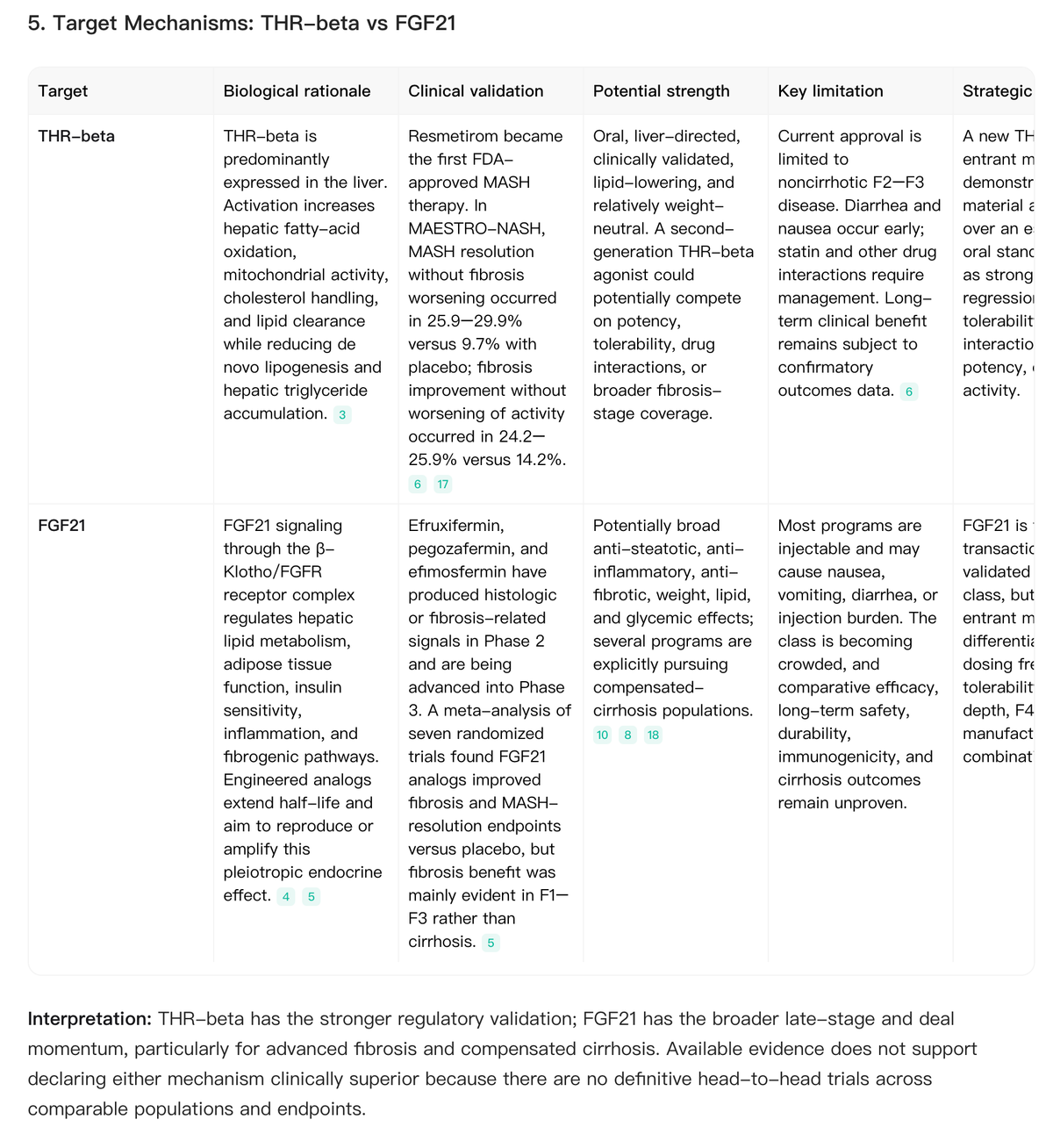
Figure 1. Noah AI compares THR-beta and FGF21 across biological rationale, clinical validation, strengths, limitations and strategic implications.
THR-beta has the strongest regulatory validation because resmetirom became the first FDA-approved therapy for MASH. Its advantages include oral dosing, liver-directed biology and favorable lipid effects. The main challenge for a new THR-beta entrant is differentiation against an established oral standard.
FGF21 offers broader endocrine and metabolic effects spanning hepatic lipid metabolism, adipose function, insulin sensitivity, inflammation and fibrosis. Multiple FGF21 programs have moved into Phase 3, including development in compensated cirrhosis. The trade-offs include injectable administration, tolerability, class crowding and still-unproven long-term comparative superiority.
The strategic conclusion is not that one mechanism is universally better. THR-beta has stronger regulatory validation; FGF21 has broader late-stage and transaction momentum. A new program needs a specific differentiation thesis rather than a mechanism label alone.
5. Clinical Competitive Landscape
The 2026 competitive field is already moving beyond the question "Can MASH be treated?" The more relevant question is which mechanism, fibrosis stage and treatment format can deliver the best durable net benefit.
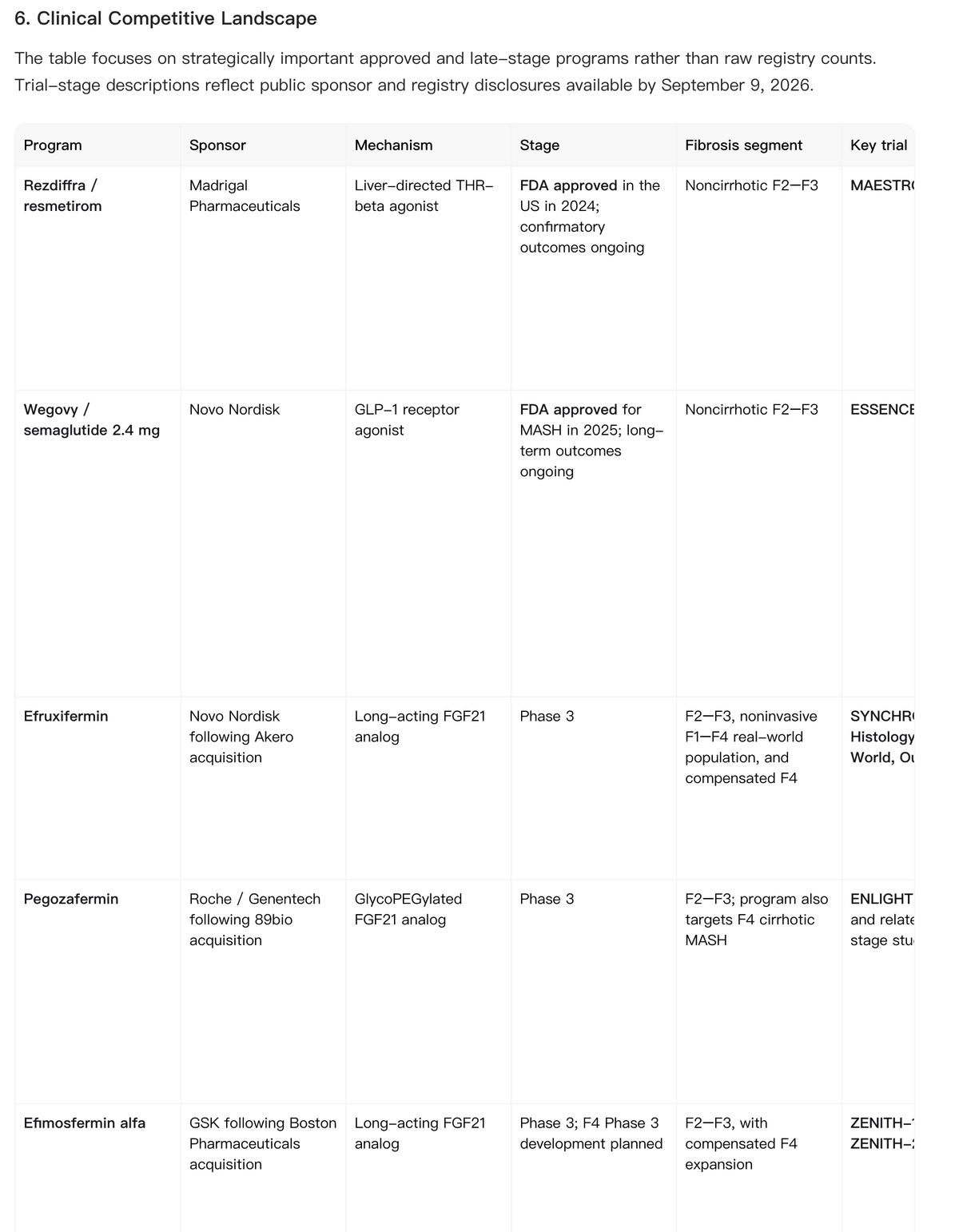
Figure 2. Noah AI maps strategically important approved and late-stage MASH programs across mechanism, stage, fibrosis segment and key trials.
- F2-F3 is validated but crowded. Resmetirom established an oral liver-directed benchmark, while semaglutide adds strong metabolic, weight and cardiometabolic positioning.
- FGF21 is a major late-stage battleground. Efruxifermin, pegozafermin and efimosfermin all compete for fibrosis differentiation and, in varying ways, advanced-disease positioning.
- Compensated F4 is attractive but difficult. It offers clearer unmet need, but programs need longer follow-up, event-driven outcomes and greater safety scrutiny.
- Liver-fat reduction alone is unlikely to be enough. MRI-PDFF, weight and metabolic changes matter, but they need to connect to fibrosis, MASH resolution or clinical outcomes.
- Combination strategy matters. As incretin backbones become more common, liver-directed or antifibrotic mechanisms may increasingly need an add-on or combination role.
Build an Indication Strategy Report with Noah AI for Free
Use Noah AI to research disease burden, patient segmentation, target biology, clinical pipelines, competitive programs, deal activity, and differentiation opportunities—and turn the evidence into a structured indication strategy report.
Free to use · Free credits included · No credit card required
[Generate an Indication Strategy Report with Noah AI →](https://www.noah.bio/signup?utm_source=blog)
6. Deal Activity and Market Attractiveness
Transaction activity is one of the strongest signs that MASH remains strategically relevant. Large pharmaceutical companies have continued to acquire differentiated late-stage programs and license new mechanisms even after the first approvals reached the market.
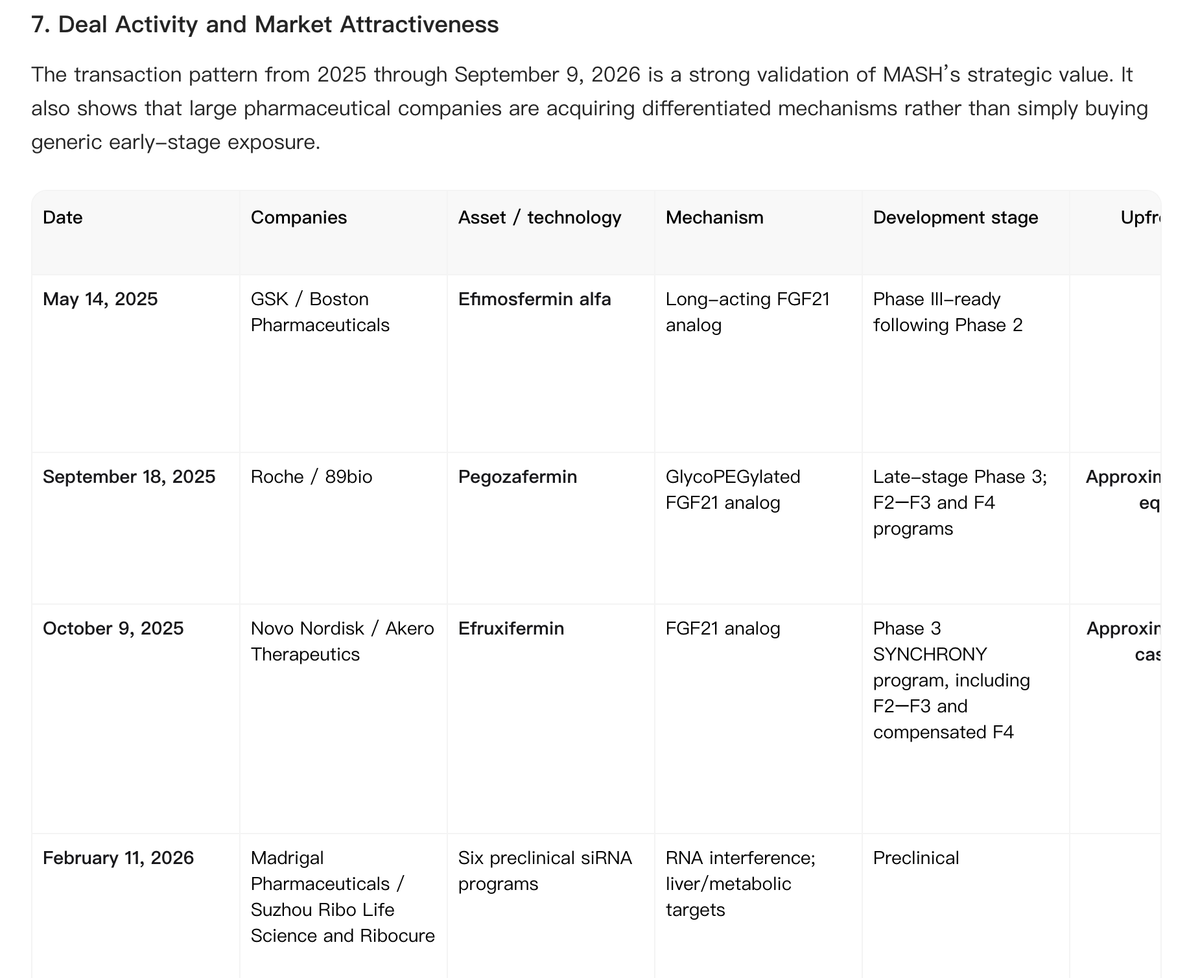
Figure 3. Noah AI summarizes major MASH transactions involving FGF21 assets and next-generation liver programs.
Several patterns stand out:
- GSK, Roche and Novo Nordisk committed substantial capital to differentiated FGF21 programs.
- Advanced fibrosis and compensated cirrhosis feature repeatedly in the strategic rationale for these transactions.
- Madrigal has expanded beyond resmetirom into RNAi and other next-generation liver programs, suggesting that even the incumbent expects the market to evolve toward combinations and segmentation.
- Headline transaction values should not be treated as guaranteed asset value. Upfront cash, contingent payments, milestones, royalties and development risk need to be separated.
Market-attractiveness conclusion: MASH remains commercially attractive, but deal activity validates selective entry rather than broad entry. Capital is flowing toward assets with a credible claim to deeper fibrosis benefit, advanced-disease activity, convenient dosing, combination utility or genetically defined differentiation.
7. Indication Strategy Recommendation
MASH should be prioritized, but only under explicit differentiation gates.
The preferred development strategy is not to target all MASLD. It is to choose a high-risk, clinically defensible segment and build the program around fibrosis regression, long-term outcomes and practical integration into cardiometabolic care.
Lead with F2-F3, but design for F3 and F4
F2-F3 remains the most straightforward entry setting for establishing histologic efficacy and regulatory feasibility. But a program should be deliberately designed to enrich or stratify F3 disease and preserve a path into compensated F4.
Require human fibrosis evidence before major investment
A new entrant should not move forward based only on MRI-PDFF reduction, ALT/AST improvement, weight loss, insulin-sensitivity improvement or preclinical antifibrotic activity.
The most important go/no-go signal is reproducible human evidence of fibrosis improvement without worsening MASH, preferably accompanied by MASH resolution or reduced progression.
Build a comparator-aware clinical strategy
Future programs need to be designed around a market where semaglutide offers weight and cardiometabolic benefits, resmetirom offers oral liver-directed positioning, and FGF21 assets may claim broader antifibrotic or cirrhosis advantages.
That means clinical development should prospectively assess treatment effects by fibrosis stage, diabetes status, obesity, background incretin therapy, liver fat, noninvasive fibrosis risk and concomitant cardiometabolic treatments.
Make compensated cirrhosis a strategic option
The most defensible white-space opportunity is a therapy that can safely and convincingly treat compensated MASH cirrhosis. A strong program would include dedicated F4 development, decompensation-related outcomes, liver-function measures, cirrhosis pharmacokinetics and a clear plan for patients who progress during treatment.
Treat chronic safety as a core differentiator
MASH patients often have obesity, diabetes, dyslipidemia, cardiovascular disease, renal disease and polypharmacy. Long-term treatment persistence, gastrointestinal tolerability, gallbladder events, drug-induced liver injury, cardiovascular effects, thyroid or bone effects where relevant, renal safety and drug-drug interactions all influence real-world value.
Solve diagnosis and monitoring operationally
A commercially practical program should support a noninvasive pathway such as:
- identify high-risk patients with diabetes, obesity or multiple cardiometabolic risk factors;
- use FIB-4 as an initial screen;
- reflex to VCTE, ELF, MRE or another validated tool;
- reserve biopsy for settings where regulatory confirmation is still necessary;
- monitor treatment response with noninvasive tests whenever possible.
Design for combinations from the beginning
Combination compatibility should be treated as a development gate. A new drug may ultimately need to work alongside GLP-1, GLP-1/GIP, GLP-1/glucagon, statins, resmetirom or other metabolic therapies rather than assume a monotherapy-only position.
Set a commercially meaningful differentiation threshold
| Scenario | Strategic decision |
|---|---|
| Strong preclinical data but no human fibrosis signal | No-go |
| F2-F3 activity similar to current approved therapies with no safety or operational advantage | No-go / partner only |
| Clear fibrosis benefit plus better dosing, tolerability or combination fit | Go |
| Robust F3 and compensated-F4 data with a clinical-outcomes strategy | High-priority go |
| Strong weight and liver-fat reduction but uncertain fibrosis benefit | Watch |
| Precision asset with early target engagement but unproven fibrosis benefit | Conditional go |
Final Strategic Takeaway
MASH remains a credible drug-development opportunity because fibrosis burden remains high, diagnosis and treatment penetration are still incomplete, and major pharmaceutical companies continue to commit capital to differentiated programs.
But the strategic question has changed. The market no longer needs proof that MASH is druggable. A new entrant now needs evidence that it can deliver durable fibrosis regression, address compensated cirrhosis, fit alongside established cardiometabolic therapies, simplify treatment or diagnosis, or create a meaningfully differentiated combination position.
That is why the most defensible 2026 conclusion is PRIORITIZE WITH DIFFERENTIATION GATES, not unrestricted entry.
Free to use · Free credits included · No credit card required
[Generate an Indication Strategy Report with Noah AI →](https://www.noah.bio/signup?utm_source=blog)