How to Update an Existing Literature Review with New Research Using AI
Linda
Learn how to update an existing literature review with AI — identify what changed after your evidence cutoff and revise only the sections that need updating.
Updating a literature review should not mean starting the entire project again. The real task is to identify what changed after the original evidence cutoff, determine whether the new research confirms or changes the old conclusions, and revise only the sections that actually need updating.
This matters most in fast-moving biomedical fields. A review that was accurate in 2022 may contain claims that are still valid, claims that now need stronger support, and claims that have become outdated because randomized trials, longer follow-up, or new survival data have changed the evidence landscape.
Testing note: We tested Noah AI directly using an existing literature review with a 2022 evidence cutoff. Noah extracted the review’s major claims first, then compared them with biomedical evidence published after the original cutoff to identify which conclusions should be retained, strengthened, weakened, or replaced.
1. Updating a Literature Review Is Different from Rewriting It
A common mistake is to treat a literature-review update as a completely new review. That usually creates unnecessary work and can even make the final document worse by replacing valid older reasoning with a fresh AI-generated narrative that is less consistent with the original project.
A stronger update workflow asks a narrower question:
What changed in the evidence since the previous cutoff?
That question leads to a more useful sequence:
- Recover the original evidence state.
- Define the new search window.
- Find only the evidence published after the cutoff.
- Compare new studies against old claims.
- Classify the impact of each new finding.
- Revise only the sections whose interpretation has actually changed.
A new paper does not automatically justify rewriting a review. It may simply reinforce a conclusion that was already well supported.
2. Use Two Evidence Cutoffs
The first requirement is to separate the old evidence state from the update period.
In our Noah test, the baseline cutoff was December 31, 2022. Noah was instructed to reconstruct the earlier evidence landscape using only evidence available on or before that date. It then searched for studies published or first reported after that cutoff and available by September 1, 2026.
This separation is important because an AI system can otherwise blend old and new evidence together and produce a polished synthesis without showing what actually changed.
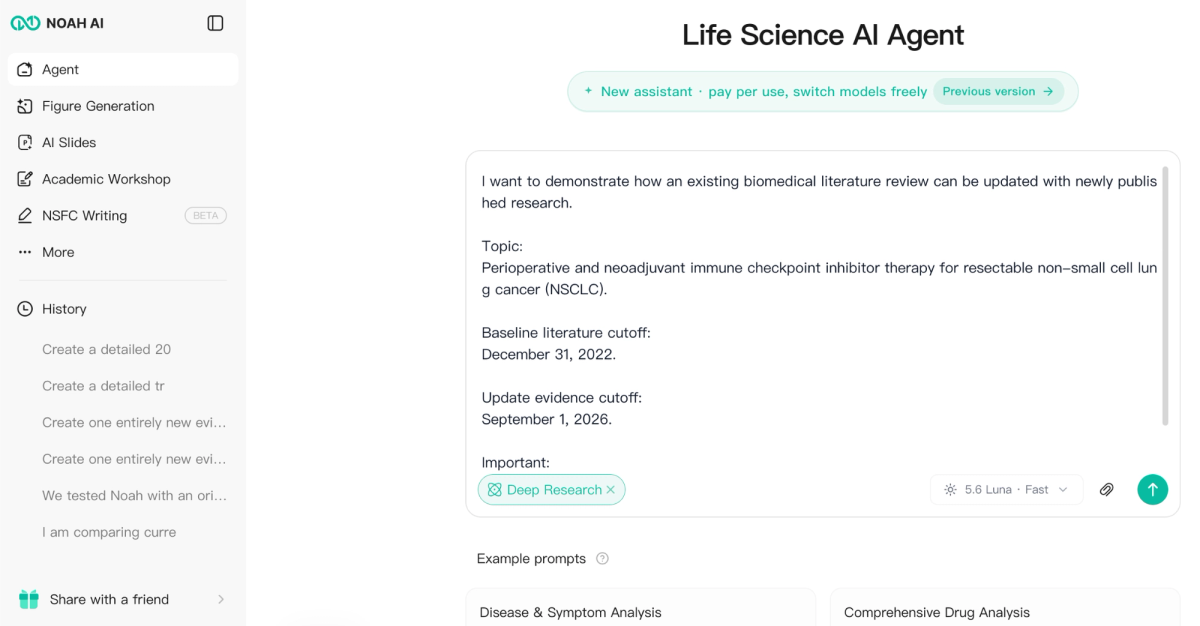
The practical advantage is that the update becomes traceable. Instead of asking, “What is the latest evidence on this topic?” the task becomes, “Which conclusions from the earlier review still stand, and which ones now need to change?”
Try the workflow with your own topic
Noah AI can be used for free with free credits, and no credit card is required to get started.
3. Reconstruct the Baseline Before Looking at New Studies
The baseline should contain the major claims that a reasonable review could support at the earlier cutoff. In this case, the pre-2023 evidence already supported several important conclusions:
- neoadjuvant nivolumab plus chemotherapy had randomized evidence for improved event-free survival (EFS) and pathological complete response (pCR);
- overall survival (OS) was not yet established in the original CheckMate 816 analysis;
- neoadjuvant immune checkpoint inhibitor therapy appeared surgically feasible in selected trial populations;
- pCR and major pathological response (MPR) were useful response endpoints but were not validated OS surrogates;
- PD-L1 was not a reliable standalone treatment-selection biomarker;
- driver-positive NSCLC remained poorly represented in the pivotal evidence;
- the optimal duration of postoperative immunotherapy remained unresolved.
The goal is not to create a perfect historical review. It is to create a stable baseline claim map that can be tested against later evidence.
4. Search Only the Update Window
Once the baseline is fixed, the next search should focus only on the update period. For this case, Noah prioritized randomized phase III trials, planned follow-up analyses, major subgroup analyses, prospective studies, and high-quality meta-analyses reported after 2022.
The post-2022 evidence stream included major programs such as AEGEAN, CheckMate 77T, KEYNOTE-671, RATIONALE-315, long-term CheckMate 816 follow-up, and other relevant analyses.
The important point is not simply that these papers are newer. Each one has to be connected back to a specific earlier claim.
5. Avoid Double-Counting Trial Updates
Literature-review updates often overstate the amount of new evidence because the same trial can generate many publications:
- a primary efficacy paper;
- a later OS update;
- a surgical analysis;
- a biomarker analysis;
- a subgroup publication.
Those publications should usually be treated as one evidence stream rather than five independent trials.
In the Noah workflow, later CheckMate 816 survival reporting updated the original randomized evidence instead of being counted as a separate study population. The same principle was used for AEGEAN follow-up and surgical analyses.
6. Compare New Evidence Against Old Claims
Each claim from the existing review is assigned one of four update states:
- RETAINED — the original conclusion still stands.
- STRENGTHENED — newer evidence provides stronger support for the original conclusion.
- WEAKENED — newer evidence introduces uncertainty or requires more cautious wording.
- REPLACED — newer evidence makes the original conclusion outdated and requires a new interpretation.
This is the most important step in the workflow.
Instead of creating another list of recent studies, Noah compared each baseline claim with the new evidence and assigned an update status.
The two rows below illustrate why this is more useful than a normal “latest papers” summary.
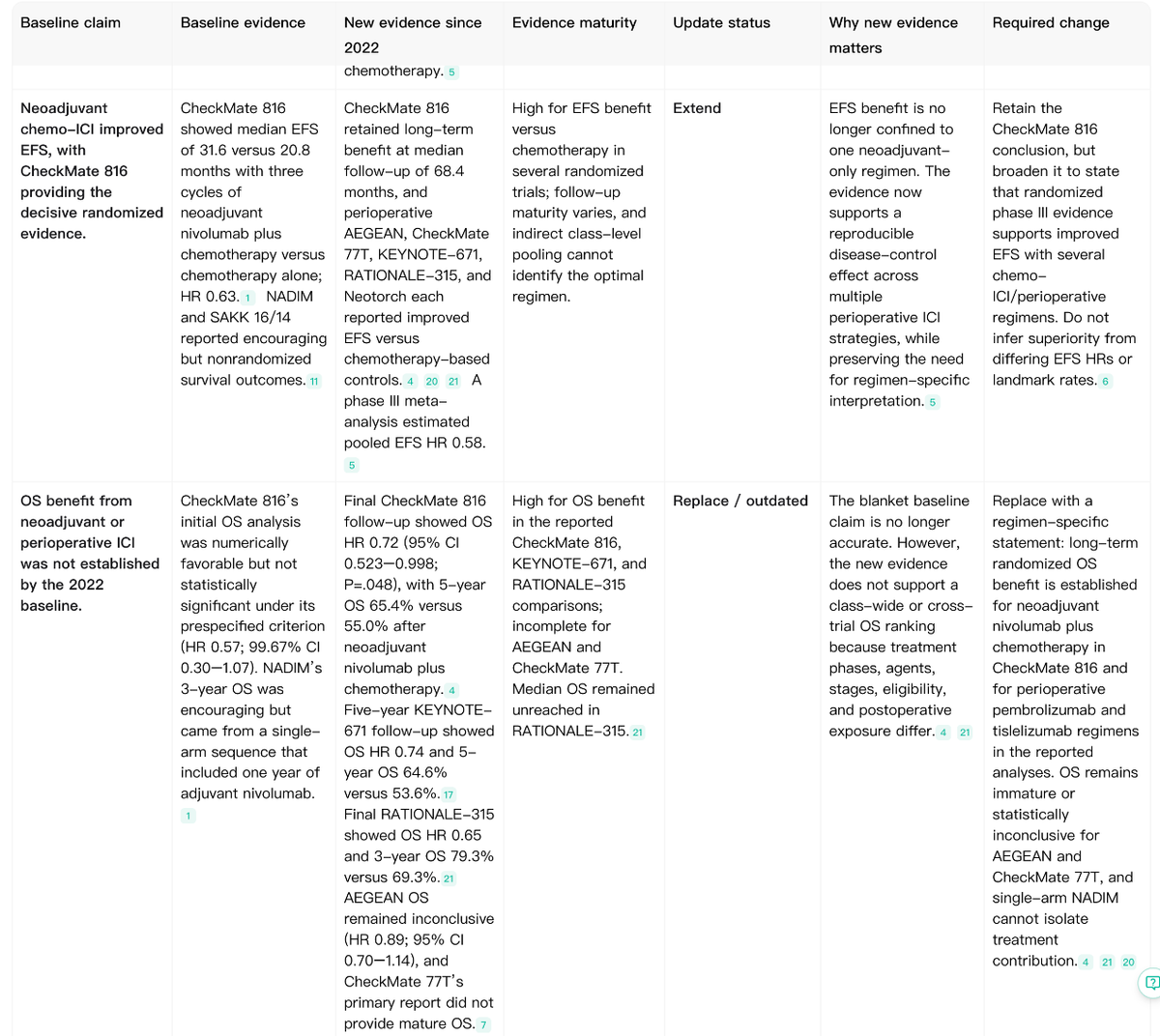
For EFS, the 2022 review already had strong randomized evidence from CheckMate 816. New phase III programs did not invalidate that conclusion; they extended it by showing that improved EFS was no longer confined to a single neoadjuvant-only regimen.
OS changed more substantially. In 2022, the broad conclusion that OS benefit had not been established was accurate. By the 2026 update window, long-term CheckMate 816 follow-up and mature perioperative data from selected trials meant that this blanket statement had become outdated. The correct update was not to claim a universal class-wide OS benefit, but to replace the old statement with a more regimen-specific interpretation.
See which conclusions actually need updating
Noah can compare a baseline evidence state with newer biomedical research and show which claims should be kept, extended, revised, or replaced. Free credits are available, and no credit card is required.
7. Use a Small Set of Update Labels
A literature-review update becomes easier to manage when every baseline claim is assigned to a small number of states.
| Update status | Meaning | Typical action |
|---|---|---|
| Confirm | New evidence supports the original conclusion without materially changing it. | Keep the original conclusion and add stronger or longer-term support if useful. |
| Extend | New evidence adds stronger evidence, new endpoints, broader applicability, or longer follow-up. | Expand the original section without replacing its core conclusion. |
| Challenge | New evidence creates meaningful uncertainty around the earlier interpretation. | Revise the wording and explain the new tension or non-comparability. |
| Replace / outdated | The old statement is no longer an accurate summary of the current evidence. | Replace the claim with a new source-traceable interpretation. |
| No meaningful change | New studies exist, but they do not materially alter the earlier conclusion. | Do not rewrite the section simply to add newer citations. |
This distinction keeps the update focused. It also helps prevent a common AI failure mode: rewriting every paragraph simply because a later paper exists.
8. Update Only the Sections That Actually Changed
The Noah output did not suggest rewriting the full review. Some parts required major changes, while others needed only a small qualification or no change at all.
For this NSCLC example:
- EFS required a major update because multiple randomized perioperative studies expanded the evidence base beyond the earlier CheckMate 816 result.
- OS required replacement of the old conclusion because mature randomized survival evidence was now available for specific regimens.
- Surgery and safety required a minor update because newer surgical analyses strengthened feasibility conclusions while pooled evidence better quantified systemic toxicity.
- pCR/MPR required no fundamental change because longer-term associations did not validate these pathological endpoints as treatment-effect surrogates for OS.
9. Build a Final Update Summary
The final output should answer a practical editorial question:
Which parts of the old review do I keep, revise, or replace?
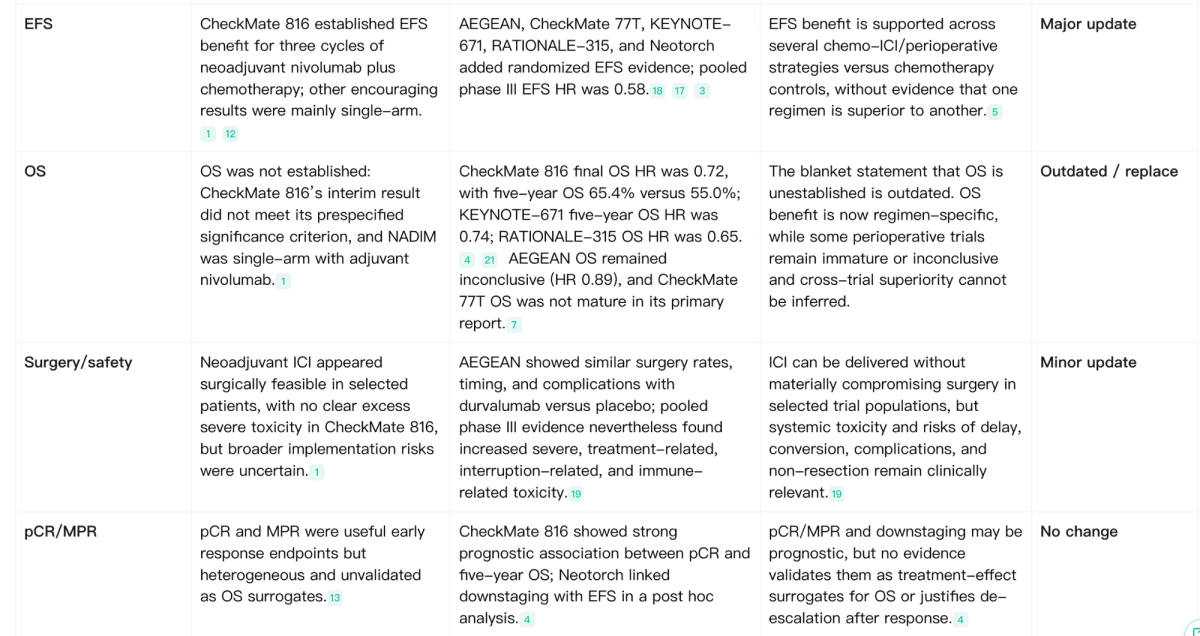
This is more useful than a generic “updated review” because the editorial decision remains visible. A researcher can immediately see which sections need substantial rewriting and which sections should be left alone.
Update Your Existing Literature Review with Noah AI
Upload your existing review and identify which claims need updating as new biomedical evidence becomes available.
See which conclusions should be retained, strengthened, weakened, or replaced based on newer research.
Free to use · Free credits included · No credit card required
Upload Your Existing Review and Identify Which Claims Need Updating →
10. What Changed in This NSCLC Review?
EFS: From One Decisive Trial to a Broader Randomized Evidence Base
In the 2022 baseline, CheckMate 816 was the decisive randomized EFS result. By 2026, AEGEAN, CheckMate 77T, KEYNOTE-671, RATIONALE-315, Neotorch, and follow-up evidence had expanded the disease-control evidence across several perioperative strategies.
The appropriate update is therefore not “CheckMate 816 was wrong.” It is that the original EFS conclusion became broader and better supported.
OS: The Old Blanket Statement Became Outdated
The initial CheckMate 816 publication did not establish statistically significant OS under its prespecified analysis. That made “OS remains unestablished” a reasonable 2022 conclusion.
With later long-term randomized follow-up and mature survival data from selected perioperative programs, that broad statement no longer represented the evidence accurately.
The replacement should remain regimen-specific. Different agents, treatment phases, eligibility criteria, and postoperative exposure prevent a simplistic cross-trial ranking.
Surgery and Safety: More Detail, Not a Reversal
The baseline view that neoadjuvant ICI could be delivered without obviously compromising surgery in selected patients remained broadly valid. Newer analyses added more detail on surgery rates, complications, and systemic toxicity.
That is a classic minor update: the original conclusion still stands, but the wording should be more precise.
pCR and MPR: New Follow-Up Did Not Close the Surrogacy Question
Longer-term evidence strengthened the prognostic importance of pathological response. But association with better outcomes is not the same as validating pCR or MPR as treatment-effect surrogates for OS.
This is why “No change” can be an important result. A review does not become better simply by replacing every cautious statement with a more confident one.
11. Why “No Meaningful Change” Is Useful
Researchers often assume that an update must add something new to every section. That creates citation inflation and can make the review harder to read.
In this case, several baseline conclusions remained fundamentally valid:
- ICI monotherapy still lacked comparable randomized survival evidence;
- pCR and MPR still were not validated OS surrogates;
- oncogene-driven NSCLC remained an evidence-limited population;
- optimal treatment duration remained unresolved;
- the independent value of postoperative ICI was not isolated by direct randomized component testing.
Recording “No meaningful change” helps preserve accurate older work rather than rewriting it unnecessarily.
12. Common Mistakes When Updating a Literature Review with AI
Searching the Entire Literature Again
If the old review already covered evidence through a known date, begin the update after that cutoff rather than rebuilding the same evidence base.
Adding Every New Paper
New publication does not equal new conclusion. Include a paper because it changes, strengthens, challenges, or meaningfully contextualizes the existing review.
Double-Counting Trial Follow-Up
A trial's primary publication, OS update, biomarker analysis, and surgical analysis belong to the same evidence stream unless they represent genuinely independent cohorts.
Treating pCR or MPR as Proven Survival Benefit
Pathological response can be useful and prognostic without being a validated surrogate for OS.
Calling Cross-Trial Numerical Differences Superiority
Different perioperative regimens should not be ranked from separate trial hazard ratios when populations, designs, stages, endpoints, and treatment architecture differ.
Letting AI Rewrite Sections That Were Already Correct
An update should preserve valid claims. Rewriting everything can create unnecessary inconsistency and introduce new errors.
13. What If You Already Have the Original Literature Review?
If you have the original review text, the workflow becomes even simpler.
Instead of reconstructing the baseline from a historical evidence cutoff, provide the original review and ask the AI to extract:
- major claims;
- supporting evidence;
- evidence cutoff;
- known limitations;
- sections that depend on immature evidence.
Then apply the same update matrix to new evidence published after the original cutoff.
The logic remains the same: baseline claim → new evidence → update status → required change.
14. Related Research Guides
- Best AI Tools for PubMed Literature Review (2026)
- Best AI Tools for Turning Research Questions into Evidence Tables (2026)
- How to Find Sources for a Research Paper with AI: A Medical Literature Workflow
- PubMed Search with AI: How Life Science Professionals Find and Analyze Biomedical Evidence Faster
- Best AI Tools for Clinical Trial Results Analysis (2026)
15. FAQ
Can AI update an existing literature review?
Yes. A useful workflow extracts the old review's major claims, searches only the evidence published after the original cutoff, compares new studies with those claims, and updates only the sections whose interpretation changed.
Do I need to rewrite the entire literature review?
No. A strong update preserves sections that remain valid and focuses revision on claims that were extended, challenged, or made outdated by newer evidence.
What if I do not know the original evidence cutoff?
Estimate it from the most recent studies cited in the original review, then verify the date manually. The update window is much more reliable when the baseline cutoff is explicit.
Should every new study be added?
No. Add studies because they materially affect an existing conclusion, improve evidence maturity, add an important endpoint, or change uncertainty—not simply because they were published later.
How should follow-up papers from the same trial be handled?
Treat them as updates to the same evidence stream rather than separate independent trials. Label the primary publication, follow-up analysis, subgroup analysis, or secondary analysis clearly.
Can AI decide whether an old conclusion is outdated?
AI can help compare old and new evidence and flag conclusions that may need revision. Researchers should still verify the cited studies and confirm that the populations, endpoints, and treatment strategies are sufficiently comparable before changing a high-stakes conclusion.
16. Final Takeaway
A good literature review update asks “What changed?” — not “What was published?”
In this NSCLC case, the most important changes were not the number of new papers. The important changes were that EFS evidence broadened across multiple randomized perioperative programs and that the old blanket statement that OS was unestablished became outdated for specific regimens.
Other conclusions remained valid, including caution around pathological-response surrogacy, treatment duration, molecularly selected populations, and direct sequencing comparisons.
That is the practical value of an AI-assisted update workflow: preserve what is still correct, identify what truly changed, and spend editorial effort only where the evidence justifies it.