How to Search PubMed More Effectively
Linda
Six principles for more effective PubMed searches: precise questions, vocabulary coverage, smart filters, synthesis over scanning, conflict awareness, and iterative refinement. With practical examples using Noah AI.
Most researchers know how to search PubMed. Few search it effectively. The difference between a mediocre search and a good one isn't about knowing more operators — it's about applying a set of principles that address the most common causes of missed papers, irrelevant results, and wasted time.
This article outlines six principles for more effective PubMed searching, each illustrated with a practical example. For each principle, we also note how AI tools like Noah AI implement it automatically.
The Six Principles
Principle 1: Start with a Precise, Structured Question
The most common search mistake happens before you type anything: starting with a vague question. A focused question gives PubMed or an AI tool specific concepts to work with.
How Noah AI helps: Noah AI applies PICO-aware parsing to your natural-language question.
Principle 2: Cover Your Vocabulary
Medical literature uses inconsistent terminology. Effective searches cover MeSH terms, free-text synonyms, and alternative terminology.
How Noah AI helps: Automatic MeSH and synonym expansion broadens vocabulary coverage.
Principle 3: Filter Aggressively, Then Expand If Needed
Start with focused filters and selectively expand if needed. PubMed filters for article type, date, species, and age can reduce noise.
How Noah AI helps: You can specify study-type preferences directly in a natural-language query.
Principle 4: Synthesize, Don't Just Scan
Scanning titles tells you what exists; synthesis tells you what the evidence collectively says.
How Noah AI helps: Structured evidence briefs organize findings across papers with inline citations.
Principle 5: Look for Conflicts, Not Just Consensus
Conflicting results, population differences, and effect-size differences are often the most informative parts of a literature review.
How Noah AI helps: Differences across cited studies can be surfaced for follow-up review.
Principle 6: Iterate and Refine
Your first search teaches you vocabulary, scope, and focus. Use that information to refine subsequent queries.
How Noah AI helps: Follow-up natural-language queries can drill into findings or sub-questions from the first pass.
Demo: Testosterone Replacement Therapy and Cardiovascular Risk
Query to enter in Noah AI (Agent → Search → PubMed Search)
Does testosterone replacement therapy increase the risk of major adverse cardiovascular events (MACE) in men with hypogonadism, and what do the TRAVERSE trial and recent meta-analyses show about cardiovascular safety?
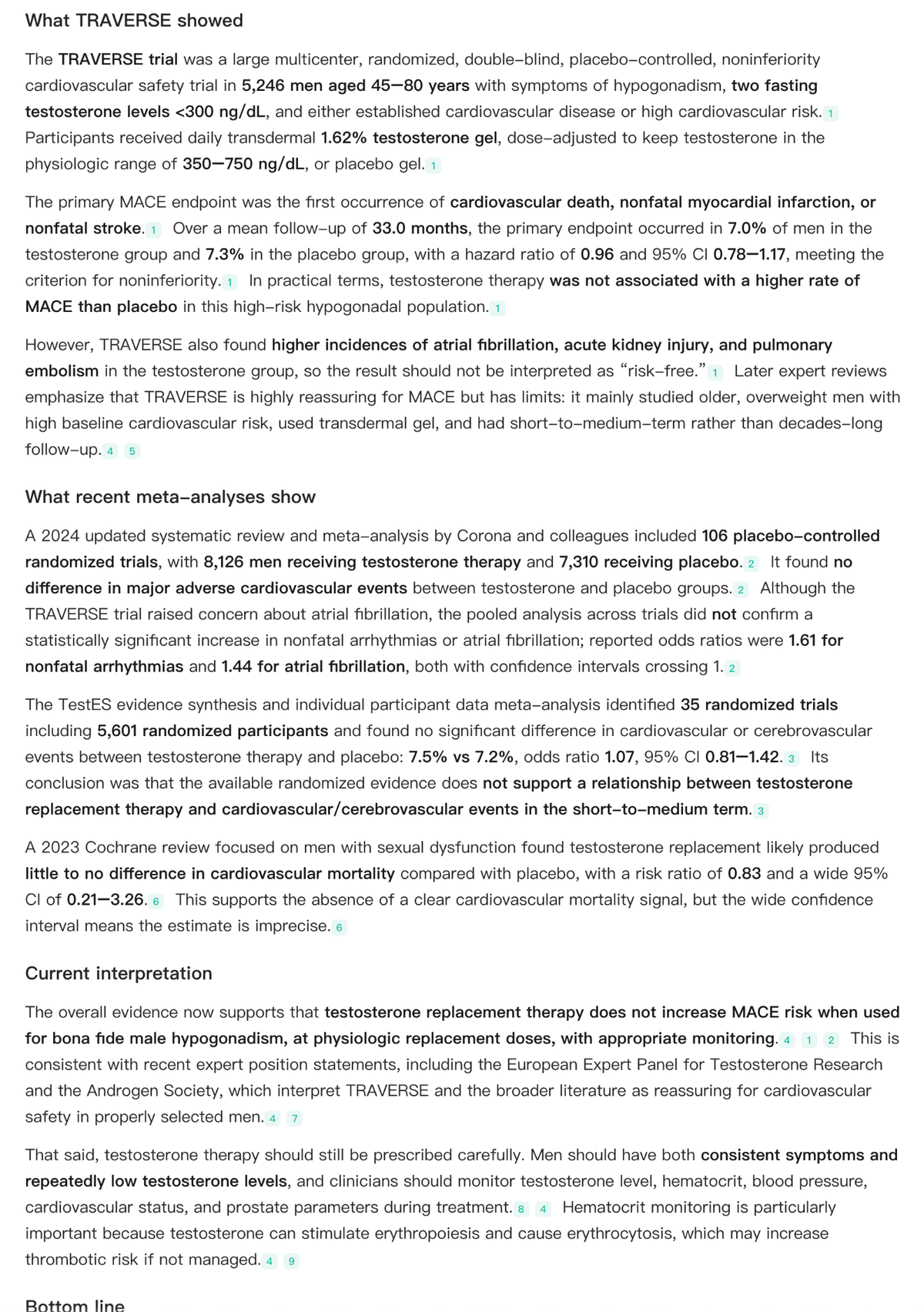
Figure 1. Noah AI evidence brief on testosterone replacement therapy and cardiovascular risk, showing TRAVERSE findings and recent meta-analysis evidence with inline citations.
Putting It All Together: A Practical Checklist
- Is my question specific enough?
- Have I covered relevant MeSH terms, synonyms, and alternative terminology?
- Am I using filters to focus on the most relevant study types and dates?
- Am I synthesizing findings, not just scanning titles?
- Am I actively looking for conflicting evidence?
- Am I refining my search based on what I've learned?
Try Noah AI for Free
Use Noah AI to search, compare, and analyze biomedical evidence with AI-powered research workflows.
Free credits are available, and no credit card is required to get started.
FAQ
Can AI tools handle all six principles automatically?
AI tools can support question structuring, vocabulary expansion, synthesis, and identifying differences across studies. Strategic filtering and iterative refinement still benefit from researcher judgment.
Should I learn Boolean search or just use AI?
For systematic reviews and reproducible research, Boolean search skills remain important. For many exploratory searches, AI tools provide a more accessible starting point.
How do I know if my search is comprehensive enough?
Check for saturation and cross-reference relevant systematic reviews.
Related Articles in This Series
Best AI Tools for PubMed Literature Review (2026)
Free AI Tools for PubMed and Biomedical Literature Search in 2026
PubMed Search with AI: How Life Science Professionals Find and Analyze Biomedical Evidence Faster
Best AI Tools for Turning Research Questions into Evidence Tables (2026)