How to Research a Drug Pipeline with AI: From Target Search to Development Milestones
Linda
Learn how to research a drug pipeline with AI using a representative EGFR landscape, from asset mapping and milestones to current development status.
A practical EGFR pipeline research workflow for mapping assets, selecting a representative drug, reconstructing development milestones, and interpreting current status correctly.
Research principle: highest phase, current trial status, molecule-level status, and regulatory status are different variables and should not be collapsed into one label.
Scope note: The EGFR landscape in this article is a representative pipeline sample rather than an exhaustive list of every EGFR-directed asset. The purpose is to demonstrate a reproducible pipeline-research workflow across different modalities, development stages, and regulatory states.
1. What Drug Pipeline Research Actually Involves
Pipeline research is not the same as asking an AI system, “Which drugs hit EGFR?” A useful pipeline review has to connect multiple layers of evidence: the asset, current owner, modality, precise mechanism, indication, historical development phase, regulatory events, current status, and major setbacks.
The most important distinction is simple: highest phase is not the same as currently active development status. A molecule may have reached Phase III historically while one indication has ended. An approved drug can still have active studies in new disease stages or combinations. A registered trial also does not prove efficacy or continuing sponsor investment.
2. Prepare the Research Question
Start with a question that can be decomposed into structured research steps:
Which drugs are targeting EGFR, which representative programs have reached late-stage development or approval, and how did one important asset progress through clinical and regulatory development?
Define the target scope, disease context, cutoff date, evidence hierarchy, and output unit before searching. For this case, the focus is direct EGFR-directed therapies, primarily in EGFR-altered NSCLC, with regulatory sources used for approval status, peer-reviewed primary studies for clinical results, trial registries for protocol status, and sponsor disclosures for interim or not-yet-published updates.
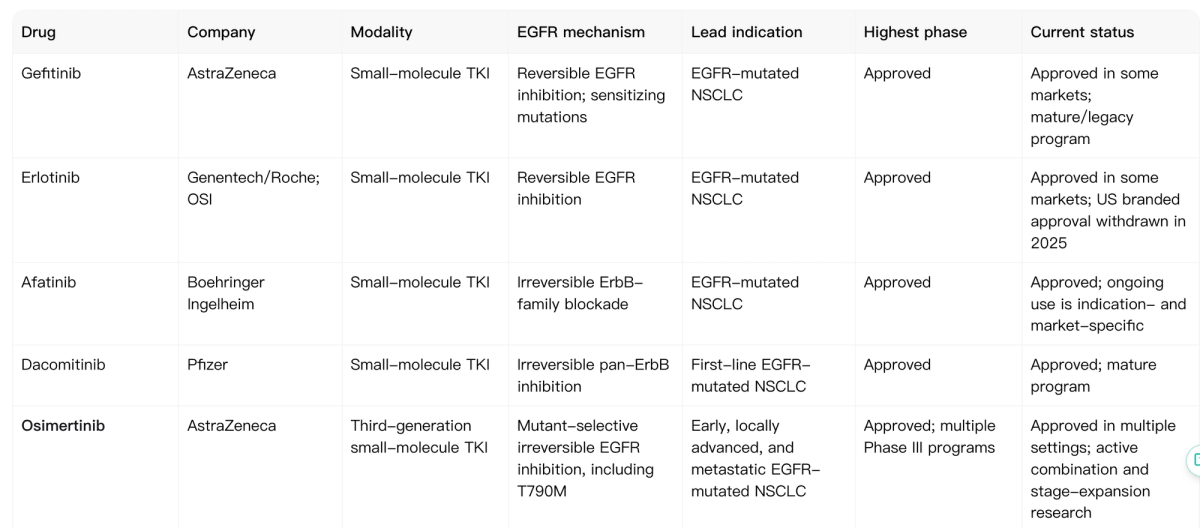
Step 1: Map a Representative EGFR Drug Pipeline Landscape
A broad target search should be normalized before comparison. The goal is not to build an exhaustive inventory of every EGFR-directed program, but to select a representative set of assets that shows how approved legacy TKIs, newer mutant-selective inhibitors, antibodies, and combination strategies occupy different positions in the development landscape.
For this workflow, representative programs are selected to illustrate differences in modality, biomarker context, indication, historical development phase, current development activity, and regulatory status.
The resulting landscape should therefore be interpreted as a structured research example rather than a complete global EGFR pipeline database.
4. Step 2: Select One Representative Asset
Osimertinib is a useful worked example because it has a clear mutant-selective EGFR mechanism, early clinical development in acquired resistance, randomized Phase III evidence in multiple settings, several regulatory expansions, and continuing development in combinations and earlier-stage disease.
It also illustrates why “approved” is too broad a status. Approval depends on mutation, disease stage, prior therapy, combination partner, and geography. The same molecule can be mature in one setting while still under active clinical development in another.
5. Step 3: Build the Development Milestone Timeline
The next step is to turn a drug profile into a chronological development history. Instead of listing every corporate update, keep only milestones that materially changed the asset's development position: first-in-human entry, pivotal trial advancement, regulatory action, label expansion, and major competitive inflection points.
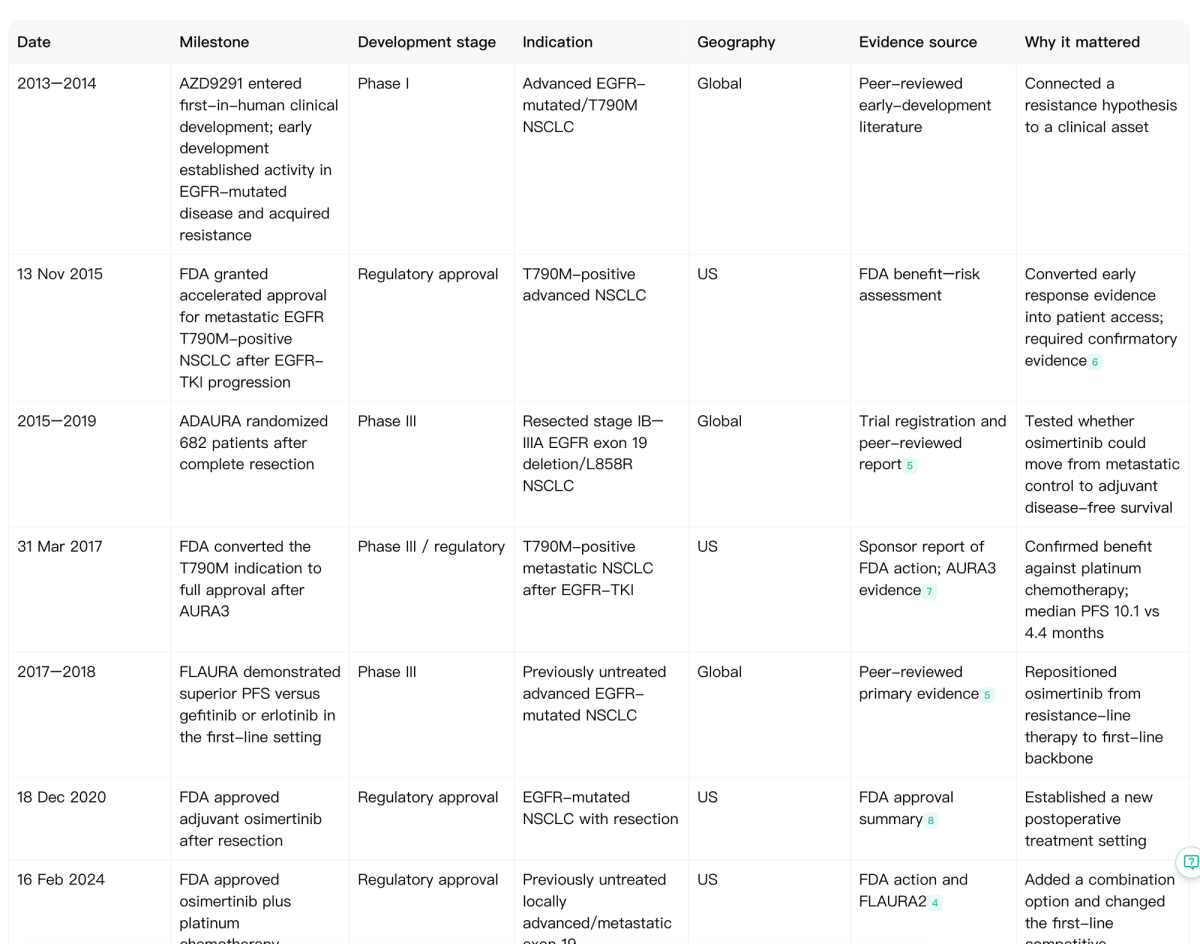
The sequence matters. Osimertinib first entered clinical development in acquired EGFR resistance, then moved through accelerated approval, randomized confirmation, first-line treatment, and adjuvant use. Later approvals and combinations further changed how the drug should be interpreted within the EGFR competitive landscape.
Milestone research should also preserve uncertainty. If the original source supports only a year range rather than an exact day, use the range. If an event is sponsor-reported rather than peer-reviewed, label it that way. A development timeline is only useful if the dates and evidence types are reproducible.
6. Step 4: Interpret Development Status Correctly
A robust pipeline review separates at least four status dimensions:
| Status dimension | What it answers | Osimertinib example |
|---|---|---|
| Highest historical phase | What is the most advanced phase ever reached? | Phase III and multiple completed pivotal trials |
| Current trial status | What is happening in a named study now? | Legacy pivotal trials are completed while newer combination or stage-expansion studies may remain active |
| Molecule-level status | Is the asset launched, active, paused, or ceased? | Approved and launched, with continuing research |
| Indication-level status | What is the status of this specific use? | First-line metastatic, adjuvant, combination, and stage III uses have separate statuses |
| Regulatory status | What has a regulator actually authorized? | Approvals are tied to mutation, stage, treatment history, and regimen |
Four common mistakes follow from collapsing these categories: assuming approval means active development everywhere, treating a terminated trial as molecule discontinuation, treating a registered study as efficacy evidence, and assuming the highest historical phase proves current investment.
7. Step 5: Ask Better Follow-Up Questions
Once the first landscape and milestone timeline are built, the next questions become more useful and more specific. For example:
- Which EGFR assets have reached Phase III or approval, and in which mutation and treatment setting?
- Which programs remain actively in development as of the cutoff date?
- Which programs were discontinued or withdrawn, and what evidence supports the reason?
- Which modalities dominate current EGFR development?
- Which major milestones occurred during the last two years?
- How do the development timelines of osimertinib and lazertinib–amivantamab compare?
- Which upcoming catalysts could change competitive positioning?
- Which claims are peer-reviewed, regulatory, registry-derived, or sponsor-reported?
8. What This Workflow Gives Researchers
The value of pipeline intelligence is not the size of a drug list. It is the ability to preserve time, indication, evidence type, status, and uncertainty while moving from a biological target to an asset-level development story.
Target → Pipeline Mapping → Asset Filtering → Asset Profile → Milestone Timeline → Current Status → Next Research Question
This structure helps distinguish historical importance from current activity, regulatory approval from ongoing development, and trial registration from demonstrated efficacy. A sparse or conflicting public record should also be preserved as a finding rather than silently resolved.
For informational product details, see Noah AI research workflows.
Separate Pipeline Phase from Current Development Status with Noah AI
Use Noah AI to map drug pipeline assets while keeping highest historical phase, current trial status, molecule-level status, indication-level status, and regulatory status separate.
Build a source-linked pipeline view that helps distinguish an old Phase III record from active development, a terminated trial from molecule discontinuation, and regulatory approval from ongoing clinical expansion.
Free to use · Free credits included · No credit card required
Research Drug Pipeline Status with Noah AI →