How to Find Research Gaps from Biomedical Literature with AI: Step-by-Step Guide
Linda
Learn how to find and validate real research gaps in biomedical literature with AI, using ctDNA-guided adjuvant treatment in stage II colon cancer as a worked example.
Finding a research gap is not the same as finding a paper that says “more research is needed.” A defensible biomedical research gap should emerge from the boundary of current evidence and remain unresolved after newer trials, follow-up publications, and systematic reviews are considered.
AI can help organize a large biomedical literature base into what is already established, what has been partially addressed, what remains genuinely open, and what older limitations have become outdated.
In this guide, we use Noah AI on a real biomedical case: ctDNA-guided adjuvant treatment in resected stage II colon cancer. The workflow moves from current evidence mapping to gap validation and then to a final research gap map.
Testing note: We tested Noah AI directly.
This guide focuses on finding and validating whether a research gap still exists. It does not yet ask whether that gap is feasible, practical, or worth pursuing as a new study. That is a separate research-feasibility question.
1. What Is a Research Gap in Biomedical Literature?
A biomedical research gap is an important scientific or clinical question that remains insufficiently answered by the available evidence.
A field does not need to have zero publications to contain a real research gap. In mature research areas, the gap often appears after substantial evidence already exists.
| Gap Type | What It Means | Example |
|---|---|---|
| Evidence coverage gap | An important clinical or scientific question has not been adequately tested. | ctDNA predicts recurrence, but treatment-predictive value remains uncertain. |
| Population gap | Important patient subgroups have limited direct evidence. | dMMR/MSI-H stage II colon cancer. |
| Comparative gap | Relevant approaches exist but have not been directly compared. | Tumor-informed versus tumor-agnostic ctDNA assays. |
| Methodological gap | Timing, thresholds, assays, or definitions remain inconsistent. | Optimal postoperative ctDNA sampling window. |
| Outcome gap | An intermediate outcome is established but its clinical meaning remains uncertain. | ctDNA clearance is prognostic but not a validated surrogate for DFS or OS. |
| Evidence-maturity gap | Relevant studies exist but follow-up or trial maturity remains inadequate. | A treatment-escalation strategy without mature randomized efficacy results. |
2. Why “Future Research” Sections Are Not Enough
A common shortcut is to read the limitations or future-research sections of several papers and turn those statements into a list of research gaps.
The problem is that research gaps can expire.
If an older paper identifies lack of long-term outcomes as a limitation, but a five-year follow-up is later published, that limitation may no longer represent an open gap.
A useful workflow therefore needs two stages: first generate candidate gaps, then validate whether each candidate remains unresolved after newer evidence is considered.
3. Real Example: ctDNA-Guided Adjuvant Treatment in Stage II Colon Cancer
We tested this process using postoperative circulating tumor DNA, or ctDNA, as a biomarker for guiding adjuvant treatment decisions after resection of stage II colon cancer.
This is a useful gap-identification case because the field is neither empty nor completely settled.
Postoperative ctDNA positivity is strongly prognostic for recurrence, and DYNAMIC provides randomized evidence for one specific ctDNA-guided management strategy. But several clinically important questions remain unresolved.
- Does ctDNA positivity predict benefit from chemotherapy?
- Which chemotherapy regimen should be used in ctDNA-positive disease?
- Can every ctDNA-negative patient safely omit chemotherapy?
- What should be done when ctDNA remains detectable after treatment?
- Can ctDNA clearance function as a treatment surrogate?
- How should MMR status, assay type, sampling timing, and recurrence site affect interpretation?
4. Step 1: Define the Research Scope
Research-gap analysis becomes unreliable when the topic is too broad.
Asking for “research gaps in ctDNA” would combine multiple cancers, disease stages, metastatic monitoring, recurrence surveillance, assay technologies, and treatment decisions.
We therefore restricted the analysis to resected stage II colon cancer, postoperative ctDNA, adjuvant treatment decisions, chemotherapy omission and escalation, serial testing, persistence and clearance, recurrence outcomes, assay limitations, and evidence maturity.
5. Step 2: Run a Structured Research-Gap Prompt in Noah AI
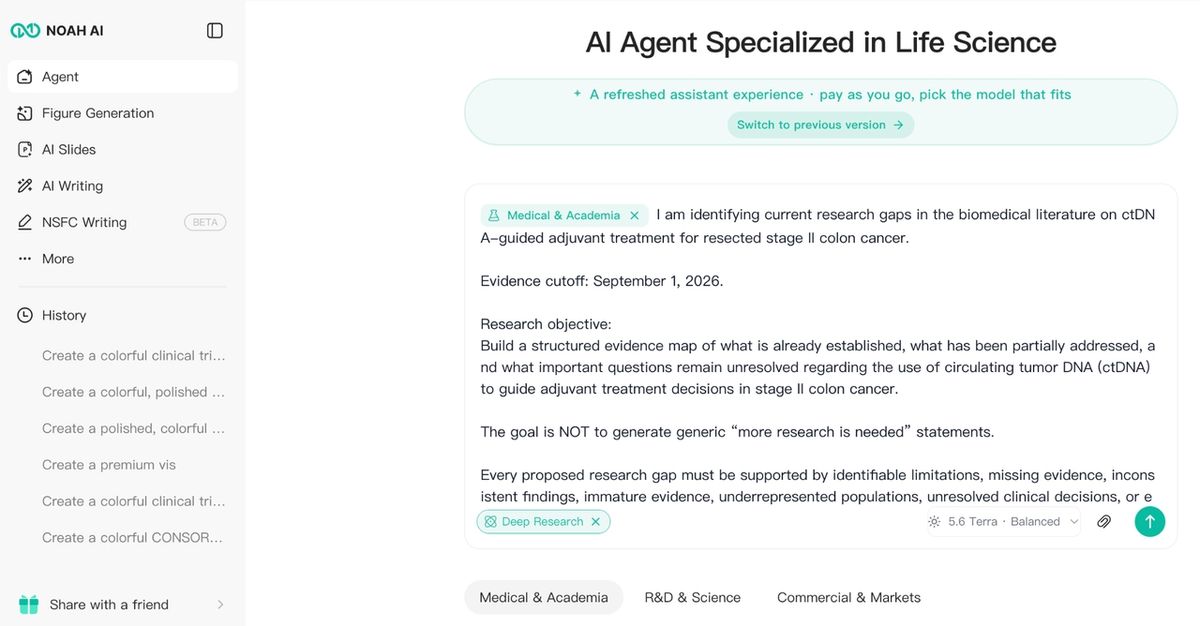
For this analysis, we used Agent → Medical & Academia → Deep Research → 5.6 Terra · Balanced.
The prompt did not ask Noah to simply list “future research ideas.” Every proposed gap had to be linked to identifiable missing evidence, inconsistent findings, immature evidence, underrepresented populations, unresolved treatment decisions, or methodological limitations.
6. Step 3: Build a Current Evidence Map
Before asking what is missing, establish what the literature already answers.
Noah organized the available evidence by research question, best available study, population, study design, main finding, follow-up maturity, what is already reasonably established, and remaining limitation.
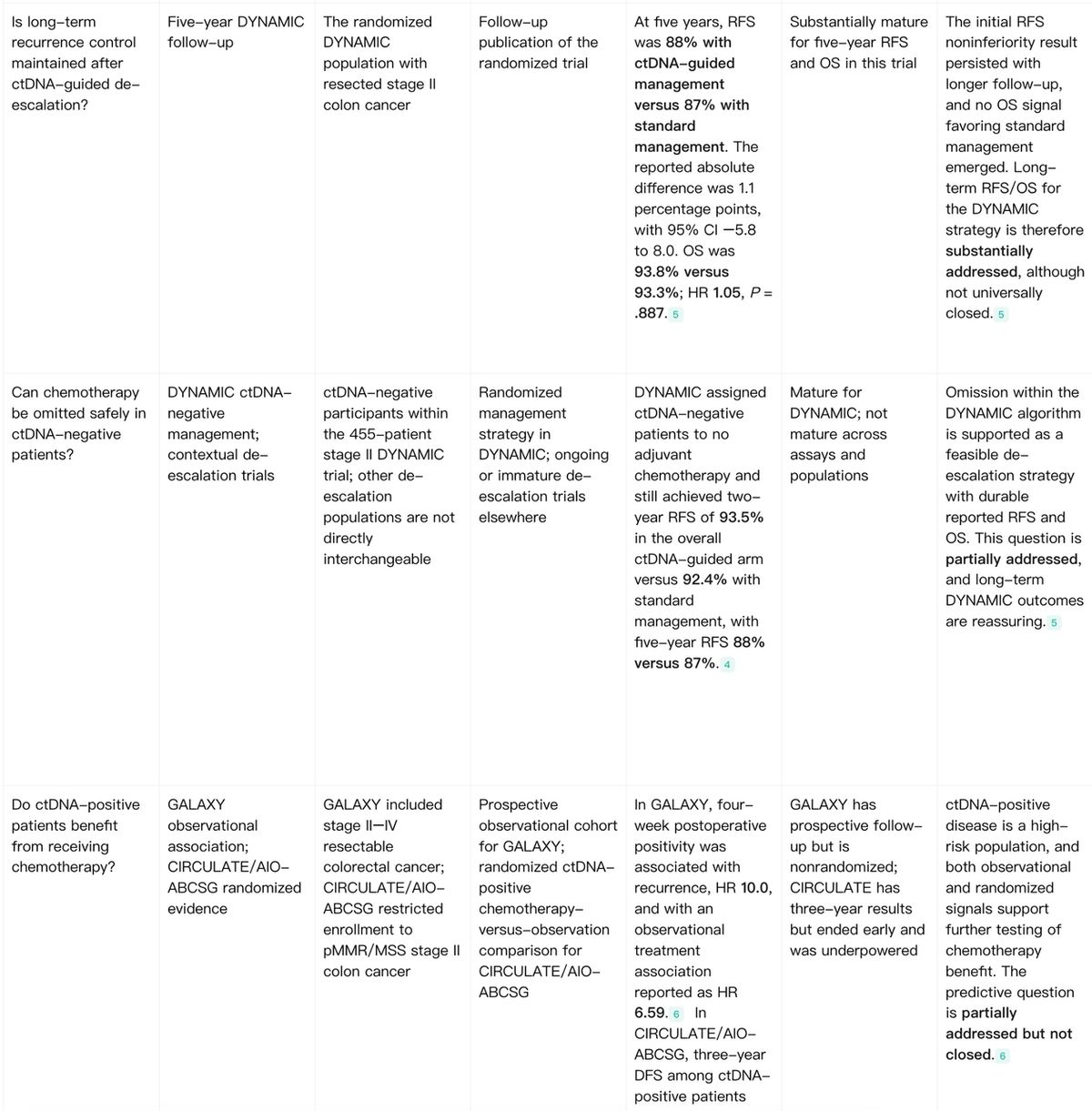
The map shows different levels of evidence maturity. Long-term recurrence control after the tested DYNAMIC strategy is now substantially addressed by five-year follow-up.
Chemotherapy omission after a negative postoperative ctDNA result is supported within the tested DYNAMIC algorithm, but the evidence does not automatically establish a universal rule across every assay, population, and clinical-risk group.
The ctDNA-positive treatment question remains less settled because prognostic evidence is strong while treatment-predictive evidence is still incomplete.
7. Step 4: Generate Candidate Research Gaps
Once the evidence map is established, candidate gaps can be generated from the boundary between what the literature supports and what it cannot yet establish.
- predictive treatment value of postoperative ctDNA positivity;
- safe treatment de-escalation after negative ctDNA;
- optimal chemotherapy for ctDNA-positive disease;
- management of persistent ctDNA after adjuvant therapy;
- ctDNA clearance as a surrogate endpoint;
- MMR/MSI-specific treatment interactions;
- postoperative sampling timing;
- tumor-informed versus tumor-agnostic assay comparability;
- recurrence-site sensitivity;
- generalizability and implementation.
At this stage, these are still candidate gaps rather than final research priorities.
8. Step 5: Validate Whether the Gap Still Exists
Gap validation is the most important part of the workflow.
Noah checked whether later evidence had addressed each candidate gap and classified its current status.
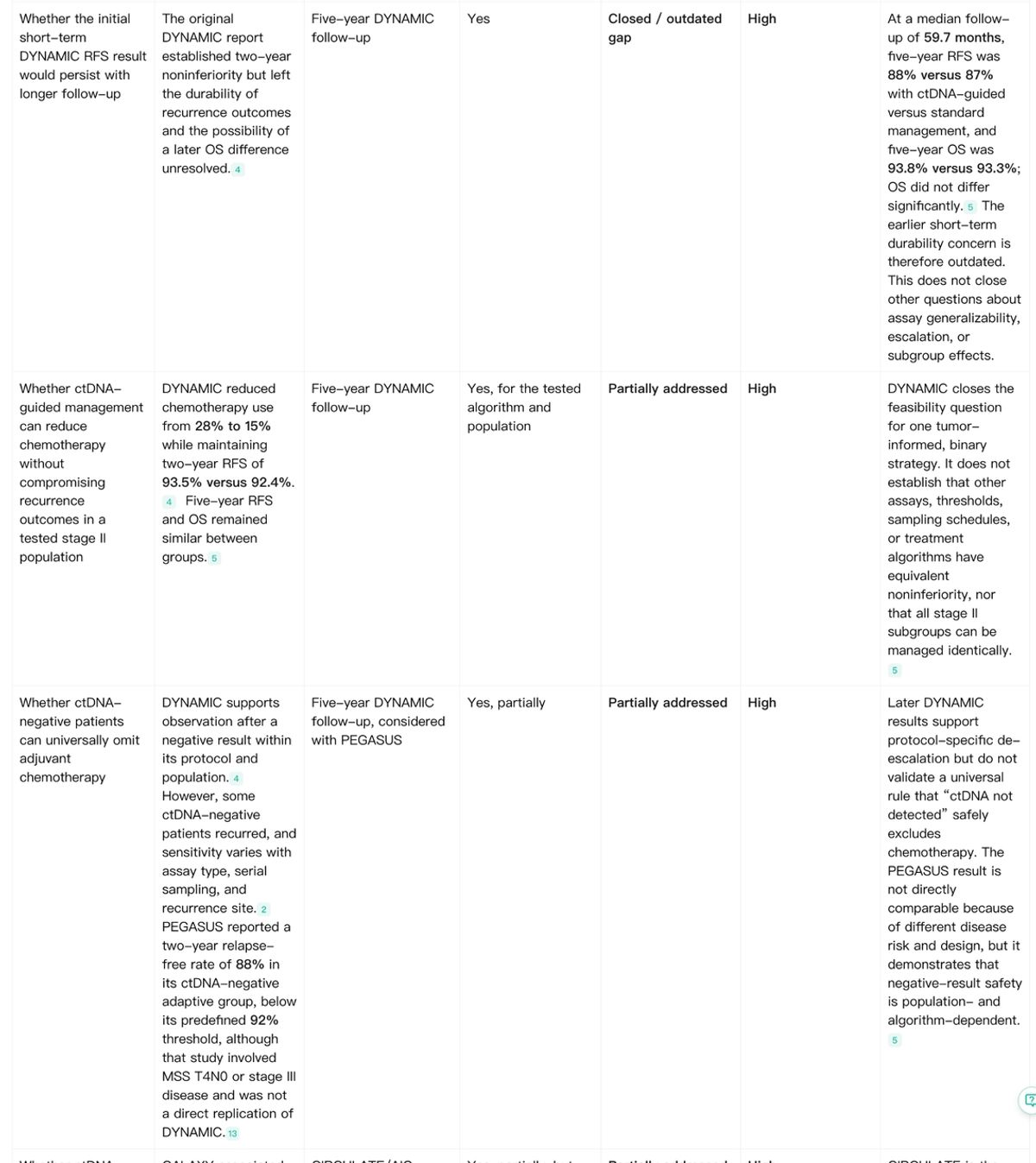
One example is the original question of whether DYNAMIC's short-term recurrence-free survival result would remain durable with longer follow-up.
Five-year outcomes are now available. That narrow durability concern should therefore no longer be presented as an open research gap.
Closed / outdated gap: the earlier question about long-term durability of the tested DYNAMIC strategy has been substantially addressed by later follow-up.
Other questions remain only partially resolved. Evidence for one ctDNA-guided strategy does not prove universal safety across other assays, thresholds, sampling schedules, populations, or treatment algorithms.
9. Step 6: Classify the Remaining Research Gaps
| Gap Status | Meaning |
|---|---|
| Open | Current evidence still does not adequately answer the research question. |
| Partially addressed | Important evidence exists, but clinically meaningful uncertainty remains. |
| Closed / outdated gap | Later evidence has substantially answered the older question. |
| Uncertain | The available literature does not support confident classification. |
10. Step 7: Build the Final Research Gap Map
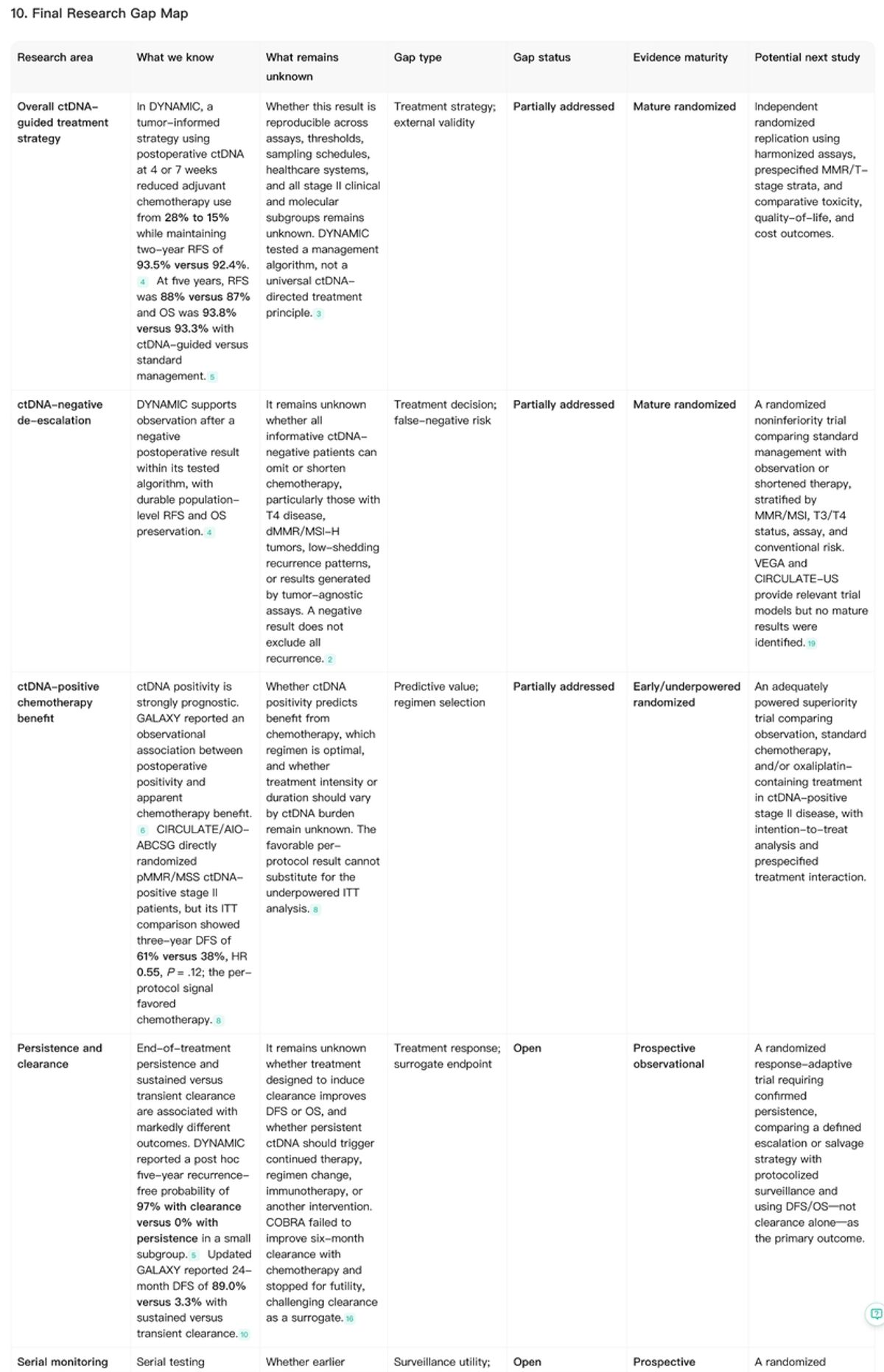
The most useful final output connects current knowledge directly with the unresolved question.
Map Biomedical Research Gaps with Noah AI
Use Noah to map established evidence, unresolved gaps, and outdated assumptions across biomedical literature.
Build a source-linked view of what is already known, what has been partially addressed, what remains genuinely open, and which older research gaps have already been closed by newer evidence.
Free to use · Free credits included · No credit card required
Map Research Gaps with Noah AI →
ctDNA-Negative De-escalation
DYNAMIC supports observation after a negative postoperative result within its tested algorithm, with durable population-level recurrence outcomes.
The remaining question is whether this conclusion can be generalized across high-risk T4 disease, dMMR/MSI-H tumors, low-shedding recurrence patterns, different assays, and other treatment algorithms.
This gap is partially addressed.
ctDNA-Positive Chemotherapy Benefit
ctDNA positivity is strongly prognostic. Observational evidence suggests possible chemotherapy benefit, while randomized evidence provides an important but still incomplete signal.
The evidence does not yet establish which regimen is optimal or whether ctDNA positivity universally predicts treatment benefit.
This gap is also partially addressed.
Persistence and Clearance
Persistent ctDNA after treatment is associated with markedly poor outcomes, but no treatment strategy has yet been validated specifically because ctDNA remains detectable.
It therefore remains unknown whether molecular persistence should trigger continued chemotherapy, regimen change, immunotherapy, or another intervention.
This remains an open research gap.
11. Step 8: Turn a Validated Gap into a Research Question
Once a gap has survived the validation step, it can be translated into a precise research question.
However, a validated gap is not automatically a feasible or worthwhile study opportunity. Gap validation answers whether the uncertainty still exists. Research-feasibility assessment is a separate step that considers factors such as available data, recruitment, sample size, endpoints, study design, timeline, competing trials, and whether the question can realistically be answered.
Example:
In adults with resected pMMR/MSS stage II colon cancer who are postoperative ctDNA-positive, does adjuvant chemotherapy improve disease-free survival compared with observation, and which regimen provides the most favorable benefit-risk profile?
Another validated question concerns persistent ctDNA:
In patients with confirmed persistent ctDNA after adjuvant therapy, does a molecularly triggered treatment-escalation strategy improve disease-free survival compared with protocolized surveillance?
The order matters:
Evidence map → Candidate gap → Gap validation → Research question → Feasibility assessment
12. The MAP framework answers:
Does this research gap still exist?
It does not answer:
Is this gap feasible or strategically worth studying?
That second question requires a separate feasibility assessment after the gap has been validated.
13. Common Mistakes When Finding Research Gaps with AI
Copying Future-Research Sections from Older Papers
An older gap may already have been addressed by newer evidence. Always search forward.
Treating Low Publication Volume as Proof of a Gap
A topic with few papers is not automatically clinically or scientifically important.
Calling Every Subgroup Understudied
A population gap should be supported by a credible reason why the result may differ in that group.
Confusing Prognostic and Predictive Evidence
A biomarker can identify high-risk patients without proving that a particular treatment modifies that risk.
Confusing Inconsistent Evidence with Missing Evidence
A field with conflicting studies may have a comparability or heterogeneity problem rather than an absence-of-evidence gap.
Treating Ongoing Trials as Evidence of Efficacy
A trial protocol shows that a question is being tested. It does not provide an efficacy result.
Claiming Novelty Without Checking Recent Evidence
A plausible question should not be called novel until recent publications and ongoing trials have been checked.
14. Research Gap Analysis vs Literature Review
| Workflow | Main Question | Final Output |
|---|---|---|
| Literature review | What does the current literature show? | Evidence synthesis |
| Evidence table | How do individual studies compare? | Study-level comparison matrix |
| Research gap analysis | What important question remains insufficiently answered? | Validated research gap map |
| Research proposal | How should the unresolved question be tested? | Hypothesis and study design |
15. Related Reading
- PubMed Search with AI: How Life Science Professionals Find and Analyze Biomedical Evidence Faster
- Best AI Tools for PubMed Literature Review (2026)
- Best AI Tools for Turning Research Questions into Evidence Tables (2026)
- How to Analyze Clinical Trial Results with AI Using Noah AI
16. FAQ
Can AI automatically find research gaps?
AI can identify candidate gaps by organizing current literature, extracting limitations, comparing study designs, and checking newer evidence. Researchers still need to verify whether the gap is current, important, and genuinely unresolved.
How do you know whether a research gap is real?
A defensible gap should show what is already known, what remains unknown, why existing evidence is insufficient, and whether later studies have already addressed the question.
Can a research gap be partially addressed?
Yes. Many biomedical questions have meaningful evidence without being fully resolved.
What is an outdated research gap?
An outdated gap is a question that older literature identified as unresolved but later evidence has substantially answered.
Can AI convert a gap into a research question?
Yes. Once the gap is validated, AI can help structure a precise PICO-style or biomedical research question. Gap validation should come before claims of novelty.
17. Bottom Line
MAP THE EVIDENCE BEFORE CLAIMING THE GAP.
A strong biomedical research-gap workflow first establishes what the literature already answers, then checks whether newer evidence has closed older gaps, and only then identifies the uncertainty that genuinely remains.
In this ctDNA case, Noah AI helped distinguish several different situations:
- long-term DYNAMIC durability is no longer the same open question it once was;
- ctDNA-negative de-escalation is partially addressed;
- chemotherapy benefit in ctDNA-positive disease is partially addressed;
- persistent ctDNA management remains open;
- and several methodological, assay, and population questions remain unresolved.
The important distinction is that finding a real research gap is only the first decision.
This article answers:
What remains genuinely unresolved?
A separate feasibility workflow should then answer:
Can this gap realistically and meaningfully be studied?
That separation prevents researchers from confusing an interesting unanswered question with a practical research opportunity.
Map Biomedical Research Gaps with Noah AI
Use Noah to map established evidence, unresolved gaps, and outdated assumptions across biomedical literature.
Identify which questions are already answered, which are only partially resolved, and which remain genuinely open before moving into research-feasibility assessment.
Free to use · Free credits included · No credit card required