How to Find Relevant Papers on PubMed Faster
Linda
Five strategies to find relevant papers on PubMed faster: AI-powered search, smart filters, citation chaining, systematic review shortcuts, and email alerts. Practical tips for every researcher.
The challenge with PubMed isn't finding papers — it's finding relevant papers without spending hours screening results.
This article covers five strategies that target different bottlenecks in the search process.
Strategy Overview
| Strategy | What It Speeds Up | Tools Needed |
|---|---|---|
| 1. AI search + synthesis | Query building, screening, and synthesis | Noah AI |
| 2. Smart use of PubMed filters | Narrowing by study type, date, population | PubMed.gov |
| 3. Start from systematic reviews | Using existing evidence syntheses | PubMed, Cochrane |
| 4. Citation chaining | Finding related papers from a seed paper | PubMed, Semantic Scholar |
| 5. Saved searches and alerts | Staying current automatically | My NCBI |
Strategy 1 — AI-Powered Search and Synthesis
AI tools can reduce the manual work involved in screening and first-pass synthesis. Noah AI accepts a natural-language research question, searches PubMed, and returns a structured evidence brief with inline citations.
Strategy 2 — Smart Use of PubMed Filters
Use article type, publication date, species, language, and age filters to reduce broad searches to a more manageable set.
Strategy 3 — Start from Existing Systematic Reviews
Recent systematic reviews and meta-analyses can provide a fast overview and a curated reference list.
Strategy 4 — Citation Chaining
Use a highly relevant paper as a seed and examine both its references and papers that cite it.
Strategy 5 — Saved Searches and Email Alerts
Save PubMed searches and enable alerts to receive newly indexed papers automatically.
Demo: JAK Inhibitors for Atopic Dermatitis
Query to enter in Noah AI (Agent → Search → PubMed Search)
What is the evidence on JAK inhibitors (baricitinib, upadacitinib, abrocitinib) for moderate-to-severe atopic dermatitis in adults, including EASI-75 response rates, itch reduction, and safety concerns from clinical trials?
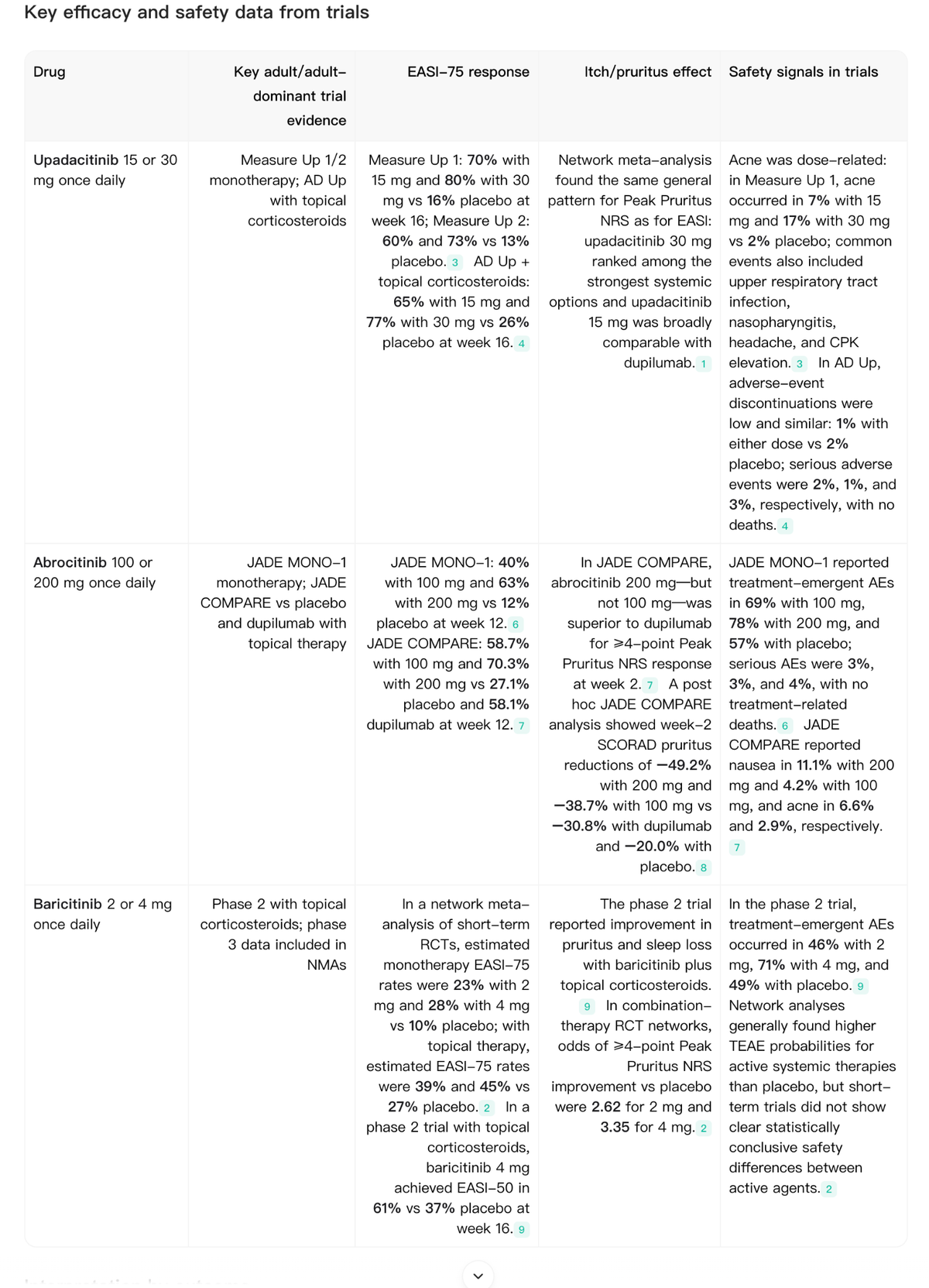
Figure 1. Noah AI structured evidence summary comparing upadacitinib, abrocitinib, and baricitinib across EASI-75 response, itch reduction, and safety findings.
Combining Strategies for Maximum Efficiency
Step 1: Check for a recent systematic review.
Step 2: Run an AI-powered search to identify key findings and papers.
Step 3: Use citation chaining from the most relevant papers.
Step 4: Set up a PubMed alert for new publications.
Optional: Use PubMed filters when a formal manual search is needed.
Try Noah AI for Free
Use Noah AI to search, compare, and analyze biomedical evidence with AI-powered research workflows.
Free credits are available, and no credit card is required to get started.
FAQ
Which strategy should I try first?
If you want a quick evidence overview, start with AI search. If you want to stay within PubMed, start with systematic reviews and filters.
How do I know when I've found enough papers?
When repeated searches and citation chaining mostly return papers you've already seen, you may be approaching saturation.
Is AI search reliable enough to replace manual screening?
No. It can reduce first-pass effort but should not be the only retrieval method for formal systematic reviews.
Related Articles in This Series
Best AI Tools for PubMed Literature Review (2026)
Free AI Tools for PubMed and Biomedical Literature Search in 2026
PubMed Search with AI: How Life Science Professionals Find and Analyze Biomedical Evidence Faster
Best AI Tools for Turning Research Questions into Evidence Tables (2026)