How to Evaluate an AI Scientist: Scientific Work, Not Just Tools
Linda
Evaluate AI scientist workflows for biomedical and pharma R&D using responder analysis, competing hypotheses, uncertainty, and five scientific tests.
A biomedical and pharmaceutical R&D framework for evaluating AI-assisted scientific work through responder analysis, competing explanations, uncertainty, and falsifiable next steps.
This article is designed for biomedical researchers, translational scientists, and pharmaceutical R&D teams evaluating whether AI-assisted research workflows can produce scientifically defensible conclusions—not simply retrieve evidence or generate polished reports.
Using datopotamab deruxtecan (Dato-DXd) responder analysis in advanced NSCLC as an illustrative case, it examines whether a workflow can distinguish predictive biology from competing explanations, preserve uncertainty, and identify the next scientific test needed to strengthen or challenge a conclusion.
Why do some patients treated with datopotamab deruxtecan (Dato-DXd) in advanced NSCLC respond while others do not? An AI system can assemble clinical evidence, pathology, treatment history, imaging outcomes, and molecular measurements, compare responders with nonresponders, and identify a signal enriched among patients who benefited. The report may look complete because the methods, citations, and evidence are all present.
The scientific problem begins when that signal is promoted directly to a treatment-predictive biomarker. A reviewer still needs to ask whether the signal was present before treatment, whether responders had greater effective exposure, whether the feature is predictive or merely prognostic, whether it appeared as a consequence of response, whether the cohorts were imbalanced, and whether assay or sampling differences could explain the observation.
An AI research workflow should be judged by whether it completes a defensible piece of scientific work—not by how many tools, sources, or models it connects.
A complete report can retrieve the right papers and reproduce the right numbers while still making the wrong scientific inference. The output becomes scientifically useful only when its design, timing, comparator, cohort balance, exposure measures, assay definition, and interpretation support the claim being made.
One Responder Signal Can Support Several Explanations
A feature enriched among Dato-DXd responders is an observation, not a settled causal explanation. The same pattern can support several competing hypotheses, and each hypothesis requires a different test before a biomarker claim can advance.
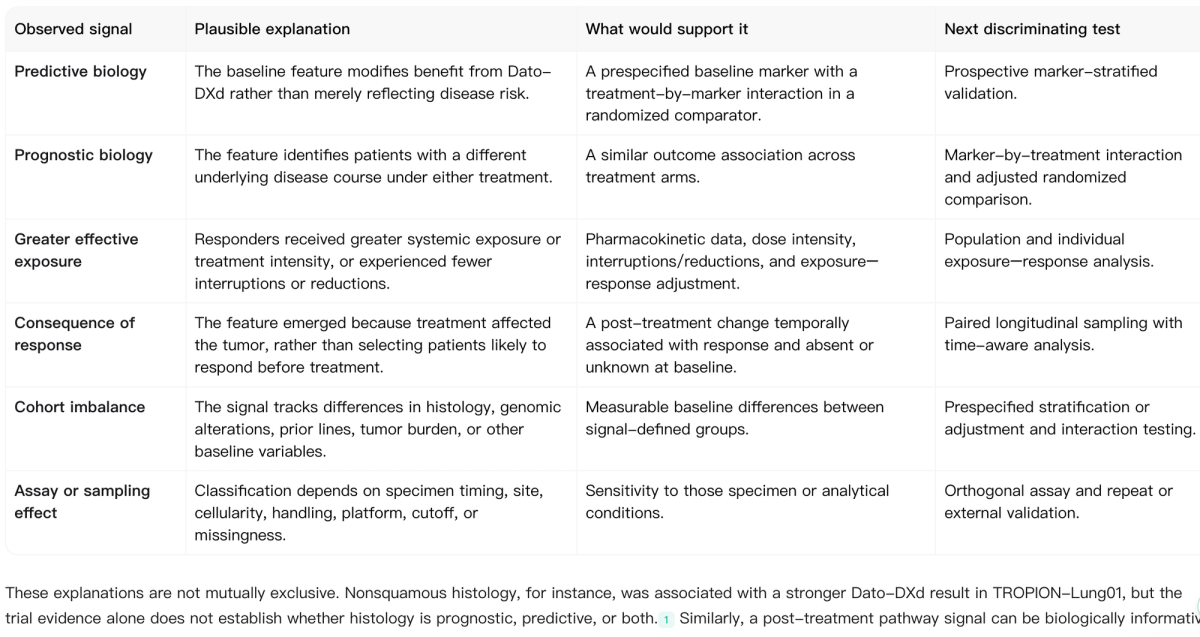
These explanations are not mutually exclusive. A stronger outcome in one histologic subgroup can reflect treatment biology, baseline prognosis, or both. An on-treatment molecular change can be scientifically informative without being useful for pretreatment patient selection. The workflow therefore has to preserve the distinction between prediction, prognosis, exposure, pharmacodynamic response, cohort imbalance, and measurement artifact.
AI Capabilities Become Useful When They Are Calibrated to the Scientific Task
Responder analysis is not a single task called "find the biomarker." It is a sequence of scientific requirements: define the cohort, define the endpoint, preserve biological timing, compare alternative explanations, retain uncertainty, and show which evidence supports each conclusion.
A scientifically useful workflow should preserve who was eligible and evaluable, which endpoint and time point were used, how the biomarker was measured, whether exposure differed, what was missing, which analyses were exploratory, and which alternative explanations were tested. A well-cited report is not enough if the claim cannot be reconstructed from those choices.
Design the Scientific Objective Top Down, Validate the Work Loop Bottom Up
The workflow should begin with the scientific output it must earn. In this example, the goal is not simply to identify a responder-associated feature. The goal is to produce a defensible explanation of differential response, rank competing biomarker hypotheses, and identify the next analysis or experiment that can distinguish among them.
Clinical question → Cohort definition → Responder / nonresponder comparison → Competing explanations → Evidence weighting → Uncertainty → Next discriminating test → Reviewable scientific position
Each step imposes a different scientific requirement. A randomized treatment-by-marker interaction is more informative for predictive validity than an association within the treated cohort. A post-treatment signal must be separated from a baseline selection marker. Exposure, histology, prior therapy, assay timing, and specimen quality may all change the interpretation.
Completing one work loop does not prove general scientific intelligence. It shows only that the workflow can complete this defined scientific task to the required standard.
Validated Scientific Work Loops Can Become Reusable Building Blocks
A validated work loop can become reusable when its reasoning requirements survive beyond one example. Reuse does not mean carrying the same biomarker cutoff or endpoint into another program. It means reusing the discipline of defining the question, comparing hypotheses, preserving uncertainty, linking evidence to claims, and specifying the next test.
- Patient responder analysis: cohort reasoning, biomarker reasoning, hypothesis comparison → biomarker position + next discriminating test.
- PK/PD-to-dose analysis: reuse hypothesis comparison and uncertainty handling, add exposure-response methods → dose rationale.
- Omics-to-target analysis: reuse evidence weighting and scientific evaluation, add omics and target-biology methods → target-prioritization memo.
Executive Evaluation Should Begin with Completed Scientific Work
Executives should evaluate what an AI-assisted workflow has actually completed, not how many tools it invokes or how polished the final report appears. The key question is whether the workflow behaves correctly when the science is ambiguous, incomplete, or contradictory.
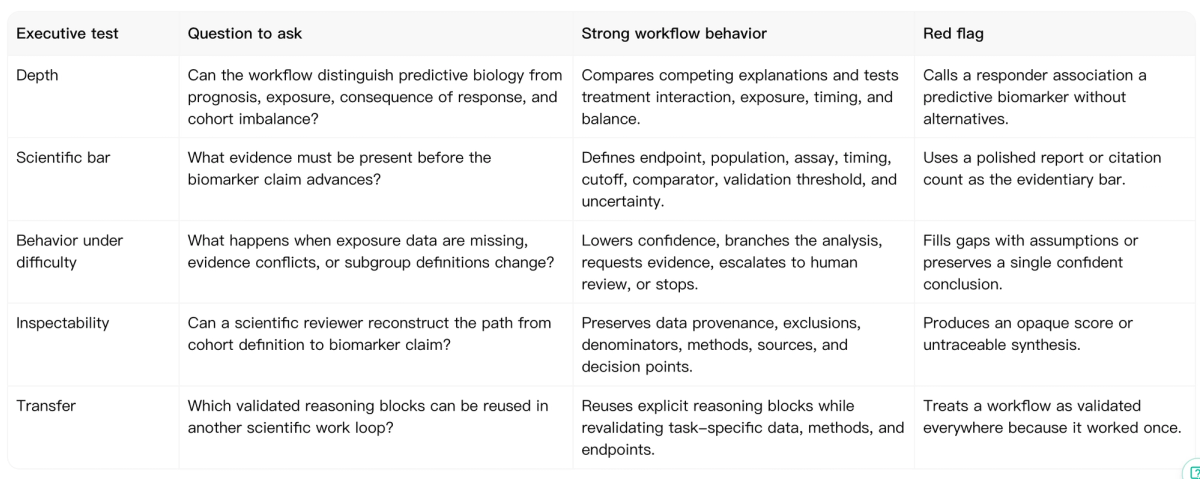
The strongest behavior may be a qualified conclusion rather than a confident one. When exposure data are missing, evidence conflicts, or subgroup definitions change, the workflow should lower confidence, branch the analysis, request additional evidence, escalate to expert review, or stop short of a definitive claim.
How Noah AI Can Support Reviewable Scientific Work
Noah AI can support human-in-the-loop biomedical research by helping researchers search and organize evidence, compare studies, structure competing hypotheses, preserve source-linked provenance, identify evidence gaps, and draft reviewable scientific outputs.
In a responder-analysis workflow, this can help separate baseline predictive hypotheses from post-treatment pharmacodynamic signals, distinguish published aggregate evidence from analyses that would require patient-level data, and make unresolved conflicts visible. Final biomarker validation and R&D decisions still require domain-expert review.
Learn more about Noah AI's human-in-the-loop research workflow: Noah AI Human-in-the-Loop.
Conclusion
AI research quality should not be judged only by data access, tool counts, citation volume, or model capability. Those components matter only when they operate together to produce completed scientific work that asks the right question, compares plausible explanations, calibrates uncertainty, remains inspectable, and produces a defensible next scientific action.
For responder analysis, that means refusing to equate a responder-associated feature with a predictive biomarker before prognosis, exposure, treatment timing, cohort balance, and assay effects have been examined. The useful output is not the most confident story. It is the scientific position that remains defensible after the alternatives have been tested.
Evaluate Competing Scientific Explanations with Noah AI
Use Noah AI to evaluate competing explanations, identify uncertainty, and define falsifiable next steps in biomedical research.
Organize source-linked evidence, compare alternative hypotheses, distinguish observations from predictive claims, and identify the additional analyses or experiments needed to strengthen a scientific conclusion.
Build a reviewable evidence framework for responder analysis, biomarker research, and pharmaceutical R&D while keeping final scientific judgment with domain experts.
Free to use · Free credits included · No credit card required