How to Critically Appraise a Clinical Research Paper with AI: Step-by-Step Guide
Linda
Learn how to critically appraise clinical research papers with AI. Evaluate study design, risk of bias, clinical significance, and limitations using Noah AI.
Learn how to evaluate study design, risk of bias, clinical significance, and evidence limitations using a real Noah AI analysis of the SURMOUNT-OSA clinical trials.
Reading a clinical research paper is not the same as critically appraising it.
A paper summary tells you what the researchers did and what they found. Critical appraisal asks whether the research methods support those findings, how clinically meaningful the results are, and where the conclusions should stop.
For medical researchers, clinicians, pharmaceutical teams, and students, these distinctions matter. A statistically significant clinical trial can provide strong evidence for one outcome while leaving other important questions unanswered.
AI can help organize the necessary evidence and identify methodological questions, but the final appraisal still requires verification against the original paper and scientific judgment.
Research Question → Study Design → Risk of Bias → Results → Clinical Relevance → Evidence Boundaries → Final Appraisal
Testing note: We tested Noah AI directly. The case uses the published SURMOUNT-OSA randomized clinical trials, with the original paper as the primary evidence source.
Scope of this guide: Unlike Best AI Tools for Critical Appraisal of Clinical Research Papers (2026), which compares AI tools and their research use cases, this article provides a step-by-step critical appraisal tutorial using Noah AI and the published SURMOUNT-OSA trials.
The goal is to demonstrate how to examine study design, risk of bias, effect size, applicability, and unsupported inference—and turn those findings into a source-linked appraisal with explicit evidence boundaries.
What Is Critical Appraisal in Clinical Research?
Critical appraisal is the systematic evaluation of a study's validity, results, and applicability. Its purpose is not to find as many flaws as possible or assign a simplistic quality score.
Instead, a good appraisal identifies what the study establishes, how confidently its findings can be interpreted, which methodological details remain uncertain, and whether the evidence applies to the intended population or clinical decision.
| Paper Summary | Critical Appraisal |
|---|---|
| What was studied? | Was the study design appropriate for the research question? |
| What were the results? | Could bias or missing data affect those results? |
| Was the P value significant? | How large, precise, and clinically meaningful was the effect? |
| Who participated? | Which patients or settings may not be represented? |
| What did the authors conclude? | Does the evidence fully justify that conclusion? |
A useful AI-assisted appraisal should preserve these distinctions rather than turn the entire paper into one generic summary.
Real Example: Critically Appraising SURMOUNT-OSA
For this step-by-step demonstration, we used the following published paper:
PRIMARY CLINICAL PAPER
Tirzepatide for the Treatment of Obstructive Sleep Apnea and Obesity
Malhotra A, Grunstein RR, Fietze I, et al.
New England Journal of Medicine, 2024
Trial program: SURMOUNT-OSA
View the original paper
SURMOUNT-OSA included two Phase 3, randomized, double-blind, placebo-controlled trials involving adults with obesity and moderate-to-severe obstructive sleep apnea (OSA).
Study 1 enrolled participants who were not using positive airway pressure (PAP) therapy. Study 2 enrolled participants who were already using PAP.
The primary endpoint was the change in apnea-hypopnea index (AHI) from baseline to week 52.
The trials reported substantial reductions in AHI with tirzepatide compared with placebo. But critical appraisal must look beyond that headline result.
Our appraisal question:
How confidently can we interpret the SURMOUNT-OSA results, and what do these trials establish—or fail to establish—about tirzepatide, sleep apnea, and broader clinical outcomes?
Step 1 — Ask Noah AI to Critically Appraise the Paper
Start by specifying the exact research paper, clinical question, and appraisal framework.
A weak prompt would be: "Summarize the SURMOUNT-OSA study."
A more useful prompt asks AI to evaluate the research question, study design, randomization, blinding, comparator, endpoints, effect size, missing data, safety, internal validity, external validity, and limitations.
For this demonstration, we used Noah AI with:
- Agent: Medical & Academia
- Research mode: Deep Research
- Model: 5.6 Terra · Balanced
- Evidence cutoff: September 30, 2026
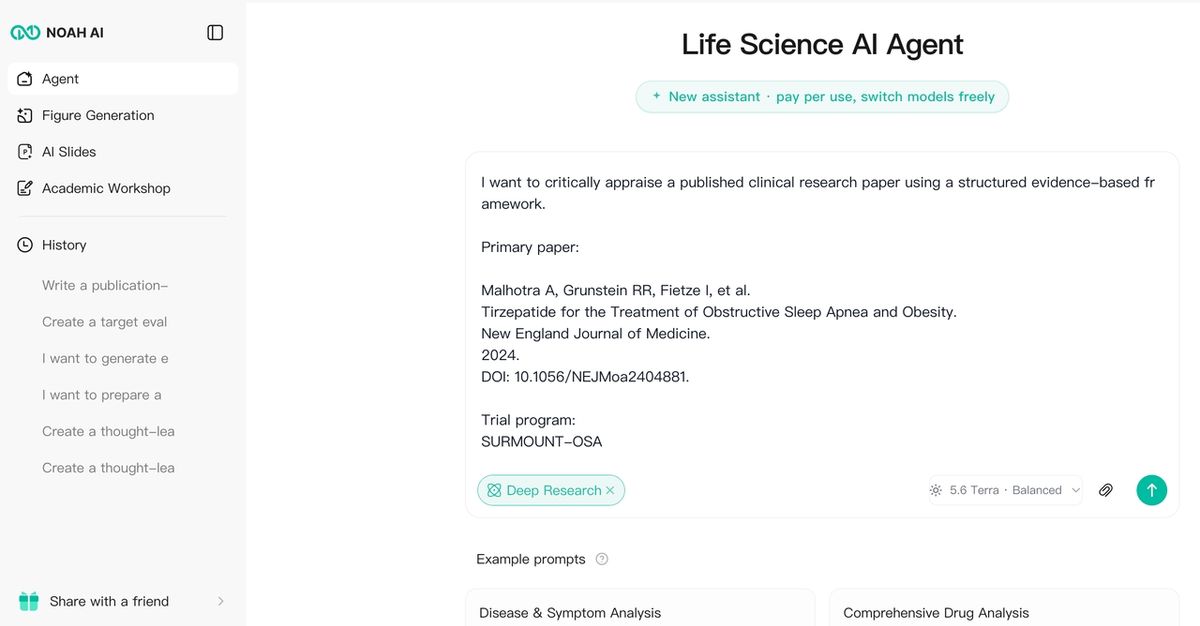
The workflow should prioritize the original paper, while using supplementary materials, protocols, and trial registration information to clarify methodological details.
Later publications can add context, but they should not be confused with the original randomized results.
Step 2 — Define the Research Question Using PICO
Before deciding whether a trial is convincing, reconstruct its actual clinical question.
| PICO | SURMOUNT-OSA |
|---|---|
| Population | Adults with obesity and moderate-to-severe OSA |
| Intervention | Once-weekly tirzepatide, titrated to a maximum tolerated dose |
| Comparator | Matching placebo, with lifestyle intervention in both groups |
| Outcome | Change in AHI measured by polysomnography |
| Follow-up | 52 weeks |
The resulting question is specific: Does tirzepatide reduce measured sleep apnea severity more than placebo in the enrolled population over 52 weeks?
It is not the same as asking whether tirzepatide prevents cardiovascular events, permanently cures OSA, or replaces PAP.
Step 3 — Check Whether the Study Design Fits the Question
SURMOUNT-OSA used two randomized, double-blind, placebo-controlled Phase 3 trials. These features support causal inference because randomized allocation can reduce confounding and placebo control helps distinguish treatment effects from expectations and other shared influences.
However, Study 1 and Study 2 had distinct PAP treatment contexts.
| Study | Population | Interpretation |
|---|---|---|
| Study 1 | Participants not using PAP | Tests treatment in a population without ongoing PAP use |
| Study 2 | Participants using PAP at enrollment | Assesses treatment in PAP-experienced participants, with PAP withdrawn before sleep assessments |
In Study 2, PAP was withdrawn for seven days before the relevant sleep assessments. Consequently, the principal AHI result should not be interpreted as directly measuring the incremental effect of tirzepatide while PAP is operating concurrently.
This is an example of why critical appraisal must reconstruct the actual assessment conditions rather than rely on a broad description of the population.
Real Appraisal Finding: PAP Withdrawal Changes What the Trial Can Establish
A critical appraisal should show not only what limitation was identified, but also how that limitation changes the interpretation of the study.
1. Evidence from the Original Paper
In SURMOUNT-OSA Study 2, participants were using positive airway pressure (PAP) therapy. However, PAP was suspended for seven days before polysomnographic assessments at baseline, week 20, and week 52.
Source: Malhotra et al., NEJM 2024.
2. Appraisal Flag — Assessment Conditions and Applicability
The primary AHI measurements in Study 2 were collected after temporary PAP withdrawal, not while PAP was operating concurrently.
This was a deliberate assessment procedure, not evidence of a trial-design error. However, it limits which clinical questions the measured effect can answer directly.
3. How This Changes the Conclusion
Supported conclusion: Tirzepatide produced a substantial reduction in measured AHI compared with placebo over 52 weeks in the studied population, including participants who ordinarily received PAP therapy.
Not established by this comparison:
- The incremental AHI benefit while PAP is being used concurrently.
- That tirzepatide can safely replace PAP therapy.
- That the treatment eliminates the need for PAP in all previously treated patients.
4. Reviewer Interpretation
The study provides persuasive evidence of improved measured OSA severity under its specified assessment conditions. Claims about PAP replacement or the incremental effect during concurrent PAP use require separate evidence.
Key lesson: Critical appraisal does not require labeling a well-designed trial as flawed. It requires preserving the distinction between what was actually measured and what readers might incorrectly infer.
Step 4 — Evaluate Randomization, Blinding, and Potential Bias
Randomization and blinding are important study-design strengths, but their labels alone do not settle every risk-of-bias question.
Researchers should check whether allocation was properly concealed, whether the baseline groups were comparable, whether outcome assessment was adequately protected, and whether treatment discontinuation or missing outcomes could distort the estimate.
| Appraisal domain | Question to investigate |
|---|---|
| Randomization | Were participants allocated using an appropriate random process? |
| Allocation concealment | Could investigators predict or influence assignment? |
| Blinding | Could treatment effects reveal which intervention was received? |
| Missing data | Were missing outcomes handled using defensible assumptions? |
| Selective reporting | Were the prespecified endpoints and relevant unfavorable results reported? |
Noah's appraisal identified meaningful methodological strengths while also flagging information that required further source verification, including aspects of allocation concealment, treatment adherence, missing-data assumptions, and the complete statistical analysis plan.
Missing information is not automatically evidence of a flawed study. It indicates where the appraisal should remain qualified until the original supporting documentation is checked.
Step 5 — Evaluate the Primary Endpoint
The primary endpoint in SURMOUNT-OSA was change in AHI from baseline to week 52.
AHI is the number of apneas and hypopneas per hour of sleep. It is an important objective measure of sleep-disordered breathing and was assessed using polysomnography.
But endpoint validity is not the same as clinical-outcome completeness.
What AHI improvement supports: A reduction in the measured frequency of sleep-disordered breathing events.
What AHI improvement alone does not prove: Fewer cardiovascular events, lower mortality, fewer accidents, durable remission after stopping therapy, or freedom from PAP treatment.
These distinctions are essential because researchers can accurately report a large effect on a physiological endpoint while overstating its implications for outcomes the trial did not establish.
Step 6 — Look Beyond the P Value
Statistical significance should never be the only result extracted from a randomized trial.
Researchers should examine the between-group effect size, confidence interval, analysis population, and clinical context.
| Trial | Tirzepatide | Placebo | Treatment difference | 95% CI |
|---|---|---|---|---|
| Study 1 | −25.3 | −5.3 | −20.0 | −25.8 to −14.2 |
| Study 2 | −29.3 | −5.5 | −23.8 | −29.6 to −17.9 |
Values represent changes in AHI, in events per hour. Both between-group comparisons had P<0.001.
Both studies reported a large reduction in AHI favoring tirzepatide, with confidence intervals excluding no effect.
The evidence therefore supports a substantial 52-week treatment effect on measured sleep apnea severity. Yet that does not determine whether the treatment reduces cardiovascular events, which were not established by these AHI comparisons.
Step 7 — Separate Statistical Significance from Clinical Meaning
A P value describes statistical evidence against a null hypothesis. It does not independently tell researchers how important an effect is for patients.
In SURMOUNT-OSA, the size of the AHI reductions, improvements in sleep-apnea-specific hypoxic burden, and selected patient-reported outcomes all contribute to the assessment of clinical relevance.
However, not every statistically significant outcome has a clearly established minimum clinically important difference, and improvements in physiological measures should not automatically be translated into unmeasured clinical benefits.
Critical appraisal requires two separate conclusions:
Statistical interpretation: The randomized AHI differences strongly favored tirzepatide in both trials.
Clinical interpretation: The magnitude of AHI improvement is likely meaningful for OSA severity, but broader patient-outcome claims require additional evidence.
Step 8 — Assess Missing Data, Multiplicity, and Safety
Some of the most important appraisal questions appear outside the main results table.
Missing data and attrition
The analysis should identify how many participants completed follow-up, which outcomes were missing, how missing values were handled, and whether treatment discontinuation could affect interpretation.
Noah identified that the reported efficacy and treatment-regimen analyses used different statistical approaches. Their broadly concordant results were reassuring, but complete missing-data assumptions and participant-level disposition required further verification.
Multiplicity
Clinical trials often evaluate several secondary outcomes. A critical appraisal should determine which results were covered by a prespecified testing procedure and which were exploratory.
Later mediation and subgroup analyses may provide useful context without becoming new confirmatory randomized evidence.
Safety
Gastrointestinal adverse events, particularly nausea and diarrhea, were more common with tirzepatide. The 52-week trial provides useful information about common tolerability events but cannot establish long-term or rare-event safety.
Researchers should also check whether adverse-event denominators, severity grades, discontinuations, and serious events are fully reported before drawing broad conclusions about comparative safety.
Step 9 — Examine Generalizability
A study may have strong internal validity while remaining applicable to only a defined patient population.
SURMOUNT-OSA enrolled people with obesity and moderate-to-severe OSA. Mean baseline BMI was approximately 39 kg/m² and mean baseline AHI approximately 50 events per hour.
These characteristics matter when considering whether the same treatment effect would occur in people without obesity, those with mild OSA, or medically complex populations who were not adequately represented.
Critical appraisal should distinguish the study's evidence in its intended population from an assumption that the treatment will produce equal benefit everywhere.
Step 10 — Separate What the Study Establishes from What It Does Not Establish
This was one of the most important outputs in the Noah AI analysis.
Instead of presenting only the favorable efficacy findings, the workflow separated conclusions supported by the randomized trial from broader claims that would require different evidence.
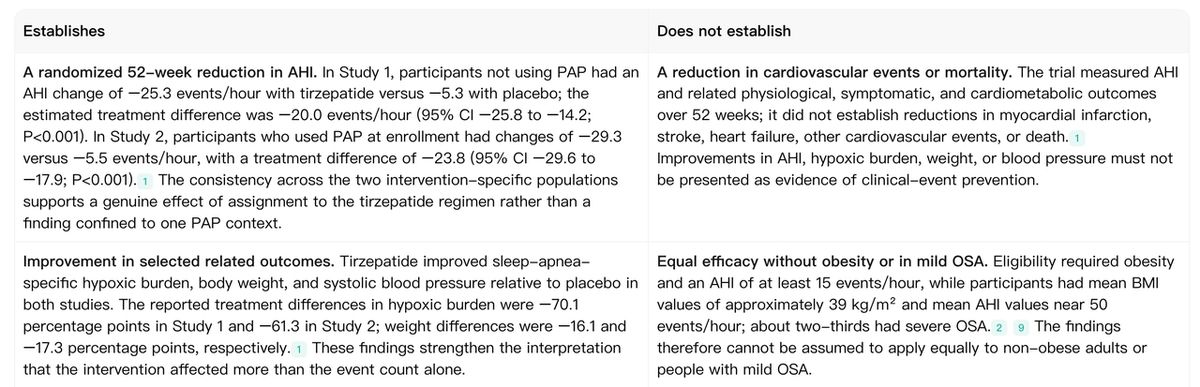
The trial supports an AHI reduction with tirzepatide in the studied population. It also supports improvements in selected related outcomes, including body weight and hypoxic burden.
However, the same evidence does not establish that tirzepatide reduces cardiovascular events or mortality, produces equal effects in non-obese adults, or can safely replace PAP.
This distinction is especially important when the primary endpoint is an intermediate or physiological outcome rather than the final clinical event that patients and decision-makers may care about most.
Key appraisal principle: A study's strongest conclusion is usually the conclusion most closely aligned with its actual randomized comparison, population, endpoint, and follow-up period.
Step 11 — Evaluate Internal Validity and External Validity Separately
These two dimensions answer different questions.
Internal validity concerns whether the methods support a credible estimate of the treatment effect in the study itself.
External validity concerns whether that estimate can reasonably be applied to other patients, settings, or treatment circumstances.
In the SURMOUNT-OSA appraisal, randomization, placebo control, blinding, and objective polysomnography support the credibility of the primary AHI effect.
At the same time, the narrow obesity and OSA eligibility criteria, specific PAP assessment conditions, finite follow-up, and remaining information gaps limit some broader interpretations.
The goal is not to collapse both domains into one "high-quality study" label.
Step 12 — Build a Final Critical Appraisal Matrix
The final step is to turn the detailed review into a structured and auditable judgment.
The matrix should identify the appraisal domain, the evidence supporting the judgment, the remaining uncertainty, and how that uncertainty changes interpretation.
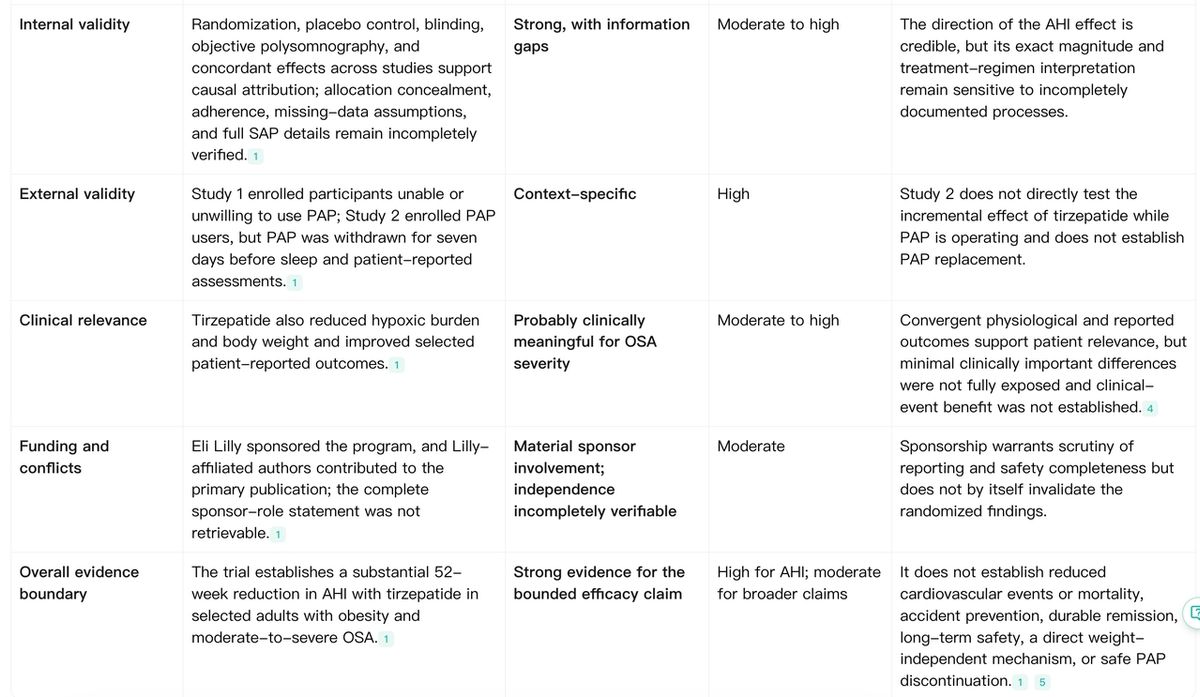
The result is more informative than a general verdict such as "This was a good randomized trial."
It preserves a qualified conclusion: the trial provides strong evidence for a substantial reduction in AHI over 52 weeks in selected adults with obesity and moderate-to-severe OSA, while not establishing several broader clinical claims.
Bottom line from the case: SURMOUNT-OSA provides persuasive evidence that the studied tirzepatide strategy improves measured sleep apnea severity compared with placebo. The strength of that result does not eliminate uncertainty about long-term safety, cardiovascular outcomes, permanent remission, weight-independent mechanisms, or application outside the enrolled population.
Critically Appraise a Research Paper with Noah AI
Use Noah AI to examine study design, results, potential bias, clinical significance, and evidence boundaries in a structured biomedical research workflow.
Try Noah AI for free. Free credits are available, and no credit card is required.
A Reusable AI Prompt for Critical Appraisal
You can apply the same workflow to another clinical paper by replacing the study details in the following prompt.
I want to critically appraise the following clinical research paper.
Paper: [Title, DOI, or uploaded PDF]
Research question: [Clinical question]
Please conduct a structured appraisal covering:
- PICO and clinical importance.
- Study design and population.
- Randomization and allocation concealment.
- Blinding and co-interventions.
- Comparator and primary endpoint.
- Effect sizes, confidence intervals, and clinical significance.
- Missing data, attrition, and multiplicity.
- Adverse events and safety limitations.
- Internal validity and external validity.
- Authors' claims versus direct trial evidence.
- What the study establishes and does not establish.
- Final critical appraisal matrix.
For each major judgment, distinguish:
- Directly reported evidence
- Reasonable interpretation
- Missing information requiring verification
Do not invent unreported methods or data.
Do not treat statistical significance as proof of clinical importance.
End with a specific, evidence-proportionate appraisal and a human verification checklist.
This prompt asks Noah to analyze evidence relevant to a methodological judgment, rather than merely restating the authors' conclusions.
You can explore Noah AI's broader human-in-the-loop research approach at Noah AI Human-in-the-Loop.
Common Mistakes When Critically Appraising Clinical Research with AI
- Asking AI to summarize instead of appraise — A summary can be accurate while omitting the most important questions about validity and applicability. Specify the appraisal domains explicitly.
- Treating P<0.05 as sufficient proof — Statistical significance must be interpreted alongside effect size, precision, endpoint relevance, and clinical context.
- Ignoring the actual comparator — A placebo-controlled trial does not necessarily answer how the experimental treatment compares with another active treatment. Claims of superiority should remain limited to the randomized comparison.
- Confusing an intermediate outcome with a clinical event — Improvement in AHI, blood pressure, or a biomarker does not automatically prove improvement in mortality or other hard outcomes.
- Treating missing information as demonstrated bias — When allocation, adherence, or analysis details are unavailable, the correct response is to document uncertainty and verify the source—not assume the study was conducted improperly.
- Generalizing beyond the study population — A trial in selected adults with obesity and moderate-to-severe OSA does not automatically establish equivalent outcomes for people with mild OSA or without obesity.
- Letting AI assign an unsupported overall quality score — Different methodological domains may carry different concerns. A domain-based explanation is more useful than an arbitrary numerical paper score.
What Should Researchers Verify Manually?
Before using an AI-assisted appraisal in a publication, journal club, research review, or clinical discussion, check the original source materials.
- The exact trial population, eligibility criteria, and exclusions.
- The protocol and randomization procedures.
- Allocation concealment and masking details.
- The prespecified primary endpoint and analysis population.
- Effect estimates, confidence intervals, and denominators.
- Missing-data assumptions and sensitivity analyses.
- The hierarchy of secondary endpoint testing.
- Safety results and treatment discontinuations.
- Funding disclosures and sponsor involvement.
- Whether the final claims remain within the study's evidence boundaries.
Where a formal risk-of-bias judgment is needed, a recognized framework such as Cochrane RoB 2 should be applied to the specific trial result. AI can help organize relevant passages, but it does not replace that assessment.
Frequently Asked Questions
Can AI critically appraise a medical research paper?
AI can assist by extracting study-design information, organizing methodological evidence, identifying possible bias, interpreting results, and distinguishing supported conclusions from unsupported extrapolations. Researchers should verify key findings before accepting the final judgment.
What is the difference between critical appraisal and literature review?
A literature review collects and synthesizes evidence across relevant studies. Critical appraisal evaluates the validity, results, and applicability of individual studies or findings. The two workflows often work together.
What are the most important elements of critical appraisal?
The most important elements include a focused research question, appropriate study design, risk-of-bias assessment, outcome measurement, statistical and clinical interpretation, missing-data evaluation, applicability, and evidence boundaries.
Can a statistically significant trial still have important limitations?
Yes. A trial may demonstrate a convincing effect on its primary endpoint while leaving uncertainty about long-term outcomes, safety, mechanism, specific subgroups, or how the findings apply beyond the enrolled population.
Should AI assign a risk-of-bias score automatically?
AI-generated labels can help organize a review, but formal risk-of-bias judgments require appropriate methodological criteria, primary-source verification, and human assessment. A missing method should not be treated as a demonstrated failure.
Can I use Noah AI for journal clubs and research presentations?
Yes. Structured appraisal findings can help organize discussions about study design, interpretation, limitations, and future research questions. Those findings should be reviewed against the original publication before presentation.
Related Reading
- Best AI Tools for Critical Appraisal of Clinical Research Papers (2026)
- How to Analyze Clinical Trial Results with AI Using Noah AI
- How to Create an Evidence Table for a Literature Review with AI
- How to Conduct a Medical Literature Review with AI: Step-by-Step Guide
Final Takeaway
Critical appraisal is not about deciding whether a paper is simply good or bad.
It is about determining which conclusions are supported by the research design, how reliably those conclusions can be interpreted, and which important questions remain unanswered.
The SURMOUNT-OSA example illustrates this distinction. The randomized trials provide persuasive evidence that tirzepatide substantially reduces AHI over 52 weeks in selected adults with obesity and moderate-to-severe OSA.
However, that conclusion should not be extended automatically to cardiovascular-event prevention, mortality, durable remission, PAP replacement, or a direct weight-independent mechanism.
Noah AI can help researchers assemble the relevant evidence, identify methodological uncertainties, and produce a structured appraisal that is easier to inspect and verify.
A Strong Appraisal Does Not Just Explain the Results. It Explains How Far Those Results Can Be Trusted and Applied.
Build a Critical Appraisal Report with Noah AI
Use Noah AI to critically appraise clinical research papers across risk of bias, effect size, clinical relevance, applicability, and unsupported inference.
Build a source-linked appraisal that identifies methodological strengths, flags uncertainties requiring verification, and distinguishes what the study establishes from what its results cannot support.
Review study design, endpoints, confidence intervals, missing data, safety, and generalizability in one structured research workflow—while keeping final scientific judgment with qualified reviewers.
Free to use · Free credits included · No credit card required