How to Build a Biomedical Research Proposal with AI: Step-by-Step Guide
Linda
Learn how to build a biomedical research proposal with AI, from evidence gaps and hypotheses to study design, endpoints, risk controls, and readiness checks.
Use AI to move from a defensible evidence gap to a testable hypothesis, specific aims, study design, biomarker strategy, endpoints, statistical requirements, risk controls, and a proposal-readiness check.
Real Noah AI case: serial postoperative ctDNA-guided treatment de-escalation after radical cystectomy for high-risk muscle-invasive bladder cancer.
A biomedical research proposal is not simply a longer literature review. A strong proposal has to explain why the question remains unresolved, what hypothesis is being tested, how the study will answer it, what could invalidate the design, and what result would change scientific or clinical-development decisions.
Scope of this guide: Unlike Best AI Tools for Biomedical Research Proposal Development (2026), which focuses on comparing and selecting AI tools, this article provides a step-by-step proposal development workflow using Noah AI.
The workflow follows a real ctDNA research case from evidence-gap identification through hypothesis development, specific aims, study design, endpoints, statistical requirements, risk controls, and final proposal-readiness assessment.
Testing note: We tested Noah AI directly on the workflow shown below. The case is intended to demonstrate proposal development, not to replace protocol development, statistical consultation, ethics review, or expert scientific judgment.
Input A focused biomedical research question plus an evidence cutoff.
AI task Convert current evidence into a proposal framework without inventing preliminary data.
Output Gap → hypothesis → aims → design → endpoint → risks → readiness.
What Makes a Biomedical Research Proposal Different?
A research question asks what you want to know. A research plan explains how you might study it. A research proposal has to connect the scientific rationale, unresolved evidence, hypothesis, aims, design, measurements, analysis, risk control, and expected impact into one defensible chain.
| Stage | Main question | Typical output |
|---|---|---|
| Feasibility assessment | Is this question worth pursuing and realistically answerable? | Proceed, refine, or stop. |
| Research plan | How could the question be studied? | Population, design, endpoints, measurements, operational plan. |
| Research proposal | Why should this study be done, what exactly will it test, and how will the result change the decision? | Evidence gap, hypothesis, specific aims, methods, analysis, risks, alternatives, impact, readiness. |
This difference matters because generative AI can easily produce polished proposal-like prose before the underlying scientific logic is stable. A useful workflow should therefore delay the final draft until the evidence gap, design, and decision criteria have been made explicit.
Real Case: ctDNA-Guided Treatment De-Escalation After Radical Cystectomy
For the case study, we used a clinically specific question rather than asking AI to write a generic proposal about ctDNA.
The research question was whether serial postoperative ctDNA negativity could identify patients with high-risk muscle-invasive bladder cancer who might safely avoid or reduce adjuvant systemic therapy after radical cystectomy.
The key distinction is that favorable outcomes in ctDNA-negative patients can support a prognostic conclusion without proving that otherwise indicated treatment can safely be omitted. A proposal therefore has to test the treatment-management strategy rather than simply repeat another prognostic biomarker study.
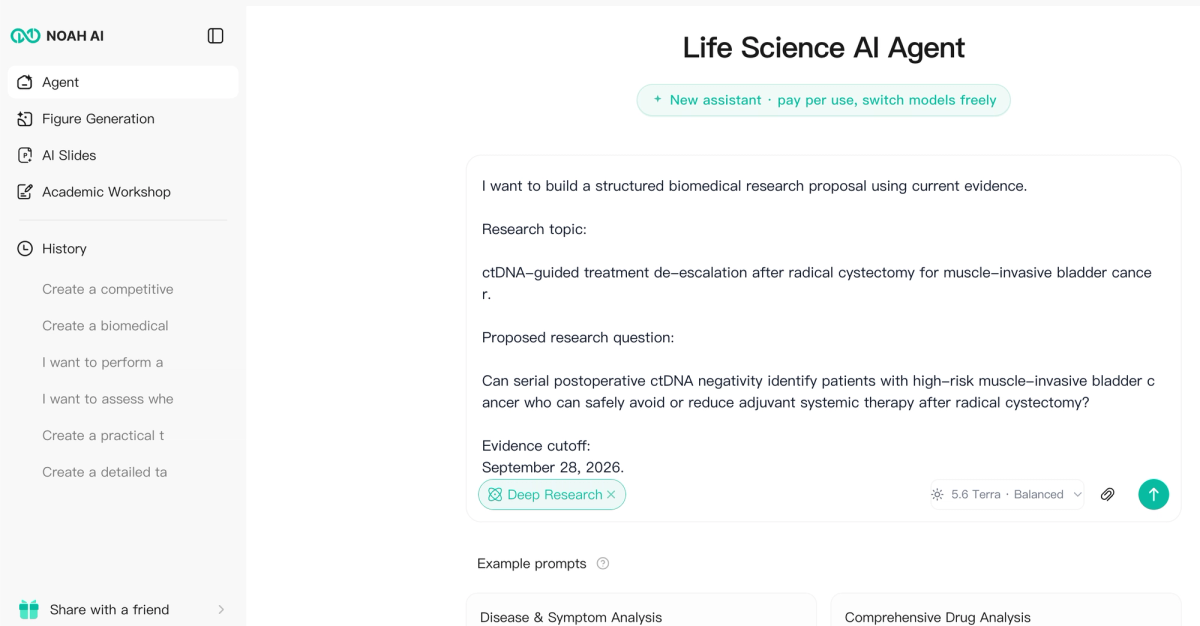
Core principle: do not start by asking AI for a complete proposal. Start by defining the biomedical question and requiring the system to expose the evidence gap, assumptions, and failure conditions before drafting.
Step 1 — Define the Evidence Gap
The first proposal section should identify the precise unresolved question that justifies the study.
In this case, the useful distinction is between prognostic evidence, predictive evidence, treatment-guiding escalation evidence, and de-escalation evidence. These evidence types answer different questions.
Favorable outcomes in a biomarker-negative cohort can support a lower-risk interpretation without proving that treatment omission is safe.
| Weak gap statement | Decision-ready gap statement |
|---|---|
| More research is needed on ctDNA after bladder-cancer surgery. | Randomized evidence has addressed ctDNA-guided treatment escalation after molecular positivity, but a randomized strategy has not yet established whether persistently ctDNA-negative, otherwise treatment-eligible patients can safely undergo protocol-defined adjuvant treatment de-escalation. |
Step 2 — Turn the Gap Into a Falsifiable Central Hypothesis
The hypothesis should be specific enough to fail. It should define the population, biomarker state or intervention, comparator logic, and clinically meaningful outcome.
In this proposal, serial ctDNA negativity should be treated as an imperfect lower-residual-disease state, not proof that residual disease is absent.
A defensible hypothesis is that a monitored treatment-de-escalation strategy could preserve disease-free outcomes within a prospectively justified noninferiority margin while reducing systemic-treatment exposure.
The proposal should also state what result would falsify that hypothesis.
Step 3 — Build Specific Aims
Specific aims should answer different parts of the research problem rather than repeat the same question three times.
- Aim 1 — Clinical utility: test whether the biomarker-guided de-escalation strategy preserves disease-free outcomes.
- Aim 2 — Biomarker validity: characterize serial ctDNA negativity, conversion, assay validity, and the relationship between molecular and radiographic recurrence.
- Aim 3 — Patient and implementation outcomes: evaluate treatment exposure, toxicity, quality of life, surveillance burden, and rescue management.
Each aim should contain a rationale, primary analysis, expected result, and decision relevance. A vague aim such as "explore ctDNA" is not sufficient.
Step 4 — Compare Candidate Study Designs
AI can help compare candidate designs against the claim the study needs to support.
| Design | Strength | Main limitation | Best use |
|---|---|---|---|
| Randomized de-escalation trial | Strongest direct estimate of the effect of reducing or omitting treatment. | Higher recruitment, ethical, and event-rate burden. | Clinical utility or noninferiority claim. |
| Prospective observational cohort | Useful for assay feasibility, natural history, and longitudinal biomarker states. | Confounding prevents a clean treatment-omission safety claim. | Feasibility or validation stage. |
| Pragmatic biomarker-guided trial | Tests the full real-world management strategy. | Assay effects, treatment uptake, crossover, and rescue are harder to disentangle. | Implementation-oriented strategy evidence. |
The key decision is not which design is easiest. It is which design can support the intended clinical-utility claim.
Step 5 — Define the Population and Biomarker Strategy Separately
Eligibility criteria and biomarker criteria should not be collapsed into one list.
Clinical eligibility defines who belongs in the research question. Biomarker eligibility defines how the molecular state is measured and when it becomes actionable.
For serial ctDNA negativity, the proposal should specify:
- assay platform;
- tumor tissue requirements;
- postoperative blood collection timing;
- definition of serial negativity;
- handling of invalid or missing results;
- conversion rules;
- confirmation requirements;
- analytic quality control.
A single negative test should not automatically be interpreted as absence of residual disease.
Step 6 — Select an Endpoint That Matches the Decision
If the study asks whether treatment can safely be reduced, the primary endpoint should represent disease control rather than only molecular change.
In this proposal, disease-free survival is the most clinically interpretable primary endpoint concept.
Important secondary or exploratory endpoints can include:
- overall survival;
- distant metastasis-free survival;
- ctDNA conversion;
- time from molecular to radiographic recurrence;
- treatment exposure;
- grade 3 or higher toxicity;
- immune-related toxicity;
- patient-reported outcomes;
- quality of life;
- ctDNA clearance and conversion kinetics.
Step 7 — Build the Statistical Framework Without Inventing a Sample Size
A proposal can be statistically structured before a final sample size is defensible.
The workflow should identify the inputs required for final sample-size planning:
- expected event rate;
- noninferiority margin;
- ctDNA-negative prevalence;
- screening yield;
- delayed conversion rate;
- treatment-effect assumptions;
- dropout;
- missing ctDNA;
- assay failure;
- crossover;
- surveillance schedule;
- confidence-interval precision.
If a quantitative parameter is not sufficiently supported, label it: Requires assumption / pilot estimate.
Step 8 — Identify Bias, Safety, Ethics, and Feasibility Risks
Proposal quality depends on whether failure modes are treated as design problems rather than hidden in a limitations section.
Relevant risks for a longitudinal biomarker-guided study can include:
- lead-time bias;
- guarantee-time bias;
- selection bias;
- assay misclassification;
- treatment crossover;
- post-randomization ctDNA conversion;
- unequal surveillance;
- missing biomarker samples;
- prior-treatment heterogeneity.
The ethical issue should also be explicit: could a false-negative ctDNA result cause a patient to miss a therapy that would otherwise reduce recurrence risk?
Monitoring frequency, confirmation rules, rescue management, stopping criteria, informed consent, and independent safety oversight therefore belong in the proposal framework.
Step 9 — Convert the Analysis Into a Final Proposal Blueprint
Only after the evidence logic is stable should AI condense the work into a proposal-ready structure.
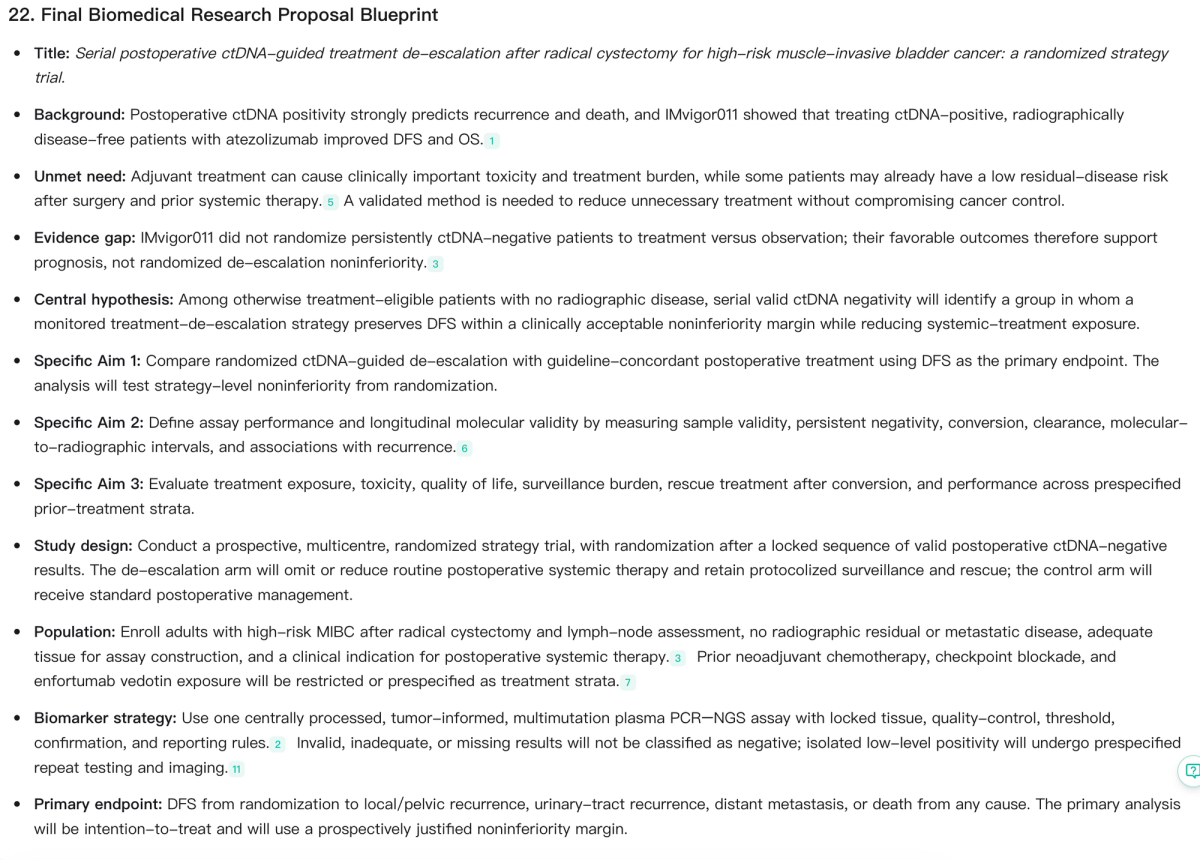
The important part is the chain between fields:
Evidence gap → Central hypothesis → Specific aims → Study design → Population → Biomarker strategy → Endpoint
Step 10 — Run a Proposal Readiness Check
A proposal is not automatically ready because every section contains text. A final readiness check should distinguish what is already sufficiently defined from what still requires evidence, feasibility testing, or pilot estimates.
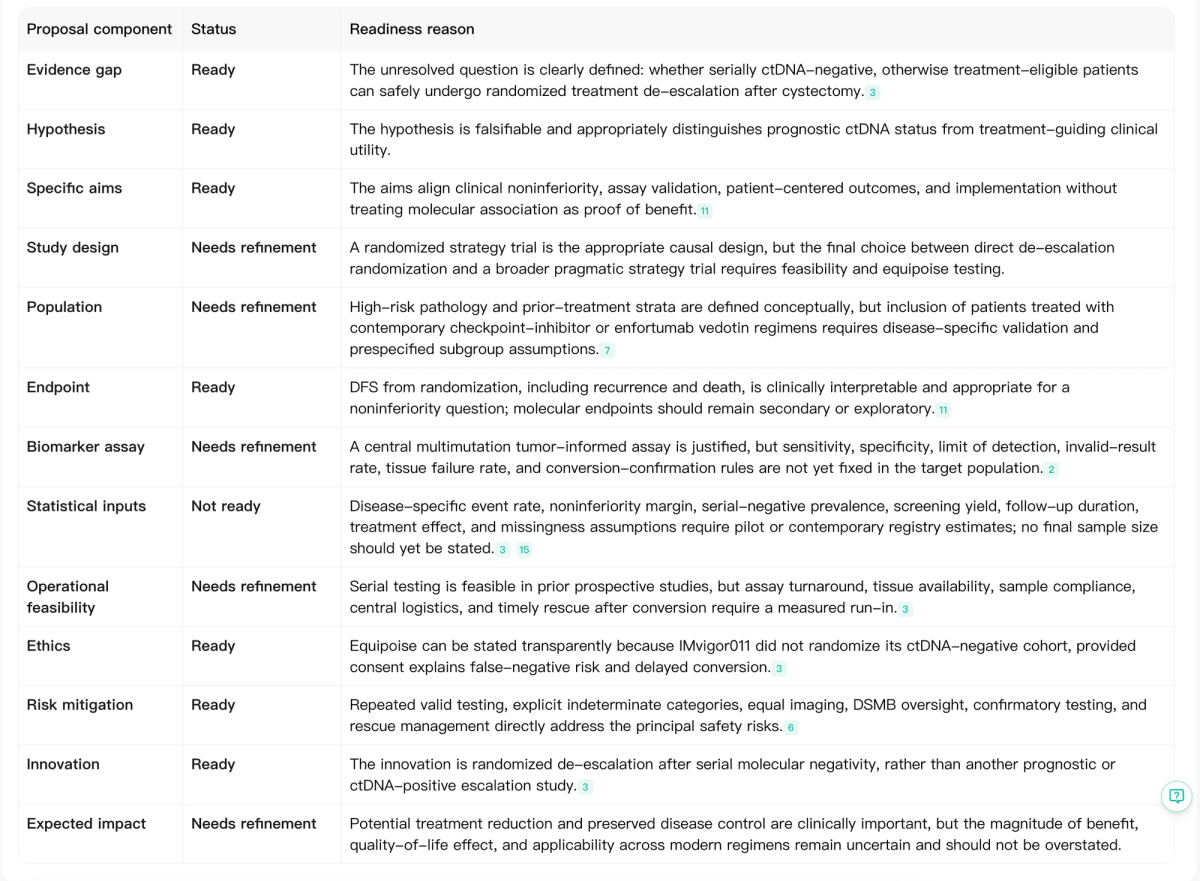
In this example, the evidence gap, hypothesis, specific aims, endpoint, ethics, risk mitigation, and innovation were sufficiently developed.
The study design, population, biomarker assay, operational feasibility, and expected impact still required refinement.
Statistical inputs were not ready because the disease-specific event rate, justified noninferiority margin, serial-negative prevalence, screening yield, treatment effect, follow-up duration, and missingness assumptions still required contemporary evidence or pilot estimates.
Build a Biomedical Research Proposal with Noah AI
Use Noah AI to move from a focused biomedical question to an evidence gap, hypothesis, specific aims, study design, endpoints, risk analysis, and proposal-readiness check.
Noah AI can be used for free, includes free credits, and requires no credit card.
What a Strong AI-Assisted Proposal Should Produce
| Proposal component | What good output should contain |
|---|---|
| Evidence gap | A bounded unresolved question supported by current evidence, not a generic statement that more research is needed. |
| Central hypothesis | A falsifiable claim with explicit assumptions and failure criteria. |
| Specific aims | Distinct, measurable aims that collectively test the hypothesis. |
| Study design | A design selected for causal relevance and interpretability, not convenience alone. |
| Population | Eligibility tied to the scientific question, with treatment history and major strata clearly separated. |
| Measurement strategy | Assay, specimen, timing, thresholds, quality control, invalid-result rules, and longitudinal states. |
| Endpoints | A primary endpoint aligned with the decision plus clearly separated secondary and exploratory outcomes. |
| Statistics | Required inputs, estimands, missing-data strategy, sensitivity analyses, and explicit unsupported assumptions. |
| Risk control | Biases, safety threats, ethical issues, operational barriers, and alternatives. |
| Readiness | A transparent statement of what is ready, what needs refinement, and what cannot yet be finalized. |
Common Mistakes When Using AI for Biomedical Research Proposals
Starting With "Write Me a Proposal"
This gives the model too much freedom to invent the population, endpoint, hypothesis, or study rationale.
Writing the Background Before Defining the Gap
A long background section can still fail to justify a new study.
Confusing Prognostic Evidence With Treatment-Guiding Evidence
A biomarker associated with outcome does not automatically identify who benefits from treatment or who can safely avoid it.
Making the Aims Broader Than the Study Design
An observational study cannot support every causal treatment claim.
Choosing an Endpoint Only Because It Matures Quickly
Molecular or surrogate endpoints should not automatically replace clinically meaningful outcomes.
Inventing a Precise Sample Size Too Early
If event rates, margins, prevalence, or missingness remain uncertain, the correct next step is to identify the missing planning inputs.
Treating Assay Failure as Biomarker Negativity
Missing, invalid, inadequate, and nonreportable results should remain separate states.
Calling Routine Technology Use "Innovation"
Innovation should describe the new scientific or methodological contribution, not simply the use of AI or ctDNA.
Writing Only the Success Scenario
A strong proposal explains what is learned if the hypothesis is supported, partially supported, or not supported.
Where AI Helps—and Where Human Review Is Still Required
AI can accelerate proposal development by structuring evidence, comparing study designs, identifying missing assumptions, drafting measurable aims, organizing bias controls, and turning a large evidence base into a coherent proposal framework.
It should not independently determine the final noninferiority margin, final sample size, ethical acceptability, assay-validation standard, statistical analysis plan, or whether a study is ready for patient enrollment.
Those decisions require domain experts, statisticians, laboratory specialists, clinical investigators, ethics oversight, and, where relevant, regulatory input.
Learn more about Noah AI's human-in-the-loop research workflow.
Frequently Asked Questions
Can AI write a complete biomedical research proposal?
AI can draft and organize a proposal, but the stronger workflow is to build the scientific logic first. The evidence gap, hypothesis, aims, design, endpoints, statistics, feasibility, and risk controls should be reviewed before producing the polished proposal narrative.
What should I give AI before asking for a research proposal?
At minimum, provide a focused research question, disease or biological setting, population, intervention or exposure, relevant comparator, intended outcome, evidence cutoff, and the type of proposal you are trying to build.
Should AI calculate the sample size?
Only when the required statistical assumptions are sufficiently supported. Otherwise, the correct output is a list of parameters that need contemporary evidence, registry estimates, or pilot data.
How is a research proposal different from a literature review?
A literature review explains what current evidence shows. A proposal uses that evidence to justify a new question, formulate a hypothesis, define aims, choose a design, specify measurements and endpoints, and explain why the study can resolve the gap.
How is a research proposal different from a research plan?
A research plan focuses mainly on how a study will be conducted. A proposal also makes the scientific case for why the work should be done, what remains unresolved, what result would matter, and how uncertainty will be managed.
Related Research Guides
- Best AI Tools for Biomedical Research Proposal Development (2026)
- Best AI Tools for Biomedical Research Question Feasibility Assessment (2026)
- How to Conduct a Medical Literature Review with AI: Step-by-Step Guide (2026)
- AI Agents for Biomedical Research: How Noah Turns Medical Evidence Into Research Workflows
Final Takeaway
The value of AI in biomedical research proposal development is not that it can generate more proposal text. The stronger workflow is to make the proposal logic explicit.
Evidence gap → Central hypothesis → Specific aims → Study design → Population → Measurement strategy → Endpoint → Statistical framework → Bias and risk control → Readiness → Proposal draft
In this Noah AI case, the research question was not converted directly into a polished grant narrative. It was first tested against current evidence, narrowed into a falsifiable hypothesis, separated into clinical, biomarker, and implementation aims, mapped to a randomized strategy design, and checked for unresolved statistical and operational assumptions.
That is the more useful role for AI: not replacing biomedical judgment, but helping researchers expose the chain of reasoning that a strong proposal must survive.
Build a Biomedical Research Proposal with Noah AI
Use Noah AI to move from a focused biomedical question to a structured proposal covering evidence gaps, central hypotheses, specific aims, study design, biomarker strategies, endpoints, risk analysis, and proposal-readiness checks.
Build a source-linked proposal framework while keeping unresolved statistical assumptions, feasibility constraints, and decisions requiring expert review visible.
Free to use · Free credits included · No credit card required