Free AI Tools for PubMed and Biomedical Literature Search in 2026
Linda
Compare free AI tools for PubMed and biomedical literature search in 2026, including Noah AI, PubMed, Elicit, Consensus, and SciSpace, with a real evidence-screening example.
Researchers who search PubMed every day usually do not have a “search” problem alone. They have a screening problem, a prioritization problem, and a synthesis problem. The real question is not simply where to search, but which tool helps you move from a natural-language question to a short, trustworthy set of papers you can actually use.This article focuses on free or free-entry tools that are commonly used for PubMed and biomedical literature search. The goal is not to list every academic search product. It is to answer a more practical question: which tools are best for finding PubMed-indexed biomedical evidence quickly, and where do they start to break down?That matters because “biomedical literature search” can mean several different tasks: searching the PubMed database directly, discovering related papers, screening the most relevant evidence, checking whether a paper is actually indexed in PubMed, and extracting enough context to decide whether the paper is worth reading in full.
What this article is really answering
- User question: If I need to find PubMed-indexed biomedical papers quickly, which free tools should I actually use?
- Core task / final output: A usable shortlist of relevant PubMed-indexed studies, with enough metadata and context to support screening and next-step review.
- What the Noah example needs to prove: Not just that Noah can run a search, but that it can turn a natural-language biomedical question into a structured evidence shortlist with a bottom-line summary, paper-level comparison, and traceable references.
Quick answer
If you want the source-of-truth biomedical database, use PubMed first. If you want AI-assisted discovery and faster paper screening, Consensus, Elicit, and SciSpace can save time. If you need a more structured workflow that goes beyond finding papers and starts organizing them into an evidence comparison, that is where a workflow-oriented tool such as Noah becomes more valuable.In other words: free tools are useful for finding papers, but they are usually weaker at turning search results into a decision-ready evidence view.
Best free tools for PubMed and biomedical literature search
| Tool | Best for | Free access | Main strengths | Main limitation |
|---|---|---|---|---|
| PubMed | Direct biomedical database search | Free | Authoritative indexing, MeSH, filters, abstracts, PMID traceability | Little help with prioritization or synthesis |
| Consensus | Natural-language discovery of research papers | Free tier available | Easy question-based search, fast discovery, research-focused interface | Coverage and evidence organization are lighter than a structured review workflow |
| Elicit | Paper discovery and early screening | Free tier available | Question-based retrieval, useful screening summaries, helpful for exploratory searching | Not every output is ideal for strict PubMed-specific workflows |
| SciSpace | Search plus reading assistance | Free tier available | Good for reading and interacting with papers after discovery | More useful after you already have papers than as a source-of-truth PubMed workflow |
| Google Scholar | Broad supplementary discovery | Free | Finds citations, related papers, and grey overlap beyond PubMed | Not curated as a biomedical database; noisier results |
| Noah | Structured biomedical evidence search and screening workflow | Access model depends on plan / workspace | Turns a natural-language query into a bottom line, structured evidence comparison, and reference list | Not a replacement for verifying the source papers themselves |
The list above is intentionally practical. It separates database search from AI-assisted screening, because those are not the same job.
PubMed: still the starting point for biomedical search
PubMed remains the best starting point when your primary requirement is to search PubMed-indexed biomedical literature directly. It is free, highly trusted, and gives you the metadata researchers actually care about: PMIDs, journal information, abstracts, publication types, MeSH terms, and filters for date, article type, species, age, and more.Its weakness is not quality; it is workload. PubMed helps you retrieve records, but it does not do much to tell you which results matter most for your exact question. That means manual screening still takes time, especially when your query spans a disease, intervention, and outcome.
Consensus: useful for quick natural-language discovery
Consensus is helpful when you want to ask a research question in natural language and quickly see relevant papers. It is usually easier for non-expert users than building a complex PubMed query from scratch.The tradeoff is that Consensus is primarily a discovery tool. It is good at helping you find likely relevant papers, but less strong when you need a structured, review-ready evidence table for a biomedical decision workflow.
Elicit: strong for exploratory paper screening
Elicit is especially useful when the research question is still a little fuzzy and you want AI help in finding and screening candidate papers. It can help surface studies, extract high-level details, and accelerate early-stage literature exploration.However, users still need to verify whether the returned studies are the right evidence set for their exact biomedical question. It is helpful for exploration, but not a substitute for checking the underlying record quality and applicability.
SciSpace: good when reading is the bottleneck
SciSpace becomes more useful after paper discovery. If your main challenge is understanding what a paper is saying rather than locating it, SciSpace can be very efficient. It is valuable for reading assistance, clarifying terms, and navigating the content of individual papers.That said, it is not the cleanest answer to a pure “PubMed literature search” need. It helps after search, but PubMed or a dedicated search workflow still does the heavier lifting for source discovery.
Google Scholar: best used as a supplement, not a replacemen
Google Scholar is still useful, especially for citation chasing and broader discovery. It can surface papers that help you expand a topic, find related work, or identify downstream citations quickly.But it is not a biomedical-specific database, and the result set is often noisier. For a PubMed-specific workflow, Google Scholar works best as a secondary tool, not as the primary source of truth.
A Noah example: from a PubMed search question to a structured screening view
The most useful thing about the Noah example is not that it can “search PubMed.” Many tools can search or point to papers. The more important product advantage is that Noah can take a natural-language biomedical question and produce a structured screening output that is closer to what a research team actually needs next.In the example below, the query asks for recent PubMed-indexed studies on GLP-1 receptor agonists and cardiovascular outcomes in adults with obesity without diabetes. That is a realistic search problem because the user is not only asking for papers. The user also wants prioritization, applicability judgment, and a clear evidence shortlist.
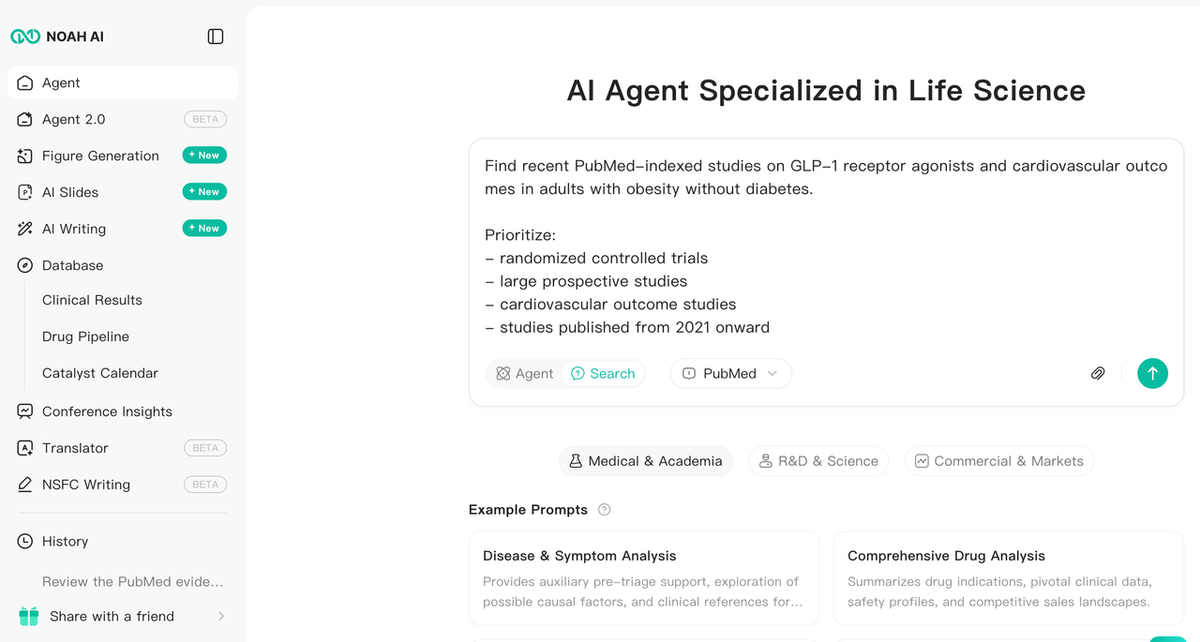
Figure 1. Noah search setup: the user enters a natural-language biomedical query in Search mode with PubMed selected as the source.
![Noah returns a rapid-screening bottom line and a structured evidence table, helping the user identify the highest-priority studies first. [图片]](https://cdn.sanity.io/images/1f0cfhcv/production/e3d01813e5f8572662b3e18f29fe794109f7dd50-1280x640.png?w=1200)
Figure 2. Noah returns a rapid-screening bottom line and a structured evidence table, helping the user identify the highest-priority studies first.
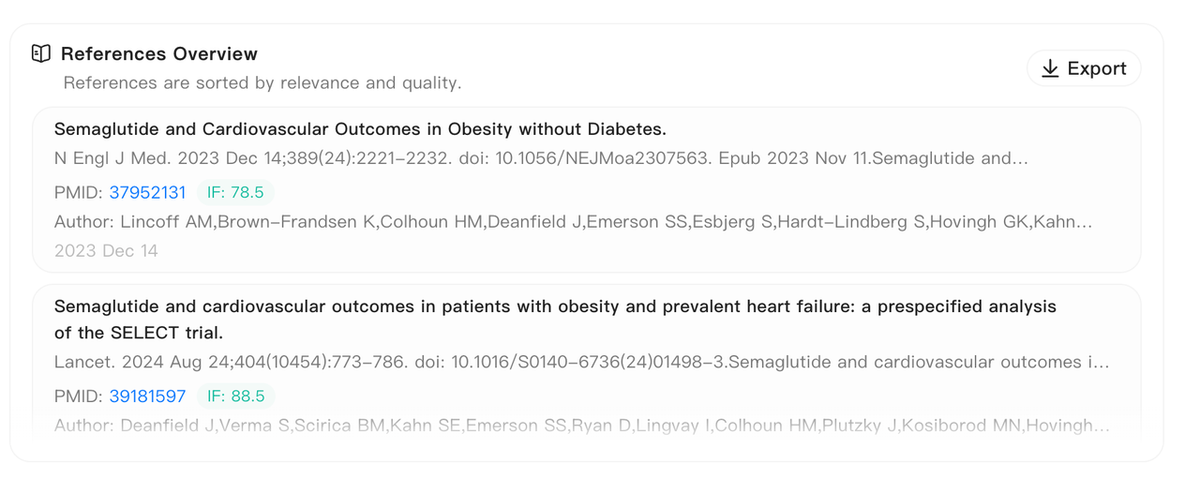
Figure 3. Noah also provides a reference overview with PMIDs and citation details, making the result set easier to verify and follow up.
Why this example is stronger than a generic product walkthrough
- It starts with a real biomedical question, not a feature demo.
- It identifies the most relevant evidence first instead of dumping an unsorted paper list.
- It adds an applicability judgment: the result explicitly notes that the strongest direct evidence is from the SELECT trial and that it is most applicable to secondary prevention rather than to all adults with obesity without known ASCVD.
- It provides a structured paper table, so the user can compare study year, design, population, intervention, and relevance without manually reconstructing the evidence set.
- It keeps reference traceability visible through PMID-linked citation details.
That is the real conversion point for Noah. The product advantage is not “AI search” in the abstract. It is the ability to move from a research question directly to a structured evidence view that is much closer to a literature review starting point.
How to choose the right tool for your workflow
- Choose PubMed if your top priority is database accuracy and you are comfortable screening results yourself.
- Choose Consensus or Elicit if you want faster question-based discovery and your main problem is finding candidate papers quickly.
- Choose SciSpace if you already have papers and your main problem is reading and understanding them efficiently.
- Choose Noah if the real bottleneck is not finding papers, but turning a biomedical question into a structured evidence shortlist that can be reviewed, discussed, and extended.
Final takeaway
Free tools can absolutely help with PubMed and biomedical literature search in 2026. PubMed itself remains essential, while Consensus, Elicit, SciSpace, and Google Scholar each help at different points in the discovery workflow.But if the actual job is to go from a question to a structured evidence screen—not just a bag of papers—the workflow-oriented advantage becomes more important than the search box alone. That is the main reason Noah is compelling in this category: it helps bridge the gap between literature search and evidence organization.For biomedical teams, that difference matters. Search is only the first step. The real value comes when the search output is already moving toward a usable evidence table.