How to Investigate FcRn and Its Competitive Pipeline with AI
Linda
A 2026 FcRn target intelligence brief covering approved therapies, Phase III challengers, dosing, durability, safety, and competitive questions in generalized myasthenia gravis.
Investigating a drug target means connecting its biology to assets, indications, clinical stages, competitors, and unresolved evidence. Using FcRn in generalized myasthenia gravis as a worked example, this article shows how to build a bounded competitive pipeline view with Noah AI without treating development stage as proof of clinical superiority.
This example maps selected approved assets and representative Phase III FcRn-directed programs in generalized myasthenia gravis (gMG).
It is not intended to be an exhaustive global FcRn pipeline. Assets were selected to illustrate major approved reference products, active late-stage challengers, and historically relevant Phase III programs across different development states.
The goal is to establish a decision-relevant competitor set and define what evidence should be reviewed next—not to rank clinical performance.
Sample output · From a Noah research workflow
FcRn Competitive Pipeline Brief
Executive Finding
FcRn/FCGRT in generalized myasthenia gravis is primarily a differentiation question, not a simple entry question. Approved FcRn therapies already define regulatory and clinical reference points, while late-stage programs continue to test whether dosing, durability, safety monitoring, population fit, and treatment burden can create meaningful differentiation.
Evidence cutoff: October 9, 2026.
Asset status, regulatory status, trial activity, and development stage in this article should be interpreted as of this cutoff date. Historical highest phase is kept separate from current development status.
Target and Scope
Target: FcRn / FCGRT
Disease focus: generalized myasthenia gravis
FcRn rescues IgG from intracellular degradation and returns it to circulation. Blocking FcRn lowers circulating IgG, including pathogenic autoantibodies, but does not eliminate the B-cell or plasma-cell source of disease. The competitive scope therefore needs to separate target biology from molecule-specific clinical performance.
Established Competition
Approved reference assets
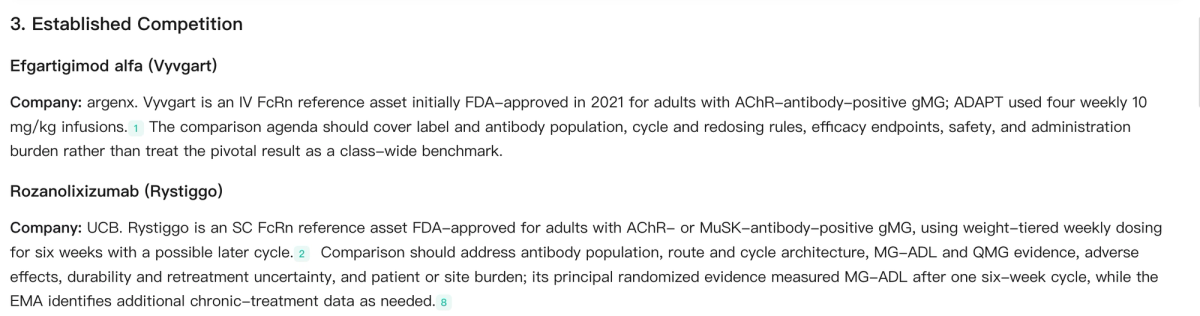
Approved FcRn reference assets in gMG: efgartigimod alfa (Vyvgart) and rozanolixizumab (Rystiggo).
Efgartigimod alfa (Vyvgart)
argenx. Vyvgart is an IV FcRn reference asset. The relevant comparison dimensions include label and antibody population, treatment cycle and redosing rules, efficacy endpoints, safety, administration burden, and the extent to which repeat treatment data support long-term use.
Rozanolixizumab (Rystiggo)
UCB. Rystiggo is a subcutaneous FcRn reference asset. A disciplined comparison should normalize antibody population, route, cycle architecture, MG-ADL and QMG evidence, adverse events, durability, retreatment strategy, and patient or site burden.
Also in the retrieved approved set: Vyvgart Hytrulo and Imaavy (nipocalimab). These products should not be treated as interchangeable because labels, eligible populations, routes, dosing schedules, endpoints, and evidence horizons differ.
Near-Term Competition
Representative Phase III challengers
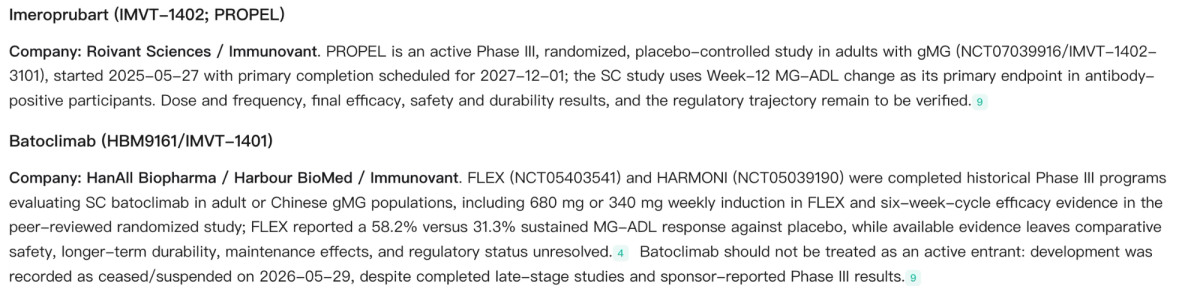
Representative late-stage FcRn programs: imeroprubart and the historical batoclimab Phase III program.
Imeroprubart (IMVT-1402; PROPEL)
Roivant Sciences / Immunovant. PROPEL is an active randomized Phase III study in adults with gMG. Key questions are final efficacy, safety, durability, dosing frequency, regulatory trajectory, and whether the program can differentiate against already approved FcRn products.
Batoclimab (HBM9161/IMVT-1401)
HanAll Biopharma / Harbour BioMed / Immunovant. Batoclimab generated Phase III evidence in adult gMG, but should not be treated as an active entrant in this competitive map because development was recorded as ceased or suspended in 2026. The program remains useful for understanding historical efficacy, safety, maintenance, and molecule-level differentiation questions.
Also in the retrieved Phase III set: nipocalimab VIVACITY-MG3, the active-comparator EPIC study, rozanolixizumab MyVision, and an efgartigimod IVIG-dependent follow-on study. Some of these are follow-on or expansion studies rather than new unapproved broad-gMG entrants.
Stage alone does not establish competitive advantage.
Comparison Agenda
Normalize indication, MGFA class and disease severity, antibody status, prior and background therapy, treatment cycle, route, dosing frequency, trial design, comparator, MG-ADL and QMG measures, responder definitions, durability, safety, infections, IgG reduction, albumin and lipid effects where relevant, regulatory geography, and current development status before interpreting competitive evidence.
Supports
Defining the relevant FcRn/gMG competitor set and structuring the evidence agenda for deeper review.
Does Not Prove
Best-in-class efficacy, safety superiority, a preferred dosing strategy, commercial leadership, or long-term treatment advantage.
Try Noah AI for Free
Use Noah AI to search, compare, and analyze biomedical evidence with AI-powered research workflows. Free credits are available, and no credit card is required to get started.
What Target Intelligence Should Help a Team Decide
A useful target-intelligence report connects target biology → approved assets → active pipeline → modality → developer → indication → clinical evidence → unresolved competitive questions. For FcRn, the target biology explains why IgG lowering can be therapeutically relevant, but it does not tell a team which molecule will deliver the most useful clinical profile.
The deeper decision is whether apparent differentiation is meaningful across efficacy, durability, retreatment, infection and protective-immunity risk, albumin or lipid effects, treatment burden, route, and population fit.
Why a Pipeline Count Is Not a Competitive Conclusion
Development stage indicates maturity, not superiority. Approved FcRn products have different labels, antibody populations, routes, schedules, and retreatment frameworks. Phase III programs may also address different populations or follow-on settings. Cross-trial comparisons can therefore mislead when inclusion criteria, background therapy, endpoint definitions, treatment cycles, and follow-up differ.
Key rule: use a stage map to define the competitor set, not to select a winner.
How Noah Builds Target Intelligence
Noah can define the target and disease scope, identify representative assets across approved, active, historical, and discontinued stages, and map each asset to its developer, indication, route, regimen, and trial status. It can also trace pivotal clinical evidence to the relevant population, comparator, endpoint, and follow-up, while separating regulatory decisions, peer-reviewed studies, trial registries, and sponsor disclosures by evidence type.
This brief establishes the competitor set; it does not make a best-in-class judgment. For more information about Noah's research workflow, visit Noah AI.
Prepare and Run
Before running the analysis, define the target, disease or indication, decision, geography, asset types, development stages, companies of interest, and evidence cutoff. State whether the result should emphasize biology, current pipeline, clinical progress, or a deeper competitive review.
Research Prompt
Investigate FcRn / FCGRT in generalized myasthenia gravis. Confirm target identity, map approved and Phase III therapies by developer and indication, separate development stage from clinical performance, and identify the efficacy, safety, dosing, durability and regulatory evidence needed before comparing assets. Cite the retrieved evidence and do not name a best-in-class therapy without comparable clinical data. Distinguish active, historical, discontinued, and approved status, and note where cross-trial comparisons are not valid.
How to Use the Result
Use the stage map to define the competitor set, not to select a winner. Review next:
- Comparable clinical endpoints, including MG-ADL and QMG
- Responder definitions and adverse events
- Treatment cycle, route, and dosing frequency
- Durability and retreatment evidence
- Current regulatory geography
- Ongoing pivotal and active-comparator studies
Frequently Asked Questions
Does the most advanced drug become the most competitive?
No. Development maturity indicates how far an asset has progressed through testing or regulation, not superior efficacy, safety, durability, or treatment burden.
Why separate approved and Phase III assets?
Approved products have defined regulatory populations and usage conditions. Phase III programs may still have uncertain outcomes and may use different populations, endpoints, dosing schedules, comparators, or follow-up.
Does a target-linked drug record prove clinical efficacy?
No. A target-linked record identifies the mechanism and development program. Clinical efficacy still requires appropriate trial evidence interpreted in the relevant population and treatment context.
Does this report establish best-in-class performance?
No. This is a non-ranking target-intelligence brief. It defines the competitor set and the evidence needed for a deeper comparison.
Build a Target and Competitive Pipeline Brief with Noah AI
Use Noah AI to investigate a drug target and map approved assets, representative pipeline programs, developers, biomarkers, modalities, clinical stages, current status, and unresolved competitive questions.
Build a source-linked target intelligence brief that keeps development stage separate from clinical performance and helps identify what evidence should be reviewed before making competitive conclusions.
Free to use · Free credits included · No credit card required
Build a Target Intelligence Brief with Noah AI →