How to Extract Evidence from Medical Research Papers with AI: Step-by-Step Guide
Linda
Learn how to extract structured, source-traceable evidence from medical research papers with AI, including PICO, endpoints, results, safety data, provenance, and QA.
Summarizing a medical paper is not the same as extracting evidence from it. A useful evidence extraction workflow preserves the exact population, study design, endpoint definition, timepoint, denominator, analysis population, numerical result, safety context, and source location behind every important claim.
This distinction matters in biomedical research because a fluent summary can still hide critical details. A sentence such as “the treatment improved disease severity” does not tell you which endpoint was used, when it was measured, which analysis population was included, whether the value came from the primary publication or a secondary source, or whether the number was directly reported at all.
In this guide, we use Noah AI on six phase III atopic dermatitis trials across three biologic programs: dupilumab SOLO 1/2, tralokinumab ECZTRA 1/2, and lebrikizumab ADvocate1/2. The goal is not to rank the drugs. The goal is to show how AI can turn medical papers into a structured, source-traceable Evidence Extraction Sheet.
Testing note: We tested Noah AI directly. The workflow below reflects a real structured extraction task. Other tools and workflows are not presented as directly tested here.
1. Evidence Extraction Is More Than Paper Summarization
A summary compresses a paper into a readable narrative. Evidence extraction does something more demanding: it breaks the paper into fields that can be checked, compared, and reused.
| Paper summary | Evidence extraction |
|---|---|
| “Dupilumab improved atopic dermatitis outcomes.” | Which trial? Which arm? Which endpoint? Which week? Which denominator? Which analysis population? What was the placebo result? Where was it reported? |
| “The primary endpoint was met.” | What was the exact endpoint definition, responder threshold, timepoint, intervention result, comparator result, P value, and source location? |
| “Safety was acceptable.” | Which safety population? What follow-up period? Any AE? Serious AE? Discontinuation? Which event was directly reported versus unavailable? |
For medical evidence work, the useful unit is not a paragraph. It is a traceable evidence field.
2. The Core Rule: Keep Every Number Attached to Its Context
Number → Endpoint → Timepoint → Population → Analysis → Source
If one of those pieces is missing, the number may be easy to misinterpret. A Week 16 response cannot be silently treated as a Week 52 result. A randomized denominator cannot automatically replace an endpoint-specific denominator. A sponsor-reported rounded percentage should not be relabeled as a directly extracted primary-paper value.
The extraction workflow should therefore preserve uncertainty instead of hiding it. If a field cannot be verified, marking it NR is better than filling the cell with an inferred number.
3. Real Example: Six Phase III Atopic Dermatitis Trials
The demonstration covers three biologic programs:
- Dupilumab: SOLO 1 and SOLO 2
- Tralokinumab: ECZTRA 1 and ECZTRA 2
- Lebrikizumab: ADvocate1 and ADvocate2
These studies are useful for an extraction tutorial because they share a broad placebo-controlled phase III structure but differ in randomization, population details, endpoint definitions, maintenance design, missing-data handling, and the completeness of accessible source tables.
That makes them suitable for demonstrating both what AI can structure and what it should refuse to normalize away.
4. Step 1: Define the Extraction Task Before Reading the Results
The first step is to tell the AI exactly what the final evidence sheet must preserve. We asked Noah to identify the papers, extract PICO, capture study design, preserve primary endpoint definitions, extract secondary outcomes and safety, record provenance, run an extraction QA check, and produce a standardized final table.
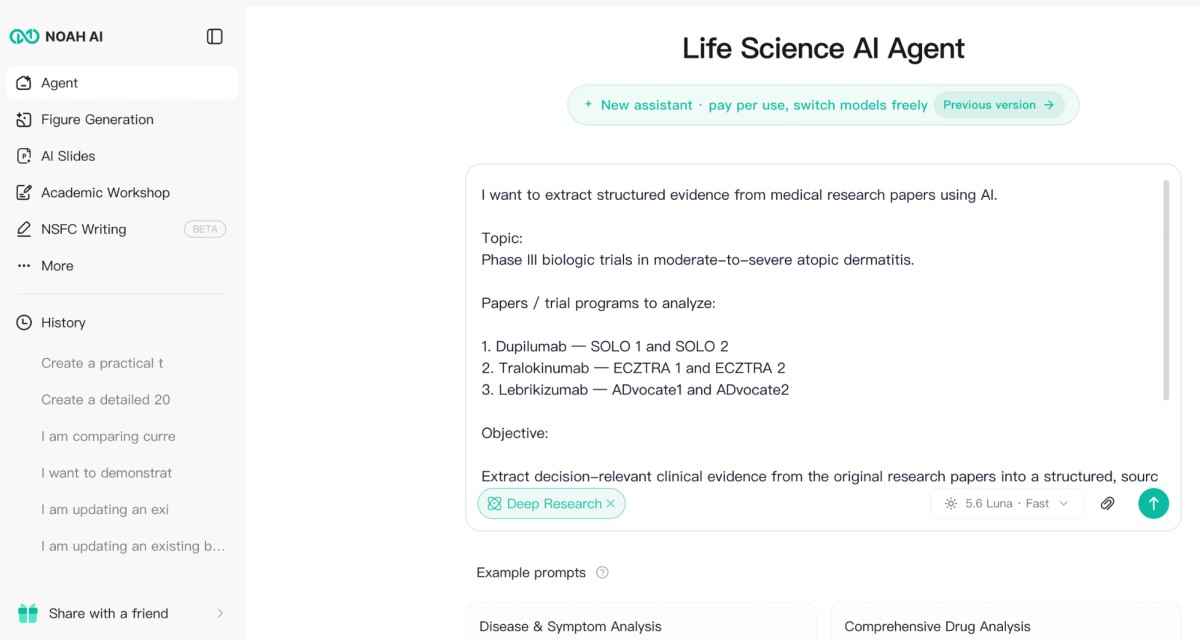
The prompt also set two boundaries explicitly: this was not a literature review and not a drug ranking. That matters because unadjusted cross-trial percentages do not become head-to-head evidence simply because they appear in the same table.
5. Step 2: Extract PICO Before Extracting Results
PICO creates the frame for every result that follows:
- Population: age, disease severity, eligibility criteria, prior therapy, and baseline characteristics that affect interpretation.
- Intervention: drug, loading dose, maintenance dose, frequency, and treatment duration.
- Comparator: placebo or active comparator, including relevant background therapy.
- Outcomes: exact primary and secondary endpoint definitions, patient-reported outcomes, and safety outcomes.
This step prevents a common extraction error: pulling a percentage out of the Results section before confirming which population and endpoint it belongs to.
6. Step 3: Capture the Study Design and Analysis Population
The trial design determines what a result means. A useful extraction sheet should keep the following fields visible:
- randomization and ratio;
- blinding;
- control type;
- number of study arms;
- randomized or enrolled N;
- efficacy analysis population;
- safety analysis population;
- rescue-treatment rules;
- missing-data handling;
- multiplicity control;
- treatment and follow-up periods.
For example, ECZTRA used a full analysis set for its Week 16 binary endpoints, while some endpoint-specific analysis labels in the accessible SOLO and ADvocate material were not fully exposed. The correct extraction behavior is to preserve that difference, not force every trial into an “ITT” label.
7. Step 4: Preserve the Exact Primary Endpoint Definition
Endpoints that look similar can still be operationally different.
SOLO 1/2 and ADvocate1/2 defined primary IGA success as IGA 0 or 1 plus a specified improvement from baseline. ECZTRA 1/2 used IGA 0/1 and EASI-75 as coprimary endpoints.
A good extraction system should not collapse all of these into a generic field such as “skin clearance.”
The endpoint definition itself is part of the evidence.
8. Step 5: Extract Results Without Inventing Missing Values
For each primary endpoint, capture:
- endpoint name and definition;
- timepoint;
- intervention result;
- comparator result;
- numerator and denominator when directly reported;
- effect estimate when reported;
- confidence interval when reported;
- P value when reported;
- analysis population;
- source location.
Do not manufacture missing counts from rounded percentages. Do not calculate a relative risk or odds ratio unless the task explicitly calls for a derived analysis. And do not turn an inaccessible field into a fabricated “not significant” result.
9. Step 6: Add Evidence Provenance
This is the step that turns extraction into something a researcher can audit.
Instead of storing only the value, Noah linked major extracted fields to the paper or trial, the source section or table, the reporting status, and an extraction-confidence label.
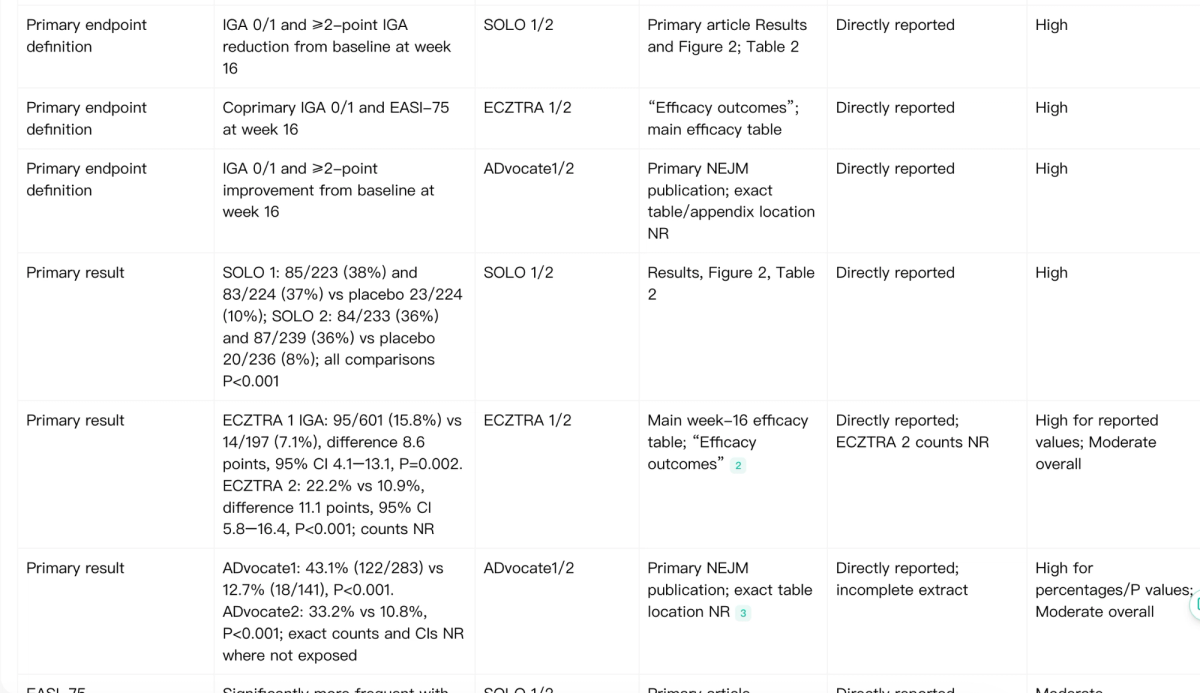
This is especially important when the retrieval record is incomplete. In the output, some ADvocate fields were directly reported but the exact table location was not exposed in the accessible extract. Those rows remained labeled as incomplete rather than being upgraded to false precision.
Extract evidence from your own medical papers with Noah AI
Use Noah AI to structure PICO, endpoints, trial results, safety data, and source provenance from biomedical research workflows.
Noah AI can be used for free, includes free credits, and requires no credit card.
10. Step 7: Keep Primary and Secondary Evidence Separate
Evidence extraction becomes unreliable when primary publications, registries, sponsor pages, regulatory documents, and later analyses are blended without labels.
A clean hierarchy is:
- Primary peer-reviewed publication for the core trial result.
- Supplement or registry for protocol details that are not visible in the main paper.
- Regulatory or sponsor material only when clearly labeled as secondary support.
- Follow-up publications for later timepoints or maintenance populations.
This matters because a sponsor page may provide a useful numerical value while still not being the controlling source for the original randomized comparison.
11. Step 8: Extract Safety with the Correct Denominator and Follow-Up
Safety tables are especially vulnerable to denominator and timepoint errors.
The extraction should identify:
- safety population;
- treatment exposure;
- follow-up period;
- any adverse event;
- serious adverse event;
- discontinuation due to adverse event;
- deaths;
- adverse events of special interest;
- source location.
If a primary extract only supports a qualitative statement such as “conjunctivitis was more frequent,” the evidence sheet should not create an event count from a different source and silently treat it as if it came from the primary paper.
12. Step 9: Run an Extraction QA Check
Before building the final sheet, run a specific quality-control pass. The most useful QA questions are:
| Potential error | What to verify |
|---|---|
| Wrong denominator | Is the denominator randomized N, FAS, endpoint-specific, PRO-specific, or safety N? |
| Wrong timepoint | Is this Week 16 induction or Week 52 maintenance? |
| Wrong analysis population | Did the paper use randomized, ITT, FAS, mITT, per-protocol, or another set? |
| Trial mixing | Are SOLO 1 and SOLO 2, ECZTRA 1 and ECZTRA 2, or ADvocate1 and ADvocate2 kept separate? |
| Endpoint mixing | Was a secondary endpoint accidentally labeled primary? |
| Source inflation | Was a sponsor or regulatory value relabeled as primary evidence? |
| Double counting | Was a follow-up paper treated as a new independent trial? |
| Cross-trial ranking | Were response percentages improperly used as head-to-head evidence? |
A strong extraction workflow should make these errors visible before the evidence is reused downstream.
13. Step 10: Build the Final Evidence Extraction Sheet
The final table should use a consistent schema across papers while preserving trial-specific differences.
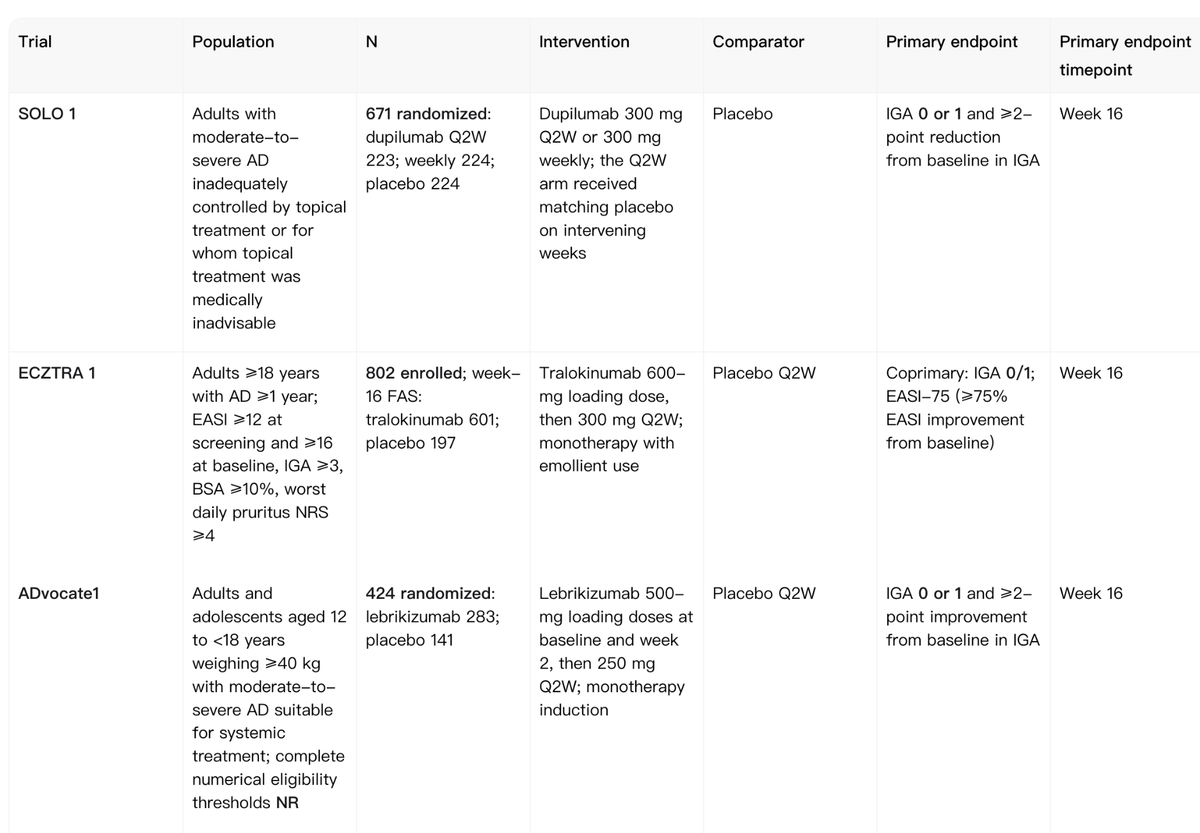
The compact view above focuses on three representative trials so the structure remains readable: SOLO 1 for dupilumab, ECZTRA 1 for tralokinumab, and ADvocate1 for lebrikizumab.
The purpose is not to make the trials look identical. The purpose is to give every paper the same extraction framework while preserving different population definitions, randomization structures, interventions, comparator details, endpoint definitions, and timepoints.
Extract Structured Evidence from Medical Research Papers
Use Noah AI to extract PICO, endpoints, denominators, results, and source provenance into a structured, source-traceable Evidence Extraction Sheet.
Extract Medical Research Evidence with Noah AI →
14. What Can and Cannot Be Harmonized Across Papers?
Reasonably alignable fields
- trial identity;
- phase and design;
- active treatment versus placebo structure;
- Week 16 induction timepoint;
- IGA and EASI endpoint concepts;
- trial-level dosing;
- source type and provenance status.
Fields that require caution
- endpoint-specific denominators;
- missing-data methods;
- rescue-treatment handling;
- patient-reported outcome definitions;
- maintenance populations;
- safety denominators;
- secondary-source rounded values.
Fields that should not be turned into cross-trial rankings
- response percentages from separate trials;
- placebo response rates across programs;
- absolute treatment differences across non-identical designs;
- any-AE rates from different safety populations;
- Week 52 responder-maintenance outcomes versus Week 16 induction outcomes.
A structured table makes evidence easier to inspect. It does not automatically make the studies directly comparable.
15. Common Mistakes When Extracting Evidence with AI
Extracting from the Abstract Only
Abstracts rarely expose all the denominators, endpoint definitions, missing-data rules, secondary outcomes, and safety details needed for a reusable evidence sheet.
Confusing the Endpoint Definition with the Result
“IGA 0/1 plus a ≥2-point improvement” is an endpoint definition. “43.1% versus 12.7%” is a result. These should be stored separately.
Assuming Every Percentage Has a Recoverable Count
Rounded percentages should not be converted back into event counts unless the source provides the relevant denominator and the count can be verified.
Mixing Randomized N with Endpoint N
Patient-reported outcomes and other endpoints can have different evaluable populations. Preserve the denominator attached to the endpoint.
Turning NR into Zero
NR means unavailable or not verifiable in the accessible source. It does not mean that an event did not happen or that an endpoint was not measured.
Mixing Induction and Maintenance Evidence
Responder-based maintenance populations are selected populations and should not be presented as if they were the original randomized induction cohort.
Using Cross-Trial Percentages as Head-to-Head Evidence
The SOLO, ECZTRA, and ADvocate programs differ in population, treatment design, endpoint handling, denominators, missing-data methods, and follow-up. A larger percentage in one trial does not establish superiority over another biologic.
16. Evidence Extraction vs Evidence Tables vs Literature Review
| Workflow | Starting point | Main task | Final output |
|---|---|---|---|
| Evidence extraction | Specific medical papers | Pull precise, source-traceable fields from each paper | Evidence Extraction Sheet |
| Evidence table | Research question + study set | Organize studies across consistent comparison fields | Cross-study evidence table |
| Literature review | Research question + literature base | Synthesize findings across papers | Narrative or structured review |
Evidence Extraction focuses on extracting PICO, endpoints, denominators, results, and source provenance from individual medical research papers. Evidence Tables organize and compare findings across multiple papers, using verified source-level records. A literature review goes further by synthesizing the broader evidence and discussing its implications.
17. Related Research Guides
- Best AI Tools for Turning Research Questions into Evidence Tables (2026)
- Best AI Tools for PubMed Literature Review (2026)
- Best AI Tools for Clinical Trial Results Analysis (2026)
- PubMed Search with AI: How Life Science Professionals Find and Analyze Biomedical Evidence Faster
- How to Search PubMed with AI: A Step-by-Step Guide
18. FAQ
Can AI extract evidence from medical research papers?
Yes. AI can help identify study design, PICO, endpoint definitions, numerical results, analysis populations, safety information, and source locations. The useful standard is not just whether the AI returns a value, but whether the value remains traceable to the correct paper, endpoint, timepoint, and population.
What fields should I extract from a clinical trial paper?
At minimum: trial identity, population, N, intervention, comparator, study design, primary endpoint definition, timepoint, intervention and comparator results, effect estimate, confidence interval, P value, analysis population, safety findings, follow-up, limitations, and source location.
What should I do when a paper does not expose a value?
Mark it NR or uncertain rather than reconstructing an unreported count or statistic. Distinguish “not retrieved” from “not reported” whenever possible.
Should AI calculate missing effect estimates?
Not by default. If the task is evidence extraction, preserve what the paper directly reports. Derived calculations should be a separate, explicitly requested analysis with transparent assumptions.
Can extracted trial results be compared directly across papers?
Only when the populations, endpoint definitions, timepoints, analysis methods, and other important design elements are sufficiently comparable. A shared table layout does not create head-to-head evidence.
Why is source provenance important?
Provenance lets a researcher return to the exact paper section, table, figure, or source type behind a value. That makes QA easier and reduces the risk of silently mixing primary, secondary, sponsor, regulatory, or follow-up evidence.
19. Final Takeaway
Good evidence extraction preserves the link between every number and where it came from.
The practical value of AI in evidence extraction is not just speed. It is structure: keeping trial identity, population, endpoint, timepoint, analysis population, reporting status, and source provenance visible at the same time.
In this atopic dermatitis case, Noah AI organized six phase III trials into a source-traceable extraction workflow while retaining differences in endpoint definitions, denominators, missing-data handling, follow-up, and evidence completeness.
That is the standard to aim for: extract what the paper actually reports, preserve what remains uncertain, and avoid turning structured tables into unsupported cross-trial conclusions.
Build Your Source-Linked Evidence Extraction Sheet
Turn a medical research paper into a structured extraction record. Capture PICO, endpoint definitions, exact denominators, reported results, and source provenance for easier verification and downstream research.
Free to use · Free credits included · No credit card required