How to Build a Decision-Relevant Public Drug Pipeline Landscape with AI
Linda
Learn to map a decision-relevant DLL3 oncology pipeline with AI, comparing public-source assets, modalities, clinical stages, and evidence gaps.
Build a Complete Drug Pipeline Landscape with AI Competitive Intelligence
How public-source evidence can help R&D teams map assets, stages, modalities, and competitive signals across a therapeutic space.
A decision-relevant public drug pipeline landscape is not just a list of known programs. It should show where public evidence is strong, where visibility is limited, which assets define the current benchmark, and which questions require deeper diligence.
This article uses the DLL3 oncology pipeline as a representative public-source example, not an exhaustive inventory of every global discovery, preclinical, or clinical asset.
Evidence cutoff: October 10, 2026.
The analysis distinguishes verified regulatory approvals, clinical trial activity, sponsor-reported developments, and programs with uncertain status. Missing public evidence should not be interpreted as proof that a program does not exist.
Why Drug Pipeline Landscapes Matter for R&D Teams
A structured drug pipeline landscape turns scattered public evidence into a decision framework. For early research and discovery teams, it helps assess whether a target is genuinely underexplored, which biological hypotheses are attracting investment, and where emerging modalities may create differentiation opportunities. For clinical and portfolio teams, it connects assets to indications, development stages, trial designs, safety signals, and competitive benchmarks.
DLL3 illustrates why this matters. Tarlatamab is the clearest regulatory and clinical benchmark for DLL3-directed therapy in extensive-stage small-cell lung cancer (ES-SCLC), but its authorisation status must be interpreted by geography and indication.
United States: Tarlatamab-dlle, marketed as Imdelltra, received FDA accelerated approval on May 16, 2024, followed by traditional approval on November 19, 2025, for adults with ES-SCLC whose disease progressed on or after platinum-based chemotherapy.
European Union: Tarlatamab, marketed as Imdylltra, received EU marketing authorisation on May 29, 2026, as monotherapy for adults with ES-SCLC requiring systemic treatment after progression on or after first-line platinum-based chemotherapy.
Status verified as of October 10, 2026.
These approvals establish an important DLL3-directed clinical benchmark but do not establish equivalent efficacy, safety, or regulatory validation across all DLL3 modalities.
Official sources:
Why Coverage Gaps Grow Earlier in Development
Public visibility generally increases as a program advances. Marketed and late-stage assets usually generate regulatory records, registered trials, results disclosures, publications, conference presentations, and company communications. Discovery and preclinical work may only appear in patents, platform announcements, conference abstracts, company disclosures, or not appear publicly at all.
The regulatory transition to human testing helps explain the gap. Before public clinical evidence appears, discovery, candidate selection, and IND-enabling work may not create a public trail. Even after regulatory steps occur, the existence of an IND is not automatically public. A defensible landscape therefore records the evidence that was found, the evidence cutoff, and the uncertainty around missing records.
A useful pipeline table should not imply that a missing program does not exist. It should state whether public evidence was located, where it came from, and which status fields remain unclear.
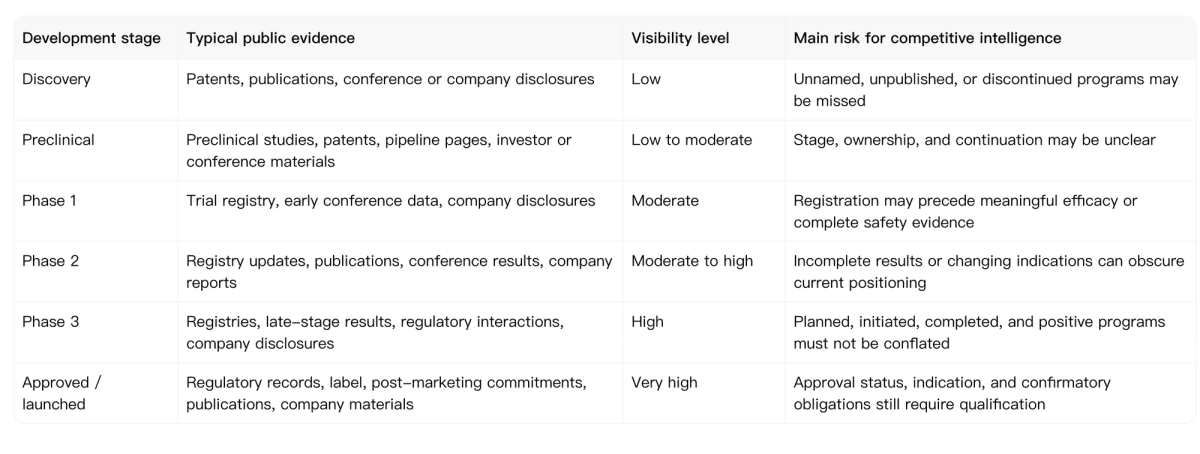
Public-Source DLL3 Pipeline Landscape
The public record shows a clinically validated DLL3 field spanning T-cell engagers, antibody-drug conjugates, engineered cell therapies, bispecific or trispecific constructs, and radioligand approaches. Tarlatamab is the anchor, but it is not the whole competitive field.
The snapshot below reflects public evidence through the stated search cutoff. It should be read as a traceable landscape, not as an exhaustive census of every DLL3 discovery or preclinical program.
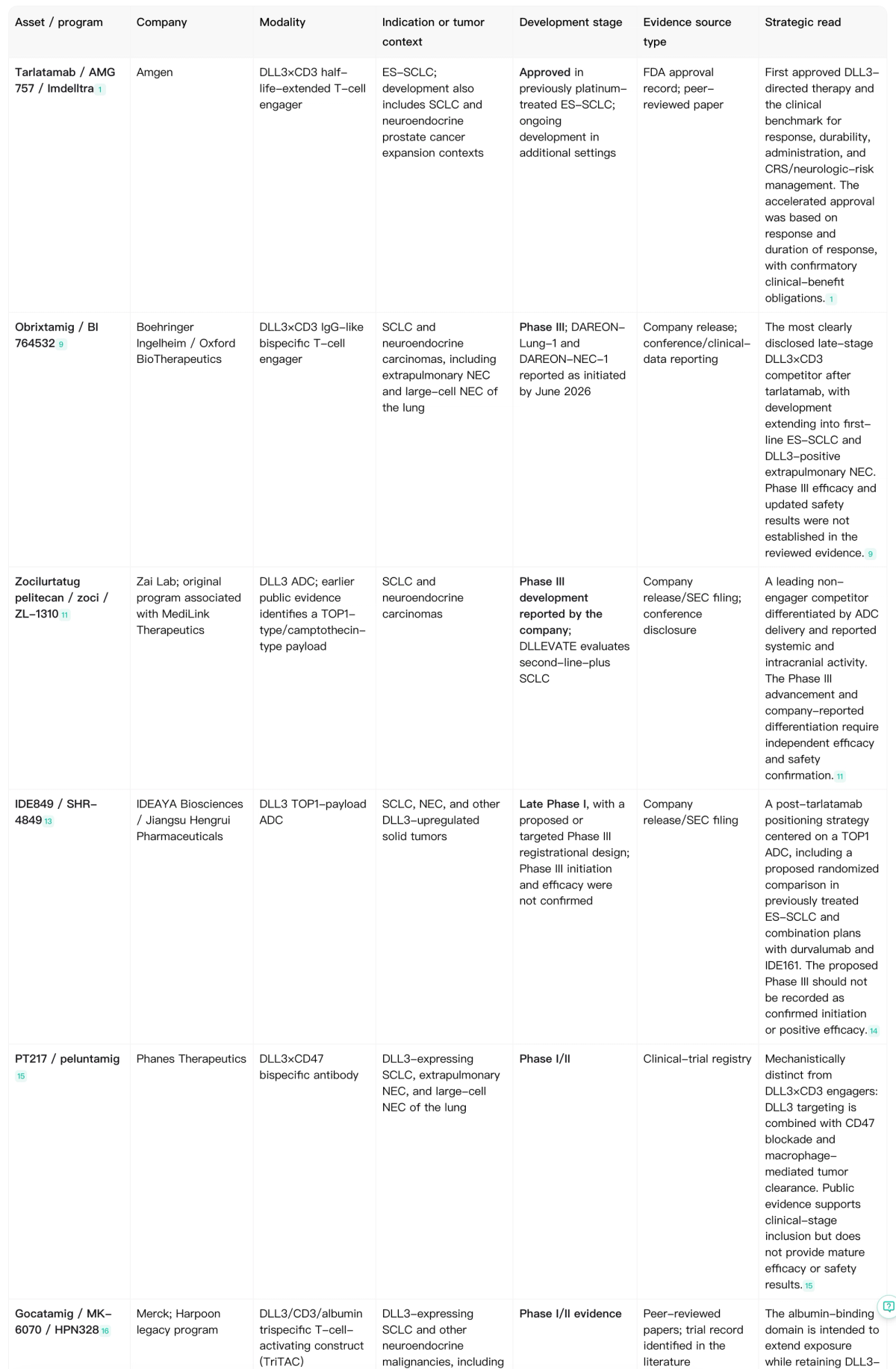
This type of table makes the competitive field reviewable. It distinguishes an FDA-approved benchmark from late-stage competitors, company-reported development plans, early clinical programs, and programs with uncertain continuation. It also prevents planned studies, initiated studies, completed studies, and positive studies from being conflated.
What a Complete Landscape Should Capture
A useful landscape is not simply an asset list. It is an evidence-linked representation of the competitive environment: what is being developed, by whom, for which population, through what technological approach, and with what level of supporting evidence.
| Landscape dimension | Why it matters | Example question |
|---|---|---|
| Target and biology | Clarifies whether programs address the same biological opportunity or only an overlapping target space. | Is DLL3 being used as a tumor-associated antigen in SCLC, NEC, or another DLL3-expressing population? |
| Asset and sponsor | Identifies developer, originator, rights holder, and partnership context. | Is the asset owned by one sponsor or split across regional or development rights? |
| Modality | Separates approaches that differ in delivery, manufacturability, pharmacology, toxicity, and positioning. | Is the program a DLL3×CD3 engager, ADC, CAR-T, bispecific antibody, or radioligand therapy? |
| Stage and status | Prevents planned, active, completed, suspended, discontinued, and approved programs from being collapsed into one label. | Is a Phase III program initiated, planned, or only proposed? |
| Evidence provenance | Allows reviewers to trace every field to a source and assess maturity, recency, and independence. | Is the claim supported by FDA, a registry, peer-reviewed literature, conference data, or a company-reported plan? |
Reproducibility in Drug Discovery Competitive Intelligence
Reproducibility matters because target prioritization and portfolio reviews often revisit the same question under changing assumptions. A reviewer should be able to reconstruct how the landscape was produced, identify the evidence behind each claim, and understand what remains uncertain.
What to define before searching
Target aliases, asset codes, sponsor names, trial identifiers, modalities, indications, geographies, source types, and cutoff date.
What to preserve after searching
Source provenance, inclusion criteria, status taxonomy, evidence versus inference, uncertainty labels, and negative-search handling.
| Reproducibility requirement | What the workflow should record | Why it matters |
|---|---|---|
| Search scope | Target names, aliases, asset codes, sponsor names, trial identifiers, source types, and search date. | Allows another reviewer to repeat the search and identify omissions. |
| Inclusion criteria | Required evidence for inclusion, such as a named asset, identifiable sponsor, disclosed activity, and acceptable public source. | Prevents inconsistent treatment of named programs, duplicate reporting, and unsupported claims. |
| Status taxonomy | Separate labels for active, terminated, completed, approved, and unclear status. | Prevents a registered or historical study from being mistaken for current development. |
| Evidence vs inference | Fields directly confirmed by sources versus analyst interpretation or normalization. | Keeps strategic positioning claims from being presented with more certainty than the evidence supports. |
| Uncertainty handling | "Public evidence limited," "not clearly disclosed," or "no public evidence located as of cutoff." | Prevents absence of evidence from being misreported as evidence of absence. |
Intelligence Across the Full R&D Pipeline
The same pipeline landscape serves different decisions at different points in R&D. Discovery teams need visibility into target biology and modality breadth. Translational teams need biomarker and mechanism context. Clinical development teams need trial status, comparator, endpoints, and safety signals. BD&L and portfolio teams need evidence maturity, rights context, and strategic risk.
| Team or use case | What they need from the landscape | Example decision |
|---|---|---|
| Discovery team | Target biology, expression context, sponsor activity, and modality breadth. | Is DLL3 sufficiently differentiated for a new discovery effort? |
| Translational team | Mechanism, biomarker strategy, evidence maturity, and patient-selection hypotheses. | Which DLL3-expressing population and assay strategy should be evaluated? |
| Clinical development team | Phase, treatment line, cohort design, comparator, endpoint, safety signals, and results maturity. | Should a program enter a particular line of therapy or use an active comparator? |
| BD&L team | Sponsor, rights holder, modality, differentiation claims, regulatory context, and source quality. | Does an external DLL3 asset warrant deeper diligence? |
What Researchers Need After a Landscape View
A pipeline list is the first layer of competitive intelligence, not the final answer. Researchers usually need to move from "who is developing what?" to "how do these programs compare, where might they win, and what evidence is still missing?"
- Asset comparison: compare maturity, source type, trial design, and sponsor claims.
- Modality comparison: distinguish immune engagers, ADCs, CAR-based therapies, and radioligands.
- Safety comparison: separate CRS, neurologic toxicity, cytopenias, ILD, and modality-specific monitoring requirements.
- Whitespace analysis: identify where public evidence is limited rather than declaring a field empty.
- Evidence-gap analysis: create a follow-up queue for missing results, unclear enrollment, uncertain ownership, and unconfirmed phase transitions.
How Noah AI Supports Public-Source Pipeline Competitive Intelligence
Noah AI can support researchers across a public-source competitive-intelligence workflow without replacing specialist databases, expert diligence, or formal portfolio governance. Its role is to help retrieve, structure, compare, and communicate public evidence while keeping humans responsible for source validation and strategic interpretation.
Used carefully, Noah can help researchers organize public evidence by target, sponsor, asset, modality, indication, development stage, evidence maturity, and uncertainty. It can also help convert a pipeline landscape into deeper comparative questions around trial design, safety, modality differentiation, and evidence gaps.
Learn more about Noah AI's human-in-the-loop approach: https://www.noah.bio/hitl?utm_source=blog
Conclusion
A complete drug pipeline landscape is not merely a list of known programs. It should show where evidence is strong, where public visibility is limited, which assets define the current benchmark, and which questions require further investigation.
In DLL3 oncology, tarlatamab establishes the clearest clinical and regulatory benchmark. Obrixtamig, zocilurtatug pelitecan, IDE849, PT217, and other programs illustrate different paths through immune engagement, ADCs, cell therapy, and radioligand development. But evidence maturity is uneven. Some statuses are supported by regulatory records or registered trials; others rely on company disclosures, conference abstracts, or early cohorts. A useful landscape keeps that uncertainty visible.
Build a Drug Pipeline Landscape with Noah AI
Use Noah AI to map public-source drug assets, developers, modalities, clinical stages, regulatory status, and competitive evidence gaps in one structured research workflow.
Build a decision-relevant pipeline landscape that separates historical development phases from current activity, identifies established clinical benchmarks, and highlights programs requiring deeper investigation.
Free to use · Free credits included · No credit card required
Build a Drug Pipeline Landscape with Noah AI →