CD47 Competitive Landscape 2026: Clinical Programs, Safety Signals and Development Strategy
Linda
A 2026 CD47 competitive landscape covering clinical programs, safety liabilities, failure analysis, modality differentiation, biomarker strategy, and development implications.
CD47 remains one of oncology’s most instructive examples of why a target cannot be judged from trial counts, early response rates, or a single failed molecule. The key question in 2026 is whether next-generation CD47/SIRPα programs can separate target biology from molecule-specific toxicity, choose more rational combination partners, and generate randomized evidence that improves the benefit–risk profile.
This report uses a structured competitive-intelligence workflow in Noah AI to compare CD47/SIRPα assets across the same dimensions: modality, mechanism, indication, development stage, efficacy evidence, safety, current status, and the main issues or plausible explanations associated with positive, negative, or still-uncertain clinical outcomes.
Where the public evidence does not establish causality, the analysis distinguishes documented findings from possible explanations rather than treating an observed program outcome as proof of why it occurred.
1. Why Structured Competitive Analysis Matters
The CD47 field contains conventional anti-CD47 antibodies, SIRPα-Fc fusion proteins, bispecifics, engineered constructs and newer macrophage-engaging formats. Those programs are not interchangeable. Their red-cell binding, Fc configuration, dose strategy, partner therapy, indication, trial comparator and evidence maturity can differ materially.
That makes a simple pipeline list misleading. A Phase I single-arm response rate does not carry the same weight as a randomized comparative trial. A terminated study may reflect a molecule-specific toxicity, a failed combination, an indication-level problem, or a business decision rather than target invalidation. A useful landscape therefore needs consistent fields and explicit evidence boundaries.
Workflow used: define the competitive scope → identify clinically relevant assets → normalize the comparison fields → separate randomized from single-arm evidence → analyze target-level versus molecule-level safety → classify failures → prioritize surviving strategies → define development implications.
2. Defining the CD47 Competitive Scope
The direct competitive set is defined by pharmacologic manipulation of the CD47–SIRPα macrophage checkpoint. It includes anti-CD47 antibodies, SIRPα-Fc proteins, CD47-containing bispecifics, and other clinical formats in which CD47/SIRPα blockade is a central therapeutic mechanism.
| Modality | Competitive rationale | Key differentiation question |
|---|---|---|
| Anti-CD47 monoclonal antibodies | Directly interrupt CD47–SIRPα signaling. | Can RBC binding, priming burden, Fc activity and hematologic toxicity be controlled? |
| SIRPα-Fc fusion proteins | Use engineered SIRPα domains to bind CD47. | Does Fc configuration improve the therapeutic window without sacrificing macrophage activity? |
| CD47-containing bispecifics | Localize CD47-axis inhibition through a tumor or immune target. | Does tumor localization reduce systemic toxicity and produce incremental efficacy? |
| Multi-axis macrophage-engaging formats | Combine CD47/SIRPα modulation with other immune mechanisms. | Can added biological complexity produce a measurable advantage rather than attribution and safety problems? |
3. CD47 Asset Landscape in 2026
The landscape is broad but clinically uneven. Magrolimab is still the most important negative benchmark because its pivotal AML/MDS development failed despite encouraging earlier single-arm signals. Evorpacept continues selectively after negative HNSCC trials. Ligufalimab has become one of the most important emerging programs because sponsor-reported randomized Phase II AML data suggested comparative benefit, although the dataset remains conference-stage rather than fully independently validated.
| Asset | Company | Modality | Development signal | Current strategic role |
|---|---|---|---|---|
| Magrolimab | Gilead / Forty Seven | Anti-CD47 mAb | Pivotal AML/MDS programs discontinued after futility and mortality concerns. | Negative benchmark for randomized validation and combination safety. |
| Evorpacept | ALX Oncology | Fc-inactive SIRPα-Fc | Selected combinations continue; HNSCC strategy failed randomized Phase II endpoints. | Leading combination- and biomarker-dependent strategy. |
| Ligufalimab | Akeso | Next-generation anti-CD47 IgG4 | Active with sponsor-reported randomized Phase II AML signal. | High-priority emerging competitor pending mature confirmation. |
| HCB101 | HanchorBio | SIRPα-Fc | Early human PK/PD and receptor-occupancy evidence. | Next-generation pharmacology platform; efficacy remains immature. |
| IMC-002 | ImmuneOncia | Anti-CD47 mAb | Early sponsor-reported combination and biomarker signal. | Biomarker hypothesis requiring prospective validation. |
| HCB301 / IMM2520 | HanchorBio / ImmuneOnco | Multi-axis / bispecific formats | Clinical-stage with limited mature efficacy evidence. | Modality differentiation rather than validated efficacy leadership. |
4. Standardized Clinical Comparison
The most useful comparison is not a ranking of raw response rates. Magrolimab, evorpacept, ligufalimab and the earlier SIRPα-Fc programs were studied in different diseases, lines of therapy, combinations and evidence settings. The important distinction is whether a signal came from randomized comparative evidence, a single-arm study, a sponsor-reported subgroup, or an early pharmacodynamic dataset.
Magrolimab demonstrates why this hierarchy matters. Early MDS studies reported strong response activity, but randomized ENHANCE-3 did not show incremental AML benefit and raised a serious mortality signal. Evorpacept shows a different pattern: failure in HNSCC did not terminate the asset globally, but it narrowed the credible development thesis toward selected antibody combinations and biomarker-enriched settings. Ligufalimab is the most important current positive counterexample, but its reported comparative benefit still requires mature, independently assessable confirmation.
5. What the Public Evidence Shows Across Positive and Negative Programs
The CD47 field has generated real pharmacologic activity, but clinical activity is not the same as incremental clinical benefit.
Several early programs produced encouraging signals in uncontrolled or early-stage cohorts. Later randomized or pivotal testing exposed additional questions around comparator choice, combination partner, safety, patient selection, and evidence maturity.
These observations should not automatically be interpreted as proven causes of success or failure. Where direct causal evidence is unavailable, they are better treated as possible explanations or major issues visible in the public evidence.
- Magrolimab: early activity did not translate into favorable randomized benefit–risk in AML/MDS. The public evidence establishes the negative clinical outcome, while the relative contribution of safety, disease context, partner therapy, and molecule-specific factors should be interpreted cautiously.
- Evorpacept: negative HNSCC trials narrowed the development thesis. Public evidence suggests that tumor context, partner therapy, and biomarker selection may matter, but the available data do not prove that any single factor caused the negative result.
- TTI-621 / maplirpacept: Fc configuration and hematologic safety remain important development considerations, but differences across assets should not be reduced to a single mechanism without direct comparative evidence.
- CC-90002: severe toxicity, immunogenicity, and lack of objective responses are major publicly reported issues. These findings support concern at the molecule and development-context level more strongly than a universal conclusion about the entire CD47 class.
- Ligufalimab: sponsor-reported randomized activity keeps the target hypothesis active, but the evidence remains less mature than a fully published and independently assessable late-stage dataset.
6. Target-Level vs Molecule-Level Safety
The central safety question is not whether “CD47 causes toxicity.” It is which liabilities plausibly follow target biology and which are strongly shaped by molecule design, Fc engineering, dosing, disease state, or combination backbone.
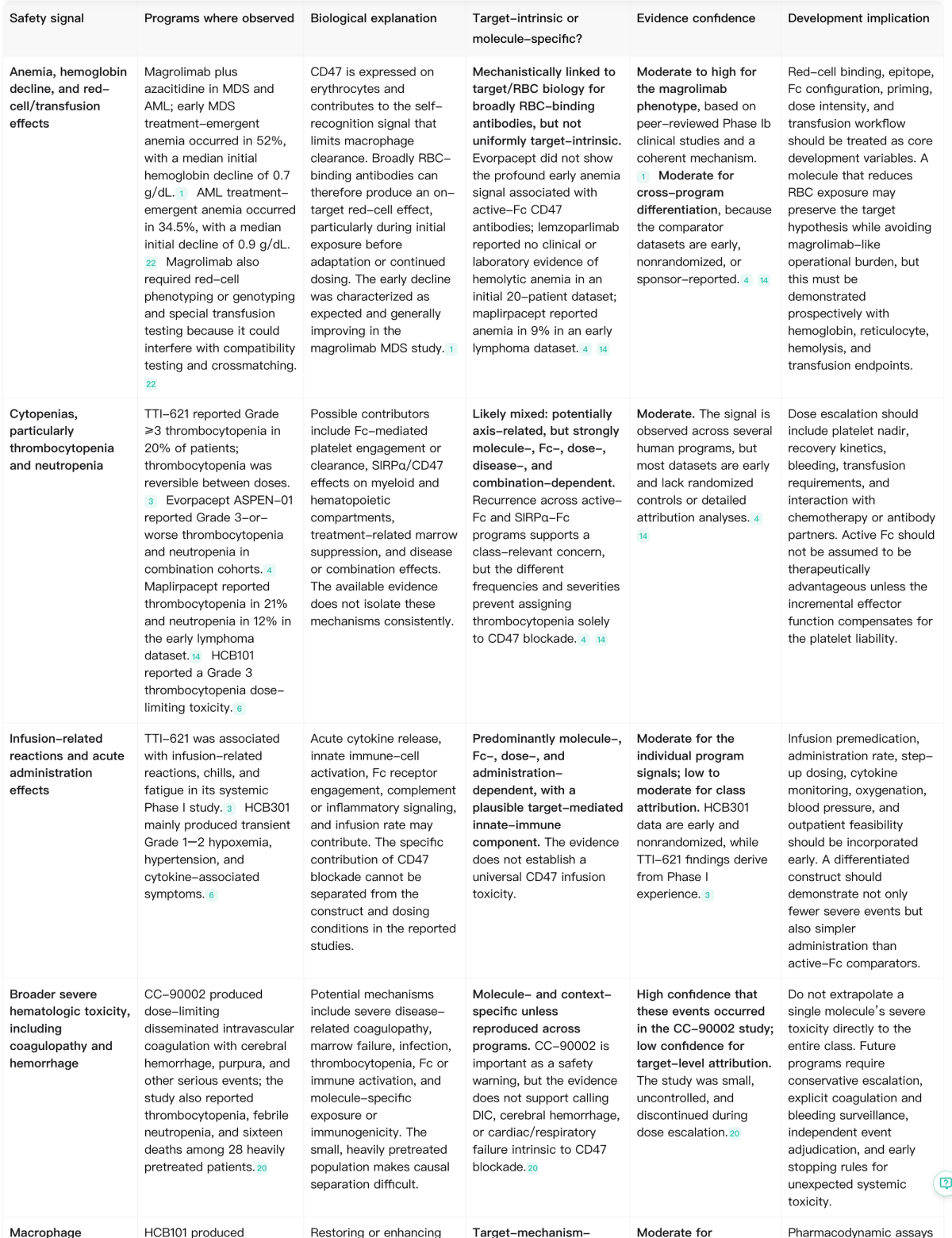
The strongest mechanistic class concern is red-cell biology. CD47 is expressed on erythrocytes, so broad RBC-binding antibodies can interfere with the normal “self” signal and produce hemoglobin decline or transfusion complexity. Yet the phenotype is not uniform across the class. Fc-inactive, red-cell-sparing and differently engineered molecules have reported different anemia patterns, which means safety must be demonstrated at the asset–regimen level.
Thrombocytopenia is also important because it appears across several formats, but the public evidence does not support reducing it to a pure target effect. Fc activity, marrow status, combination partners and dose intensity can all contribute. Likewise, the severe coagulopathy and immunogenicity seen with CC-90002 should not be promoted to universal class liabilities without cross-program replication.
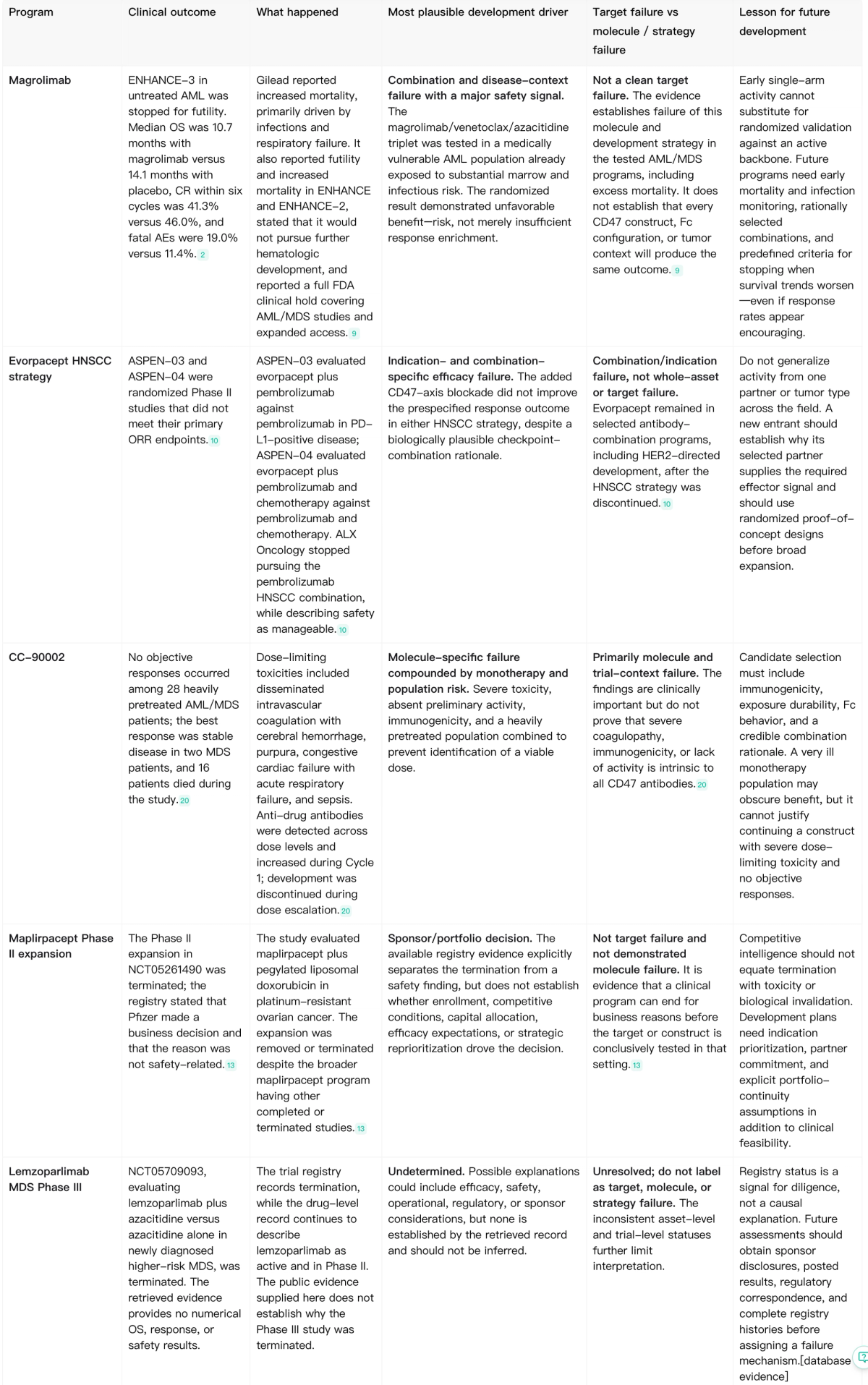
7. Program Outcome Analysis: What Can the Public Evidence Support?
Program termination or a negative trial should be treated as an evidence question rather than a simple label.
The CD47 field contains several different types of negative outcomes, including:
- unfavorable randomized benefit–risk;
- indication-specific efficacy failure;
- molecule-specific toxicity or immunogenicity;
- combination-strategy failure;
- sponsor portfolio decisions;
- and trial termination without a publicly established causal explanation.
The key analytical rule is to separate:
documented outcome → major issue visible in the evidence → plausible explanation → unresolved causality
A negative program outcome does not automatically establish target failure, just as a positive early signal does not establish class validation.
8. Competitive Prioritization
Strategic relevance is now concentrated in a relatively small group of differentiated programs. Ligufalimab deserves close monitoring because it carries the strongest newly reported randomized efficacy signal in the retrieved landscape, although the evidence remains sponsor- and conference-stage. Evorpacept remains important because it represents a distinct Fc-inactive, partner-dependent strategy and has a developing biomarker hypothesis despite negative randomized HNSCC results.
HCB101 and IMC-002 are earlier competitors whose value lies more in pharmacodynamic control or biomarker exploration than proven efficacy. HCB301 and IMM2520 represent a broader shift toward tumor-localized or multi-checkpoint formats, but clinical attribution becomes harder as construct complexity rises. Magrolimab remains strategically important primarily as the negative benchmark that sets the safety and randomized-evidence bar for every new entrant.
| Program | Current evidence | Differentiation | Main uncertainty |
|---|---|---|---|
| Ligufalimab | Randomized Phase II signal, sponsor-reported | Next-generation antibody / RBC profile | Maturity, reproducibility and full safety dataset |
| Evorpacept | Regimen-dependent clinical evidence | Fc-inactive, partner- and biomarker-oriented | Whether biomarker enrichment is prospectively predictive |
| HCB101 | Strong PK/PD, limited efficacy evidence | SIRPα-Fc with quantitative receptor occupancy | Whether occupancy translates into durable benefit |
| IMC-002 | Small sponsor-reported Phase Ib dataset | Biomarker-oriented anti-CD47 strategy | Prospective validation of expression-based selection |
| HCB301 / IMM2520 | Early clinical-stage | Multi-axis or tumor-localized formats | Clinical attribution, safety and efficacy maturity |
9. Development Implications for a New Entrant
Scientific validation is stronger than class-level clinical validation
Human studies support the core biology: the CD47–SIRPα axis can be pharmacologically engaged, macrophage-associated pharmacodynamics can be measured, and selected combinations can produce clinical responses. What remains unproven is a broad, reproducible class-level benefit across tumor types and regimens.
Modality choice should be driven by therapeutic window
The most credible next-generation thesis is not “more CD47 blockade.” It is better control of where and how the macrophage checkpoint is engaged. Fc-inactive constructs, RBC-sparing antibodies, tumor-localized bispecifics and multi-axis formats all attempt to solve the same problem from different directions: preserve antitumor macrophage activity while reducing red-cell, platelet, inflammatory and systemic liabilities.
Opportunity is likely to be context-specific
The strongest remaining opportunities appear to be settings with a rational combination partner, a measurable biological context, and a comparator that can test true incremental benefit. Biomarker-enriched HER2-positive disease is one hypothesis because evorpacept has generated an exploratory CD47-high signal. Hematologic disease remains possible but carries a much higher burden of proving safety and survival benefit. Localized or tumor-restricted delivery may also offer a narrower therapeutic window.
Biomarker strategy must be prospective
CD47 expression alone is not a validated predictive biomarker. A credible program should evaluate tumor CD47 expression, partner-antigen density, receptor occupancy, exposure, macrophage state and treatment-induced immune changes as prespecified hypotheses rather than post-hoc responder stories.
Minimum win conditions
| Win condition | What a differentiated program must show |
|---|---|
| RBC safety and usability | Limited hemoglobin disruption, no clinically meaningful hemolysis, and minimal transfusion-compatibility burden. |
| Hematologic therapeutic window | Acceptable platelet, marrow, infection and early-mortality profile in the intended regimen. |
| Relevant target engagement | PD or receptor-occupancy evidence linked to exposure and clinical outcome rather than reported in isolation. |
| Rational partner selection | Clear partner-antigen or immune rationale with a plausible effector mechanism. |
| Early comparative validation | Randomized evidence early enough to distinguish true incremental benefit from single-arm selection effects. |
| Prospective biomarker testing | Prespecified assay, threshold or continuous model, and a treatment-by-biomarker interaction analysis. |
| Durability | Meaningful progression or survival improvement that outweighs added toxicity. |
10. Bottom Line
CD47 should neither be described as a dead target nor treated as a clinically validated class. The biology remains credible, and several human programs demonstrate measurable target engagement, macrophage pharmacology and clinical activity. But pivotal failures—most importantly magrolimab—show that early response signals are insufficient when randomized benefit–risk is unfavorable.
The central development lesson is that failure must be decomposed. Some problems plausibly follow red-cell biology; some are heavily influenced by Fc configuration, exposure, dose and combination partner; others reflect molecule-specific immunogenicity, indication mismatch or portfolio decisions. The competitive opportunity therefore lies in a differentiated, biomarker-aware, tumor-contextualized or RBC-sparing program tested against an active standard.
For a new entrant, the win condition is not simply to show CD47 binding. It is to demonstrate controllable macrophage engagement, a usable safety profile, rational patient or partner selection, and randomized evidence of durable benefit.
Build a Source-Linked Competitive Landscape with Noah AI
Use Noah AI to compare clinical programs, evidence maturity, safety liabilities, modality differences, biomarker strategies, and major unresolved development questions across a therapeutic landscape.
Build a structured view that separates documented trial outcomes from plausible explanations and keeps the underlying evidence linked to the analysis.
Build a Competitive Landscape with Noah AI →
Related Research Guides
- Best AI Tools for Research Evidence Tables (2026)
- AI Tools for Clinical Trial Results Analysis (2026)
- Drug Pipeline, Clinical Trial and Market Signals
Learn more about Noah’s evidence-grounded research workflow at Noah AI.