How to Build a Disease Landscape Report: A Complete Guide
Linda
earn how Noah AI helps life science teams build disease landscape reports by analyzing epidemiology, treatment pathways, guidelines, clinical evidence, drug pipelines, unmet needs, and traceable references.
Disease landscape reports are essential for life science teams that need to understand a therapeutic area before making medical, clinical, commercial, or business development decisions. A strong disease landscape report usually brings together epidemiology, patient segmentation, treatment pathways, guideline recommendations, clinical evidence, competitive products, pipeline activity, unmet needs, and strategic implications.The challenge is that this information rarely lives in one place. Teams often need to review medical literature, clinical trial results, treatment guidelines, regulatory updates, drug pipelines, conference insights, and market signals before they can form a complete view of a disease area.Noah AI helps life science teams build disease landscape reports by connecting professional medical research workflows with structured AI analysis. Users can begin with a disease area and research scope, then use Noah AI to organize evidence, compare treatments, identify gaps, and keep references visible for review. The result is not a final approved strategy document, but a stronger evidence-backed draft that teams can refine for medical strategy, BD research, market assessment, or internal briefing.
Why Disease Landscape Reports Are Hard to Build
A disease landscape report is difficult to prepare because it has to connect multiple types of evidence. Teams may need to understand disease burden, current treatment pathways, guideline recommendations, clinical evidence, approved products, pipeline programs, regulatory context, unmet needs, and market implications in one coherent story.The hardest part is not only collecting information. It is connecting the evidence into a coherent landscape that teams can use for strategy, briefing, or decision support. A literature search may provide papers, but a disease landscape report needs to explain what those papers mean for a specific disease area, treatment class, patient segment, or market question.This is why a structured workflow matters. Without one, teams can spend hours moving between PubMed, clinical trial databases, guidelines, company releases, conference updates, and internal spreadsheets before they can create a useful report. For teams new to the platform, the Noah AI Tutorial explains how Agent Mode supports structured medical and biopharma research workflows.
What Should a Disease Landscape Report Include?
A strong disease landscape report should usually cover several layers of analysis. The exact structure depends on the disease area and business question, but most reports include the following components:
- Disease overview and clinical definition
- Epidemiology, prevalence, incidence, and patient segmentation
- Disease burden and public health impact
- Current treatment pathways and standard of care
- Guideline context and clinical recommendations
- Key clinical evidence and pivotal trial findings
- Approved therapies and competitive products
- Pipeline activity and emerging mechanisms
- Unmet medical needs and evidence gaps
- Market implications and strategic takeaways
- Traceable references for validation and review
Disease Landscape Report Checklist
✅ Disease Overview
✅ Epidemiology
✅ Incidence
✅ Prevalence
✅ Patient Journey
✅ Standard of Care
✅ Guidelines
✅ Clinical Trials
✅ Approved Therapies
✅ Drug Pipeline
✅ Competitors
✅ Unmet Needs
✅ Future Trends
How Noah AI Supports Disease Landscape Analysis
Noah AI is useful when a disease landscape report needs to combine medical evidence, clinical trial data, pipeline context, guideline interpretation, and strategic analysis in one workflow. Users can start with Agent Mode, define the disease area and report scope, and ask Noah AI to generate a structured report with cited sources.For example, a team can ask Noah AI to build a disease landscape report for type 2 diabetes with a focus on GLP-1 receptor agonists and cardiovascular risk reduction. The prompt can request disease burden, patient segmentation, treatment pathways, guideline context, clinical evidence, competitive drug landscape, pipeline activity, unmet medical needs, market implications, and traceable references.
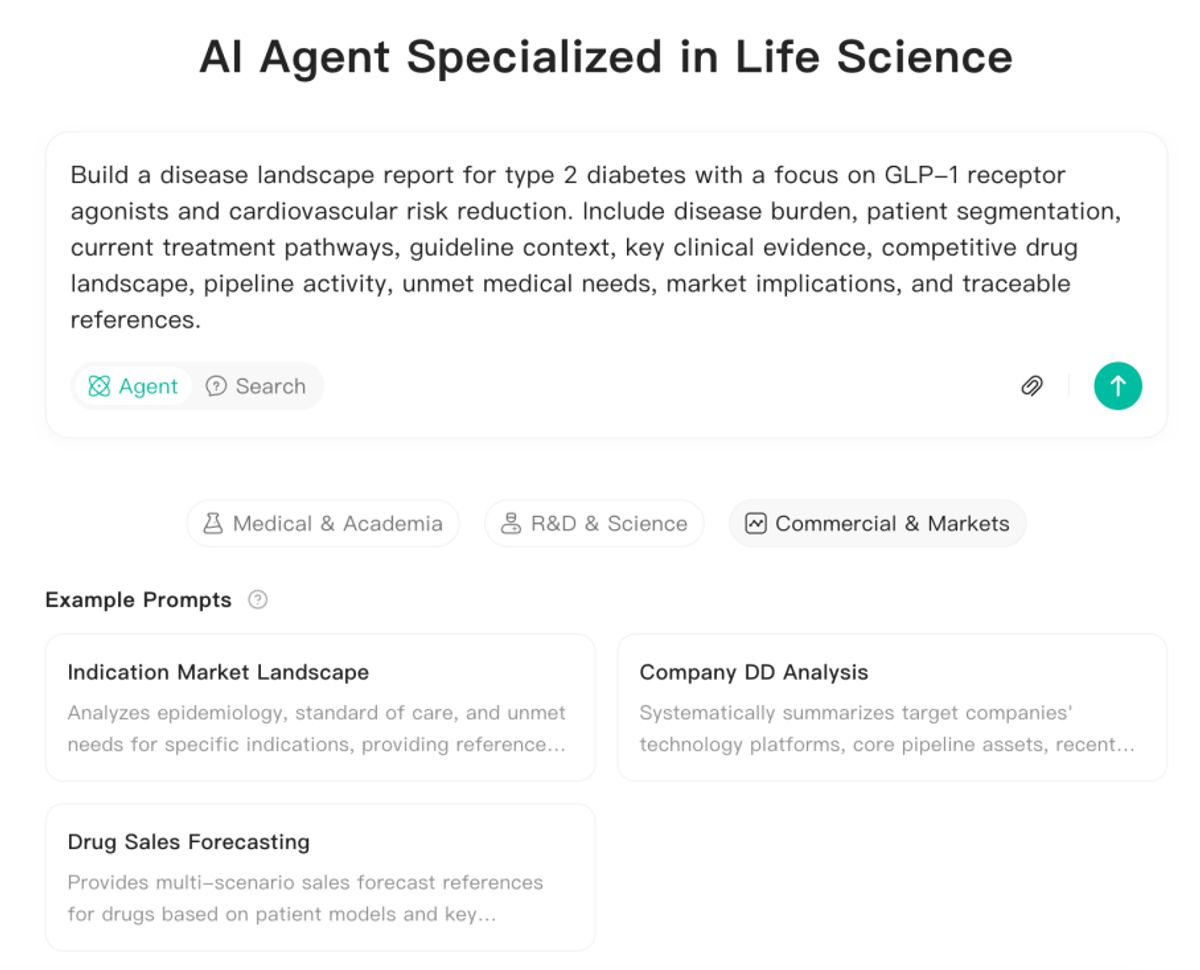
Figure 1. Users can start a disease landscape report in Noah AI Agent Mode by defining the disease area, treatment focus, evidence scope, and required report sections.
Step 1: Define the Disease Area and Research Scope
The first step is to define the disease area, treatment focus, audience, and required output. A broad prompt such as “write about type 2 diabetes” is usually not enough. A better prompt gives Noah AI a clearer research scope and asks for specific sections that match a real business or medical workflow.
For a disease landscape report, teams should specify the disease area, region if relevant, treatment class, clinical question, evidence scope, target audience, and output format. This helps the report become more useful for Medical Affairs, BD research, market assessment, or internal strategy discussion.
Step 2: Generate a Structured Disease Landscape Report
After the research scope is defined, Noah AI can generate a structured disease landscape report. In the type 2 diabetes and GLP-1 receptor agonist example, the report begins with an executive summary that connects disease burden, cardiovascular risk, guideline context, clinical evidence, and commercial implications.
This matters because a disease landscape report needs to connect scientific and strategic information. A useful report should not only say that a disease is important. It should explain how disease burden, treatment changes, clinical evidence, and market dynamics interact.
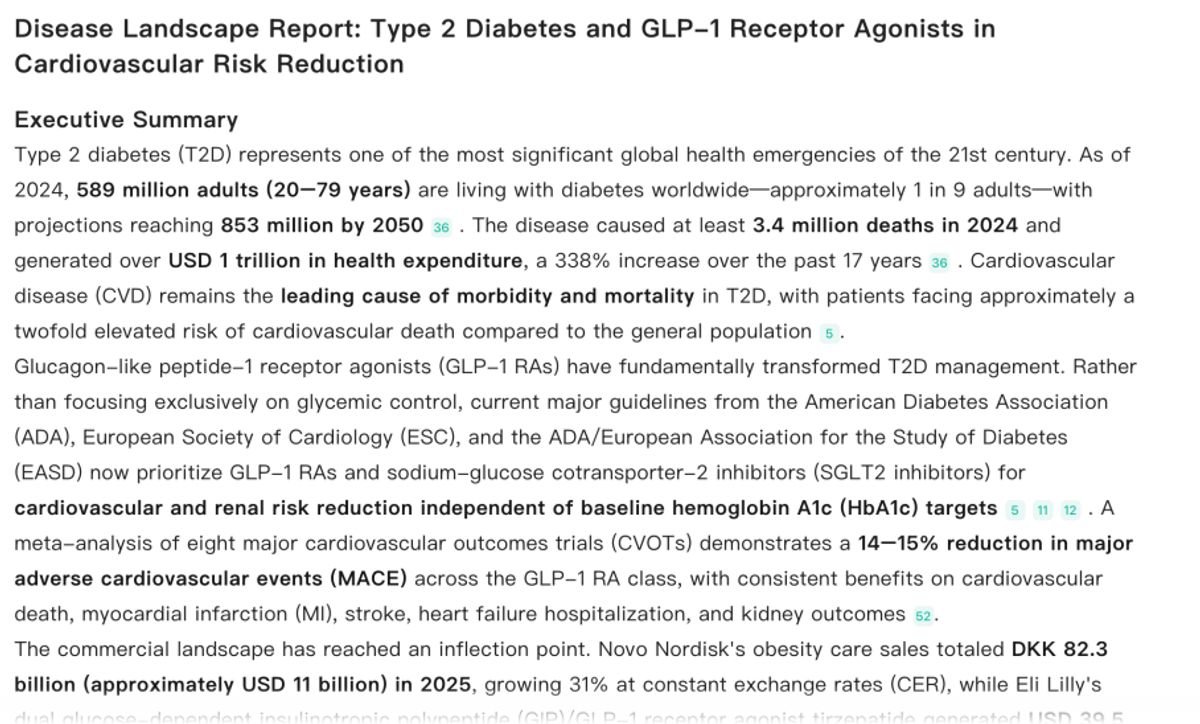
Figure 2. Noah AI can turn a disease research question into a structured landscape report with an executive summary, cited evidence, guideline context, clinical findings, and market implications.
Step 3: Analyze Disease Burden, Treatment Pathways, and Guidelines
Disease burden and epidemiology are often the foundation of a disease landscape report. Teams need to understand prevalence, incidence, mortality, patient segments, risk factors, and regional differences. These data points help frame the size and urgency of the disease area.Noah AI can organize epidemiology and burden-of-disease information into structured tables. This makes it easier for teams to compare sources, check dates, and understand how different data sets support the overall landscape. In the example below, the report compares global diabetes prevalence estimates and projections from sources such as IDF Diabetes Atlas and GBD-related data.
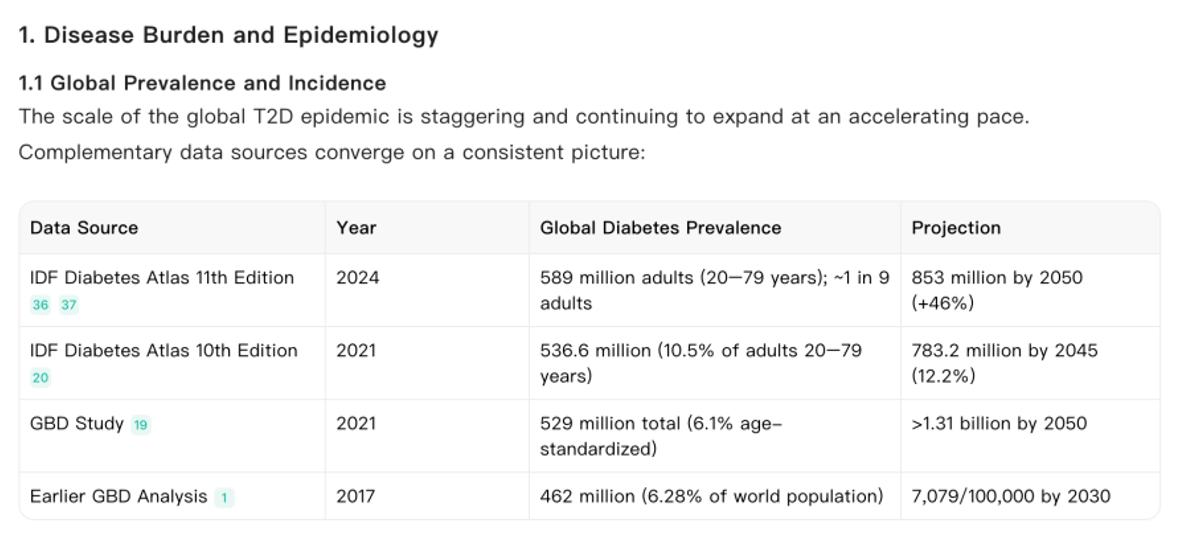
Figure 3. Noah AI summarizes disease burden and epidemiology using structured tables with cited evidence, helping researchers quickly understand prevalence trends and key public health indicators.
Step 4: Review Clinical Evidence and Drug Pipeline Activity
A disease landscape report also needs to explain the treatment and competitive landscape. For many biopharma questions, this means reviewing approved therapies, pivotal clinical trials, emerging mechanisms, pipeline assets, development stage, and major companies active in the space.Noah AI can help connect disease context with clinical trial evidence and pipeline activity. For a GLP-1 receptor agonist landscape, this may include cardiovascular outcomes trials, guideline positioning, approved agents, emerging incretin therapies, obesity-related indications, and adjacent cardiometabolic opportunities.For clinical evidence review, teams can also use Noah AI to analyze clinical trial results in a structured workflow. Disease landscape reports often need to connect clinical evidence with drug pipelines, clinical trials, and market signals to support medical, commercial, and BD decisions.
Step 5: Identify Unmet Needs and Strategic Implications
The value of a disease landscape report is not only in summarizing what is already known. Teams also need to understand what remains unresolved. These unresolved areas may include efficacy gaps, safety concerns, access barriers, adherence challenges, underserved patient subgroups, biomarker questions, or limitations in current treatment pathways.Noah AI can help surface these gaps and translate them into strategic implications. For Medical Affairs teams, this may support evidence planning or MSL briefing. Medical Affairs teams can also use disease landscape reports as a foundation for evidence-based briefing materials. For BD teams, the report may help identify opportunities for partnership or investment. For market research teams, it may clarify where future product differentiation could matter.
Disease Landscape Report Sections and How Noah AI Supports Them
| Report Section | What Teams Need to Understand | How Noah AI Can Help |
|---|---|---|
| Disease burden | Prevalence, incidence, patient segments, risk factors | Summarize epidemiology and patient population context |
| Treatment pathway | Current standard of care, treatment sequence, guideline recommendations | Organize therapies and clinical positioning by treatment setting |
| Clinical evidence | Key trials, endpoints, efficacy and safety findings | Summarize clinical evidence into structured sections or tables |
| Competitive landscape | Approved drugs, major competitors, mechanisms, companies | Compare assets by drug, target, company, phase, and indication |
| Pipeline activity | Emerging therapies, development stage, trial direction | Track pipeline programs and development signals |
| Unmet needs | Gaps in efficacy, safety, access, adherence, subpopulations | Identify evidence gaps and strategic opportunity areas |
| Strategic implications | What the findings mean for medical, BD, or market teams | Generate briefing-ready takeaways for internal discussion |
| References | Source quality and traceability | Keep citations visible for review and validation |
Why Traceable References Matter in Disease Landscape Reports
A disease landscape report may influence internal strategy, medical planning, BD research, market analysis, or cross-functional briefing. For that reason, source transparency matters. Teams need to know which claims are supported by epidemiology data, clinical guidelines, clinical trial evidence, regulatory sources, company materials, or scientific publications.Noah AI keeps references visible so users can review the evidence behind the output. In a disease landscape workflow, references may include epidemiology sources, guideline documents, clinical trial records, FDA or EMA materials, journal articles, conference updates, and market-related sources. Users can review these references before adapting the report for internal discussion, slides, or follow-up research.For medical workflows, traceable references are one of the key differences between domain-specific AI tools and general AI chatbots. You can read more about this difference in Noah vs ChatGPT.
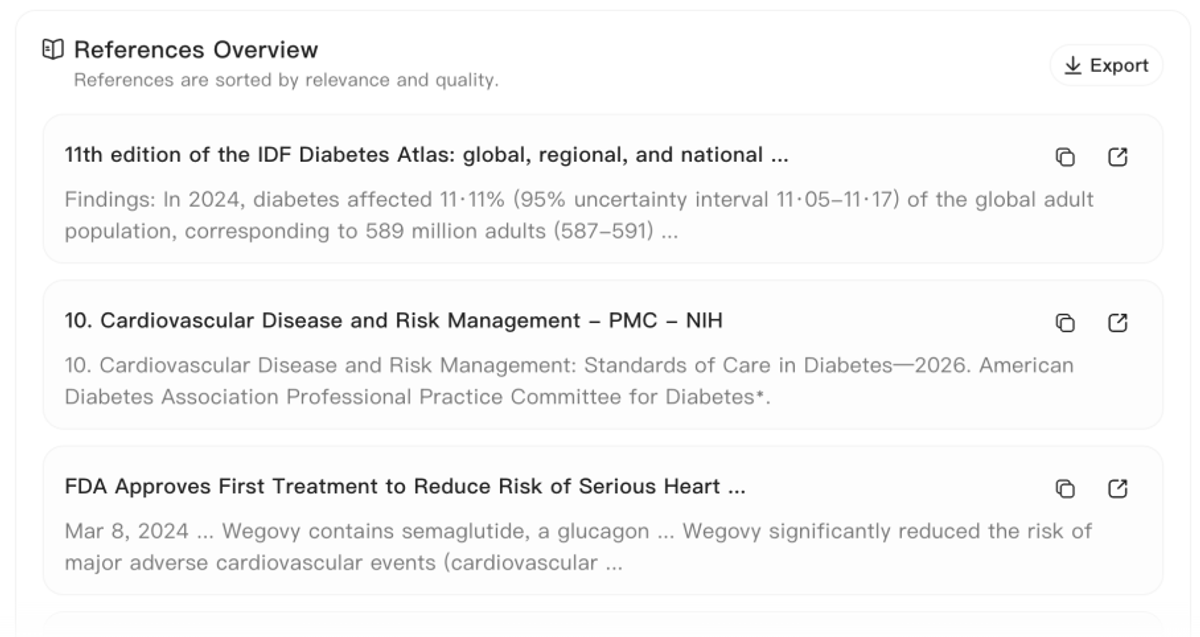
Figure 4. Noah AI keeps references visible and exportable so teams can review the sources behind disease burden, guideline, regulatory, and market findings.
Common Use Cases for Disease Landscape Reports
Disease landscape reports are useful across several life science workflows:
- Medical Affairs teams can prepare evidence-based disease area briefings.
- BD teams can evaluate therapeutic areas and identify competitive opportunities.
- Clinical strategy teams can understand prior evidence and trial design patterns.
- Market research teams can assess patient burden, treatment pathways, and unmet needs.
- Commercial teams can understand disease context before product strategy discussions.
- Consulting teams can create structured background reports for client engagements.
How to Turn a Disease Landscape Report into Briefing Materials
After a structured report is generated, teams often need to turn it into a briefing document or presentation. Noah AI can help support this step by keeping the report structure clear and by supporting workflows that convert report content into slide deck drafts.After generating a structured report, users can turn the content into an editable medical slide deck. This helps reduce manual copying and allows teams to focus on reviewing the evidence, refining the story, and adapting the output for the intended audience.
When Should Teams Use Noah AI for Disease Landscape Analysis?
Noah AI is most useful when teams need to combine multiple evidence types into one structured disease area view. It is especially relevant for reports that need medical literature, clinical evidence, guideline context, drug pipeline activity, competitive positioning, unmet needs, and references in one workflow.Noah AI should not replace expert review. Disease landscape outputs should be reviewed by qualified medical, scientific, market research, BD, regulatory, or compliance stakeholders before being used in formal decision-making or external communication.
Final Takeaway
Disease landscape reports help life science teams understand a therapeutic area before making medical, clinical, commercial, or business development decisions. The challenge is that disease evidence is often scattered across publications, guidelines, clinical trials, pipeline databases, conference updates, and market sources.Noah AI helps teams turn scattered disease evidence into a structured, reference-backed disease landscape report for medical strategy, BD research, market assessment, and internal briefing.Ready to build a disease landscape report with AI? Try Noah AI.
FAQ
What is a disease landscape report?
A disease landscape report is a structured analysis of a disease area, including disease burden, patient population, treatment pathways, guideline context, clinical evidence, competitive products, pipeline activity, unmet needs, and strategic implications.
Can AI help build a disease landscape report?
Yes. AI can help organize evidence, summarize clinical and market information, compare treatment options, and generate a structured draft. However, outputs should be reviewed by qualified medical, scientific, or business experts.
How does Noah AI help with disease landscape analysis?
Noah AI helps users define the research scope, gather and organize evidence, review clinical trial and pipeline information, summarize guidelines, identify unmet needs, and keep references visible for validation.
Who uses disease landscape reports?
Disease landscape reports are commonly used by Medical Affairs, BD teams, clinical strategy teams, market research teams, pharma marketing teams, consultants, and biopharma researchers.
Can Noah AI turn a disease landscape report into slides?
Yes. After generating a structured report, users can use Noah AI’s slide generation workflow to turn report content into an editable presentation draft. Read more about the workflow in AI Medical PPT Generator.
Research and Compliance Disclaimer
This article is for research workflow education only. AI-generated disease landscape reports should not be used as clinical, regulatory, investment, or medical decision-making advice without review by qualified professionals.Users should verify source documents, epidemiology data, clinical evidence, guideline recommendations, pipeline information, market assumptions, and strategic interpretation before using any output in formal reports, external communications, or decision-making workflows.