
Best Elicit Alternatives for Biomedical Literature Review (2026)
Linda
Compare the best Elicit alternatives for biomedical literature review in 2026, including Noah AI, Consensus, and SciSpace, with a real BCMA CAR-T evidence synthesis case.
Elicit has become a much more capable research platform in 2026. Its Systematic Review workflow now supports protocol refinement, source gathering across PubMed and ClinicalTrials.gov, screening, extraction, synthesis, and PRISMA 2020-auditable decisions. That changes the comparison: biomedical researchers should not look for an Elicit alternative simply because they need “more than paper search.”The better question is what kind of literature-review output must be produced. A formal systematic reviewer may care most about reproducible search, inclusion criteria, screening decisions, and extraction. A biomedical researcher, translational scientist, or medical affairs team may instead start with a clinical question and need study-level evidence organized into comparisons, limitations, and a cited narrative brief.This guide compares Elicit with Noah AI, Consensus, and SciSpace through that decision lens. The goal is not to declare one universal winner. It is to match each tool to the biomedical literature-review job it is best suited to perform.
Quick Answer
- Noah AI: A strong fit when a biomedical question needs to become a structured, cited literature review with study-level distinctions preserved.
- Elicit: A strong fit for formal, reproducible systematic-review workflows where search, screening, extraction, and auditability are central.
- Consensus: Useful when the priority is fast question-to-literature synthesis and a broad understanding of what the research says.
- SciSpace: Useful when the workflow is centered on searching, reading, analyzing, and organizing papers or PDFs.
Which Elicit Alternative Fits Your Literature Review Task?
| Your literature-review task | Strong fit | Why |
|---|---|---|
| Biomedical question → trial-level evidence → cited review brief | Noah AI | Built around medical evidence search, synthesis, structured tables, and source-traceable outputs. |
| Formal systematic review | Elicit | Protocol, search, screening, extraction, PRISMA auditability, and reproducible decisions. |
| Rapid question-to-literature synthesis | Consensus | Deep Review breaks a question into sub-questions and synthesizes a structured review across a large research corpus. |
| Paper/PDF-centered literature review | SciSpace | Combines literature search with paper analysis, custom columns, Deep Review, and citation workflows. |
The distinction that matters most is the final deliverable. “Biomedical literature review” can describe everything from discovering papers to producing a formal systematic review to building a cross-study evidence brief for a specific decision question.
Noah AI: Strong Fit for Biomedical Literature Review That Requires Structured Evidence Synthesis
To make the comparison concrete, we used a real biomedical literature-review task: synthesize the clinical evidence for BCMA-directed CAR-T therapy in relapsed or refractory multiple myeloma, focusing on idecabtagene vicleucel (ide-cel) and ciltacabtagene autoleucel (cilta-cel).This is a good benchmark because the job cannot be completed well by retrieving papers alone. The evidence spans pivotal studies, long-term follow-up reports, real-world cohorts, and indirect comparisons. A useful literature-review output must keep those study-level differences visible rather than collapsing everything into one headline conclusion.
Start With the Biomedical Review Question
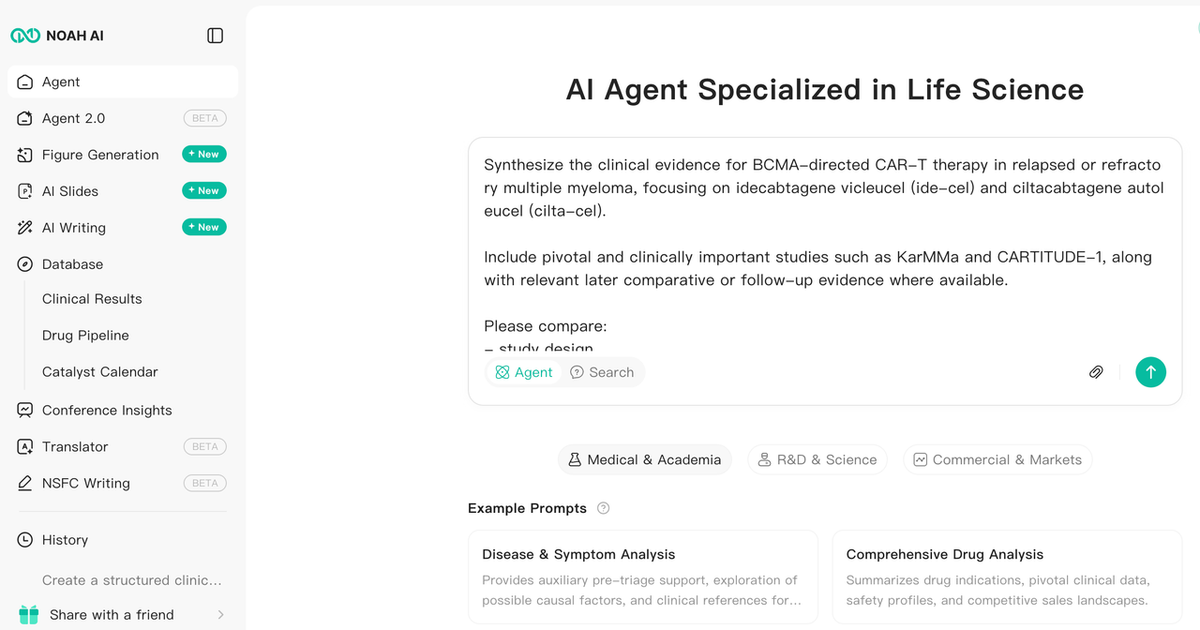
Figure 1. Noah AI receives a biomedical literature-review prompt comparing ide-cel and cilta-cel in relapsed or refractory multiple myeloma.
The prompt defines the evidence dimensions up front: study design, patient population, prior therapy, efficacy, survival maturity, safety, and the limits of indirect comparison. That framing matters because it determines what a rigorous biomedical literature review should extract and compare.
Convert Multiple Studies Into a Structured Cross-Study Comparison
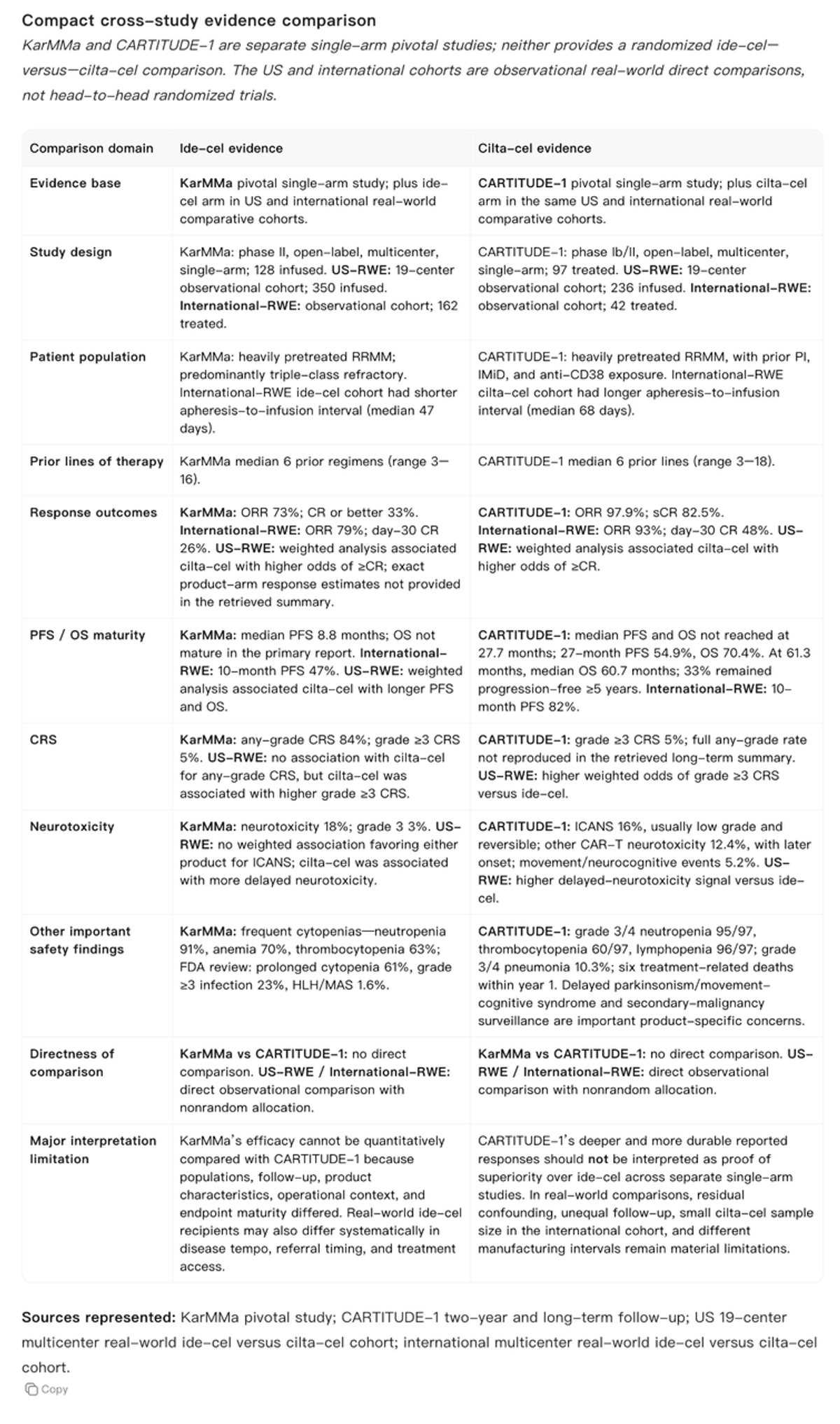
Figure 2. Noah AI organizes the ide-cel and cilta-cel literature into a compact cross-study evidence comparison that preserves design, efficacy, safety, and interpretation limits.
This image is the key proof point for Noah. Instead of producing a loose narrative summary, Noah turns multiple studies into a compact cross-study evidence comparison. The output retains distinctions across evidence base, study design, patient population, prior therapy, response outcomes, PFS/OS maturity, CRS, neurotoxicity, and major interpretation limitations.That is exactly what many biomedical literature-review workflows need. A reader can quickly see what comes from pivotal single-arm trials, what comes from real-world cohorts, and why apparent differences between ide-cel and cilta-cel should not be treated as definitive proof of superiority.
End With a Cautious Evidence Synthesis, Not an Overstated Verdict
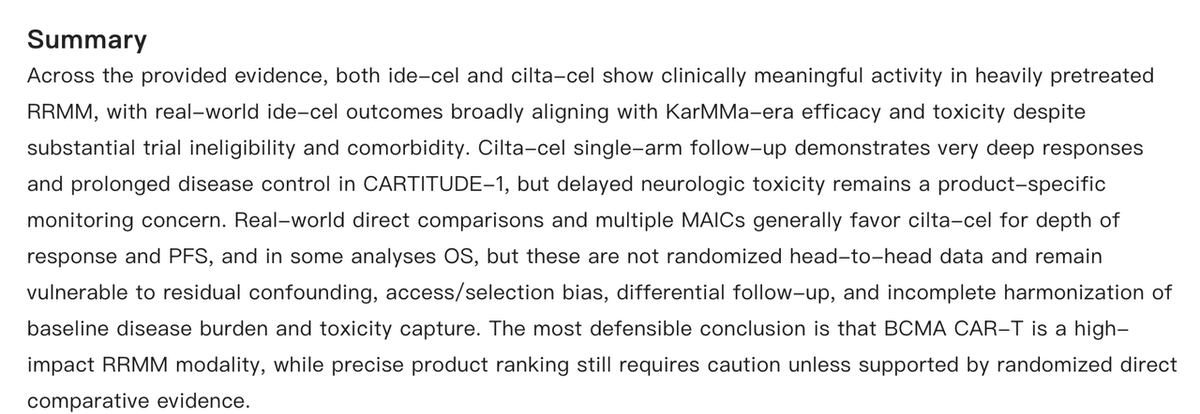
Figure 3. Noah AI produces a final literature-review summary that synthesizes ide-cel and cilta-cel evidence while explicitly preserving cross-study limitations.The final summary does not simply rank the two CAR-T products. It explains that both ide-cel and cilta-cel show clinically meaningful activity, notes where real-world comparisons trend in favor of cilta-cel, and explicitly warns that those comparisons remain non-randomized and vulnerable to residual confounding, selection bias, different follow-up, and incomplete harmonization.This is the Noah advantage the case demonstrates: the workflow moves from biomedical question to structured study comparison to a synthesis that keeps uncertainty visible. That is much more useful than a literature-review assistant that only retrieves papers or drafts a generic paragraph.
Elicit: Best When the Review Method Must Be Reproducible
Elicit is no longer accurately described as a simple paper-search or extraction tool. In 2026, its Systematic Review product supports question refinement, search across PubMed and ClinicalTrials.gov, large-scale screening, structured extraction, synthesis, and PRISMA-auditable decisions.That makes Elicit especially strong when the review method itself is part of the deliverable. If a team must document inclusion and exclusion criteria, preserve screening decisions, explain exclusion reasons, and maintain an auditable review trail, Elicit is a strong choice.Choose Elicit when methodological reproducibility is the center of the workflow. Choose Noah when the starting point is a biomedical question and the desired output is a structured, cited literature review or evidence brief that preserves clinical context and study-level differences.
Consensus: Better for Rapid Question-to-Literature Synthesis
Consensus is a strong option when speed matters and the user wants to understand what the research says about a biomedical question without first building a formal review protocol. Its Deep Review workflow decomposes a question into sub-questions, runs targeted searches, and produces a structured review with citations.That makes Consensus useful for orientation, broad evidence mapping, and rapid review. It is less naturally aligned with the kind of explicit trial-by-trial biomedical evidence organization shown in the Noah CAR-T example, where study comparability and interpretation limits must remain visible throughout.
SciSpace: Better When the Workflow Starts With Papers and PDFs
SciSpace is well suited to researchers who need to find papers, interact with PDFs, extract methods or findings, organize literature, and use Deep Review for more advanced analysis. Its strength is the combination of literature discovery and document-centered research assistance.Choose SciSpace when the paper set itself is the center of the workflow and the main bottleneck is reading, comparing, and organizing documents. Noah is a better fit when the job begins with a biomedical question and the expected deliverable is a structured, source-traceable literature-review output rather than a paper-centered workspace.
How to Choose an Elicit Alternative
- Choose Noah AI when you start with a biomedical research question and need study-level evidence, comparisons, limitations, and a cited review output.
- Choose Elicit when you need a reproducible systematic review with explicit screening and extraction methods.
- Choose Consensus when you need a fast structured view of what the literature says about a research question.
- Choose SciSpace when you already have papers or PDFs and want AI help reading, extracting, organizing, and synthesizing them.
FAQ
What is the best Elicit alternative for biomedical literature review?
No single tool is best for every workflow. Noah is a strong fit for biomedical question-to-evidence literature review; Elicit is stronger for formal systematic-review methodology; Consensus is useful for rapid synthesis; and SciSpace is useful for paper- and PDF-centered research.
Which tool is better for systematic reviews: Noah AI or Elicit?
Elicit is better aligned with formal systematic-review methodology, including reproducible search, screening, extraction, and PRISMA-auditable decisions. Noah is better aligned with medical questions that need structured evidence comparison and cited review outputs.
Is Noah AI similar to Elicit?
There is overlap in literature search and synthesis, but the workflows differ. Noah is positioned around medical and life-science research tasks, while Elicit has a stronger dedicated systematic-review workflow across scientific research.
Can AI-generated biomedical literature reviews be used without review?
No. Researchers should verify the underlying papers and check study design, populations, outcomes, follow-up maturity, citations, and limitations before using the synthesis in scientific or medical work.
Final Takeaway
Elicit is now a much more complete systematic-review platform, so choosing an alternative should depend on the final deliverable rather than on a simplistic feature checklist. If the job is formal, reproducible systematic review, Elicit remains a strong fit. If the goal is rapid orientation, Consensus may be enough. If the work is paper- or PDF-centered, SciSpace is useful.The Noah CAR-T example demonstrates a different workflow: a biomedical literature-review question can be decomposed into study-level evidence, carried through a compact cross-study comparison, and synthesized without erasing the limitations that make cross-study interpretation difficult. For teams that need that question-to-evidence-to-output path, Noah is a strong fit.
Explore Noah AI Search + Agent for medical evidence search, structured synthesis, and cited research outputs.