Best AI Tools for Unmet Medical Need Analysis (2026)
Linda
Compare the best AI tools for unmet medical need analysis, with a real 2026 metastatic pancreatic cancer case accounting for the daraxonrasib (RASONQUE) FDA approval.
An unmet medical need analysis should not stop at saying that a disease has poor survival or limited treatment options. The more useful question is narrower: which clinically important problems remain insufficiently addressed after accounting for current standards of care, recent approvals, and the maturity of the available evidence?
That distinction matters in fast-moving therapeutic areas. A statement that was accurate a year ago can become misleading after a pivotal trial or regulatory approval. For this guide, we tested a real 2026 case in metastatic pancreatic adenocarcinoma, focusing on adults whose disease has progressed after prior systemic therapy and explicitly accounting for the August 26, 2026 FDA approval of daraxonrasib (RASONQUE).
Quick answer: Noah AI is a strong fit when the task is to turn a biomedical research question into a cited unmet-need map that separates mature clinical problems from evidence gaps and unvalidated research opportunities. Elicit is better aligned with formal systematic-review workflows. Consensus is useful for broad literature exploration. Scite is useful for checking how published findings are supported or challenged by later research. SciSpace is useful when the evidence workflow is centered on papers and PDFs.
Unmet Need Is Not the Same as a Treatment Landscape
A treatment landscape asks what therapies, trials, and development programs exist. An unmet medical need analysis asks what remains unresolved after those therapies are taken into account.
A weak unmet-need analysis often turns into a list of negative disease statistics. A stronger one connects each claimed need to a specific limitation of current treatment or evidence: inadequate durability, resistance, toxicity, underrepresented populations, uncertain sequencing, missing biomarker evidence, limited quality-of-life data, or lack of effective options after progression.
Why This Case Changed in 2026
On August 26, 2026, the FDA approved daraxonrasib (RASONQUE) for adults with metastatic pancreatic adenocarcinoma who have received at least one prior systemic therapy or who are not candidates for multiagent systemic therapy. The approval was based on RASolute 302, a randomized study of 500 patients comparing daraxonrasib with physician's-choice standard chemotherapy.
In the overall trial population, the FDA reported median overall survival of 13.2 months versus 6.7 months, median progression-free survival of 7.2 months versus 3.6 months, and objective response rates of 30% versus 11% for daraxonrasib and standard chemotherapy, respectively.
That is a meaningful change in the later-line benchmark. But it does not mean the unmet medical need has disappeared. The research question shifts from “is there any targeted option?” to “which needs remain despite this new option?”
Running an Unmet-Need Question in Noah's New Agent Interface
Noah's updated interface starts from the Agent workspace in the left navigation. For this case, the task was placed under Medical & Academia and run in Deep Research mode.
The current interface separates the research category, research mode, and model controls rather than presenting the user with a single generic chat box. That is useful for this type of task because the prompt can define not only the disease and treatment setting, but also the evidence cutoff, regulatory context, required evidence hierarchy, and the exact structure of the final deliverable.
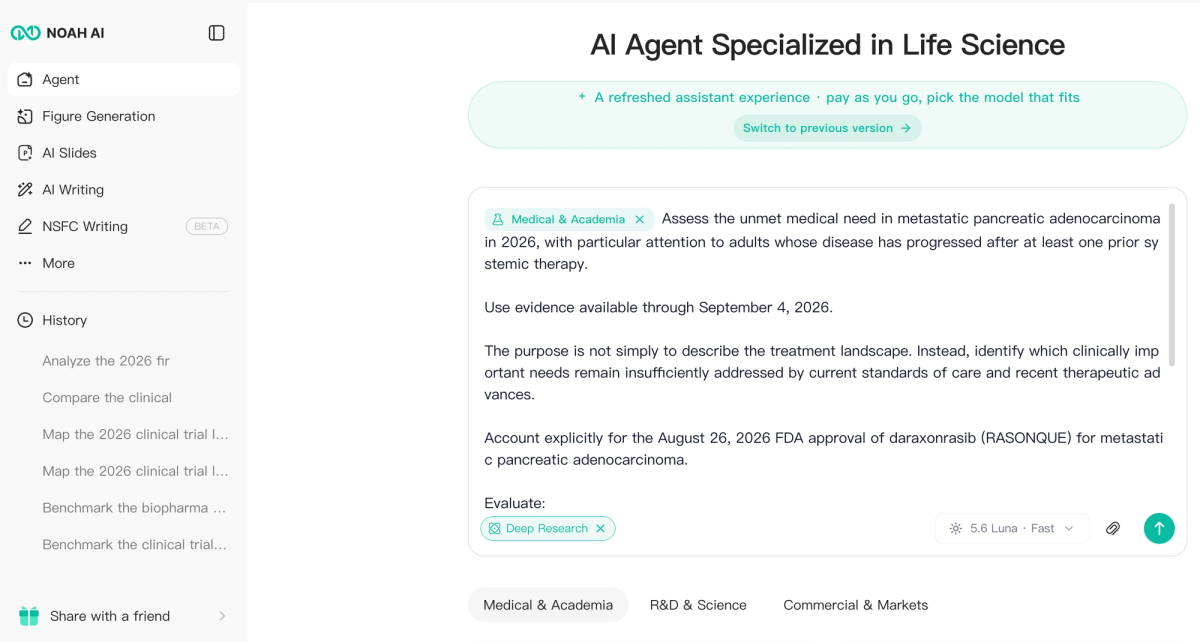
Figure 1. A focused unmet medical need question entered in Noah AI's updated Agent interface, with Medical & Academia and Deep Research selected.
The prompt deliberately included two constraints that improve the analysis:
- do not equate poor prognosis alone with a specific unmet medical need; and
- distinguish a mature clinical unmet need from an evidence gap or an investigational research opportunity.
What Current Treatment Has Solved — and What It Has Not
The Most Useful Noah Output: An Unmet Medical Need Evidence Matrix
The strongest result from this run was not the treatment summary or the efficacy table. It was the Unmet Medical Need Evidence Matrix, which converted a broad disease question into a set of specific, evidence-linked gaps.
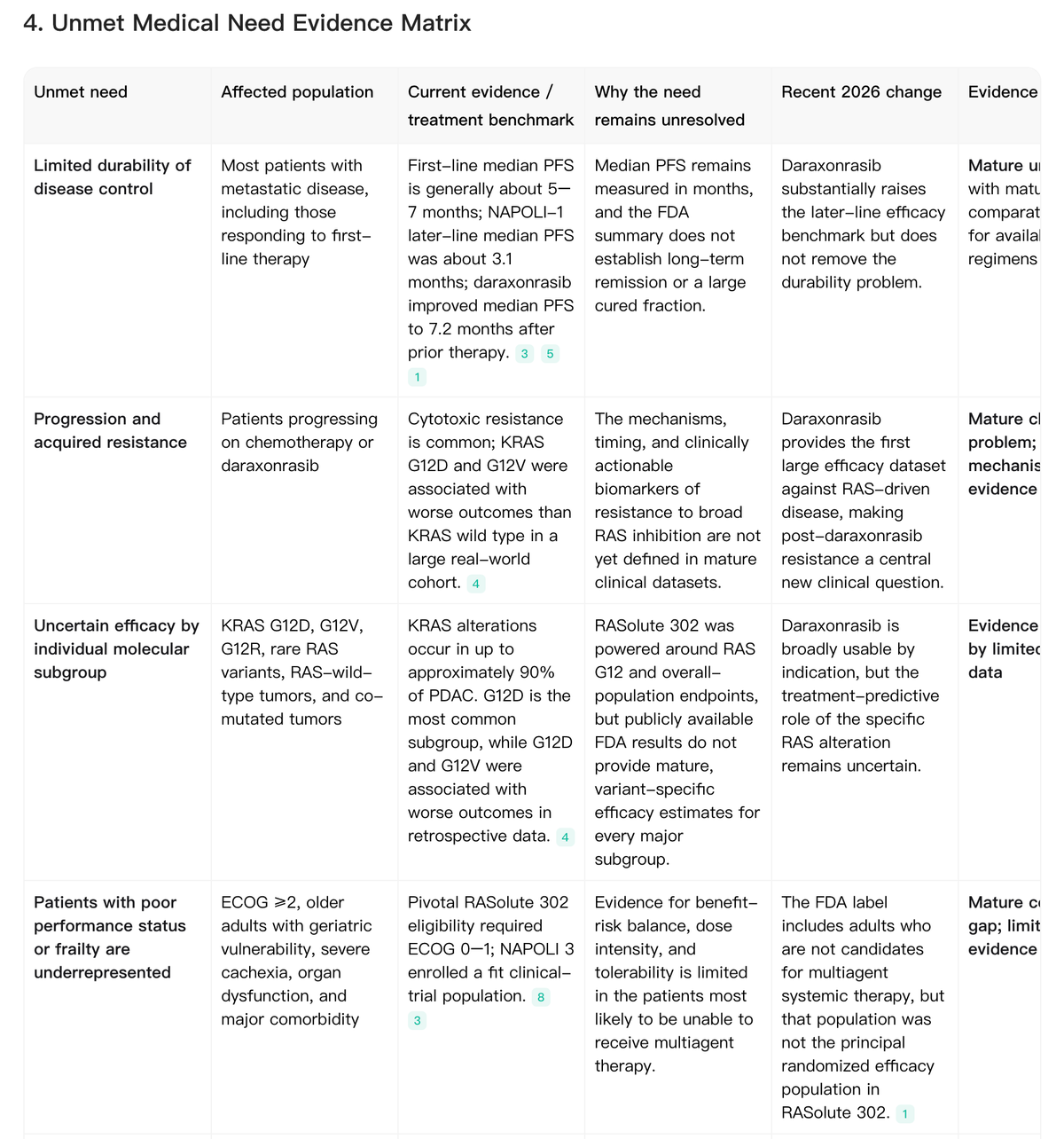
Figure 2. Noah AI separates major unmet needs by affected population, current evidence benchmark, reason the need remains unresolved, recent 2026 change, and evidence maturity.
Four different kinds of unmet need appear in the same case
- Limited durability of disease control: a mature clinical unmet need. Even after meaningful survival improvements, median disease control remains limited for most patients.
- Progression and acquired resistance: a mature clinical problem with less mature mechanistic evidence, especially in the new post-daraxonrasib setting.
- Uncertain efficacy by molecular subgroup: primarily an evidence gap. A broad treatment effect does not automatically establish the same magnitude or durability of benefit in every RAS variant or co-mutational context.
- Frailty and poor performance status: a coverage and generalizability gap. Many pivotal trials enroll fitter patients than those commonly encountered in clinical practice.
This is a better output than a generic “high unmet need” statement because it tells the reader what the gap is, who it affects, why existing evidence does not resolve it, and what kind of evidence would reduce the uncertainty.
Best AI Tools by Unmet-Need Workflow
Different tools fit different parts of an unmet-need project. The comparison below is workflow-based rather than a universal ranking.
| Tool | Best fit | Useful contribution | Where human review remains essential |
|---|---|---|---|
| Noah AI | Biomedical question → cited clinical synthesis | Connecting treatment benchmarks, regulatory changes, patient gaps, evidence maturity, and research priorities in one structured research task | Validation of trial details, labels, subgroup interpretation, and strategic prioritization |
| Elicit | Systematic-review-led evidence synthesis | Searching, screening, extracting, and organizing papers and clinical-trial evidence with traceable source support | Defining the protocol, assessing clinical relevance and risk of bias, and deciding whether a gap is strategically important |
| Consensus | Broad peer-reviewed literature exploration | Multi-step search and citation-backed synthesis around focused research questions | Regulatory interpretation and integration of non-paper evidence |
| Scite | Citation-context verification | Checking whether later research supports, contrasts with, or discusses influential findings | Building the complete unmet-need framework and translating citation context into development priorities |
| SciSpace | Paper discovery and PDF-centered review | Finding literature, filtering papers, reviewing documents, and organizing study-level evidence | Regulatory status, trial-landscape completeness, and formal prioritization of unmet needs |
How to Separate an Unmet Need From an Evidence Gap
Calling all three categories “unmet need” can exaggerate the maturity of the evidence. A research opportunity is not proof that a problem will be solved, and a missing subgroup analysis is not the same as evidence that the treatment does not work in that subgroup.
What Researchers Still Need to Verify
- current FDA, EMA, NMPA, or other jurisdiction-specific regulatory status;
- the exact pivotal trial identifier, population, analysis set, and data cutoff;
- trial inclusion criteria, especially performance status and prior lines of therapy;
- absolute efficacy outcomes and confidence intervals;
- subgroup analyses and whether they were prespecified or exploratory;
- safety denominators, treatment exposure, dose modifications, and discontinuations;
- patient-reported outcomes and missing-data patterns;
- whether an emerging therapy is approved, late-stage, early-stage, or only preclinical;
- whether a claimed gap is supported by direct evidence or inferred from missing data.
Verification note: FDA identifies the pivotal daraxonrasib study used for the 2026 approval as RASolute 302, NCT06625320. Trial identifiers are worth checking independently because a plausible-looking but incorrect NCT number can propagate quickly through secondary summaries.
Try Noah AI for Free
Use Noah AI to search, compare, and analyze biomedical evidence with AI-powered research workflows.
Free credits are available, and no credit card is required to get started.
FAQ
What is unmet medical need analysis?
It is a structured assessment of clinically important problems that remain insufficiently addressed by current treatment and evidence. A useful analysis specifies the affected population, current benchmark, reason the gap remains, evidence maturity, and the research needed to reduce the gap.
Is poor survival enough to prove high unmet medical need?
No. Poor survival establishes disease burden, but an unmet-need claim should identify the specific limitation of current care or evidence. Examples include inadequate durability, toxicity, resistance, underrepresented patients, uncertain sequencing, or a lack of effective post-progression options.
Can AI identify unmet medical needs automatically?
AI can help retrieve evidence, organize treatment benchmarks, identify recurring limitations, and build a structured evidence matrix. Researchers still need to verify the underlying evidence and decide whether a gap is clinically meaningful, methodologically valid, and strategically relevant.
What is the difference between an unmet need and an evidence gap?
An unmet need is a patient or clinical problem that remains insufficiently addressed. An evidence gap means the available data are not adequate to answer an important question. The two can overlap, but they are not interchangeable.
Why does regulatory status matter in unmet-need analysis?
Because a new approval can materially change the current treatment benchmark. A report that ignores a recent approval may identify a need that has already been partly addressed or mischaracterize an investigational therapy as the only available option.
Which AI tool is best for unmet medical need analysis?
It depends on the workflow. Noah AI is a strong fit for biomedical question-to-synthesis work; Elicit is well suited to systematic-review search, screening, and extraction; Consensus is useful for broad literature synthesis; Scite is useful for citation-context checking; and SciSpace is useful for paper-centered literature review.
Final Takeaway
Unmet medical need analysis is most useful when it moves beyond “this disease is difficult to treat” and identifies exactly which patient problems remain unresolved, how strong the evidence is, and what new research would actually reduce the gap.
The metastatic pancreatic cancer case shows why evidence cutoff matters. Daraxonrasib materially changed the later-line treatment benchmark in August 2026, but major questions remain around durability, resistance, sequencing, subgroup-specific benefit, medically frail patients, and post-progression treatment. A credible 2026 analysis needs to capture both sides of that change.