Best AI Tools for PubMed Literature Review (2026)
Linda
Compare the best AI tools for PubMed literature review in 2026, including Noah AI, Elicit, SciSpace, and Consensus, with a real NSCLC evidence case.
Finding papers on PubMed is not the same as completing a literature review. The harder task begins after retrieval: deciding which studies belong together, preserving differences in population and design, comparing outcomes without flattening important context, and turning the evidence into a source-traceable synthesis.For this comparison, the practical question is: which AI tools are best when a biomedical research question needs to move from PubMed-indexed evidence into a structured literature review that a researcher can inspect, verify, and continue editing?That distinction matters because a useful PubMed literature-review tool should do more than return relevant papers. It should help organize evidence across studies, expose disagreement and non-comparability, and produce a review in which the underlying sources remain visible.
Quick Answer
Noah AI is a strong fit when the task is biomedical and the goal is to move from a focused research question through PubMed-grounded evidence comparison into a structured, cited review. Elicit is better suited when the project is a formal systematic review with reproducible search, screening, extraction, and PRISMA-oriented reporting. SciSpace is useful when broad literature discovery, PDF analysis, and theme or gap exploration are the main needs. Consensus is useful when the priority is rapidly turning a research question into a structured literature review across a large scholarly corpus.This comparison is intentionally about tool selection for the review task. If you only need search strategy and retrieval guidance, see PubMed Search with AI. For a step-by-step Noah workflow, see How to Use Noah for Medical Literature Review.
What Should an AI Tool Actually Do With PubMed Evidence?
The final deliverable is not a list of papers. For this article, a useful output is a structured, source-traceable literature review in which study differences remain visible through synthesis.
| Literature-review task | What a useful output should preserve |
|---|---|
| Find relevant evidence | PubMed-indexed studies that can be traced back to the source record. |
| Compare studies | Population, design, intervention, endpoint, and follow-up differences rather than isolated summaries. |
| Synthesize across papers | Patterns, disagreements, and clinically meaningful distinctions across the evidence base. |
| Preserve uncertainty | Missing data, uneven follow-up, and cross-trial limitations should remain visible. |
| Produce a review | Readable synthesis with source-linked claims that a researcher can verify and refine. |
Best PubMed Literature Review AI Tools at a Glance
| Tool | Best when... | Most useful output | Less suitable when... |
|---|---|---|---|
| Noah AI | A biomedical question needs PubMed-grounded comparison and synthesis | Structured evidence comparison + cited medical literature review | You need a formal PRISMA systematic-review process with explicit screening workflow |
| Elicit | The review must be reproducible and systematic | Screening decisions, extraction tables, synthesis report, methods documentation | You mainly need a fast exploratory biomedical synthesis rather than a formal review protocol |
| SciSpace | You need broad literature discovery and PDF-centered analysis | Paper analysis, themes, gaps, structured literature synthesis | You require the evidence base to be specifically constrained to PubMed-indexed studies |
| Consensus | You want fast question-to-literature-review synthesis | Structured review with citations and evidence summaries | A PubMed-only evidence set is a hard requirement |
Noah AI: From PubMed Evidence to a Structured Literature Review
Noah Search & Agent is designed to move beyond retrieval: Agent can plan a deeper research task, synthesize evidence across sources, and produce cited reports or tables that can be reviewed and reused.
A Real PubMed Literature-Review Test
We tested a focused oncology question on perioperative immune-checkpoint inhibitor strategies in resectable non-small-cell lung cancer. The review centered on four pivotal programs: CheckMate 816, KEYNOTE-671, AEGEAN, and CheckMate 77T.The benchmark was deliberately harder than asking for four paper summaries. The task required Noah to separate study design and treatment architecture, compare the evidence across trials, and then synthesize what the literature collectively establishes without implying direct superiority from cross-trial numerical differences.
How Was the PubMed Literature-Review Task Framed?
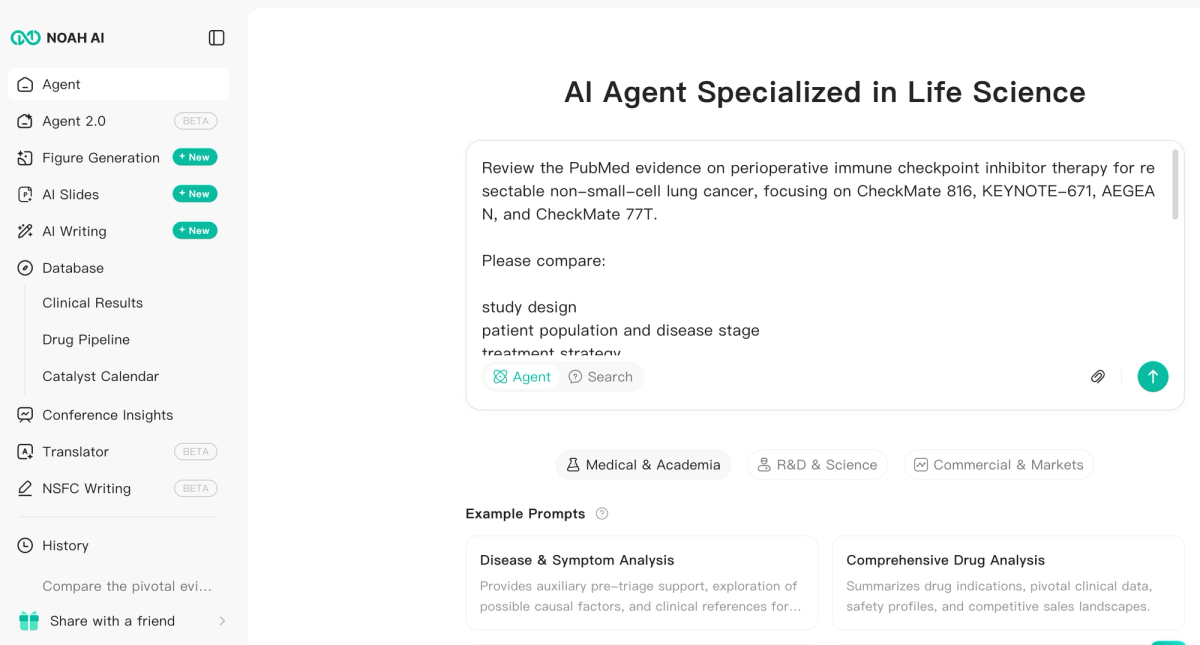
Figure 1. Noah AI Agent receives a focused PubMed literature-review task covering CheckMate 816, KEYNOTE-671, AEGEAN, and CheckMate 77T.
The task starts with a defined biomedical question, a specified evidence source, four named trial programs, and an explicit final deliverable: structured comparison followed by cross-paper synthesis. This framing matters because the article is testing whether an AI tool can complete a PubMed-based literature-review task, not simply whether it can retrieve papers.
Did the Evidence Become Comparable Before It Became Prose?
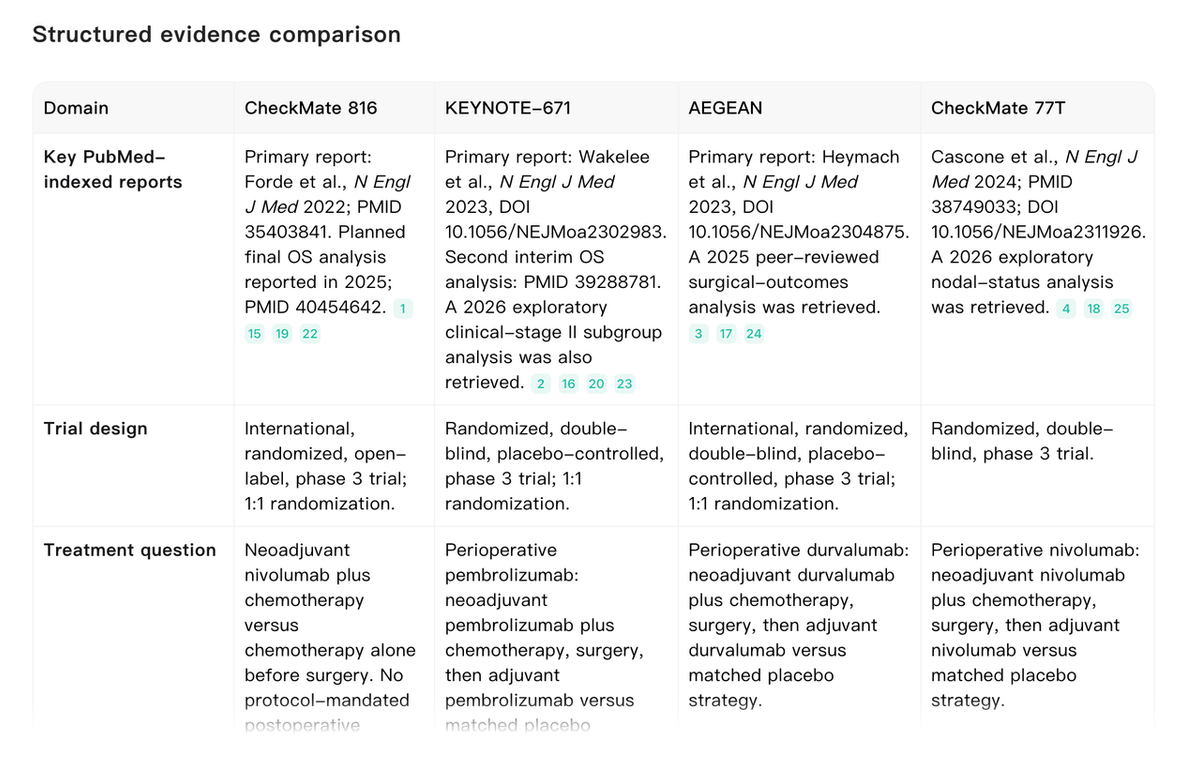
Figure 2. Noah AI organizes PubMed-indexed evidence for four resectable-NSCLC trials into a structured comparison rather than returning an unstructured list of papers.
The visible output separates the four trials into columns and begins by distinguishing source reports, trial design, and the treatment question each program addresses. That structure matters because CheckMate 816 evaluates a neoadjuvant-only strategy, while KEYNOTE-671, AEGEAN, and CheckMate 77T evaluate perioperative strategies that continue immunotherapy after surgery.The useful product behavior here is not simply retrieval. The evidence is organized around comparison dimensions before the narrative review is written, making it easier to see that the studies answer related but non-identical clinical questions.
Did the Final Review Synthesize Across Papers?
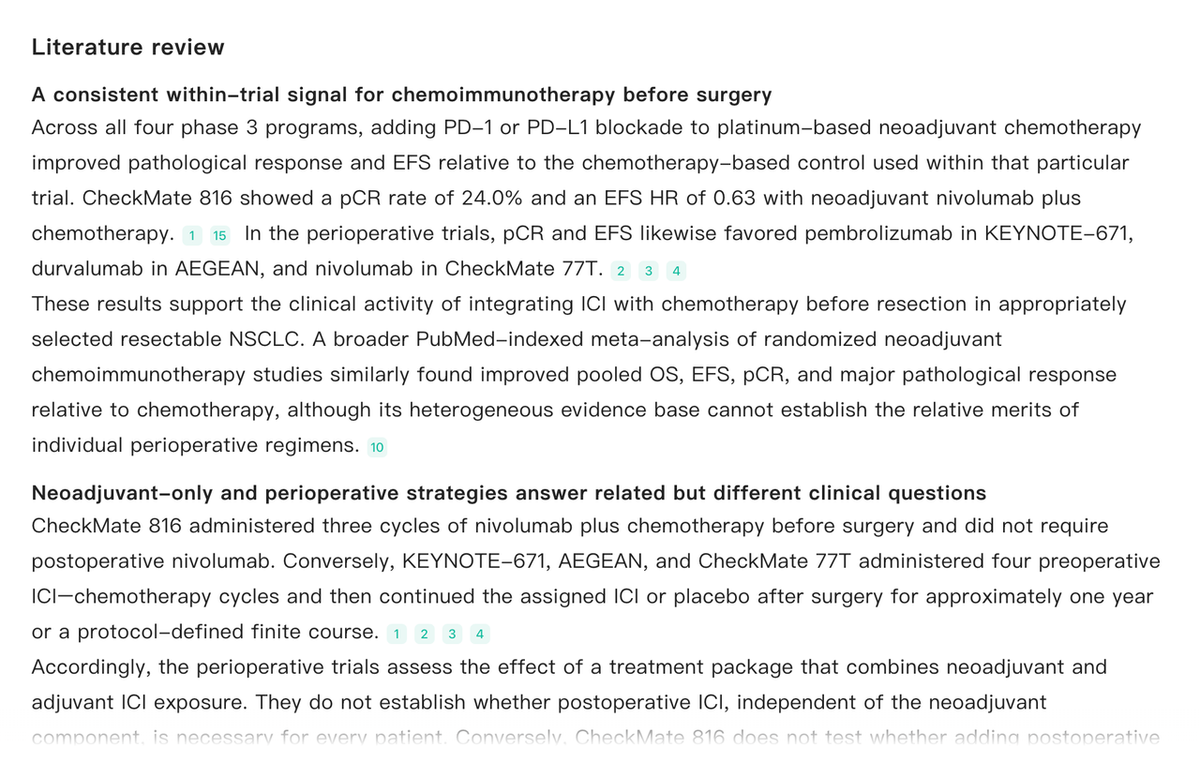
Figure 3. The Noah AI literature review moves from trial-level evidence into cross-paper synthesis while keeping the distinction between neoadjuvant-only and perioperative strategies explicit.The second output is the more important test. Instead of presenting four disconnected trial summaries, the review groups findings around a clinical question: what is established across the evidence, and where do treatment architectures differ?The synthesis explicitly separates CheckMate 816 from the three perioperative programs and explains why the perioperative trials evaluate a combined preoperative-plus-postoperative treatment package. That is the specific advantage demonstrated by this case: PubMed-indexed studies remain distinguishable and comparable inside the final literature review instead of being flattened into one generic conclusion.Researchers should still verify citation-to-claim alignment, numerical results, eligibility details, and interpretation against the original publications before using an AI-generated review in a manuscript, regulatory document, clinical-development decision, or other high-stakes setting.
Elicit: Better for Formal Systematic Reviews
Elicit Systematic Review is the stronger choice when the research question must be handled through a reproducible systematic-review process. Its current workflow supports source gathering across PubMed and other sources, title-and-abstract screening, structured extraction, evidence synthesis, and PRISMA-auditable review steps.That makes Elicit particularly useful when inclusion criteria, exclusion reasons, extraction methodology, and review reproducibility are part of the deliverable. For a focused biomedical narrative review where the main task is turning a research question into structured evidence comparison and cited synthesis, Noah is more directly aligned with the case tested above.
SciSpace: Better for Broad Literature and PDF-Centered Analysis
SciSpace Deep Review is useful when the bottleneck is broad literature analysis rather than a PubMed-specific evidence set. Deep Review gathers insights from multiple papers and organizes themes, findings, trends, gaps, methodologies, and sources; SciSpace also combines literature review with PDF analysis and follow-up questioning.SciSpace is therefore a good fit when researchers are moving between discovery, document reading, and thematic analysis. It is less directly matched to a workflow where PubMed-indexed evidence itself is the defined source boundary.
Consensus: Better for Fast Question-to-Literature-Review Synthesis
Consensus Deep Review is designed to turn a research question into a structured literature review quickly. Deep Review decomposes a question into subquestions, runs multiple targeted searches, selects relevant papers, and synthesizes the results into a report with citations.Consensus is especially useful when speed and broad scholarly coverage matter. Its Medical mode can narrow the corpus toward medical research, but if a review must be explicitly anchored to PubMed-indexed evidence, that source constraint should be checked before relying on the final set.
Which PubMed Literature Review Tool Should You Choose?
Choose Noah AI when you have a focused biomedical question and want PubMed-grounded evidence to become a structured comparison and cited literature-review output.Choose Elicit when your deliverable is a formal systematic review and screening, extraction, auditability, and PRISMA-oriented methods are central.Choose SciSpace when your work is broader than PubMed and revolves around discovering papers, reading PDFs, identifying themes or gaps, and organizing literature.Choose Consensus when you want rapid question-to-review synthesis across a large scholarly corpus and do not require a PubMed-only source boundary.
FAQ
Can AI write a literature review from PubMed papers?
Yes, but the useful standard is not whether the AI can produce fluent prose. A stronger workflow keeps the relevant PubMed studies traceable, compares them before synthesis, preserves important differences, and lets the researcher verify the claims against the original papers.
Is a PubMed literature review the same as a systematic review?
No. A narrative or structured literature review can synthesize PubMed evidence without following a formal systematic-review protocol. A systematic review requires predefined methods, reproducible search and screening, explicit eligibility criteria, and transparent reporting.
What should I verify in an AI-generated PubMed literature review?
Check whether the cited paper actually supports the claim, then verify population, intervention, study design, endpoint definitions, numerical results, follow-up, and limitations. Citation presence alone is not enough.
Which AI tool is best for a formal PubMed systematic review?
Elicit is a stronger fit when formal systematic-review steps such as reproducible searching, screening, extraction, and PRISMA-auditable decisions are required. Noah is more directly suited to focused biomedical research tasks that need structured evidence synthesis and cited output.
Why not just use PubMed search by itself?
PubMed is the source-discovery layer. The additional value of an AI research tool is in organizing the retrieved evidence, comparing studies, synthesizing cross-paper findings, and producing a review that remains traceable to those sources.
Final Takeaway
The best AI tool for a PubMed literature review is not the one that returns the most papers. It is the one that matches the review task you actually need to complete.In the Noah case, the useful difference is visible across the full task: a focused PubMed literature-review question is defined first, four PubMed-indexed NSCLC trial programs are then organized into a comparison structure, and the final review synthesizes the clinically meaningful differences without collapsing them into a false cross-trial ranking.