Best AI Tools for Pipeline Asset Comparison (2026)
Linda
Compare the best AI tools for pipeline asset comparison, with a real 2026 KRAS G12D-mutated metastatic pancreatic cancer case spanning zoldonrasib, setidegrasib, and INCB161734.
Pipeline asset comparison is not the same as listing every drug in a target landscape. The harder task is to compare a small set of directly relevant development programs across mechanism, modality, route, stage, trial strategy, evidence maturity, differentiation, and development risk—without pretending that early response rates from separate trials form a head-to-head ranking.
For this guide, we used a real 2026 competitive case in KRAS G12D-mutated metastatic pancreatic ductal adenocarcinoma (PDAC). The comparison focuses on three late-stage investigational programs: zoldonrasib (RMC-9805) from Revolution Medicines, setidegrasib (ASP3082) from Astellas, and INCB161734 from Incyte.
This is a useful pipeline case because all three programs are now in Phase 3 first-line development, but they represent different development hypotheses. Zoldonrasib is an oral RAS(ON) G12D-selective covalent inhibitor, setidegrasib is a weekly intravenous KRAS G12D-targeted protein degrader, and INCB161734 is an oral selective ON/OFF KRAS G12D small-molecule inhibitor.
Three Assets, Three Development Hypotheses
| Asset | Core approach | Current late-stage strategy | Most important unresolved question |
|---|---|---|---|
| Zoldonrasib | Oral RAS(ON) G12D-selective covalent tri-complex inhibitor | Phase 3 RASolute 305 adds zoldonrasib to investigator-choice first-line chemotherapy | Will encouraging early combination activity translate into randomized OS/PFS benefit with acceptable chemotherapy dose intensity? |
| Setidegrasib | KRAS G12D-targeted protein degrader | Phase 3 setidegrasib plus mFOLFIRINOX or NALIRIFOX versus placebo plus chemotherapy | Will target degradation create clinically meaningful durability that offsets weekly IV delivery and infusion-related burden? |
| INCB161734 | Oral selective ON/OFF KRAS G12D inhibitor | Phase 3 DAWN-303 adds INCB161734 to investigator-choice chemotherapy | Will early Phase 1 activity and molecular response reproduce in a large randomized first-line population? |
Quick answer: Noah AI is a strong fit when the goal is to turn a focused biopharma question into a cited asset-level comparison across science, trials, evidence maturity, and competitive context. Citeline Pharmaprojects+ is stronger for structured global drug-R&D tracking and company/pipeline benchmarking. Patsnap Synapse is useful for connected drug, trial, patent, deal, and company intelligence. AlphaSense is useful for competitive monitoring across company disclosures, expert calls, regulatory material, and market commentary.
What Researchers Actually Need From Pipeline Asset Comparison
A pipeline table is useful only if the columns answer a decision question. For late-stage oncology assets, the highest-value comparison fields usually include:
- mechanism and modality — what biological strategy is actually different;
- route and dosing — oral versus infusion and how that may affect chronic use;
- development stage — early signal versus registrational evidence;
- trial strategy — line of therapy, chemotherapy backbone, comparator, endpoints, and biomarker definition;
- evidence maturity — peer-reviewed, conference-reported, sponsor-reported, or randomized Phase 3;
- potential differentiator — what could matter if confirmed;
- development risk — what still has to work before the asset can support a competitive claim.
The last two fields are particularly important. "Potential differentiator" is a hypothesis; "proven clinical advantage" is an evidence claim. They should not be treated as the same thing.
Running the Comparison in Noah's New Agent Interface
Noah's current interface allows a user to start inside Agent, select a task category, choose a deeper research mode, and enter a structured competitive question. For this case, the task was placed under Commercial & Markets because the deliverable is a competitive pipeline assessment rather than a pure literature review.
The prompt specified the three lead assets, the September 7, 2026 cutoff, the required comparison fields, the evidence hierarchy, and an explicit instruction not to declare a "best drug" from unadjusted early-phase response rates.
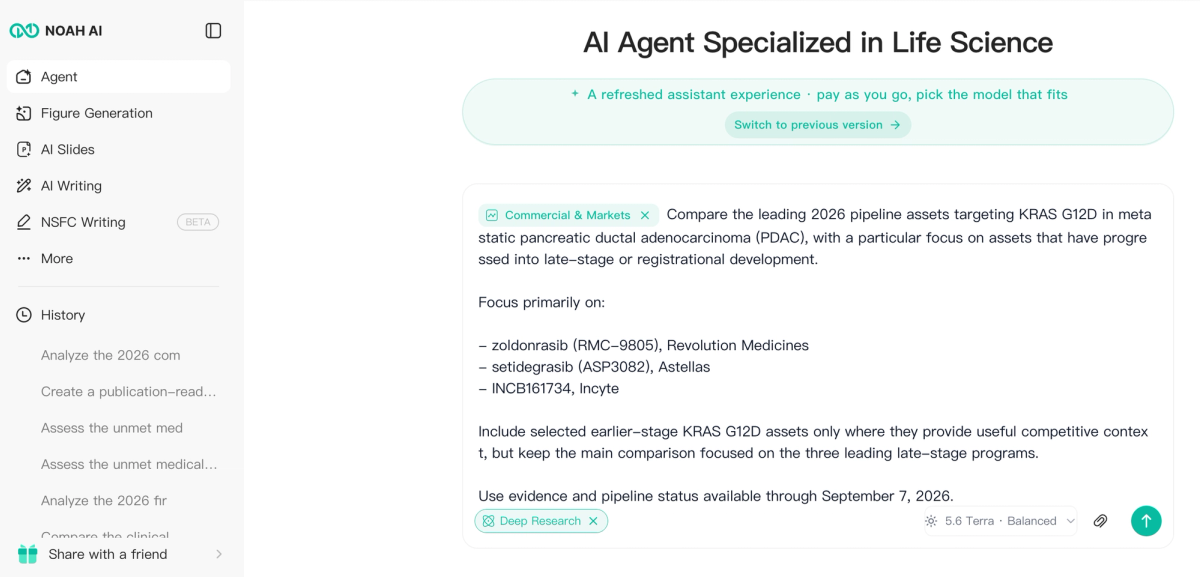
Figure 1. A focused pipeline asset comparison prompt in Noah AI's updated Agent interface, using Commercial & Markets and Deep Research.
The interface also exposes model-selection controls. The important point for this workflow is not a specific model label; it is that the research task, evidence cutoff, asset set, and requested output structure are defined before the analysis begins.
The Most Useful Output: A Structured Pipeline Asset Comparison
The strongest output from the run was the Pipeline Asset Comparison Table. It aligned the three programs by sponsor, mechanism, route, development stage, pivotal strategy, evidence maturity, potential differentiation, and key uncertainty.
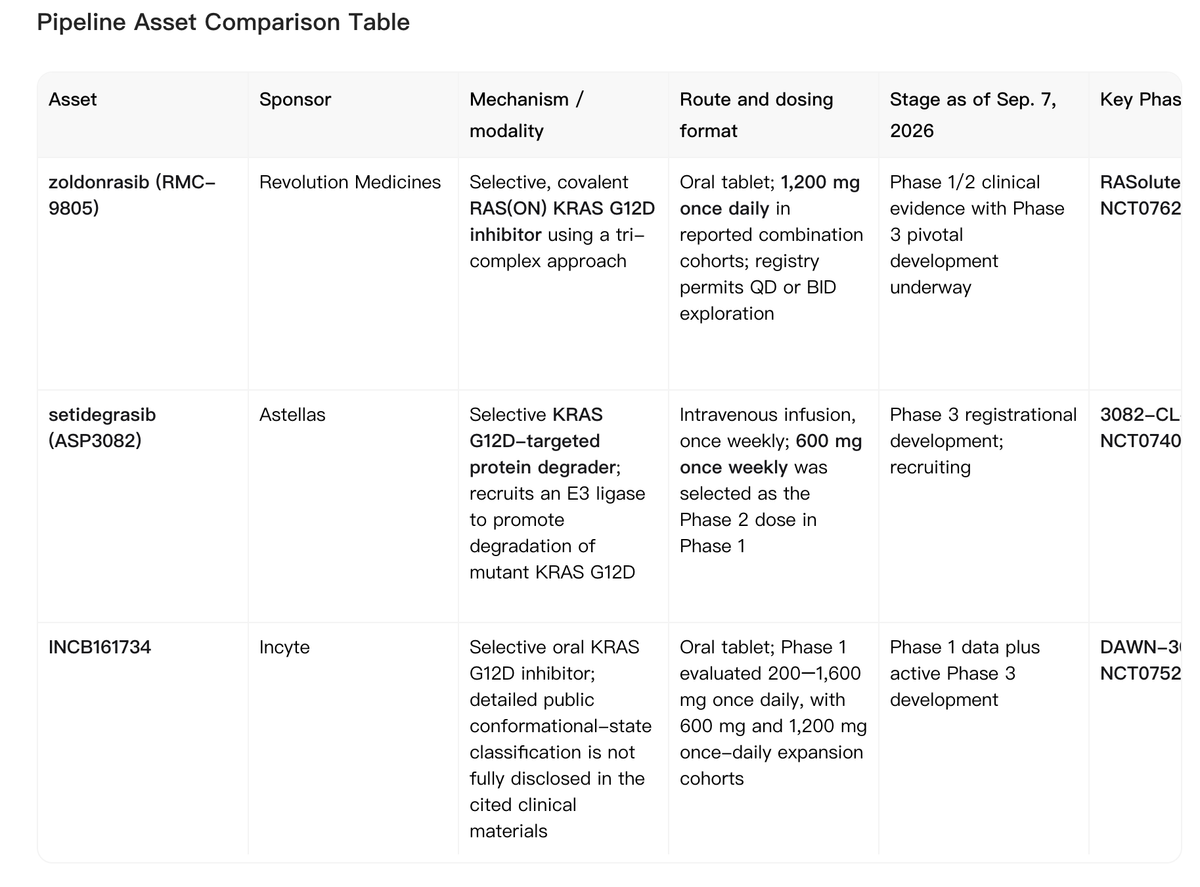
Figure 2. Noah AI organizes three KRAS G12D pipeline assets into a consistent development-comparison structure rather than ranking separate early clinical datasets.
Source-verification note: one mechanism field benefits from an external check. The 2026 ASCO GI Journal of Clinical Oncology abstract explicitly describes INCB161734 as a selective ON/OFF KRAS G12D small-molecule inhibitor. This article uses that published description rather than treating the conformational-state classification as undisclosed.
Research Pipelines and Competitive Landscapes with Noah AI for Free
Use Noah AI to research drug pipelines, competing assets, clinical trials, development stages, and market signals in one structured workflow.
Free to use · Free credits included · No credit card required
Research Pipelines and Competitive Landscapes with Noah AI →
How the Three Assets Differ
- Zoldonrasib: oral RAS(ON) inhibition with a broad combination strategy
Zoldonrasib is an investigational oral RAS(ON) G12D-selective covalent tri-complex inhibitor. Revolution Medicines initiated RASolute 305 (NCT07621718) in June 2026. The Phase 3 trial evaluates zoldonrasib plus investigator-choice chemotherapy versus placebo plus the same chemotherapy in previously untreated metastatic RAS G12D PDAC. The chemotherapy options are modified FOLFIRINOX or gemcitabine plus nab-paclitaxel.
The sponsor also reported first-line Phase 1/2 combination data at ESMO GI 2026. At the February 8, 2026 cutoff, the reported objective response rate was 82% in the zoldonrasib plus modified FOLFIRINOX cohort and 61% in the zoldonrasib plus gemcitabine/nab-paclitaxel cohort. Those results are preliminary and nonrandomized. They are useful as a signal supporting Phase 3 development, not as evidence that zoldonrasib is superior to another KRAS G12D asset.
- Setidegrasib: the most mechanistically distinct program
Setidegrasib is a KRAS G12D-targeted protein degrader designed to bind mutant KRAS G12D and recruit an E3 ligase, promoting degradation of the disease-driving protein. Astellas dosed the first patient in its Phase 3 registrational study in April 2026. The study, NCT07409272, evaluates setidegrasib plus mFOLFIRINOX or NALIRIFOX versus placebo plus the corresponding chemotherapy backbone in first-line metastatic KRAS G12D-mutated PDAC.
Setidegrasib also has the most mature peer-reviewed evidence among the three assets in this comparison. Its Phase 1 results were published in the New England Journal of Medicine in 2026. In the 21-patient metastatic PDAC subgroup treated at 600 mg in second- or third-line therapy, the reported response rate was 24%, median PFS was 3.0 months, and median OS was 10.3 months. Those results establish clinical activity in a previously treated population, but they should not be compared numerically with first-line chemotherapy-combination cohorts from other programs.
- INCB161734: oral ON/OFF inhibition moving rapidly into Phase 3
INCB161734 is an investigational oral selective ON/OFF KRAS G12D inhibitor. Its Phase 3 study, DAWN-303 (NCT07522073), is recruiting previously untreated patients with KRAS G12D-mutated metastatic PDAC. The study randomizes patients to standard chemotherapy with or without INCB161734 and has an estimated enrollment of 588 participants.
Public Phase 1 evidence remains conference-level. The 2026 ASCO GI abstract reported early monotherapy activity across selected dose cohorts and ctDNA molecular-response analyses, while the initial chemotherapy-combination cohorts were still small. This makes the program strategically important but still less mature than a program with peer-reviewed PDAC data.
Why Early ORR Should Not Become an Asset Ranking
| Asset | Public early evidence used here | Why direct ranking is invalid |
|---|---|---|
| Zoldonrasib | First-line combination cohorts with standard chemotherapy | Response reflects the targeted agent plus an active multiagent chemotherapy backbone in previously untreated patients. |
| Setidegrasib | Small second-/third-line monotherapy PDAC subgroup in a Phase 1 study | Later-line disease, different prior treatment exposure, and monotherapy make the population fundamentally different. |
| INCB161734 | Early Phase 1 monotherapy dose-expansion data with preliminary combination safety | Dose cohorts are small and nonrandomized, and mature duration, PFS, and OS evidence is limited. |
Randomized Phase 3 evidence is the point at which these programs can begin to answer the more consequential question: whether adding the KRAS G12D-directed asset improves clinically meaningful outcomes over a matched chemotherapy control.
Daraxonrasib Changed the Competitive Context in August 2026
Pipeline comparison in this field also changed after the FDA approved daraxonrasib (RASONQUE) on August 26, 2026 for adults with metastatic pancreatic adenocarcinoma who had received at least one prior systemic therapy or were not candidates for multiagent systemic therapy.
Daraxonrasib is not one of the three investigational KRAS G12D-specific assets compared here. It is an approved RAS-directed benchmark. The FDA approval was based on the randomized RASolute 302 trial, which enrolled 500 patients and reported a major overall-survival and progression-free-survival benefit versus physician-choice chemotherapy.
That approval changes competitive interpretation in at least three ways:
- RAS-directed therapy is clinically validated in metastatic pancreatic cancer.
- The three KRAS G12D programs are now competing against a real approved RAS benchmark, not only against chemotherapy and other investigational assets.
- First-line differentiation matters more. All three lead KRAS G12D programs are pursuing first-line chemotherapy combinations rather than simply replicating the later-line setting in which daraxonrasib is already approved.
Best AI and Intelligence Tools for Pipeline Asset Comparison
Pipeline comparison usually requires more than one source type. Structured drug databases are strong at development status and company portfolios; literature tools are stronger at publications; market-intelligence platforms are stronger at company disclosures and competitive signals. The most useful tool depends on the starting point.
| Tool | Best fit | Strength for pipeline asset comparison | Main limitation |
|---|---|---|---|
| Noah AI | Question-to-cited life-science synthesis | Useful for defining an asset set and comparing mechanism, trials, evidence maturity, regulatory context, and development risk in one structured research output | Material fields still need primary-source verification; not a substitute for proprietary pipeline databases or validated valuation work |
| Citeline Pharmaprojects+ | Global drug R&D and competitor tracking | Structured pipeline data, Company Compare, Drug Similarity, analytics, and the Ella AI assistant make it well suited to repeated pipeline benchmarking | Best value comes from its proprietary structured intelligence; not designed primarily as an open-ended biomedical narrative research agent |
| Patsnap Synapse | Connected biopharma R&D, IP, and competitive intelligence | Combines drug, clinical trial, patent, literature, organization, and deal data; useful for asset profiling, competitor tracking, partnership work, and portfolio analysis | Broad data coverage still requires careful source-level review when making clinical or mechanistic claims |
| AlphaSense | Competitive and market intelligence | Useful for monitoring pipeline shifts across filings, transcripts, expert calls, regulatory material, company announcements, and market commentary | Better for company and market signal intelligence than for replacing primary biomedical evidence review |
| Primary literature + registries | Claim verification | ClinicalTrials.gov, PubMed, congress abstracts, FDA records, and sponsor trial registries remain the primary check for trial design, status, and reported outcomes | Manual cross-source comparison is slower without a synthesis layer |
What Could Actually Differentiate These Assets?
At this stage, differentiation should be expressed as a testable development hypothesis rather than a conclusion.
| Dimension | Zoldonrasib | Setidegrasib | INCB161734 |
|---|---|---|---|
| Mechanistic strategy | Active-state RAS(ON) inhibition | Targeted protein degradation | ON/OFF KRAS G12D inhibition |
| Route | Oral | Weekly IV | Oral |
| Evidence maturity | Strong sponsor/congress first-line combination signal; Phase 3 underway | Peer-reviewed Phase 1 evidence; Phase 3 underway | Conference-reported Phase 1 evidence; Phase 3 underway |
| Potential differentiator | Combination flexibility and oral RAS(ON) platform | Novel degrader modality and direct target-removal hypothesis | Oral ON/OFF inhibition with rapid progression into a large first-line program |
| Key risk | Randomized benefit and combination tolerability remain unproven | IV burden, infusion reactions, and whether degradation improves durability | Limited mature durability data and execution risk after rapid Phase 1-to-Phase 3 advancement |
What Researchers Still Need to Verify
- the latest ClinicalTrials.gov status and record history;
- the exact Phase 3 design, chemotherapy backbone, endpoints, and enrollment;
- the most current sponsor-reported data cutoff;
- whether efficacy data are peer-reviewed, conference-reported, or only in a press release;
- whether response data are monotherapy or combination therapy;
- line of therapy and prior-treatment exposure;
- dose selected for registrational development;
- treatment-related versus all-cause adverse events;
- mechanism wording from primary scientific or company sources;
- regulatory status and whether an asset is investigational, approved, or planned for future development.
A pipeline comparison is especially vulnerable to stale status. Trial starts, enrollment, protocol changes, congress readouts, discontinuations, partnerships, and approvals can alter the competitive picture within weeks.
What to Watch Next
- RASolute 305: recruitment, chemotherapy compatibility, PFS, OS, response durability, and treatment discontinuation.
- Setidegrasib Phase 3: whether the degrader mechanism translates into durable benefit and whether weekly infusion plus intensive chemotherapy is practical.
- DAWN-303: whether INCB161734's early oral monotherapy and molecular-response signals translate into first-line randomized benefit.
- Post-daraxonrasib strategy: how prior RAS-directed treatment will affect sequencing, resistance, and future trial eligibility.
FAQ
What is pipeline asset comparison?
Pipeline asset comparison is a structured assessment of competing development programs across dimensions such as target, mechanism, modality, route, stage, trial strategy, evidence maturity, differentiation, and risk. It is narrower than a full pipeline landscape because it focuses on a defined set of assets relevant to the same competitive question.
Can AI rank investigational drugs by efficacy?
Not reliably from separate early-phase studies. Response rates, PFS, OS, and safety percentages can differ because of line of therapy, population, chemotherapy backbone, dose, follow-up, and assessment method. AI can organize the evidence and flag those differences, but it should not convert unrelated cohorts into a head-to-head ranking.
What should be included in a pipeline asset comparison table?
Useful columns include asset, sponsor, mechanism, modality, route, stage, pivotal trial, setting, evidence maturity, potential differentiator, and major uncertainty or development risk.
Is pipeline asset comparison the same as asset valuation?
No. Asset comparison organizes scientific, clinical, and competitive evidence. Asset valuation also requires commercial assumptions, probability of technical and regulatory success, market size, pricing, competitive share, intellectual property, deal terms, and financial modeling.
Which tool is best for pipeline asset comparison?
It depends on the workflow. Noah AI is useful for a focused, cited life-science synthesis. Citeline Pharmaprojects+ is strong for structured global R&D tracking and pipeline benchmarking. Patsnap Synapse is useful when drug, trial, patent, deal, and company data all matter. AlphaSense is useful for competitive monitoring across market and company information.
Why does evidence maturity matter?
A peer-reviewed Phase 1 study, a conference abstract, a sponsor press release, and a randomized Phase 3 result do not carry the same evidentiary weight. A good asset comparison shows that difference rather than placing all numbers in one undifferentiated table.
Final Takeaway
The useful question in pipeline asset comparison is not "which drug has the highest early response rate?" It is "what development hypothesis is each program testing, how mature is the evidence, what could genuinely differentiate it, and what still has to be proven?"
In this KRAS G12D PDAC case, zoldonrasib, setidegrasib, and INCB161734 are all late-stage programs, but they differ materially in mechanism, route, evidence maturity, and Phase 3 strategy. Noah's structured comparison makes those differences visible in one research workflow. Primary registries, publications, FDA records, and sponsor disclosures remain necessary to verify the final claims.