Best AI Tools for PICO Question Formulation in Medical Research (2026)
Linda
Compare 5 AI tools for PICO question formulation in 2026. See how Noah AI refines a broad medical question into a structured, evidence-informed PICOT.
Compare five tools for refining medical PICO questions, and see a real Noah AI workflow that turns a broad oral-iron question into a focused, evidence-informed PICOT.
A medical research question can sound clear in everyday language but still be too vague to guide a literature review or a clinical study. "Is alternate-day oral iron better than daily iron?" seems straightforward—until you ask which patients, what dose, which formulation, what outcome, and how long treatment should last.
The PICO framework helps translate broad questions into defined comparisons. AI tools can assist with that translation, but the most useful workflows go beyond filling in four boxes. They reveal missing definitions, compare possible scopes, check existing evidence, and show how a final question can guide literature searches and study eligibility.
In this guide, we compare Noah AI, Elicit, Consensus, ChatGPT, and Rayyan. We tested Noah AI directly on a medical PICO-formulation task. Other tools are described according to their publicly documented functions and typical use cases; they were not tested on the same case.
Quick Answer: Which AI Tool Is Best for PICO Formulation?
Noah AI is a useful fit when a broad biomedical question needs to be refined against published evidence and turned into a structured PICOT and screening framework. Elicit is useful for moving a research question toward an evidence-review protocol. Consensus helps explore what the literature already says. ChatGPT can draft and revise alternative PICO formulations. Rayyan is particularly useful after a question has been defined, when reviewers need to identify PICO elements in retrieved abstracts.
| Tool | Best-fitting task | Important distinction |
|---|---|---|
| Noah AI | Evidence-informed PICO refinement and final PICOT drafting | Directly demonstrated in this article |
| Elicit | Question and protocol refinement linked to evidence screening | Built around the broader evidence-review process |
| Consensus | Natural-language evidence exploration | Useful for checking literature context, not a dedicated PICO editor |
| ChatGPT | Rapid PICO drafts and iterative clarification | Source claims and clinical definitions still need checking |
| Rayyan | PICO identification and filtering in article abstracts | Primarily downstream of question formulation |
What Does a Good PICO Question Include?
PICO stands for Population, Intervention, Comparison, and Outcome. The optional T in PICOT adds Time. These elements clarify what evidence should answer the question and which studies should be considered relevant.
| Element | Question to define |
|---|---|
| P — Population | Who exactly is being studied, and how is the condition diagnosed? |
| I — Intervention | What treatment, exposure, or strategy is being evaluated? |
| C — Comparison | Against what alternative is it evaluated? |
| O — Outcome | Which measurable result matters most? |
| T — Time | At what time or within which follow-up window? |
The challenge is choosing the right level of specificity. A question that is too broad combines incomparable populations and interventions; one that is too narrow may yield too few studies. Neither extreme is automatically better.
Best AI Tools for PICO Question Formulation in 2026
1. Noah AI — For Evidence-Informed Biomedical PICO Refinement
Noah AI can support an extended medical-research workflow: begin with a broad clinical question, review relevant literature, identify unclear elements, compare alternative PICO definitions, and assemble a final research-question framework. It is particularly useful when question formulation and evidence context need to be considered together.
For this article, we directly used Noah AI to compare broad, balanced, and narrow PICO formulations for alternate-day versus daily oral iron in iron-deficiency anemia. The test focused on defining an answerable review question, not conducting a complete systematic review or claiming a new therapeutic finding.
Best use: Turning an incompletely specified medical comparison into a review-ready, evidence-informed PICO draft that remains open to researcher verification.
2. Elicit — For Question Refinement Within a Systematic-Review Workflow
Elicit documents support for refining research questions, searching papers, defining screening criteria, extracting study data, and organizing evidence-review workflows. This makes it relevant when a PICO question must progress toward a review protocol and operational eligibility criteria.
Best use: Research teams planning literature screening and structured evidence extraction after defining their clinical question.
Consideration: Its broader systematic-review workflows may be more extensive than needed for a quick PICO draft, and access depends on the chosen plan.
3. Consensus — For Checking the Evidence Landscape
Consensus supports natural-language searching across scientific literature. In a PICO-formulation process, this type of search can help researchers see whether a proposed comparison has already been studied and which outcomes or populations appear frequently in published work.
Best use: Rapid evidence orientation before locking a PICO question.
Consideration: Finding relevant evidence is different from constructing final inclusion criteria or a complete reproducible systematic-review search strategy.
4. ChatGPT — For Iterative PICO Drafting
ChatGPT can help structure an initial question into Population, Intervention, Comparator, Outcome, and Time, propose alternative wording, and ask which definitions are still missing.
Best use: Quickly creating first-draft PICO alternatives or refining a question through conversation.
Consideration: The user should independently verify clinical criteria, cited papers, treatment specifications, and any claims that the question is novel.
5. Rayyan — For PICO Identification During Screening
Rayyan provides PICO highlighting and filtering that identifies relevant terms in article abstracts and makes them available for screening. This is especially helpful once the researcher has a defined PICO and a collection of potentially relevant records.
Best use: Checking whether retrieved papers contain the population, intervention, comparator, and outcome concepts specified for a review.
Consideration: This feature is principally an extraction and screening aid rather than a dedicated question-formulation system; PICO feature access depends on plan.
How we compared the tools
Only Noah AI was tested directly for the example below. The positioning of Elicit, Consensus, ChatGPT, and Rayyan reflects official product information and their documented workflows. This is a use-case comparison, not a benchmark of accuracy, speed, or output quality.
Real Noah AI Case: Alternate-Day vs Daily Oral Iron
To test PICO formulation rather than generic topic brainstorming, we started with a real, already-studied clinical comparison:
INITIAL BROAD QUESTION
Is alternate-day oral iron better than daily oral iron for treating iron deficiency anemia?
That question leaves several important variables undefined: whether participants have laboratory-confirmed iron-deficiency anemia, whether pregnancy and chronic kidney disease are included, which ferrous salt is used, how much elemental iron is given each week, what "better" means, and how long treatment lasts.
The comparison is not novel. A 2023 randomized controlled trial directly compared alternate-day and daily oral iron. A 2025 systematic review and meta-analysis synthesized 11 randomized trials involving 1,014 participants and found no statistically significant overall hemoglobin difference between the schedules. Most outcomes had low or very low evidentiary certainty, and study populations and dosing regimens differed.
These existing publications make the case useful for demonstrating evidence-informed question refinement. The goal is to define a more interpretable question, not invent a gap in the literature.
Step 1 — Start with a Broad Clinical Question
In the live Noah AI workflow, the prompt named the topic, the initial question, the evidence cutoff, and the requested outputs. It explicitly asked for an initial PICO, an ambiguity check, three alternative formulations, a literature scope check, a final PICOT, and a screening framework.
The actual input interface showed Deep Research with 5.6 Luna · Fast. The purpose of the run was research-question formulation, not treatment guidance.
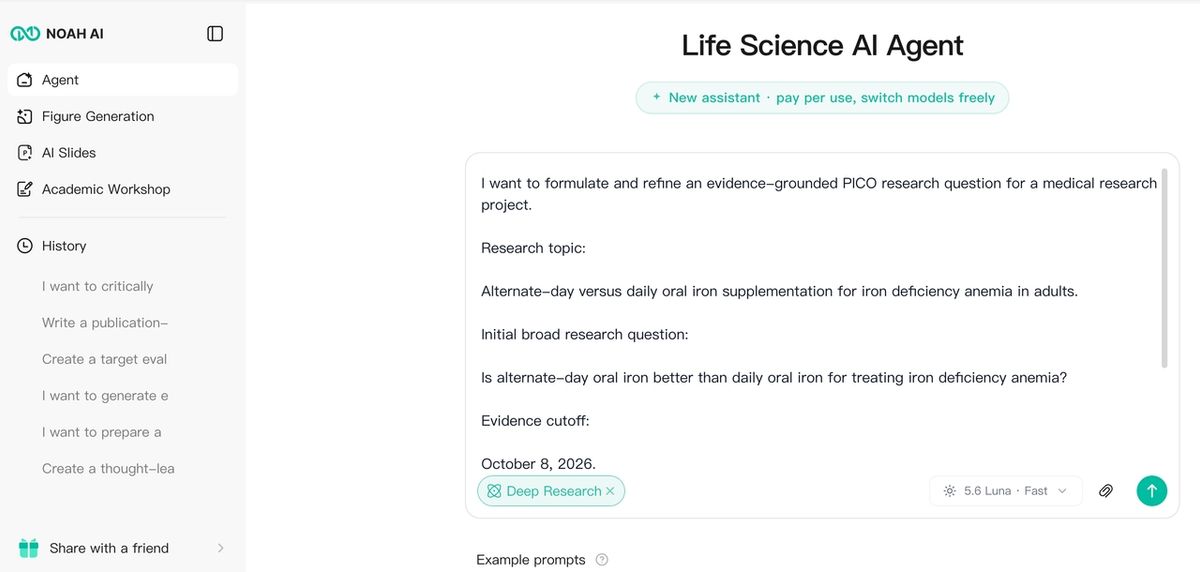
A good starting prompt should describe the research task, not prejudge the answer. Rather than asking AI to prove alternate-day dosing is better, ask it to define a fair comparison and explain which design choices can change the interpretation.
Step 2 — Extract the Initial PICO
The first task is to identify the concepts already present in the broad question and mark what remains undefined.
| PICO | Initial definition | What is still unclear? |
|---|---|---|
| P | Adults with iron-deficiency anemia | Confirmed diagnosis, pregnancy, inflammation, comorbidities |
| I | Alternate-day oral iron | Formulation, per-dose and total iron amount |
| C | Daily oral iron | Whether the iron exposure is comparable |
| O | Treatment effectiveness | Hemoglobin, symptoms, tolerability, adherence |
| T | Not defined | Time for early response versus longer-term repletion |
This first draft is a scaffold. It should not yet be treated as a finalized study protocol or screening rule.
Step 3 — Identify Ambiguities That Could Change the Answer
Noah's report highlighted a particularly important issue: alternate-day and daily regimens may differ in both frequency and total elemental-iron exposure. A comparison that changes both variables cannot cleanly isolate the effect of dosing frequency.
For example, the 2023 trial compared 120 mg elemental iron on alternate days with 60 mg daily while keeping prescribed weekly exposure approximately equivalent. Other studies use different schedules, formulations, or cumulative exposure. Those designs answer related but not identical questions.
Population definition also matters. Adults with uncomplicated, confirmed iron-deficiency anemia should not automatically be combined with pregnant patients, people with chronic kidney disease, or individuals who are iron-depleted but not anemic.
Finally, "better" must be replaced by an outcome. Hemoglobin improvement measures hematologic response; gastrointestinal adverse events and treatment adherence measure different aspects of treatment feasibility. One schedule could have an advantage for tolerability without demonstrating a superior hemoglobin response.
Step 4 — Compare Broad, Balanced, and Narrow PICO Versions
Rather than automatically making the question as narrow as possible, Noah generated three candidate formulations. Each serves a different research purpose:
- Broad: Suitable for an initial evidence map, but may combine clinically different populations, doses, and follow-up periods.
- Balanced: Focuses on nonpregnant adults with confirmed IDA and conventional oral ferrous salts, while allowing important treatment differences to be extracted and analyzed separately.
- Narrow: Restricts the question to a more uniform population and a matched-weekly-exposure ferrous sulfate comparison, potentially yielding fewer eligible studies.
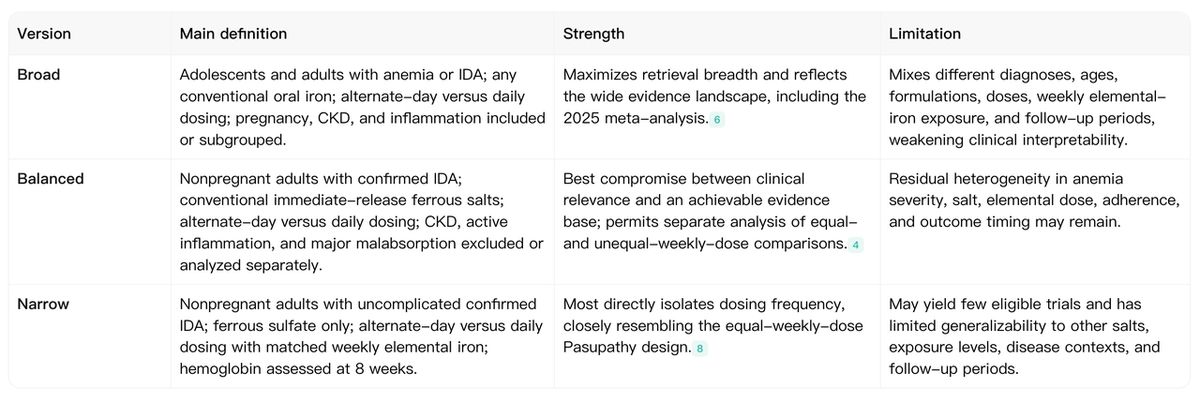
The balanced PICO was selected for this demonstration because it offers a practical compromise: the population and treatment class become more clearly defined, but enough flexibility remains to examine differences in elemental dose, formulation, and follow-up across published studies.
The narrow version may offer a more controlled frequency comparison, but it could also exclude relevant evidence. Narrower is not automatically stronger if the resulting research question becomes too restrictive to answer.
Step 5 — Check Whether the Question Has Already Been Reviewed
Before presenting the refined question as a research opportunity, check existing clinical trials, reviews, and guidelines. Noah identified published randomized evidence and prior reviews, including the 2025 synthesis of daily versus alternate-day oral iron supplementation.
That systematic review included 11 randomized trials and 1,014 participants. Its pooled hemoglobin comparison showed a small, statistically non-significant advantage for daily dosing (mean difference 0.28 g/dL; 95% CI −0.01 to 0.56; P=0.06), with important heterogeneity and low or very low certainty for many results.
Therefore, the broad question is already substantially reviewed. A refined PICOT could be useful as a focused update or more carefully specified comparison, but it would be misleading to label the topic entirely unexplored. Any formal update still needs a fresh, reproducible search through the intended cutoff date.
Step 6 — Choose Outcomes and Timing That Match the Decision
Noah recommended change in hemoglobin from baseline at approximately 8–12 weeks as a practical primary outcome for the proposed review question. It also retained secondary outcomes such as hemoglobin normalization, ferritin, transferrin saturation, gastrointestinal adverse effects, adherence, and treatment discontinuation.
The timing was selected as a useful evidence-synthesis window, not as a universal clinical guideline. Earlier hemoglobin response can be assessed separately, and longer follow-up may be needed to interpret iron-store repletion, recurrence, or sustained adherence.
These distinctions make the outcome measurable without pretending that all studies used the same timing or laboratory definitions.
Step 7 — Produce a Final Evidence-Informed PICOT
After comparing the candidate questions with the literature and clarifying the principal ambiguities, Noah produced a final PICOT formulation card.
FINAL RESEARCH QUESTION
In nonpregnant adults with confirmed, uncomplicated iron-deficiency anemia, does alternate-day oral conventional ferrous-salt treatment, compared with daily treatment using the same or a clinically comparable salt, produce a different change in hemoglobin from baseline at 8–12 weeks?
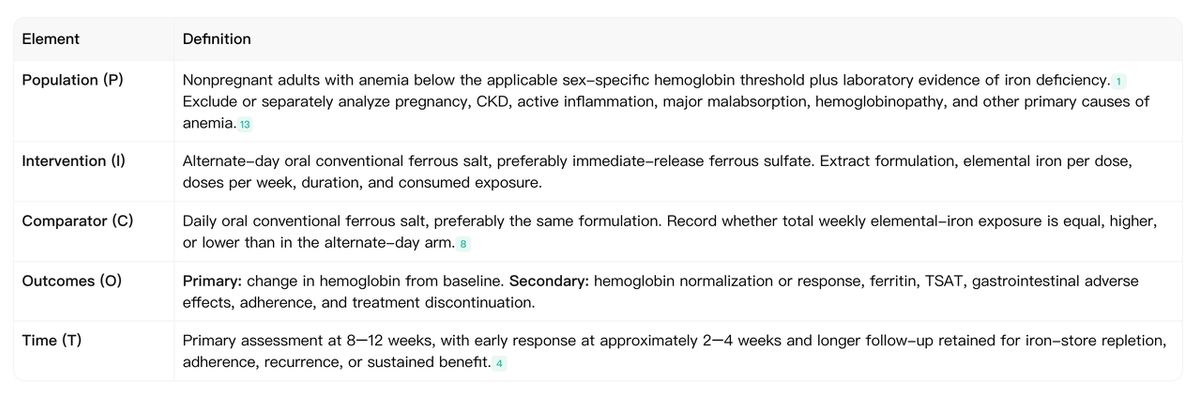
This is a more useful research question than "Is alternate-day iron better?" because it specifies the patient population, treatment comparison, primary outcome, and follow-up period. It also creates a clear requirement to record dose and formulation differences before comparing studies.
The card is ready as a focused evidence-review draft, not necessarily as a fully registered systematic-review protocol. Diagnostic cutoffs, weekly elemental-iron comparability, eligible formulations, and analysis rules require final decisions before quantitative synthesis.
Step 8 — Translate the PICOT into Search Concepts and Eligibility Criteria
A well-written PICO is useful only if it can guide actual evidence retrieval and screening. It should clarify which records belong in a review and which comparisons cannot answer the question.
| Research task | How the PICOT helps |
|---|---|
| Literature search | Identify iron-deficiency-anemia terms, oral ferrous-salt terminology, and daily or alternate-day dosing synonyms. |
| Study screening | Distinguish confirmed adult IDA from pregnancy, CKD, other anemia causes, and nonanemic iron depletion. |
| Extraction | Capture formulation, elemental iron per dose, weekly exposure, hemoglobin change, GI outcomes, and follow-up. |
| Interpretation | Separate matched-weekly-exposure trials from those that compare both different schedules and different total doses. |
Importantly, an electronic database search should not blindly require every PICO element as a separate mandatory term. Forcing outcome words such as "hemoglobin" into every search may exclude otherwise eligible papers whose abstracts omit that wording.
Search strategies should be piloted against known relevant papers, checked for valid database terminology, and reviewed before formal use. A useful follow-on guide is How to Search PubMed for a Literature Review with AI.
Before and After: From a Broad Medical Question to a Review-Ready PICOT
The Noah AI workflow demonstrates how an initially vague clinical question can be refined into a more specific, evidence-informed research question and a practical screening framework.
Stage 1 — Original Broad Question
Is alternate-day oral iron better than daily oral iron for treating iron deficiency anemia?
Main problem: The question does not specify the patient population, iron formulation, elemental-iron exposure, primary outcome, or follow-up period.
Stage 2 — Compare Three Candidate PICO Scopes
| Candidate | Research Scope | Main Trade-Off |
|---|---|---|
| Broad PICO | Patients with iron-deficiency anemia receiving alternate-day versus daily oral iron across varying regimens and outcomes | Captures more evidence but combines heterogeneous populations, doses, and follow-up periods |
| Balanced PICO | Nonpregnant adults with confirmed IDA, comparing conventional oral ferrous-salt regimens while tracking dose and formulation differences | Offers a clearer comparison while retaining useful published evidence |
| Narrow PICO | A more restricted population receiving alternate-day versus daily ferrous sulfate with matched weekly elemental-iron exposure | Better isolates dosing frequency but may exclude relevant studies |
Selected scope: Balanced PICO.
This option provides a practical compromise between clinical specificity and evidence availability. It also requires reviewers to record regimen differences rather than assume that alternate-day and daily treatment provide equivalent iron exposure.
Stage 3 — Final Evidence-Informed PICOT
In nonpregnant adults with confirmed, uncomplicated iron-deficiency anemia, does alternate-day oral conventional ferrous-salt treatment, compared with daily treatment using the same or a clinically comparable salt, produce a different change in hemoglobin from baseline at 8–12 weeks?
| PICOT Element | Final Definition |
|---|---|
| P — Population | Nonpregnant adults with confirmed, uncomplicated iron-deficiency anemia |
| I — Intervention | Alternate-day conventional oral ferrous-salt treatment |
| C — Comparator | Daily treatment using the same or a clinically comparable ferrous salt |
| O — Outcome | Change in hemoglobin from baseline |
| T — Time | Approximately 8–12 weeks |
Stage 4 — Translate the PICOT into Draft Inclusion Criteria
| Screening Domain | Proposed Eligibility Rule |
|---|---|
| Population | Adults with laboratory-confirmed uncomplicated iron-deficiency anemia |
| Intervention | Alternate-day conventional oral ferrous-salt treatment |
| Comparator | Daily treatment with the same or a clinically comparable oral ferrous salt |
| Primary outcome | Reported change in hemoglobin from baseline |
| Timing | Outcome assessment around 8–12 weeks, with rules for other assessment windows to be finalized |
| Dosing | Record elemental-iron dose, weekly exposure, and formulation for comparability assessment |
| Special populations | Define in advance whether pregnancy, chronic kidney disease, and other clinically distinct populations are excluded or analyzed separately |
| Study design | Finalize eligible designs before formal screening; do not assume the PICOT alone establishes an RCT-only rule |
These are draft eligibility criteria, not a finalized systematic-review protocol. Diagnostic thresholds, treatment comparability, study-design restrictions, and handling of heterogeneous follow-up require researcher verification.
Final Transformation
Broad clinical question → Three candidate PICO scopes → Selected balanced PICOT → Draft inclusion criteria → Literature screening framework
The outcome is not a claim that alternate-day iron is clinically superior. It is a more interpretable research question that can guide evidence retrieval, eligibility assessment, and later synthesis.
Turn a Broad Medical Question into an Evidence-Informed PICOT with Noah AI
Use Noah AI to turn a broad medical question into an evidence-informed PICOT and screening framework.
Compare alternative PICO formulations, identify missing clinical definitions, check relevant literature, and develop a focused research question with draft inclusion criteria.
Build a source-linked foundation for literature searching, study screening, and evidence synthesis—while keeping final eligibility and methodological decisions with researchers.
Free to use · Free credits included · No credit card required
Build an Evidence-Informed PICOT with Noah AI →
How to Choose Between These PICO AI Tools
Choose a tool based on what needs to happen next, not simply on whether it accepts natural-language prompts.
- Need a question with biomedical evidence context? Start with a structured Noah AI research run and inspect the source-grounded output.
- Preparing a systematic-review protocol? Consider Elicit's question, screening, and extraction workflow.
- Checking whether the medical comparison has been studied? Use natural-language literature discovery such as Consensus and verify the original studies.
- Need rapid drafts before literature checking? Use ChatGPT to explore candidate PICO wording and unresolved definitions.
- Already screening retrieved abstracts? Rayyan's PICO highlighting can help identify matching study characteristics.
These workflows can complement one another. Question drafting, literature discovery, evidence extraction, and screening are related tasks, but they should not be mistaken for the same capability.
Common Mistakes in AI-Assisted PICO Formulation
- Treating PICO as Four Empty Boxes — Completing P, I, C, and O is only a starting point. Diagnostic criteria, dosing, outcome definition, and follow-up can determine whether the question is actually answerable.
- Assuming Narrower Always Means Better — A narrowly specified question may improve comparability but eliminate much of the relevant evidence. Scope should reflect the decision and the available literature.
- Ignoring Dose and Formulation Differences — Daily and alternate-day schedules may deliver different total weekly doses. Without recording elemental-iron exposure, a dosing-frequency comparison can be misleading.
- Confusing Clinical Effectiveness with Tolerability — Hemoglobin recovery, GI symptoms, adherence, and discontinuation are different outcomes. The preferred primary outcome should be chosen deliberately.
- Claiming Novelty Without Checking Prior Reviews — A published question can still be worth refining, but a more specific PICOT does not automatically imply a previously unrecognized evidence gap. The 2025 oral-iron meta-analysis is an essential contextual check for this case.
- Assuming an AI-Generated PICO Is a Finished Protocol — Before registration or evidence synthesis, reviewers still need finalized eligibility criteria, verified database searches, rules for heterogeneous treatments, and a prespecified analysis plan.
Frequently Asked Questions
What is PICO in medical research?
PICO is a framework for structuring a medical or clinical research question around Population, Intervention, Comparison, and Outcome. PICOT adds Time when follow-up is important.
Can AI generate PICO research questions?
AI can propose PICO elements, identify ambiguities, compare alternative scopes, and draft a final question. The researcher should check clinical definitions, published evidence, and whether the question is feasible for the intended review or study.
What is the difference between PICO and PICOT?
PICOT adds a time component. That is useful when outcome meaning changes with assessment timing, as with early hemoglobin response versus later iron-store repletion.
How specific should a PICO question be?
It should be specific enough to guide study eligibility and outcome measurement but not so restrictive that it unnecessarily excludes useful evidence. Broad, balanced, and narrow options can be compared before a final scope is selected.
Does PICO replace literature searching?
No. PICO guides the concepts and boundaries of a search. A formal review still requires database-specific strategies, search testing, study screening, and source verification.
Is PICO appropriate for every research design?
PICO is especially useful for intervention and comparative-effectiveness questions. Exposure, diagnostic, prognostic, or qualitative questions may require different or adapted frameworks such as PECO, PIRD, or SPIDER.
Can I use Noah AI to formulate a PICO for free?
Noah AI offers free credits, requires no credit card to get started, and can be used to try a structured research-question refinement workflow.
Related Reading
Once a clinical question has been structured, the next steps are checking feasibility, searching the literature, and extracting consistent evidence.
- Best AI Tools for Biomedical Research Question Feasibility Assessment (2026)
- How to Search PubMed for a Literature Review with AI
- How to Create an Evidence Table for a Literature Review with AI
- How to Conduct a Medical Literature Review with AI
Final Takeaway
The best AI tool for PICO question formulation depends on whether the immediate task is drafting, checking the literature, refining review scope, or screening papers.
In our directly tested Noah AI case, the original oral-iron question was too broad to specify a fair, interpretable comparison. The workflow identified missing population criteria, iron formulation and dosing differences, outcome ambiguity, and follow-up uncertainty. It compared broad, balanced, and narrow formulations before producing a more operational PICOT.
The crucial result was not a claim that one dosing schedule is superior. It was a research question that states what is being compared, which evidence is relevant, and where methodological decisions remain open.
Good PICO formulation is more than filling four boxes: it is the process of turning a clinical idea into an explicit question that can guide evidence retrieval, screening, and interpretation.
Refine Your Medical Research Question with Noah AI
Turn broad research ideas into evidence-informed PICO and PICOT frameworks, review competing formulations, and prepare clearer questions for literature searches and evidence synthesis.
Try Noah AI for free. Free credits included. No credit card required.