Best AI Tools for Medical Research Workflow Automation (2026)
Linda
Compare the best AI tools for medical research workflow automation, from planning and evidence retrieval to synthesis, verification, and cited research outputs.
Medical research is rarely slowed down by one search box. The real bottleneck is the chain of handoffs around the search: defining the question, finding the right sources, comparing studies, checking what is missing, and turning all of that into a report someone can actually use.That is where workflow automation becomes more useful than a generic research chatbot. The goal is not to remove the researcher from the process. It is to reduce repetitive coordination work while keeping the evidence traceable and the final judgment reviewable.In 2026, the most useful research AI tools are starting to specialize at different layers of this process. Noah AI is built around life-science research runs, Elicit is especially strong for systematic-review workflows, Consensus is useful for rapid literature discovery and synthesis, and Scite adds citation-context checks that can strengthen verification.The right tool therefore depends less on which product has the longest feature list and more on which part of the research workflow you need to automate.
Where Medical Research Workflows Actually Slow Down
- Turning a broad question into a research plan. A medical question often needs scope, population, intervention, outcomes, constraints, and an output format before a useful search can even begin.
- Retrieving evidence from the right sources. The challenge is not simply finding papers. It is retrieving relevant medical evidence from sources that can support the final claims.
- Comparing evidence across studies. Researchers frequently have to reconcile different populations, endpoints, follow-up periods, methods, and effect estimates before drawing a conclusion.
- Checking gaps and uncertainty. A polished summary can still be weak if important populations, contradictory studies, or missing evidence are not identified.
- Turning evidence into a usable deliverable. The output may need to be a cited brief, evidence table, literature review, decision memo, or presentation-ready summary rather than a conversational answer.
What Medical Research Workflow Automation Should Mean
A useful automation system should coordinate several research steps without hiding the logic of the work. It should make the plan visible, retrieve evidence, synthesize the findings, show where confidence is limited, and preserve citations so the researcher can verify the output.That standard is more demanding than “ask a question and get a summary.” It is closer to research orchestration: the AI manages repeated operations while the researcher retains control over scope, evidence quality, interpretation, and final use.
A Real Automated Medical Research Run in Noah AI
Noah AI is a domain-specific research workspace for life science and medical work. Its Search & Agent workflow is designed to clarify a task, plan the research process, synthesize evidence, and generate a cited output.
The task: compare three SGLT2 inhibitors for chronic kidney disease
For this test, the Agent was asked to compare dapagliflozin, empagliflozin, and canagliflozin for chronic kidney disease, including randomized trials, populations, renal and cardiovascular outcomes, safety considerations, uncertainty, and source citations. The request also explicitly asked the Agent to plan the workflow, search relevant literature and databases, identify evidence gaps, and produce a concise decision-ready report.
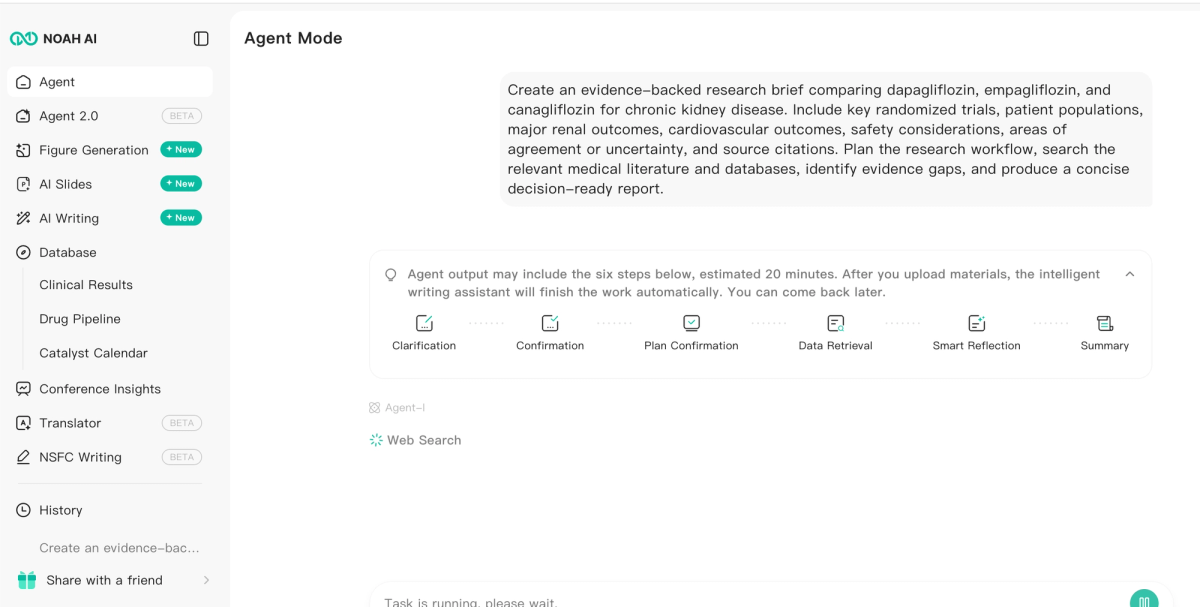
Figure 1. Noah AI Agent Mode shows a multi-stage research run: Clarification, Confirmation, Plan Confirmation, Data Retrieval, Smart Reflection, and Summary, with search running below.
This is the important part of the example. The screen is not just a prompt box. It exposes a sequence of research stages, which makes the automation logic visible to the user.The workflow also creates a natural checkpoint structure. A researcher can understand where the system is in the process instead of receiving a single opaque answer at the end.
The output: a decision-ready evidence brief
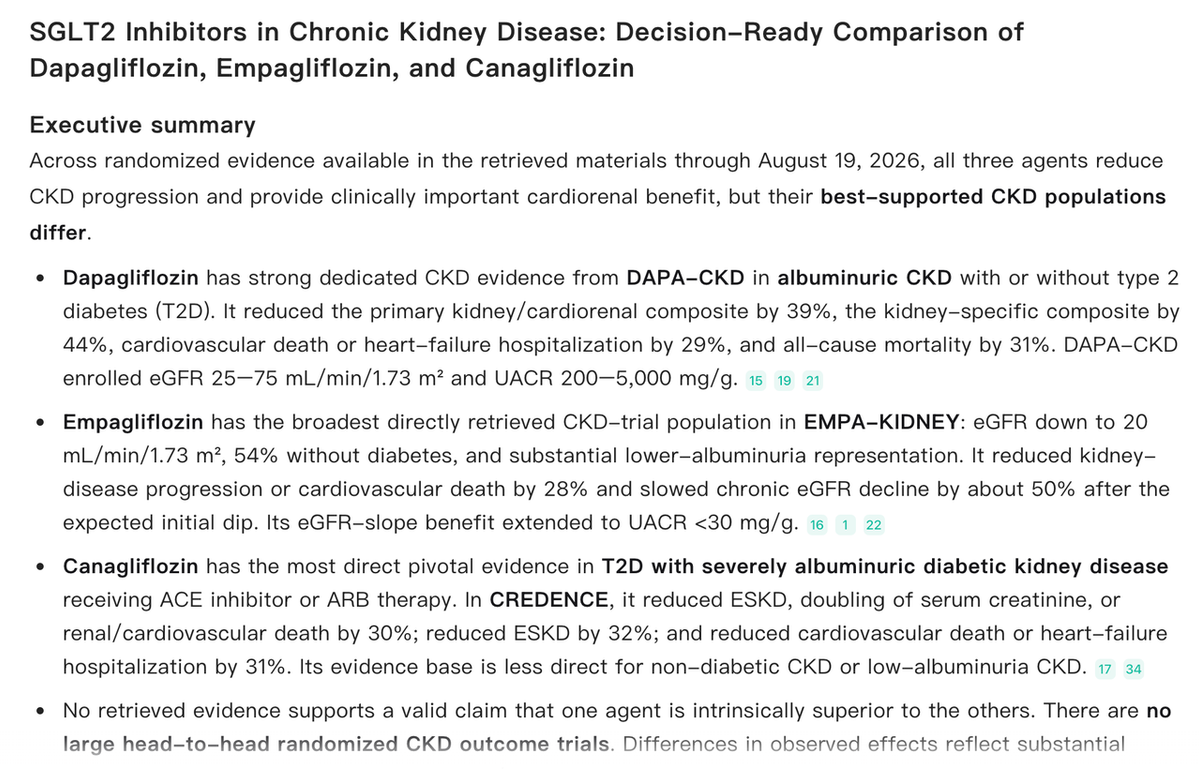
Figure 2. The resulting Noah AI brief compares dapagliflozin, empagliflozin, and canagliflozin using an executive summary, study-level claims, and visible source citations.The final output is structured around the comparison rather than presented as a generic chat response. It summarizes where each drug has its strongest evidence base, includes trial-level effect statements, and keeps citation markers attached to the claims.That is a more useful demonstration of workflow automation than showing a search result alone: one complex research request becomes a planned run and then a structured deliverable. The output still requires researcher review, especially before clinical, regulatory, or publication use.
The Best AI Tools by Workflow Stage
Noah AI — Best for End-to-End Biomedical Research Orchestration
Noah is the strongest fit in this group when the workflow itself is the problem. Its current Search & Agent positioning is centered on medical evidence search, research planning, synthesis, and cited outputs, with access to sources such as PubMed and other trusted medical data sources.
Use Noah when: you want one life-science workspace to move from a complex research question through retrieval and synthesis to a structured deliverable.
Do not treat it as: a replacement for expert review, source verification, or final scientific judgment.
Elicit — Best for Systematic Review Workflow Automation
Elicit is a better fit when the workflow is specifically a systematic review. Its official workflow covers protocol refinement, source gathering, paper screening, data extraction, and evidence synthesis. In 2026, Elicit also describes the core systematic-review workflow as search, screening, extraction, and synthesis.
Use Elicit when: you need a structured review pipeline with screening and extraction steps rather than a broader medical research agent.
Consensus — Best for Fast Literature Discovery and Synthesis
Consensus is useful when the slowest part of your workflow is quickly finding relevant peer-reviewed research and getting an initial synthesis. Consensus describes its product as an AI search engine for academic research that retrieves relevant papers and generates a cited synthesis of the findings.
Use Consensus when: you need a fast first pass on what the literature says before moving into a deeper review or analysis workflow.
Scite — Best for Citation Context and Verification
Scite adds a different layer to automation: citation context. Its Smart Citations classify citation statements as supporting, contrasting, or mentioning, which can help researchers evaluate how later work engages with a finding rather than relying on citation counts alone.
Use Scite when: you need to pressure-test important claims, inspect citation context, or add a verification layer after an initial literature synthesis.
A Practical Workflow Stack
These tools do not have to be treated as mutually exclusive. A medical research team can use a domain-specific agent for orchestration, a systematic-review platform for formal screening and extraction, a search engine for rapid landscape discovery, and a citation-intelligence tool for verification.For example, a researcher might use Noah to scope and synthesize a medical question, Elicit when the project requires a formal systematic-review protocol, Consensus for quick exploration of adjacent questions, and Scite to inspect how key claims are cited in later literature.The automation value comes from reducing repeated manual work at the right stage, not from forcing every research task into one tool.
What Should Still Stay Human?
Research scope and inclusion criteria: AI can propose a plan, but the researcher should decide what evidence is actually relevant to the question.
Clinical and scientific interpretation: A synthesized result still needs domain judgment, especially when populations, endpoints, or study designs differ.
Source verification: Important claims should be checked against the original paper or trusted source before they are used externally.
Uncertainty and contradiction: The absence of evidence, conflicting evidence, and subgroup limitations should not be smoothed away for the sake of a clean narrative.
Final publication or decision use: AI-generated reports and figures should be reviewed and refined before formal publication, clinical use, or high-stakes decision-making.
How to Choose the Right Tool
Choose Noah AI when you want an end-to-end life-science research run that connects planning, evidence retrieval, synthesis, and a cited deliverable.
Choose Elicit when systematic-review screening and structured extraction are the main workload.
Choose Consensus when fast peer-reviewed literature discovery and initial synthesis are the priority.
Choose Scite when citation context and claim verification are the bottleneck.
FAQ
What is medical research workflow automation?
It is the use of AI or software to coordinate repeated research steps such as task planning, literature retrieval, evidence extraction, synthesis, verification, and report generation while keeping the researcher in control of scientific judgment.
Can AI automate an entire literature review?
AI can automate or accelerate parts of a review, but formal systematic reviews still require researcher-defined protocols, eligibility decisions, quality checks, and verification of the final evidence base.
Which AI tool is best for medical research workflow automation?
For a life-science-specific end-to-end workflow, Noah AI is a strong fit. Elicit is stronger for formal systematic-review workflows, Consensus for rapid literature search and synthesis, and Scite for citation-context checking.
Should AI-generated medical research reports be trusted without review?
No. A cited output is easier to verify, but citations, study details, interpretations, and conclusions should still be checked against the original evidence before high-stakes use.
Final Takeaway
The most useful AI research tools in 2026 are moving beyond paper chat toward workflow-level assistance. The important question is no longer simply whether an AI can summarize a paper. It is whether it can reduce the coordination burden across planning, retrieval, synthesis, verification, and delivery without making the evidence harder to inspect.For medical and life-science work, Noah AI is especially relevant when those stages need to be connected in one research run. Elicit, Consensus, and Scite remain valuable because they automate different parts of the same broader research process.The best setup is therefore task-driven: automate the repetitive steps, preserve source traceability, and keep scientific judgment with the researcher.
CTA: Try Noah AI to run a life-science research task from planning through cited output.