Best AI Tools for Indication Expansion Research (2026)
Linda
Compare AI tools for indication expansion research, with a real Noah AI case evaluating Enhertu from previously treated to first-line HER2-mutant NSCLC.
Indication expansion research asks a different question from ordinary drug review. It is not simply, "Where else might this drug work?" A useful expansion assessment has to connect the current label, biological rationale, prior clinical activity, registrational evidence, safety transferability, biomarker requirements, competitive context, and regulatory status.
For this guide, we tested that workflow on trastuzumab deruxtecan (T-DXd; Enhertu) in HER2-mutant non-small cell lung cancer (NSCLC). The current U.S. NSCLC indication covers adults with unresectable or metastatic disease whose tumors have activating HER2/ERBB2 mutations and who have already received prior systemic therapy. The expansion question is whether the evidence now supports moving Enhertu into the first-line setting.
This became especially relevant in August 2026, when AstraZeneca and Daiichi Sankyo reported that DESTINY-Lung04 met its primary endpoint and showed a statistically significant and clinically meaningful progression-free survival benefit versus platinum-pemetrexed chemotherapy plus pembrolizumab. But a positive Phase 3 topline result is not the same thing as a new FDA indication.
Quick answer: Noah AI is a strong fit when indication expansion research requires a cited synthesis across current label, biology, prior trials, registrational evidence, safety, diagnostics, competitive programs, and remaining regulatory gaps. Citeline Pharmaprojects+ is better suited to structured global pipeline tracking. Patsnap Synapse is useful when drug, trial, target, patent, deal, and company data need to be connected. AlphaSense is useful for competitive monitoring, while Elicit is better suited to literature-led evidence review.
From an Approved Use to the Next Development Question
| Current U.S. indication | Expansion being evaluated | |
|---|---|---|
| Treatment line | Previously treated | First-line |
| Disease setting | Unresectable or metastatic NSCLC | Unresectable locally advanced or metastatic non-squamous NSCLC |
| Biomarker | Activating HER2/ERBB2 mutation | HER2-mutant disease; DESTINY-Lung04 specifically studies exon 19 or 20 mutations |
| Evidence basis | Accelerated approval based on response rate and duration of response | Randomized Phase 3 PFS evidence versus chemoimmunotherapy |
The FDA prescribing information still describes the HER2-mutant NSCLC indication as an accelerated approval. It requires prior systemic therapy and an FDA-approved test for an activating HER2 mutation. The label also allows patient selection from tumor or plasma specimens; if no mutation is detected in plasma, tumor tissue should be tested.
Running the Indication Expansion Question in Noah AI
For this case, Noah was used through the updated Agent interface with R&D & Science, Deep Research, and the currently available 5.6 Terra · Balanced setting.
The prompt explicitly separated the current approved indication from the proposed expansion and asked Noah to distinguish regulatory facts from sponsor-reported Phase 3 evidence, biological hypotheses, and unresolved gaps.
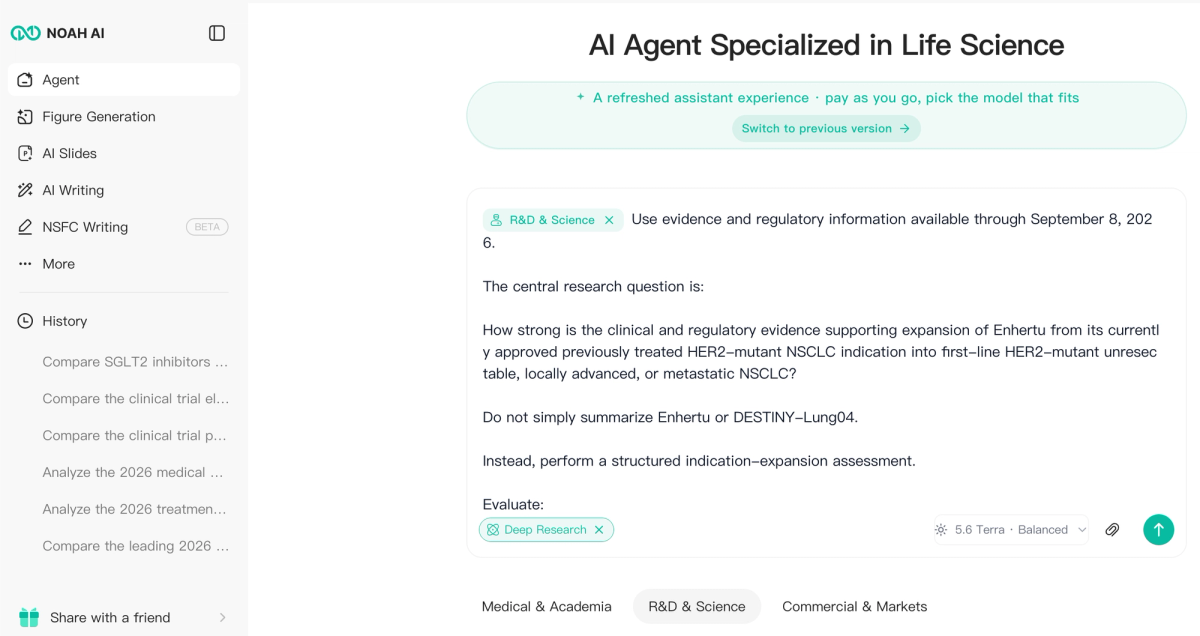
Figure 1. Noah AI Agent configured for an indication-expansion assessment using R&D & Science and Deep Research.
Current Indication Versus Proposed Expanded Indication
The clearest Noah output was not an efficacy summary. It was a direct comparison between the current FDA indication and the proposed first-line expansion. That makes the development transition visible before the trial data are interpreted.
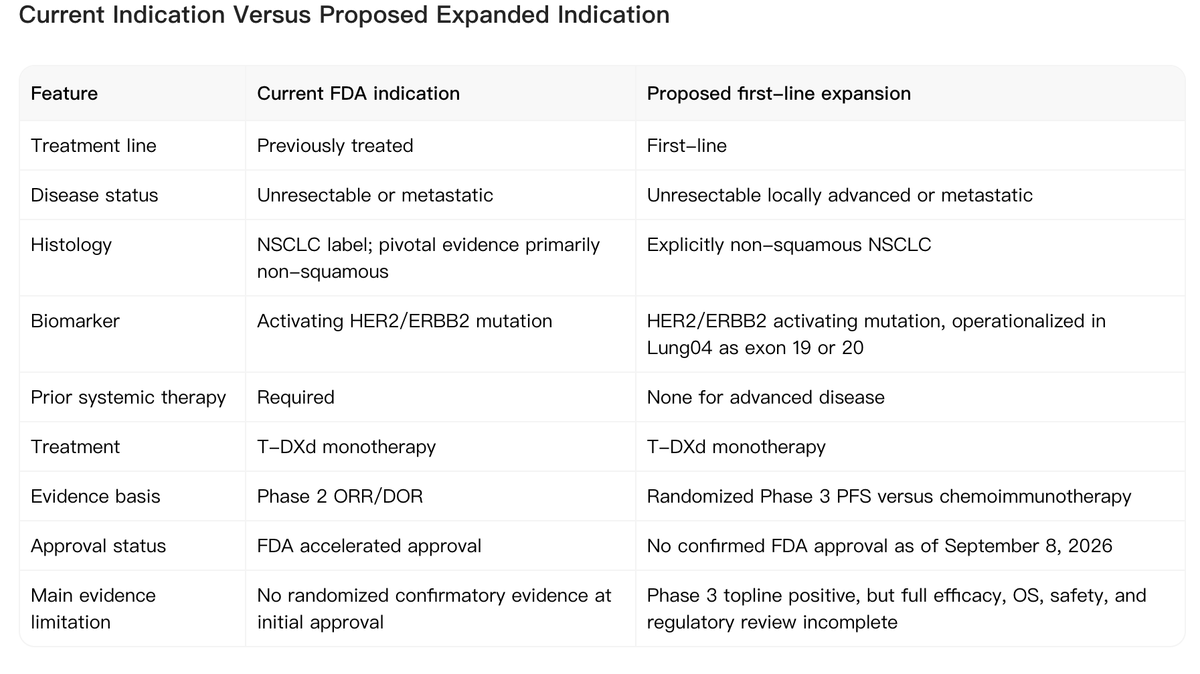
Figure 2. Noah AI separates the current later-line FDA indication from the proposed first-line HER2-mutant NSCLC expansion.
Research Drug Development with Noah AI for Free
Use Noah AI to research drug pipelines, development programs, clinical trials, scientific evidence, and competitive context across the drug development lifecycle.
Free to use · Free credits included · No credit card required
[Research Drug Development with Noah AI →](https://www.noah.bio/signup?utm_source=blog)
Evidence Layer 1: The Drug Is Already Clinically Validated
HER2-mutant NSCLC is not a speculative disease hypothesis. Activating HER2/ERBB2 mutations are established oncogenic alterations, and Enhertu already has regulatory validation in previously treated disease.
DESTINY-Lung01 provided important clinical proof. In 91 patients with previously treated HER2-mutant NSCLC, the confirmed objective response rate was 55%, median duration of response was 9.3 months, median PFS was 8.2 months, and median OS was 17.8 months. The study also showed activity across different HER2 mutation subtypes. It also highlighted a major risk: adjudicated drug-related interstitial lung disease or pneumonitis occurred in 26% of patients, including two fatal events.
Evidence Layer 2: DESTINY-Lung02 Supported the Approved Dose
DESTINY-Lung02 compared two T-DXd doses in previously treated HER2-mutant metastatic NSCLC. At the clinically relevant 5.4 mg/kg every three weeks dose, confirmed ORR was 49.0% and median duration of response was 16.8 months.
The lower dose also had a more favorable safety profile than 6.4 mg/kg. Grade 3 or higher drug-related treatment-emergent adverse events occurred in 38.6% versus 58.9%, while adjudicated drug-related ILD/pneumonitis occurred in 12.9% versus 28.0%.
Evidence Layer 3: DESTINY-Lung04 Tests the Actual Expansion
DESTINY-Lung04 (NCT05048797) is the pivotal step, because it moves from later-line activity toward randomized first-line testing.
| Design element | DESTINY-Lung04 |
|---|---|
| Phase | Phase 3 |
| Population | Unresectable locally advanced or metastatic non-squamous NSCLC with HER2 exon 19 or 20 mutations |
| Prior advanced-disease therapy | No prior palliative-intent systemic therapy |
| Experimental arm | T-DXd 5.4 mg/kg IV every 3 weeks |
| Comparator | Cisplatin or carboplatin + pemetrexed + pembrolizumab |
| Primary endpoint | BICR-assessed PFS |
| Key secondary endpoints | OS, investigator PFS, ORR, DOR, CNS outcomes, safety, and patient-reported outcomes |
As of the September 8, 2026 cutoff, ClinicalTrials.gov listed the study as active, not recruiting and had not yet posted results.
What the August 2026 Result Actually Establishes
On August 17, 2026, AstraZeneca and Daiichi Sankyo announced that DESTINY-Lung04 met its primary endpoint. Enhertu produced a statistically significant and clinically meaningful PFS improvement versus platinum-pemetrexed plus pembrolizumab.
That materially increases evidence maturity. But the public package at the cutoff remained incomplete. The sponsor announcement did not provide the full numerical PFS dataset, hazard ratio, confidence interval, mature OS results, full safety tables, CNS results, or a peer-reviewed Phase 3 publication.
Key distinction: "Phase 3 met its primary endpoint" is a clinical development fact. "Enhertu is FDA approved first-line in HER2-mutant NSCLC" would be a regulatory claim, and that approval was not confirmed as of September 8, 2026.
Positive Phase 3 Results Do Not Equal an Approved Expansion
| Evidence state | What can be said | What should not be said |
|---|---|---|
| Later-line accelerated approval | Enhertu is FDA approved after prior systemic therapy in HER2-mutant unresectable or metastatic NSCLC. | The label automatically applies first-line. |
| Positive Phase 3 topline | DESTINY-Lung04 met its primary PFS endpoint. | The complete magnitude and precision of benefit are already public. |
| Regulatory readiness | The result can support a potential approval regulatory submission. | A new FDA first-line side exists before FDA review and approval. |
The Competitive Context Changed During 2026
Indication expansion is not evaluated in a static market. In February 2026, FDA granted an expanded accelerated approval to zongertinib (Hernexeos) for adults with unresectable or metastatic non-squamous NSCLC whose tumors have HER2 tyrosine kinase domain activating mutations. The FDA efficacy population included patients who had not received systemic therapy for advanced disease.
That means an eventual Enhertu first-line expansion would enter a U.S. market where an approved oral HER2-directed TKI already exists for an overlapping molecular population. Sevabertinib (Hyrnuo) was also approved in 2025 for previously treated HER2 TKD-mutant non-squamous NSCLC, adding another HER2-directed comparator.
| Therapy | Relevant U.S. status | Implication |
|---|---|---|
| Enhertu | Accelerated approval after prior systemic therapy; first-line Phase 3 PFS topline positive | Potential first-line move based on randomized evidence |
| Zongertinib (Hernexeos) | Expanded accelerated approval in 2026, including untreated advanced-disease evidence | Approved targeted first-line drug |
| Sevabertinib (Hyrnuo) | Accelerated approval after prior systemic therapy | Later-line targeted competitor |
No direct efficacy ranking should be inferred across these programs because their populations, designs, comparators, molecular definitions, and endpoints differ.
Safety Has to Be Reconsidered When a Drug Moves Earlier
A later-line therapy may be used for longer when moved earlier, and the acceptable risk portal may shift when patients have better performance status and more treatment systems. For T-DXd, the key known risks include ILD/pneumonitis, neutropenia, anemia, nausea, vomiting, fatigue, and left ventricular dysfunction.
The 5.4 mg/kg dose improved the benefit-risk profile versus 6.4 mg/kg in DESTINY-Lung02, but the detailed first-line safety profile from DESTINY-Lung04 remains important for evaluating an earlier-line label.
Biomarker Definition Matters for the Expansion
The currently approved Enhertu NSCLC label broadly refers to an activating HER2/ERBB2 mutation. DESTINY-Lung04 operationalized the first-line population around HER2 exon 19 or exon 20 mutations. A future label therefore has to define exactly which mutation factors and testing approaches qualify.
Best AI Tools for Indication Expansion Research
| Tool | Best fit | Strength | Main limitation |
|---|---|---|---|
| Noah AI | Focused biomedical expansion question | Connects label, literature, trials, target rationale, safety, regulatory standard, and competition into one cited assessment. | Material claims still need primary-source verification. |
| Citeline Pharmaprojects+ | Global drug development intelligence | Strong for development stages, competing assets, indication histories, company pipelines, and drug classification. | Best suited to proprietary structural intelligence workflows. |
| Patsnap Synapse | Connected biopharma intelligence | Links drugs, targets, trials, patents, companies, deals, and literature. | Clinical interpretation still needs source-level review. |
| AlphaSense | Competitive and market intelligence | Useful for company disclosures, analyst commentary, expert calls, and regulatory monitoring. | Not a replacement for primary biomedical or regulatory sources. |
| Elicit | Literature-led evidence review | Useful for systematic search, screening, and extraction across scientific evidence. | Less suited to tracking regulatory and competitive changes. |
How to Separate a Real Expansion Opportunity From a Weak Hypothesis
- Target relevance: (the target biology remains relevant in the proposed population).
- Drug validation: the asset already shows reproducible activity.
- Clinical bridge: current trials support movement into the new line, stage, biomarker, or disease.
- Registrational design: a trial directly tests the proposed indication against an appropriate comparator.
- Safety transferability: the benefit-risk profile remains acceptable.
- Diagnostic feasibility: the biomarker can be identified reproducibly.
- Regulatory path: the evidence can support a new label.
- Competitive relevance: the opportunity remains meaningful after market changes.
What Still Needs to Happen?
- full publication of the primary Phase 3 PFS data;
- mature or sufficiently informative OS follow-up;
- first approval safety data, especially ILD/pneumonitis;
- CNS efficacy and subgroup analyses;
- clarification of the exact mutation population for a future label;
- supplemental regulatory submission and FDA review;
- positioning relative to using and other HER2-directed options.
FAQ
What is indication expansion in the industry?
Indication expansion is refining an existing drug for a new disease population, treatment line, stage, or biomarker-defined population beyond the label.
Is indication expansion the same as a drug?
They overlap but are not identical. Drug republishing broadly refers to finding a new test case for an existing molecule, while indication expansion more often means the drug's existing clinical or commercial plan extends the label.
Can AI identify indication expansion opportunities?
AI can connect mechanistic evidence, trials, publications, regulatory registries, biomarkers, and competitor programs. However, it should not treat biological ester alone as sufficient evidence.
Is Enhertu FDA approved first-line in the HER2 mutant population?
As of September 8, 2026, no FDA first-line approval for Enhertu HER2-mutant NSCLC was confirmed. The current label requires distance to therapy, while DESTINY-Lung04 evaluated a high-quality first-line Phase 3.
Which AI tool is best for indication expansion?
It depends on the workflow. Noah AI is useful for focused, cited assessments; Citeline Pharmaprojects+ for structured execution; Synapse for connected data; AlphaSense for monitoring; and Elicit for establishment.
Final Takeaway
Indication is not about finding the most optimistic next use for a drug. It is about testing whether the biological rationale, clinical activity, randomized evidence, safety, diagnostics, competition, and regulatory status are aligned strongly enough to support the next clinical development.
For Enhertu in HER2-mutant NSCLC, the 2026 evidence package is materially stronger after the positive DESTINY-Lung04 PFS topline result. But the public dataset remains incomplete, OS remains under follow-up, the U.S. first-line landscape has changed with zongertinib, and FDA first-line approval for Enhertu was not confirmed at the cutoff.
Noah's current-versus-expanded indication view is useful because it keeps the boundary visible: strong expansion evidence is not the same as an approved expansion.