Best AI Tools for Drug Target Validation Assessment (2026)
Linda
Compare AI tools for drug target validation in 2026. Learn how AI can assess genetic, biological, causal, target-engagement, and clinical evidence using a TREM2 Alzheimer's disease case.
Drug target validation is not the same as finding a gene associated with disease. A target can have strong human genetics, compelling disease biology, and measurable target engagement while the therapeutic hypothesis remains clinically unvalidated.
This guide compares tools that can support different parts of a target-validation workflow: Noah AI, Open Targets Platform, BenchSci ASCEND, Causaly, and structural biology tools such as AlphaFold. For the real case, we tested Noah AI on TREM2 in Alzheimer's disease.
Testing note: We tested Noah AI directly. Other tools are described based on their documented workflows and typical research use cases.
1. What Is Drug Target Validation?
A useful target assessment separates three questions:
- Target–disease involvement: Is altered target biology involved in disease?
- Therapeutic-hypothesis validation: Do we know how, when, and in which direction the target should be modulated?
- Clinical-efficacy validation: Has a target-directed intervention improved meaningful patient outcomes?
Those layers should not be collapsed into one “validated / not validated” label.
2. What Evidence Should Be Assessed?
| Evidence layer | Key question |
|---|---|
| Human genetics | Does inherited variation connect the target to disease, and does it inform therapeutic direction? |
| Disease biology | Is the target active in relevant cells, tissues, pathways, and disease states? |
| Functional / causal biology | What happens when the target is removed, restored, activated, inhibited, or otherwise perturbed? |
| Direction of modulation | Should the target be activated, inhibited, restored, or modulated only in selected contexts? |
| Target engagement | Can a drug reach and modulate the target in humans? |
| Tractability | Can the target be addressed with a practical therapeutic modality? |
| Safety | What on-target or modality-related liabilities could constrain development? |
| Clinical translation | Has human engagement translated into disease modification or patient benefit? |
3. Best AI and Data Tools for Target Validation
Noah AI
Directly tested
Noah AI is useful when the goal is to integrate multiple target-validation layers into one structured assessment. In this TREM2 case, the workflow combined human genetics, disease biology, functional evidence, modulation direction, biomarkers, clinical development, safety, tractability, contradictory findings, and remaining validation gaps.
The useful output is not a single target score. It is a map of which evidence layers are strongly supported, mixed, clinically unresolved, or still insufficient.
Noah AI can be used for free, includes free credits, and requires no credit card to get started.
Open Targets Platform
Open Targets is useful for target–disease association and prioritization. It brings together public evidence relevant to genetics, disease association, expression, known drugs, tractability, and safety-related target properties. It is especially useful at the beginning of target due diligence, before deeper mechanistic and translational interpretation.
BenchSci ASCEND
ASCEND is oriented toward preclinical disease biology. It can support target and disease due diligence, causality assessment, experimental validation, model selection, and interpretation of experiment-focused biomedical evidence.
Causaly
Causaly can support target identification, prioritization, and validation by linking mechanistic evidence, biological rationale, safety signals, literature, and development context. It is particularly useful when a team needs to move quickly across a broad target evidence landscape.
AlphaFold and Structural Tools
AlphaFold and related structural tools support protein structure prediction and structural analysis, including domains, potential binding surfaces, and structure-informed druggability assessment. These predictions can inform target tractability and experimental design, but they do not validate a target's involvement in disease, establish therapeutic causality, or demonstrate clinical efficacy. Structural evidence should therefore be treated as one supporting layer, not as proof of biological or clinical target validation.
4. Real Case: TREM2 in Alzheimer's Disease
The Noah task asked a focused question: How strongly does current evidence support TREM2 as a therapeutic target in Alzheimer's disease?
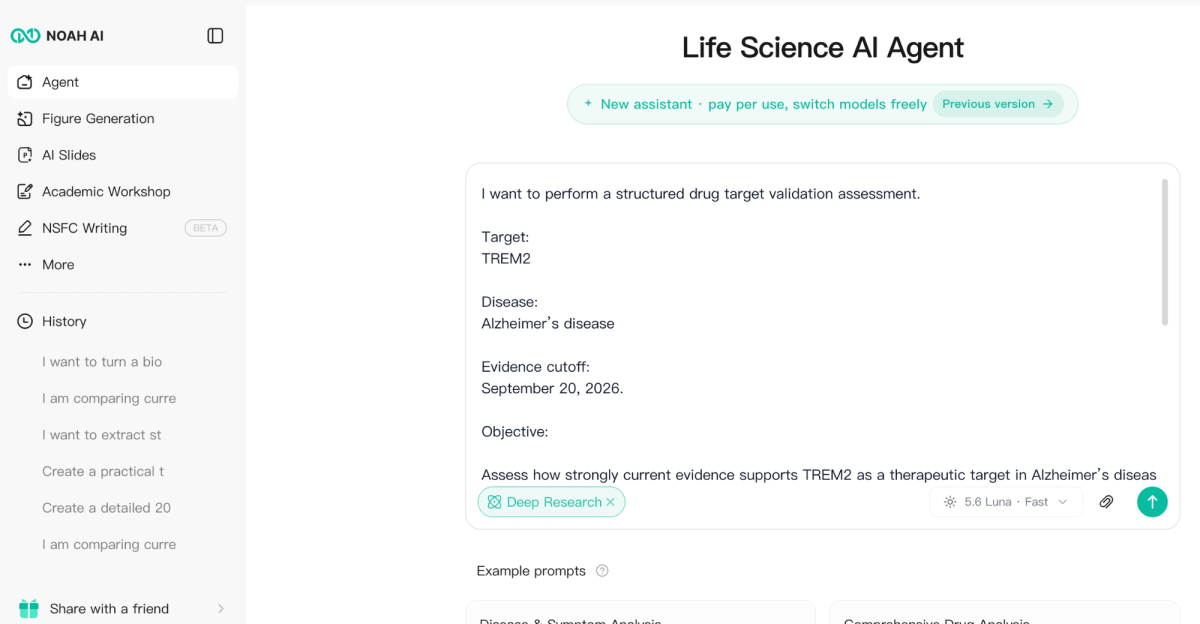
The prompt deliberately separated genetics, human disease biology, functional evidence, therapeutic direction, target engagement, biomarkers, tractability, safety, clinical development, efficacy, and translational gaps.
5. Start with Human Genetics, but Do Not Stop There
Human genetics gives TREM2 a strong disease-association foundation. Rare variants, particularly R47H, have repeatedly been linked to Alzheimer's disease risk. That supports target–disease involvement.
It does not automatically prove that broad TREM2 agonism is therapeutic. A risk variant can support the importance of the pathway while leaving the optimal magnitude, timing, cell state, and direction of pharmacologic modulation unresolved.
6. Evaluate Human Disease Biology
TREM2 is closely connected to microglial biology, including survival, plaque engagement, migration, metabolic adaptation, substrate handling, and disease-associated cell states. Human tissue and cell evidence therefore supports a disease-relevant role.
But the biology is not simply “more TREM2 activity is better.” Some evidence is consistent with deficient receptor function, while other work shows inflammatory, synaptotoxic, or abnormal downstream states. A credible assessment must preserve those tensions.
7. Ask Whether the Therapeutic Direction Is Actually Clear
The TREM2 evidence supports restoration or activation of selected deficient functions in some settings. It does not validate indiscriminate, sustained global activation as a universal Alzheimer's strategy, and it does not establish inhibition as the correct alternative.
The better-supported hypothesis is context-, stage-, dose-, ligand-, valency-, and pathway-specific modulation.
This is a key distinction for AI-assisted target validation: genetics may validate involvement while modulation direction remains mixed.
8. Separate Target Engagement from Clinical Benefit
The strongest translational lesson comes from AL002. In the randomized phase 2 INVOKE-2 study, the antibody produced central pharmacodynamic activity, including sustained changes in CSF soluble TREM2 and a downstream osteopontin response.
But the week-96 clinical endpoint did not show statistically significant improvement across the three tested doses.

| Layer | What the AL002 evidence showed | What it did not show |
|---|---|---|
| Target engagement | TREM2-associated CSF pharmacodynamic modulation | That the measured engagement represented the beneficial receptor state required for disease modification |
| Downstream biology | A measurable osteopontin response | That the downstream response corrected Alzheimer's disease biology |
| Clinical efficacy | No statistically significant CDR-SB improvement across the tested doses | Clinical validation of the tested agonist strategy |
Target engaged ≠ biology corrected ≠ patient benefited.
9. Why One Negative Trial Does Not Automatically Invalidate the Target
AL002 materially weakens the proposition that the tested form of systemic agonist-antibody activation is sufficient to slow clinical progression in the studied early-AD population. That is important negative evidence.
But the result does not identify a single definitive reason for failure. Remaining possibilities include therapeutic direction, disease timing, biomarker-selected population, modality, exposure, receptor epitope or valency, microglial state, or the possibility that the therapeutic hypothesis itself is insufficient.
A rigorous assessment should label those explanations according to evidence strength rather than choosing a convenient post-hoc story.
10. Tractability and Safety Are Separate Validation Layers
TREM2 has been addressed with antibody and small-molecule strategies, so it is not merely a theoretical target. But “clinically testable” is different from “clinically validated.”
For a CNS target, tractability also includes brain exposure, cellular access, receptor occupancy or productive signaling, control over dose and duration, and the ability to separate useful microglial responses from unwanted immune effects.
Safety should likewise distinguish established clinical observations, mechanistic concerns, modality-specific risks, and theoretical liabilities. A target may be biologically strong but still fail if the exposure needed for efficacy cannot be achieved safely.
11. Build a Layered Final Assessment
The final Noah output kept the evidence dimensions separate rather than combining them into a composite score.
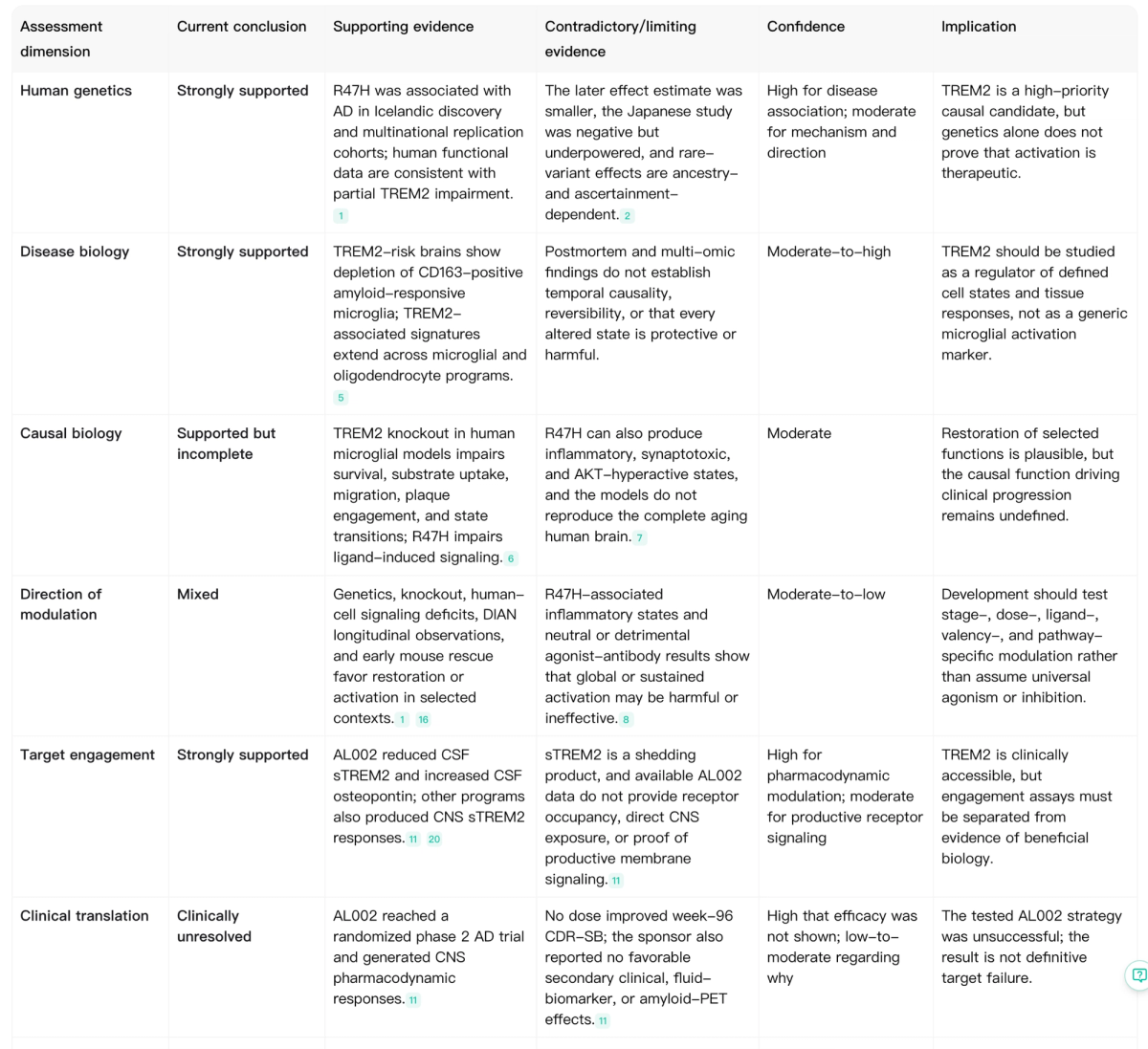
| Dimension | Current assessment | Interpretation |
|---|---|---|
| Human genetics | Strongly supported | Credible human evidence links TREM2 to Alzheimer's disease risk. |
| Disease biology | Strongly supported | TREM2 participates in disease-relevant microglial and tissue biology. |
| Causal biology | Supported but incomplete | Perturbation affects relevant biology, but the clinically causal function remains incompletely defined. |
| Direction of modulation | Mixed | Restoration or activation may help in selected contexts, but universal agonism is not established. |
| Target engagement | Strongly supported | Human pharmacology shows that TREM2-associated biology can be modulated. |
| Clinical translation | Clinically unresolved | Human engagement has not yet translated into demonstrated clinical efficacy. |
This is more informative than a single “8/10” score. It shows exactly where evidence is strong and where the development hypothesis still breaks down.
Assess your own drug target with Noah AI
Use Noah AI to organize human genetics, disease biology, causal evidence, therapeutic direction, target engagement, clinical translation, tractability, safety, and remaining validation gaps.
Noah AI can be used for free, includes free credits, and requires no credit card.
12. What Makes a Target Assessment Decision-Useful?
For each evidence layer, ask:
- What is directly established?
- What remains an inference?
- Does the evidence support disease involvement, therapeutic direction, or both?
- Has the target been engaged in humans?
- Has engagement changed disease biology?
- Has disease biology translated into patient benefit?
- What contradictory evidence exists?
- What experiment or trial would materially change the assessment?
This makes the output useful for target due diligence, translational research, preclinical planning, and R&D review.
13. Common Mistakes in AI-Assisted Target Validation
Equating Association with Therapeutic Validation
Expression or genetic association can support disease relevance without proving that pharmacological modulation will improve disease.
Assuming Genetics Defines the Correct Direction
Human genetics may indicate impaired biology while leaving the appropriate magnitude, timing, and modality of intervention uncertain.
Treating Mouse Rescue as Human Efficacy
Animal perturbation can support causality within a model. It cannot establish clinical benefit.
Calling a Biomarker Change Clinical Validation
Target engagement and pharmacodynamic activity are different from disease modification and patient benefit.
Calling One Negative Trial Definitive Target Failure
A negative trial directly weakens the tested therapeutic hypothesis. Broader target invalidation requires stronger evidence that the relevant biology, exposure, direction, stage, and population were adequately tested.
Ignoring Contradictory Evidence
Target validation becomes less reliable when supportive experiments are collected but neutral or detrimental findings are omitted.
Using a Composite Score Too Early
A single score can hide a pattern such as strong genetics, mixed modulation direction, strong engagement, and unresolved clinical translation.
14. Which Tool Fits Which Part of the Workflow?
| Task | Useful tool | Typical role |
|---|---|---|
| Integrated target assessment | Noah AI | Combine genetics, biology, clinical evidence, contradictions, and validation gaps. |
| Target–disease evidence | Open Targets | Explore public genetics, association, tractability, expression, drug, and safety-related evidence. |
| Preclinical disease biology | BenchSci ASCEND | Investigate experiments, models, causality, and preclinical validation questions. |
| Mechanistic due diligence | Causaly | Connect biological rationale, mechanisms, safety signals, and literature. |
| Structural feasibility | AlphaFold / structural tools | Support structural and tractability questions rather than overall target validation. |
15. Related Research Guides
- Best AI Tools for Drug Mechanism of Action Analysis (2026)
- Best AI Tools for Drug Safety Evidence Review (2026)
- How Noah AI Helps Life Science Teams Track Drug Pipelines, Clinical Trials, and Market Signals
- How to Analyze Clinical Trial Results with AI Using Noah AI
- How to Prepare a Target Product Profile with Noah AI
16. FAQ
What is drug target validation?
Drug target validation is the process of assessing whether a biological target is meaningfully connected to disease and whether modifying it has a defensible therapeutic rationale.
Can AI validate a drug target?
AI can help retrieve, organize, compare, and synthesize evidence across validation layers. It should not replace experimental validation or expert judgment.
Does target engagement mean a target is clinically validated?
No. Target engagement shows that a therapeutic intervention can reach or modulate a target-associated pathway. Clinical validation requires evidence of meaningful patient benefit.
Does a failed clinical trial invalidate the target?
Not automatically. It weakens the tested therapeutic hypothesis. Broader interpretation depends on modality, exposure, direction, stage, patient selection, safety, and the strength of the rest of the evidence.
Should target validation use a numerical score?
A score can support internal prioritization, but a layered assessment is often more informative because genetics, causality, therapeutic direction, tractability, safety, and clinical translation can have very different levels of support.
17. Final Takeaway
A target can be genetically and biologically validated while its therapeutic hypothesis remains clinically unvalidated.
TREM2 shows why target validation should be layered rather than binary. Human genetics and disease biology strongly support involvement in Alzheimer's disease. Functional evidence supports a causal role but also reveals context-dependent biology. Human pharmacology shows that TREM2-associated pathways can be engaged. Yet the leading completed randomized efficacy test did not demonstrate clinical benefit.
The most useful conclusion is therefore not simply "TREM2 works" or "TREM2 failed." It is that target–disease involvement is well supported, modulation direction remains mixed and context-dependent, human engagement is feasible, and clinical translation remains unresolved.
Assess Genetic, Biological, Causal, and Clinical Validation Evidence with Noah AI
Use Noah AI to evaluate genetic associations, disease biology, causal evidence, therapeutic hypotheses, target engagement, and clinical validation. Identify conflicting findings and unresolved gaps before making target-development decisions.
Free to use · Free credits included · No credit card required