Best AI Tools for Drug Safety Evidence Review (2026)
Linda
Compare the best AI tools for drug safety evidence review. We test Noah AI on T-DXd and ILD/pneumonitis to show how regulatory, trial, and real-world evidence fit together.
Drug safety evidence review is more demanding than simply collecting a list of adverse events. A useful review needs to distinguish between regulatory warnings, clinical trial safety data, pooled analyses, systematic reviews, and real-world evidence.
That distinction matters because the same adverse event can look different depending on the evidence source. Trial populations are often more selected, monitoring is more protocolized, and outcome adjudication is more standardized than in routine practice.
AI research tools can help retrieve, structure, and summarize safety evidence, but the best tools are the ones that preserve source traceability and avoid mixing unlike evidence as if it were directly comparable.
Evaluation note: We tested Noah AI directly using a real safety-review case: trastuzumab deruxtecan (T-DXd, Enhertu) and the evidence on interstitial lung disease (ILD) / pneumonitis. Other tools were evaluated from their current official documentation and published workflows.
What Is Drug Safety Evidence Review?
A drug safety evidence review examines how a clinically important safety issue is described across multiple layers of evidence.
A strong review should usually cover:
- current FDA warning or prescribing-information language,
- major clinical trial safety data,
- pooled safety analyses,
- systematic reviews or meta-analyses,
- real-world evidence,
- event severity and fatal-event risk,
- time to onset,
- reported or proposed risk factors,
- monitoring and management recommendations,
- key limitations and areas of uncertainty.
This means a true safety review is not just about incidence. It is also about evidence hierarchy, interpretation, and practical use.
Best AI Tools for Drug Safety Evidence Review
| Tool | Best For | Evidence Search | Safety Evidence Structuring | Source Traceability | Typical Output |
|---|---|---|---|---|---|
| Noah AI | Structured biomedical safety evidence review | Strong | Strong | Strong | Cited safety overview and evidence synthesis |
| Elicit | Safety evidence extraction across larger literature sets | Strong | Strong | Strong | Evidence tables and reports |
| Consensus | Rapid literature exploration for safety questions | Strong | Moderate | Strong | Academic evidence synthesis |
| SciSpace | Reading safety details inside papers and PDFs | Strong | Moderate–Strong | Strong | Paper-level safety extraction |
| ChatGPT Deep Research | Multi-source safety research | Strong | Strong | Strong | Source-documented research brief |
| Perplexity Research | Fast cross-source safety orientation | Moderate–Strong | Strong | Strong | Cited research report |
Noah AI
Best for: turning a drug safety question into a structured, cited evidence review.
Noah AI is particularly useful when the goal is not just to identify a safety signal, but to organize the full evidence stack behind it. That includes label language, major trials, pooled analyses, real-world evidence, and the practical implications for monitoring and management.
This is especially valuable for medical affairs, clinical development, pharmacovigilance-adjacent research, and literature review workflows where safety claims need clear source support.
Example: T-DXd and ILD / Pneumonitis
We tested Noah using a focused safety-review question: what does the evidence show about trastuzumab deruxtecan (T-DXd, Enhertu) and interstitial lung disease (ILD) / pneumonitis?
This is a strong case because ILD/pneumonitis is a clinically important and well-recognized risk, but the evidence comes from multiple different source types. A good AI tool should not collapse those sources into one undifferentiated answer.
The prompt asked Noah to review the current FDA warning, trial incidence and severity, fatal-event risk, time to onset, risk factors, real-world evidence, management recommendations, retreatment data, and the limitations of the available evidence.
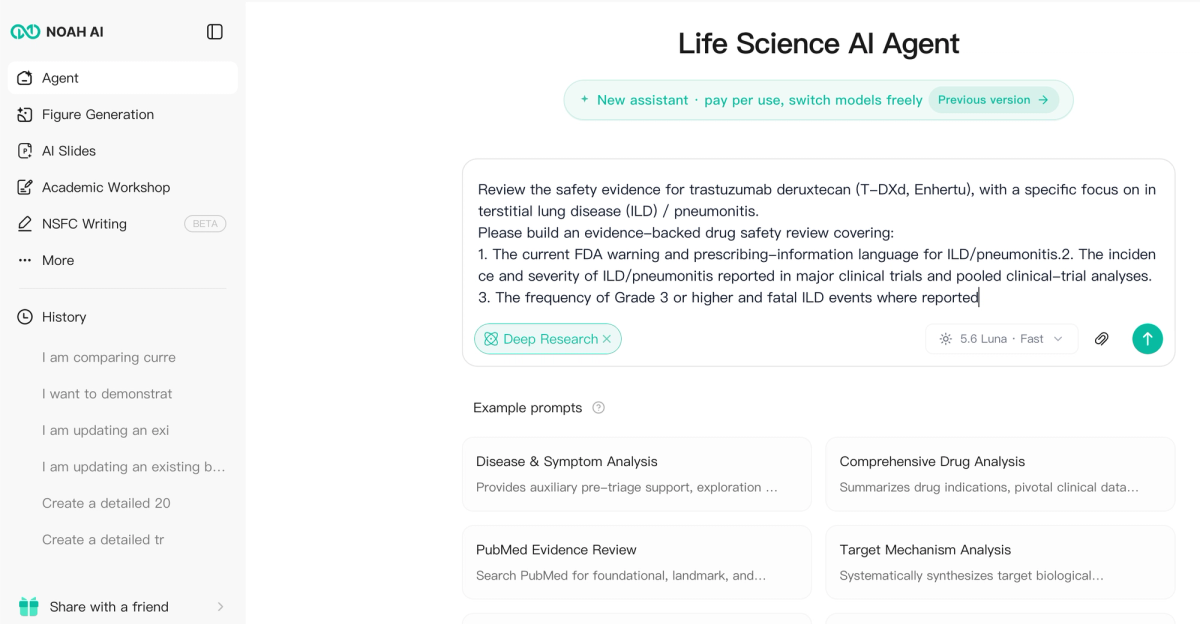
A drug safety evidence review prompt entered into Noah AI for trastuzumab deruxtecan and ILD / pneumonitis.
What Noah Returned
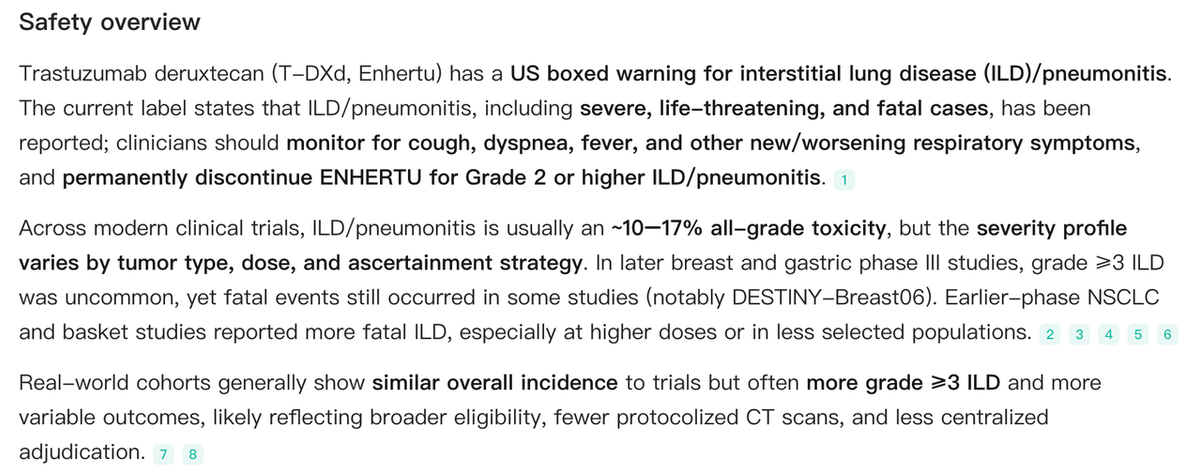
Noah returned a concise safety overview that clearly separated three layers of evidence: regulatory warning, clinical trial evidence, and real-world evidence.
It identified that T-DXd carries a US boxed warning for ILD/pneumonitis and that the current label instructs clinicians to monitor for new or worsening respiratory symptoms and to permanently discontinue ENHERTU for Grade 2 or higher ILD/pneumonitis.
Noah then summarized that across modern clinical trials, ILD/pneumonitis is often an approximately 10% to 17% all-grade toxicity, while emphasizing that severity varies by tumor type, dose, and ascertainment strategy.
It also summarized an important real-world pattern: overall incidence may look broadly similar to trial experience, but some real-world cohorts report more grade 3 or higher ILD and greater outcome variability, likely reflecting broader eligibility and less protocolized monitoring.
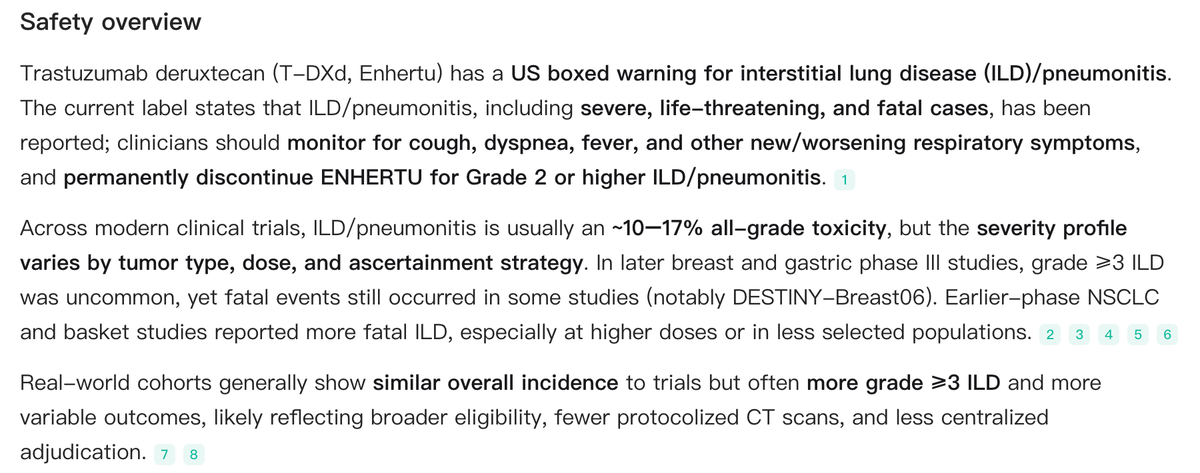
Noah AI summarizes T-DXd ILD / pneumonitis evidence across regulatory guidance, clinical trial evidence, and real-world studies.
Try Noah AI for Free
Use Noah AI to search, compare, and analyze biomedical evidence with AI-powered research workflows.
Free credits are available, and no credit card is required to get started.
Why This Is a Good Safety Review Example
This example works well because it shows that a meaningful safety review is not just a list of event rates. It requires interpreting the safety signal across different evidence contexts.
The current US label warns that ILD/pneumonitis, including severe, life-threatening, and fatal cases, has occurred, and the label requires permanent discontinuation for Grade 2 or higher ILD/pneumonitis.
Meanwhile, pooled and trial-level evidence provides a more detailed picture of frequency, severity, and timing. One widely cited pooled analysis of nine T-DXd monotherapy studies reported 15.4% all-grade adjudicated ILD/pneumonitis, with most first events occurring within the first 12 months and a median time to first event of 5.4 months.
Real-world evidence adds another layer: it may show broadly similar overall incidence but more severe cases in some settings, which matters for interpretation and monitoring strategy.
Why Safety Evidence Sources Should Not Be Mixed Carelessly
A common mistake in drug safety writing is to merge all safety evidence into a single apparent incidence number. That is usually methodologically weak.
Safety evidence often differs because of:
- tumor type and disease setting,
- dose level,
- prior therapy exposure,
- follow-up length,
- screening intensity,
- central adjudication versus routine practice,
- trial eligibility versus real-world heterogeneity.
For this reason, a useful AI safety workflow should preserve the evidence type, not just the number.
Elicit
Best for: extracting and synthesizing safety evidence across a larger literature set.
Elicit is useful when the question requires assembling safety evidence from many papers rather than a small number of already known sources. Its Research Agent can search scientific sources, extract structured information, and generate reports or evidence tables.
That makes it relevant for broader safety-review tasks such as identifying reported adverse-event frequencies, risk factors, and study-level differences across multiple publications.
Official documentation: Introducing Elicit Research Agent.
Consensus
Best for: quickly exploring the academic literature around a focused drug-safety question.
Consensus is useful when the first task is literature orientation. Its Deep Review workflow can decompose a question, search academic papers, and summarize what the literature says.
For example, it can help answer questions such as:
- What adverse event is most frequently discussed for a given drug?
- Which papers reported fatal events?
- What risk factors are repeatedly mentioned?
- Where do studies disagree?
Official documentation: Consensus Deep Review.
SciSpace
Best for: reading safety details inside individual papers, appendices, and PDFs.
Drug safety evidence is often buried in trial supplements, subgroup tables, methods sections, or appendices. SciSpace is useful when the key problem is extracting and interpreting those paper-level details.
Typical use cases include:
- finding grade 3 or higher adverse-event rates,
- checking whether an event was adjudicated,
- locating time-to-onset data,
- reviewing how safety endpoints were defined,
- checking management language in a publication.
Official documentation: How to Conduct a Literature Review Using SciSpace.
ChatGPT Deep Research
Best for: multi-source safety evidence review across papers, labels, websites, and uploaded files.
Some drug safety reviews depend on more than journal articles. Important information may come from labels, regulatory pages, uploaded documents, review articles, and real-world evidence sources.
ChatGPT Deep Research is useful when the task requires combining those source types into a single structured brief while keeping source links or citations visible.
Official documentation: Deep research in ChatGPT.
Perplexity Research
Best for: fast cross-source safety orientation before deeper review.
Perplexity Research can be helpful early in a safety project, when the goal is to quickly identify major trials, label warnings, reviews, and real-world studies worth reading more closely.
It is useful for rapid orientation, but high-impact safety claims should still be checked against original regulatory or scientific sources.
Official documentation: What is Research mode?.
How to Review Drug Safety Evidence with AI
1. Start with the Safety Question — Specify the drug, the adverse event of interest, and the type of review you want. “Review safety” is usually too broad.
2. Pull the Current Regulatory Language First — The label or regulatory warning is the best starting point for understanding the current standard safety position.
3. Separate Trial Evidence from Real-World Evidence — Do not present real-world event rates as though they came from the same evidence environment as trial data.
4. Track Severity, Not Just Incidence — All-grade event rates can be misleading if severe, fatal, or management-critical events are not clearly separated.
5. Look for Time to Onset and Risk Factors — A safety review becomes more clinically useful when it includes when events tend to happen and which patients may require greater caution.
6. Keep Management Recommendations Visible — Monitoring, interruption, discontinuation, and retreatment rules are often as important as the incidence figure itself.
7. State the Evidence Limits — Safety evidence is frequently heterogeneous. A reliable summary should say where the uncertainty still is.
Which Tool Should You Choose?
Choose Noah AI when you want to start from a drug safety question and generate a structured, cited review that keeps regulatory, trial, pooled, and real-world evidence visible.
Choose Elicit when the task is broader evidence extraction across many papers or a larger review set.
Choose Consensus when you need a quick literature overview of a specific safety question.
Choose SciSpace when you need to inspect safety details inside individual papers or PDFs.
Choose ChatGPT Deep Research when the review spans labels, publications, public web sources, and uploaded files.
Choose Perplexity Research when you need fast cross-source orientation before a deeper review.
Frequently Asked Questions
What is a drug safety evidence review?
A drug safety evidence review examines a safety issue across multiple evidence layers, including regulatory warnings, trials, pooled analyses, reviews, and real-world evidence.
Can AI review adverse-event evidence across studies?
Yes. AI can help retrieve and organize safety evidence, but the most reliable workflows keep the source type visible and avoid overstating comparability.
Why should trial and real-world safety data be separated?
Because they usually come from different populations and monitoring environments. Combining them into one implied incidence can be misleading.
Is incidence enough for a safety review?
No. A useful safety review also needs to address severity, fatal events, timing, risk factors, management recommendations, and the strength of the evidence.
Can AI identify current safety management recommendations?
Yes, especially when the workflow includes current label information and review articles, but important recommendations should still be checked against the most current regulatory source.
Why use T-DXd ILD as an example?
Because it is a clinically significant safety issue with evidence across labels, trials, pooled analyses, and real-world studies, making it a strong test case for a real safety evidence review workflow.
Final Takeaway
Drug safety evidence review is not just a summarization task. It is an evidence-structure task.
Elicit, Consensus, and SciSpace are useful at different stages of literature review and safety evidence extraction. General deep-research tools can help when evidence is spread across several source types.
Noah AI is particularly relevant when the goal is to move from a focused drug-safety question to a structured, cited review that preserves regulatory guidance, clinical trial findings, pooled analyses, and real-world evidence in one workflow.
The core rule is simple: do not treat all safety evidence as though it were the same kind of evidence.
Want to review drug safety evidence with the same workflow? Use Noah AI to search medical evidence, separate regulatory and clinical evidence layers, and turn the findings into a structured, cited safety review.
Related Research Guides
- Best AI Tools for Clinical Trial Results Analysis (2026)
- How to Analyze Clinical Trial Results with AI Using Noah AI
- Best AI Tools for Turning Research Questions into Evidence Tables (2026)
- Best AI Tools for Medical Literature Search and Research Writing (2026)
- Best Elicit Alternatives for Biomedical Literature Review (2026)