Best AI Tools for Drug Resistance Mechanism Analysis (2026)
Linda
Compare AI tools for drug resistance mechanism analysis in 2026. Learn how AI maps on-target escape, bypass signaling, and non-genetic resistance using an osimertinib NSCLC case.
Drug resistance analysis is not simply a search for mutations that appear after treatment. A useful workflow has to explain how resistance occurs, how strong the evidence is, how the mechanism can be detected, whether multiple mechanisms can coexist, and what remains uncertain.
This guide compares five tools that can support different parts of that workflow: Noah AI, Causaly, BenchSci ASCEND, Elicit, and Scite.
For the real case, we tested Noah AI on acquired resistance to first-line osimertinib in advanced EGFR-mutant non-small cell lung cancer (NSCLC). The goal was not to produce a generic list of resistance mutations. It was to build a structured resistance evidence map spanning on-target escape, bypass signaling, downstream pathway reactivation, acquired fusions, histologic transformation, non-genetic resistance, detection constraints, and coexisting mechanisms.
Scope note: This article focuses on tool selection and a general framework for drug resistance mechanism analysis. The osimertinib case is used as a worked example to demonstrate that framework. For a topic-focused review of osimertinib resistance biology, biomarkers, patient stratification, and next-line strategies, see the dedicated osimertinib resistance article.
1. What Is Drug Resistance Mechanism Analysis?
Drug resistance mechanism analysis asks why a treatment that initially controlled disease later becomes less effective or ineffective.
- On-target resistance: the drug target changes so the drug no longer binds or suppresses it effectively.
- Bypass signaling: another receptor or pathway restores downstream signaling despite inhibition of the original target.
- Downstream reactivation: alterations below the target reactivate MAPK, PI3K, or other survival pathways.
- Acquired fusions: a new fusion driver creates an alternative oncogenic route.
- Histologic transformation: the tumor changes lineage, such as transformation from adenocarcinoma to small-cell lung cancer.
- Phenotypic or non-genetic resistance: cells enter drug-tolerant or plastic states that may not be visible on DNA sequencing.
- Compound resistance: different resistant clones or mechanisms coexist across lesions or over time.
This is why drug resistance should be treated as an evolving tumor state rather than a mutation checklist.
2. What Should an AI Tool for Drug Resistance Analysis Do?
| Capability | Why it matters |
|---|---|
| Mechanism taxonomy | Separates on-target, bypass, downstream, fusion, lineage, and non-genetic resistance. |
| Evidence maturity | Distinguishes recurrent human mechanisms from emerging or primarily preclinical findings. |
| Treatment-line context | Prevents first-line and later-line resistance frequencies from being treated as interchangeable. |
| Specimen awareness | Tracks whether evidence came from tissue, plasma/ctDNA, or preclinical models. |
| Detection mapping | Shows which mechanisms can be detected genomically and which require pathology, RNA, protein, or other tissue-state measurements. |
| Coexistence analysis | Recognizes that one detected alteration may not explain every progressing lesion. |
| Uncertainty handling | Preserves unresolved mechanisms instead of interpreting a negative assay as biological absence. |
3. Best AI Tools for Drug Resistance Mechanism Analysis
Noah AI
Directly tested
Noah AI is useful when the deliverable needs to integrate mechanistic and clinical resistance evidence into a single structured analysis. In this case, Noah separated first-line osimertinib resistance by biological category, evidence maturity, specimen type, detection method, co-occurrence, and uncertainty.
The most useful outputs were the tissue-versus-ctDNA detection table and the final resistance mechanism map. Together, they show not only what resistance mechanisms have been reported, but also how confidently they can be established.
Noah AI can be used for free, includes free credits, and requires no credit card to get started.
Causaly
Causaly is useful for exploring mechanistic relationships across drugs, targets, pathways, biomarkers, diseases, and safety signals. For a resistance project, it can help researchers move from an observed alteration toward pathway context, biological rationale, and supporting evidence.
BenchSci ASCEND
BenchSci ASCEND is oriented toward preclinical disease biology and experimental evidence. It is relevant when a resistance hypothesis needs to be tested against model systems, perturbational evidence, pathway biology, causality, or experimental validation strategies.
Elicit
Elicit is useful when the bottleneck is retrieving and structuring a large body of resistance literature. Its systematic-review workflow supports search, screening, extraction, and evidence synthesis, making it suitable for building large study-level evidence tables.
Scite
Scite is useful after a resistance claim has already been identified. Smart Citations can help researchers see whether later papers support, contrast, or simply mention the original finding.
4. Real Case: Acquired Resistance to First-Line Osimertinib
The Noah case focused specifically on acquired resistance after first-line osimertinib in advanced EGFR-mutant NSCLC.
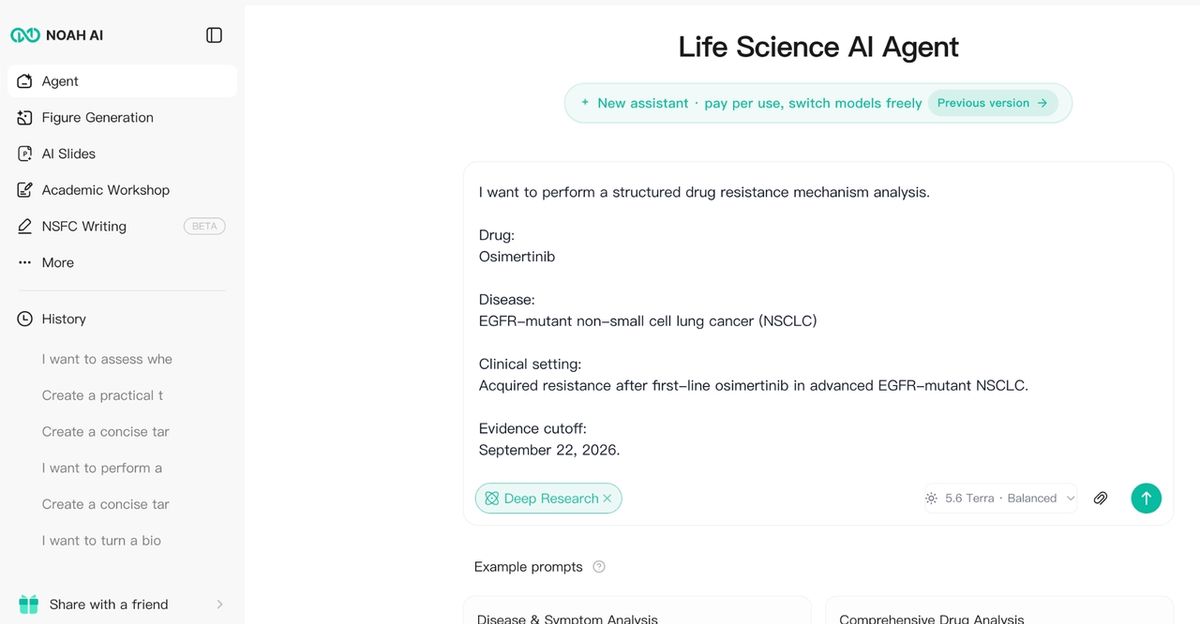
The research question asked Noah to identify the major evidence-supported mechanisms, explain how they produce resistance, evaluate how mature the evidence is, distinguish tissue from plasma evidence, and connect each mechanism to the appropriate confirmation method.
5. Separate Acquired Resistance from Primary Resistance
Acquired resistance means that the tumor initially experienced meaningful control on osimertinib and later progressed with a treatment-selected or newly detected resistance process.
This is different from primary resistance, where the disease never achieves meaningful initial control. Baseline co-alterations can influence prognosis or progression risk, but they should not automatically be classified as acquired resistance without evidence that progression selected or enriched them.
6. Start with On-Target EGFR Resistance
The best-established on-target mechanism in the first-line setting is EGFR C797S.
Osimertinib relies on covalent binding to cysteine 797 in EGFR. Substitution at this residue can interfere with the irreversible drug–target interaction and create a direct route of escape.
Other tertiary EGFR variants have also been reported, but evidence maturity varies, and some structural observations come from later-line exposure. A resistance map should preserve that context instead of merging all tertiary EGFR mutations into one uniform category.
7. Look for Bypass Signaling
The most reproducibly supported bypass mechanism after first-line osimertinib is MET amplification.
Increased MET signaling can maintain downstream oncogenic activity even when EGFR is inhibited. But reported frequency depends strongly on specimen type and copy-number method.
MET amplification is not the same as MET exon 14 skipping. One is a copy-number event; the other is a splice-altering MET activation event.
8. Map Downstream Pathway Reactivation
Alterations affecting KRAS, BRAF, PIK3CA, PI3K–AKT–mTOR signaling, and cell-cycle biology can reduce dependence on EGFR by restoring downstream signaling or supporting resistant cellular states.
The evidence is not equally mature across all of these mechanisms. Some have human first-line observations but low counts; others are supported mainly by functional models or mixed-line evidence.
A useful resistance analysis should therefore label mechanisms as Established human, Supported human, Emerging human, Primarily preclinical, or Uncertain.
9. Include Acquired Fusions Without Overstating Rare Events
Acquired kinase fusions can provide EGFR-independent signaling. First-line evidence includes rare examples involving RET and BRAF.
A biologically convincing case report or small cohort can establish that a mechanism is possible without establishing that it is common. Fusion analysis also highlights an assay problem: DNA-only or plasma testing may miss some rearrangements, while tissue with RNA-capable fusion testing can add important evidence.
10. Check for Histologic Transformation
Histologic transformation is fundamentally different from finding another mutation.
A progressing EGFR-mutant adenocarcinoma can transform into small-cell lung cancer or a squamous phenotype while retaining the founding EGFR alteration.
ctDNA cannot establish histologic transformation.
Plasma can reveal accompanying genomic alterations, but confirming SCLC or squamous transformation requires progression tissue, morphology, pathology, and integrated molecular evaluation.
11. Do Not Ignore Non-Genetic Resistance
DNA sequencing does not capture every route to drug tolerance. Preclinical studies support mechanisms involving EMT, drug-tolerant persister states, YAP and chromatin adaptation, Notch-related persistence, and microenvironmental signaling.
These are important hypotheses, but many remain primarily preclinical and should not be presented as established recurrent first-line human mechanisms without appropriate evidence.
12. Compare Tissue and ctDNA Detection
One of the most useful outputs from Noah was a direct comparison of what different specimen types can and cannot establish.
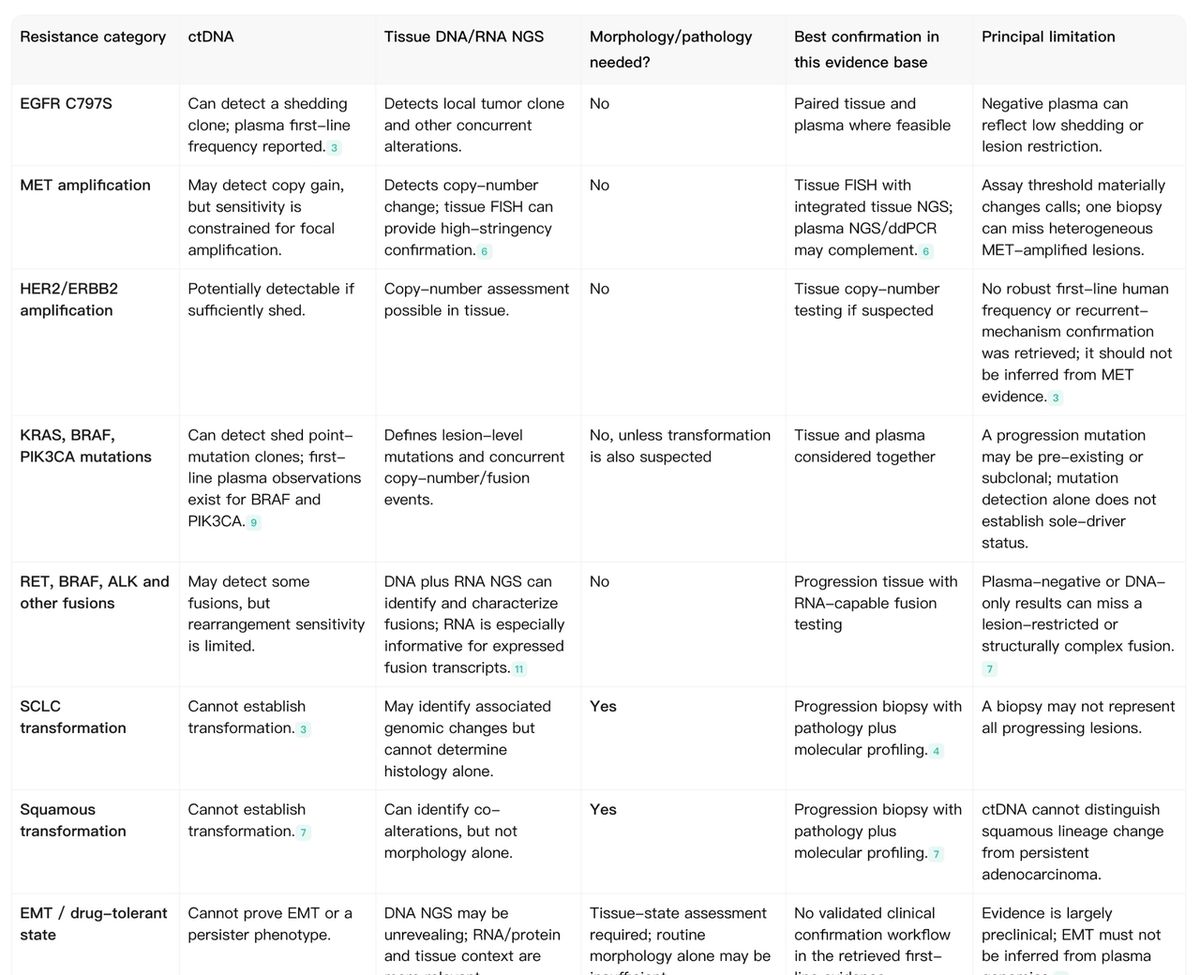
| Mechanism | ctDNA | Tissue / pathology |
|---|---|---|
| EGFR C797S | Can detect a shedding clone | Can confirm a local clone and concurrent alterations |
| MET amplification | May detect copy gain, but focal amplification can be difficult | Copy-number testing and FISH can provide stronger confirmation |
| Acquired fusions | Can detect some rearrangements | DNA plus RNA testing can improve characterization |
| SCLC transformation | Cannot establish histology | Requires progression biopsy and pathology |
| EMT / persister state | Cannot prove the phenotype | Requires tissue-state, RNA, protein, or functional assessment |
A negative plasma result therefore means "not detected in this assay and specimen context," not "no resistance mechanism exists."
13. Look for Coexisting Resistance Mechanisms
Resistance is often polyclonal and spatially heterogeneous. A patient can have one mechanism in one progressing lesion and another mechanism elsewhere.
This has two implications: a detected resistance mechanism may be real without being the only active mechanism, and a single tissue biopsy or plasma sample can underrepresent the full resistance landscape.
14. Build the Final Drug Resistance Mechanism Map
The final Noah output organized the main mechanisms by biological route, evidence maturity, detection priority, translational implication, and central uncertainty.
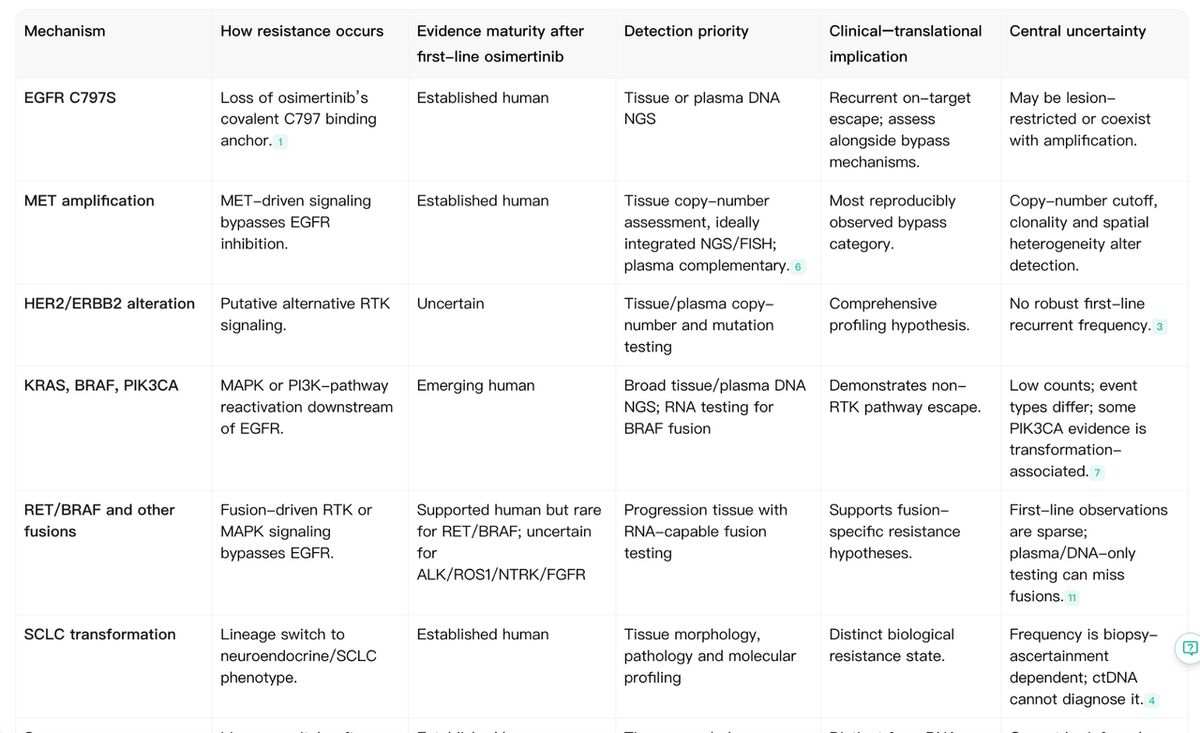
| Mechanism | Category | Evidence maturity | Key detection point |
|---|---|---|---|
| EGFR C797S | On-target | Established human | Tissue or plasma DNA NGS |
| MET amplification | Bypass signaling | Established human | Tissue copy-number assessment; plasma complementary |
| KRAS / BRAF / PIK3CA | Downstream pathway reactivation | Emerging human | Broad DNA profiling; RNA where fusion is possible |
| RET / BRAF and other fusions | Acquired fusion | Supported human but rare for best-documented examples | Progression tissue with RNA-capable testing |
| SCLC transformation | Histologic transformation | Established human | Progression tissue morphology and pathology |
| EMT / persister programs | Phenotypic / non-genetic | Primarily preclinical | No validated routine clinical confirmation workflow |
Analyze drug resistance mechanisms with Noah AI
Use Noah AI to organize resistance mechanisms by evidence maturity, specimen type, detection method, coexisting alterations, translational implications, and uncertainty.
Noah AI can be used for free, includes free credits, and requires no credit card.
15. Why Resistance Frequencies Often Look Contradictory
Two studies can report very different frequencies without truly contradicting each other. Apparent frequency depends on first-line versus later-line therapy, tissue versus plasma sampling, plasma shedding, copy-number thresholds, DNA versus RNA-capable assays, progression-biopsy availability, lesion selection, and whether multiple mechanisms were allowed to coexist.
A resistance frequency should therefore never be separated from its denominator, specimen, assay, treatment line, and sampling design.
16. Common Mistakes in Drug Resistance Analysis
Mixing First-Line and Later-Line Resistance
Later-line evidence can clarify mechanism biology, but it should not be used as first-line frequency evidence unless the treatment context is clearly labeled.
Treating Plasma-Negative as Mechanism-Negative
Low shedding, focal amplifications, rearrangements, transformation, and non-genetic resistance can all be missed by plasma testing.
Equating MET Amplification with MET Exon 14 Skipping
They are distinct biological events and should remain separate in a resistance map.
Assuming One Detected Mutation Is the Only Driver
Resistance can be polyclonal and lesion-specific. A detected C797S or MET amplification may explain only part of the progression pattern.
Ignoring Histologic Transformation
DNA testing cannot establish SCLC or squamous transformation. Tissue pathology remains necessary.
Promoting Preclinical Mechanisms to Clinical Facts
EMT, AXL activation, persister states, Notch, YAP, and other experimental mechanisms should remain labeled according to the maturity of their human evidence.
Comparing Frequencies Without Assay Context
Different copy-number thresholds, tissue availability, plasma sensitivity, and sampling designs can produce very different apparent rates.
17. Which Tool Fits Which Part of the Workflow?
| Workflow stage | Useful tool | Typical role |
|---|---|---|
| Integrated resistance evidence map | Noah AI | Combine mechanisms, evidence maturity, detection context, co-occurrence, and uncertainty. |
| Mechanistic relationship exploration | Causaly | Explore drug–target–pathway–disease relationships and mechanistic evidence. |
| Preclinical causality and validation | BenchSci ASCEND | Investigate disease biology, models, perturbation evidence, and experimental validation. |
| Large literature evidence table | Elicit | Search, screen, extract, and synthesize resistance studies. |
| Claim-level citation context | Scite | Inspect whether resistance findings are supported, contrasted, or discussed by later literature. |
18. Related Research Guides
- Best AI Tools for Drug Mechanism of Action Analysis (2026)
- Best AI Tools for Drug Safety Evidence Review (2026)
- Best AI Tools for Clinical Trial Results Analysis (2026)
- How to Analyze Clinical Trial Results with AI Using Noah AI
19. FAQ
Can AI identify drug resistance mechanisms?
AI can help retrieve, classify, and synthesize reported resistance evidence across molecular, histologic, and phenotypic layers. The strength of the conclusion still depends on the underlying human evidence, specimen type, and assay.
Why are tissue and ctDNA both useful?
ctDNA can provide minimally invasive genomic information across shedding lesions. Tissue can establish morphology, improve characterization of focal copy-number events and fusions, and reveal cell-state changes that plasma cannot diagnose.
Can ctDNA diagnose small-cell transformation?
No. ctDNA may reveal associated genomic changes, but histologic transformation requires tissue morphology and pathology.
Is MET amplification the same as MET exon 14 skipping?
No. MET amplification is a copy-number increase. MET exon 14 skipping is a splice-altering activating event.
Does finding C797S explain all progression?
Not necessarily. C797S can coexist with bypass signaling, focal amplification, or other resistant clones in different lesions.
Why can resistance-mechanism frequencies differ between studies?
Treatment line, specimen type, assay architecture, copy-number thresholds, progression-biopsy availability, lesion selection, plasma shedding, and cohort denominators can all change apparent frequency.
20. Final Takeaway
Drug resistance is not a single mutation—it is an evolving tumor state shaped by on-target escape, bypass signaling, downstream reactivation, lineage transformation, non-genetic adaptation, and clonal heterogeneity.
In first-line osimertinib resistance, C797S and MET amplification have strong human evidence, histologic transformation represents a distinct tissue-defined resistance state, and several downstream or fusion mechanisms are clinically credible but less frequent. EMT and persister-state biology remain important mainly at the preclinical or translational level.
The most useful AI workflow is therefore not the one that produces the longest list of mutations. It is the one that preserves treatment context, evidence maturity, specimen limitations, coexisting mechanisms, and remaining uncertainty.
Build a Drug Resistance Evidence Map with Noah AI
Use Noah AI to build an evidence map across on-target resistance, bypass signaling, histologic transformation, and non-genetic resistance.
Compare mechanisms by evidence maturity, specimen type, detection method, coexisting alterations, translational implications, and remaining uncertainty.
Free to use · Free credits included · No credit card required