Best AI Tools for Drug Mechanism of Action Analysis (2026)
Linda
Compare the best AI tools for drug mechanism of action analysis. We test Noah AI on trastuzumab deruxtecan (T-DXd) to map the HER2-to-payload mechanistic sequence with cited evidence.
Drug mechanism-of-action analysis is no longer just about identifying a drug target. Researchers often need to connect molecular binding, intracellular events, downstream biological effects, resistance mechanisms, and supporting evidence into one coherent explanation.
For complex therapies such as antibody-drug conjugates, targeted small molecules, bispecific antibodies, and other advanced modalities, relevant evidence may be spread across regulatory documents, pharmacology studies, preclinical research, translational studies, and peer-reviewed publications.
AI research tools can reduce the time required to find and organize this evidence, but different platforms are better suited to different parts of the workflow.
Evaluation note: We tested Noah AI directly using the trastuzumab deruxtecan workflow shown below. Other tools were evaluated based on their official documentation and published workflows.
What Should an AI Tool for Mechanism of Action Analysis Do?
A useful mechanism-of-action workflow should go beyond generating a short explanation of what a drug targets.
Ideally, it should help researchers reconstruct a mechanistic sequence such as:
Drug → Target → Molecular Interaction → Intracellular Effect → Biological Consequence → Therapeutic Effect
Depending on the therapeutic modality, researchers may also need to investigate:
- drug structure and key components,
- target engagement and internalization,
- downstream pathway activity,
- payload effects,
- bystander effects,
- biomarker dependence,
- tumor heterogeneity,
- reported mechanisms of resistance,
- which findings are established versus still proposed.
The key distinction is that a plausible AI-generated explanation is not the same as an evidence-backed mechanism supported by traceable biomedical sources.
Best AI Tools for Drug Mechanism of Action Analysis
| Tool | Best For | Evidence Search | Mechanistic Synthesis | Citations |
|---|---|---|---|---|
| Noah AI | Structured biomedical MoA analysis | Strong | Strong | Strong |
| Elicit | Scientific evidence synthesis | Strong | Strong | Strong |
| Consensus | Exploring peer-reviewed evidence | Strong | Moderate | Strong |
| SciSpace | Reading and analyzing scientific papers | Strong | Moderate–Strong | Strong |
| ChatGPT Deep Research | Broad multi-source research | Strong | Strong | Strong |
| Perplexity Research | Fast cross-source research | Moderate–Strong | Strong | Strong |
Noah AI
Best for: structured, evidence-backed biomedical mechanism-of-action research.
Noah AI is particularly relevant when the research process begins with a biomedical question rather than a predefined list of papers.
For mechanism-of-action research, the user can ask Noah to investigate multiple mechanistic layers within the same research task, including drug structure, target engagement, downstream molecular events, resistance, and evidence certainty.
Example: Analyzing the Mechanism of Trastuzumab Deruxtecan
We tested Noah using trastuzumab deruxtecan (T-DXd, Enhertu), a HER2-directed antibody-drug conjugate.
This is a useful test case because its mechanism involves several connected steps rather than a single drug-target interaction.
The research prompt asked Noah to analyze:
- the HER2-targeting antibody, linker, and DXd payload,
- HER2 binding and internalization,
- intracellular linker cleavage and payload release,
- topoisomerase I inhibition,
- DNA damage and tumor-cell death,
- the proposed bystander effect,
- HER2 heterogeneity,
- reported or proposed resistance mechanisms.
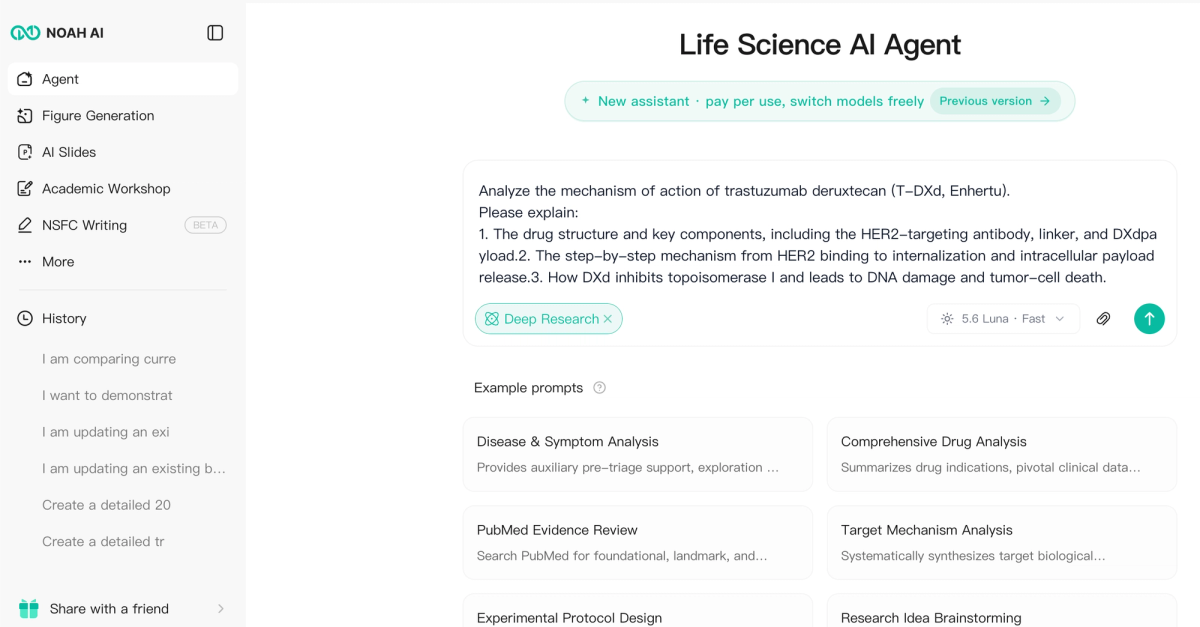
A drug mechanism-of-action research question entered into Noah AI.
What Noah Returned
Noah organized the result around a clear mechanistic sequence:
HER2 binding → internalization → lysosomal linker cleavage → DXd release → TOP1 inhibition → DNA damage and replication stress → apoptosis and cell death
The result also separated T-DXd into its major structural components:
- HER2-targeting antibody,
- cleavable linker,
- DXd payload,
- drug-to-antibody ratio.
Major statements were linked to supporting references, allowing the mechanism to be reviewed against regulatory and biomedical sources rather than being presented as an uncited explanation.
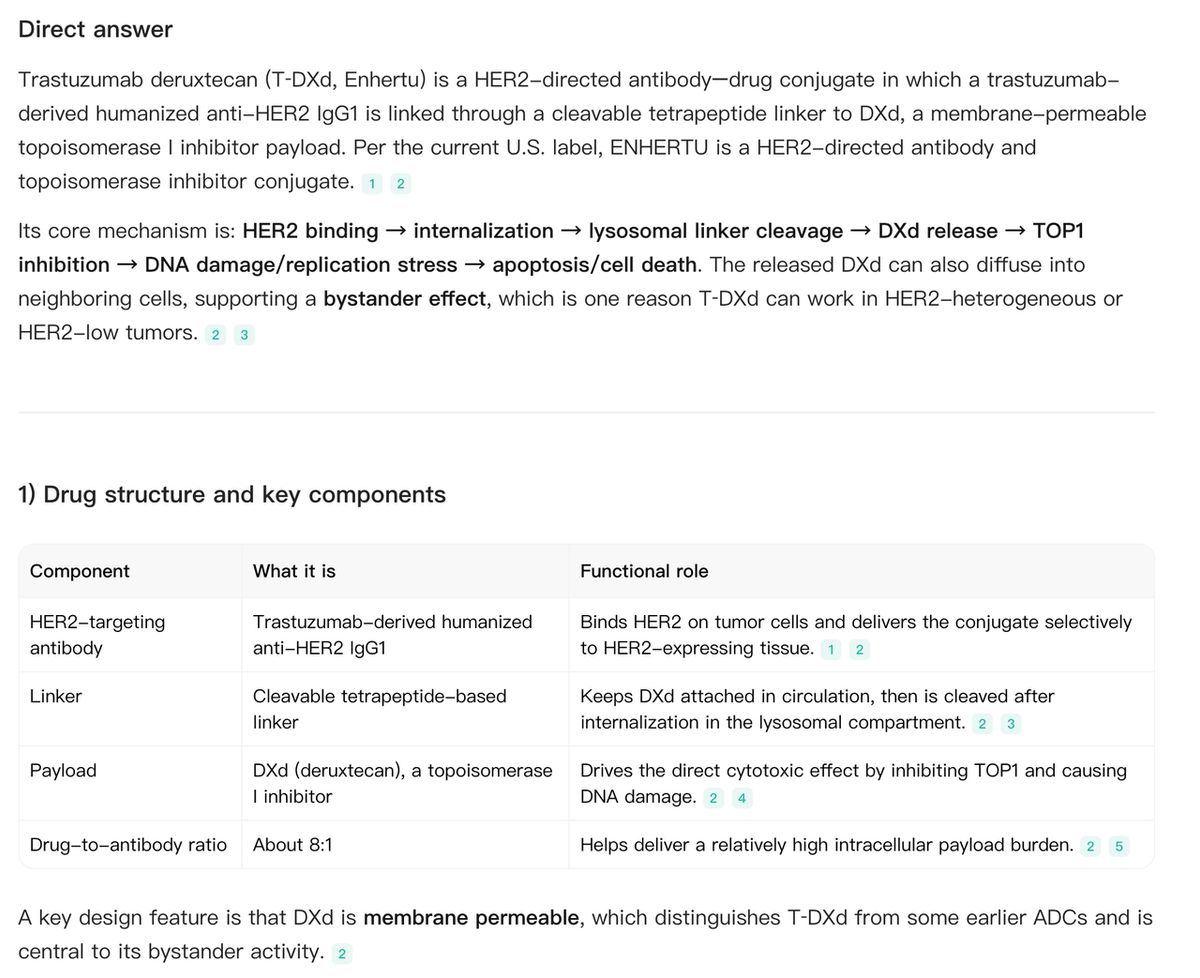
Noah AI organizes the T-DXd mechanism from HER2 binding and payload release to TOP1 inhibition and tumor-cell death, with citations attached to major claims.
Why This Matters for MoA Research
Mechanism-of-action analysis becomes more useful when the output separates well-established pharmacology from proposed or emerging mechanisms.
For T-DXd, the core sequence of HER2 binding, internalization, intracellular payload release, TOP1 inhibition, DNA damage, and cell death represents the central pharmacological mechanism.
Other questions, such as the exact contribution of the bystander effect in individual tumors or the importance of specific resistance pathways, may depend more heavily on preclinical and translational evidence.
Elicit
Best for: scientific literature discovery and structured evidence synthesis.
Elicit is useful when mechanism-of-action research involves reviewing a relatively large scientific literature base.
Researchers can use it to identify and organize papers related to target biology, pharmacological pathways, preclinical response, biomarkers, and resistance mechanisms.
Its main value becomes more apparent when the task involves moving from a larger literature set to selected evidence, structured extraction, and synthesis.
Consensus
Best for: quickly exploring what peer-reviewed research says about a mechanism.
Consensus is useful for focused questions such as:
- What evidence supports inhibition of pathway X by drug Y?
- What resistance mechanisms have been reported?
- Does target X regulate pathway Y?
- What preclinical evidence supports a proposed mechanism?
This makes it particularly useful during the early stage of mechanism research, when the goal is to understand which questions have strong literature support and which require deeper investigation.
SciSpace
Best for: reading and interrogating individual scientific papers.
Mechanistic evidence is often located inside methods sections, pathway experiments, supplementary materials, figures, preclinical models, and discussion sections.
SciSpace can help researchers examine individual papers and ask focused questions about experimental evidence.
For example:
- What evidence supports receptor-mediated internalization?
- Which experiments support the bystander effect?
- Which model systems were used?
- What evidence supports a proposed resistance mechanism?
Its strongest role is often paper-level understanding rather than the entire end-to-end mechanism research process.
ChatGPT Deep Research
Best for: broad research across multiple types of sources.
Mechanism-of-action evidence does not always come exclusively from journal articles. Relevant information may also appear in regulatory documents, trial publications, company scientific materials, target databases, and uploaded files.
A general deep-research workflow can therefore be useful when a mechanism question requires investigation across several types of sources.
For biomedical use, however, researchers should still verify important scientific claims against the original regulatory or peer-reviewed source.
Perplexity Research
Best for: fast cross-source research and initial orientation.
Perplexity Research can be useful at the beginning of a drug investigation, when the researcher wants to quickly identify the major areas that need deeper review.
For example:
- primary drug target,
- downstream pathways,
- important mechanism publications,
- regulatory descriptions,
- emerging resistance research.
It is useful for rapid orientation, but higher-stakes mechanism analysis should still distinguish primary studies and regulatory evidence from secondary sources.
Evidence Search Is Not the Same as Mechanism Prediction
The tools discussed above primarily help researchers understand what existing evidence says about a drug's mechanism.
That is different from discovering a previously unknown mechanism.
Novel mechanism prediction may require specialized methods involving:
- molecular docking,
- molecular dynamics,
- protein structures,
- transcriptomics,
- proteomics,
- perturbation screening,
- chemical similarity,
- biological network analysis.
If the research question is:
What does the existing evidence show about how this drug works?
literature-search and research-agent tools can be appropriate.
If the question is:
What unknown biological target might explain this compound's phenotype?
specialized computational biology or experimental target-identification approaches may be required.
Try Noah AI for Free
Use Noah AI to search, compare, and analyze biomedical evidence with AI-powered research workflows.
Free credits are available, and no credit card is required to get started.
How to Analyze a Drug Mechanism of Action with AI
Define the Therapeutic Modality
First identify whether the therapy is a small molecule, monoclonal antibody, antibody-drug conjugate, bispecific antibody, protein degrader, cell therapy, gene therapy, or another modality.
Identify the Primary Target
Determine:
- the direct molecular target,
- how the drug interacts with it,
- what evidence supports target engagement.
Reconstruct the Mechanistic Sequence
Build the mechanism step by step:
Drug → Target → Molecular Event → Pathway Change → Cellular Effect → Therapeutic Consequence
Separate Evidence Levels
Do not treat every mechanistic claim as equally established.
- Established: supported by regulatory or strong experimental evidence.
- Translational: supported by biomarker or patient-linked studies.
- Preclinical: mainly demonstrated in cell or animal models.
- Proposed: biologically plausible but incompletely validated.
Analyze Resistance Separately
Resistance mechanisms may involve:
- target loss or mutation,
- altered internalization,
- pathway bypass,
- downstream signaling adaptation,
- drug efflux,
- payload resistance,
- changes in DNA repair,
- tumor microenvironment effects.
Verify Important Claims
AI can reduce the time required for evidence discovery and synthesis, but high-impact mechanistic claims should still be checked against original publications and regulatory documents.
Which Tool Should You Choose?
Choose Noah AI when you want to start with a biomedical research question and produce a structured, cited mechanism-of-action analysis.
Choose Elicit when the main task involves larger-scale literature discovery, evidence extraction, and scientific synthesis.
Choose Consensus when you want to quickly explore what peer-reviewed literature says about a focused mechanistic question.
Choose SciSpace when you already have relevant papers and need to understand their experiments and mechanistic details.
Choose ChatGPT Deep Research when the investigation spans publications, regulatory documents, websites, and uploaded files.
Choose Perplexity Research when you need a rapid overview before beginning a deeper evidence review.
Frequently Asked Questions
What is the best AI tool for drug mechanism of action analysis?
The best tool depends on the workflow. Noah AI is relevant for structured biomedical research and cited synthesis, Elicit for scientific evidence synthesis, Consensus for peer-reviewed evidence exploration, SciSpace for paper-level analysis, and general deep-research tools for broader multi-source investigation.
Can AI determine a drug's mechanism of action?
AI can help discover, organize, and synthesize existing evidence about known or proposed mechanisms. This is different from experimentally proving a previously unknown mechanism of action.
Can AI identify drug resistance mechanisms?
Yes. AI research tools can retrieve and summarize published resistance mechanisms, but researchers should distinguish clinically supported mechanisms from preclinical and hypothesis-generating findings.
Can AI compare the mechanisms of two drugs?
Yes. Researchers can compare targets, molecular interactions, downstream pathways, drug modality, biomarkers, payload mechanisms, and resistance biology, provided the analysis remains grounded in source evidence.
Can AI analyze antibody-drug conjugate mechanisms?
Yes. ADC mechanisms can be separated into antigen binding, internalization, linker processing, payload release, payload activity, bystander effects, and resistance mechanisms.
Should AI-generated mechanism-of-action reports be trusted without verification?
No. AI can accelerate biomedical research, but important claims should still be checked against original publications, regulatory documents, and other primary sources.
Final Takeaway
The best AI tool for mechanism-of-action research depends on where the research bottleneck occurs.
Consensus, Elicit, and SciSpace are useful when the problem is primarily literature discovery, evidence extraction, or paper-level understanding. General deep-research tools can be useful when evidence is distributed across several source types.
Noah AI is particularly relevant when the goal is to move from a biomedical research question to a structured, cited analysis connecting the drug, its mechanism, supporting evidence, uncertainty, and resistance.
Regardless of the tool, a useful mechanism-of-action analysis should separate established mechanisms from hypotheses, preserve source traceability, and verify important claims against primary evidence.
Related Research Guides
- How to Analyze Clinical Trial Results with AI Using Noah AI
- Similar Products to Consensus for Biomedical Evidence Synthesis (2026)
- Best AI Tools for Turning Research Questions into Evidence Tables (2026)
- How to Map Biomarkers and Patient Segmentation with Noah AI
- Best AI Tools for Creating Cited Literature Review Reports (2026)