Best AI Tools for Drug Competitive Landscape Analysis (2026)
Linda
Compare the best AI tools for drug competitive landscape analysis, with a real 2026 U.S. obesity-drug case spanning Wegovy, Zepbound, Foundayo (orforglipron), and retatrutide.
Drug competitive landscape analysis is not simply a matter of putting several efficacy percentages into a table.
A useful competitive landscape needs to explain who is already established, who has just entered the market, which late-stage assets could change the field, and what actually differentiates those competitors across regulatory maturity, mechanism, route of administration, clinical evidence, outcomes evidence, tolerability, and convenience.
The U.S. obesity-drug market is a useful 2026 example because the competitive structure changed materially during the year. Wegovy and Zepbound remain major established therapies, Foundayo entered as a newly approved oral GLP-1 option, and retatrutide advanced through Phase III while remaining investigational.
Real-case test: We used Noah AI to map the September 2026 U.S. obesity-drug competitive landscape, focusing on semaglutide, tirzepatide, orforglipron, and retatrutide.
The 2026 Competitive Map
The easiest way to understand this market is not as a simple ranking, but as four different competitive positions.
| Competitive Position | Drug | 2026 Status | Main Differentiation |
|---|---|---|---|
| Established incumbent | Wegovy (semaglutide) | FDA approved | Mature GLP-1 obesity program with cardiovascular-outcomes evidence and an obesity-specific cardiovascular-risk-reduction indication. |
| Established major challenger | Zepbound (tirzepatide) | FDA approved | Dual GIP/GLP-1 mechanism, mature obesity program, OSA indication, and direct comparative evidence versus semaglutide. |
| New oral entrant | Foundayo (orforglipron) | FDA approved April 2026 | Once-daily oral small-molecule GLP-1 therapy with no injection requirement. |
| Late-stage challenger | Retatrutide | Investigational | Triple GIP/GLP-1/glucagon receptor agonism with positive Phase III topline data, but no FDA approval yet. |
This is what a competitive landscape should make visible: different competitors are competing from different positions.
What Changed in the Obesity Drug Market in 2026?
Oral therapy became a much more important competitive dimension
Foundayo, or orforglipron, received FDA approval on April 1, 2026 for chronic weight management in adults with obesity or adults with overweight plus at least one weight-related comorbidity.
The commercial significance is not simply another GLP-1 approval. Foundayo introduces a once-daily, non-peptide oral option into a market strongly associated with injectable incretin therapy.
That makes route of administration part of the competitive argument: convenience may matter independently of headline efficacy.
Competition is moving beyond single-receptor GLP-1 biology
Mechanistically, the landscape now spans several generations of incretin therapy.
- Semaglutide targets GLP-1.
- Tirzepatide combines GIP and GLP-1 receptor agonism.
- Retatrutide adds glucagon-receptor activity to GIP and GLP-1 agonism.
But a more complex mechanism is not automatically evidence of a better drug. Regulatory maturity, safety, clinical outcomes, dosing, manufacturing, adherence, and access all affect competitive positioning.
Late-stage promise is not the same as an approved competitor
Lilly reported positive Phase III results for retatrutide in 2026, increasing the asset's strategic importance.
However, retatrutide remains investigational and has not been approved by a regulatory agency. Its Phase III topline results therefore belong in a future competitive-threat analysis, not in the same evidence tier as an FDA-approved label.
How We Built the Landscape With Noah AI
Noah's refreshed Agent interface is useful for this type of research because the workflow can be configured around the task rather than beginning with a generic search box.
For this analysis, we used:
- Agent
- Commercial & Markets
- Deep Research
- 5.6 Terra · Balanced
The prompt asked Noah to separate established products, newly approved entrants, and late-stage investigational competitors while preserving the distinction between FDA evidence, peer-reviewed evidence, direct comparative evidence, company-reported topline results, and strategic interpretation.
That distinction matters in competitive-intelligence work because a recent press release should not silently become equivalent to a regulatory decision or a peer-reviewed head-to-head trial.
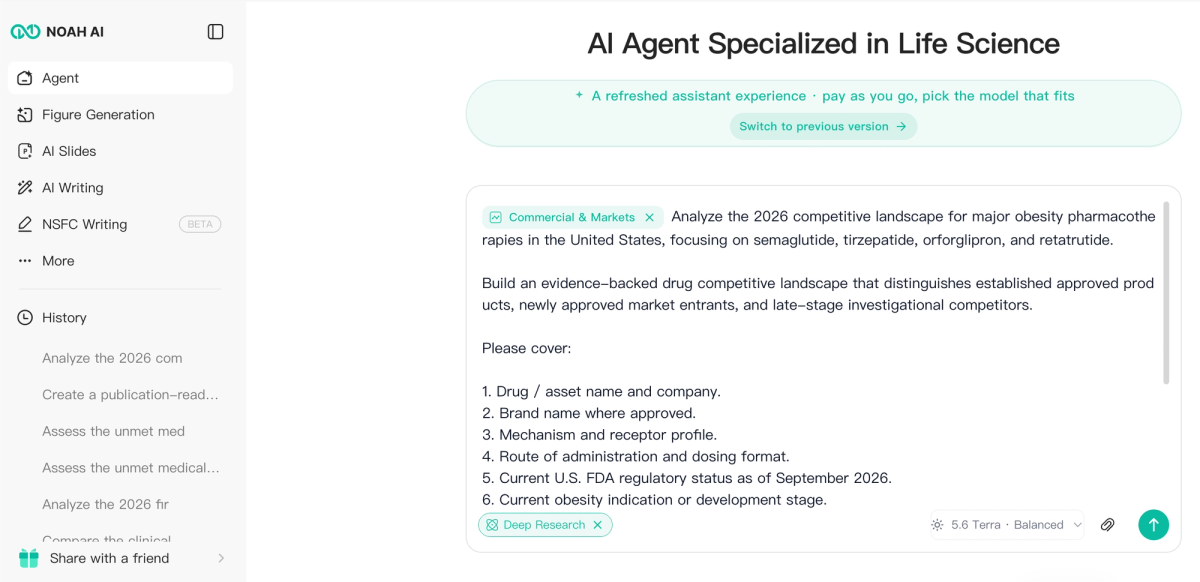
A Drug Competitive Landscape Analysis task entered into Noah AI's refreshed Agent workflow.
From Four Drug Names to a Structured Competitive Landscape
Noah's output organized the four drugs using common competitive dimensions rather than returning four disconnected summaries.
The table covered:
- company and brand,
- FDA status and obesity indication,
- mechanism and receptor profile,
- route and dosing format,
- pivotal or Phase III evidence,
- current positioning and differentiation,
- outcomes and tolerability.
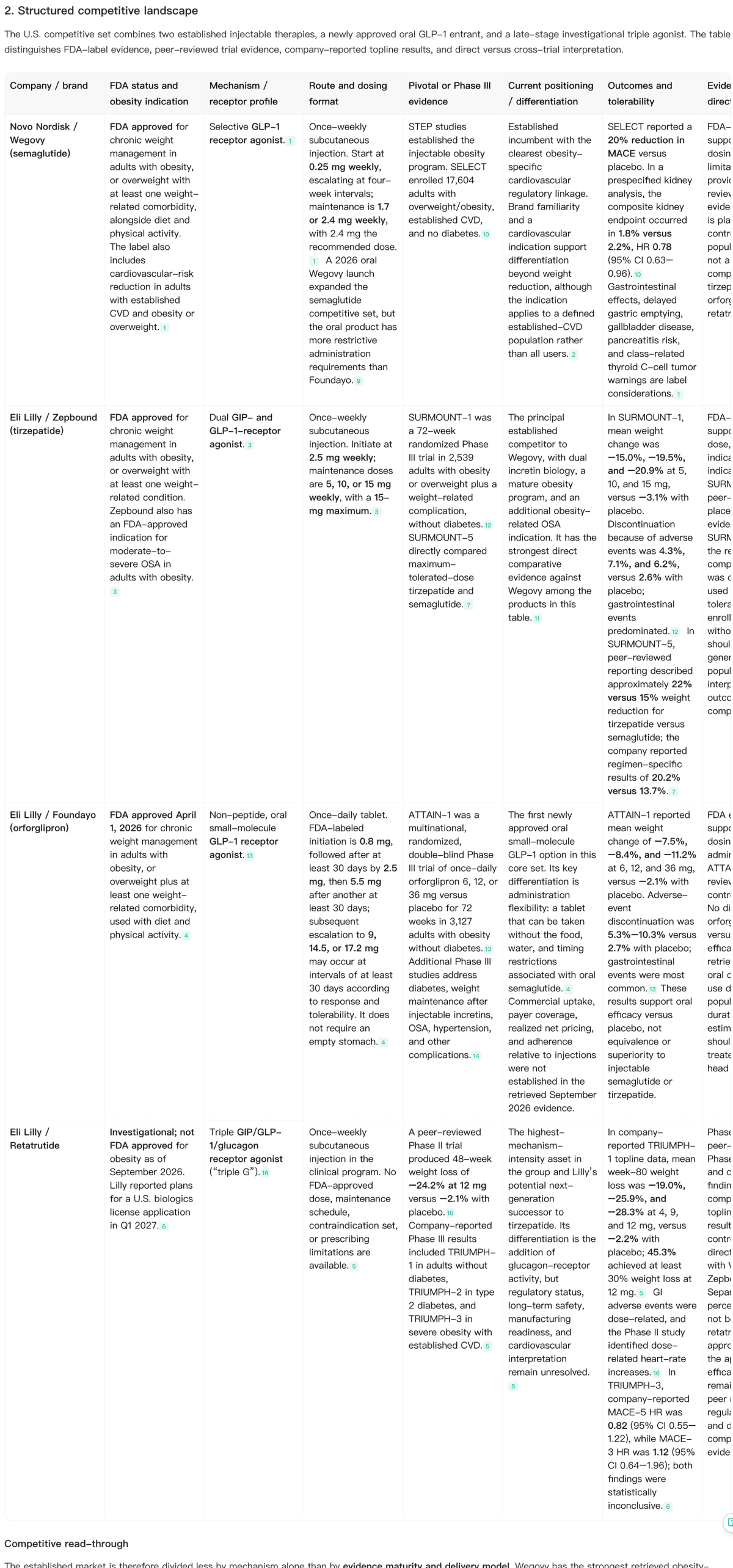
Noah AI compares established, newly approved, and investigational obesity competitors across regulatory status, mechanism, administration, clinical evidence, and differentiation.
Research Drug Competitive Landscapes with Noah AI for Free
Use Noah AI to research competing assets, clinical trials, mechanisms, development stages, and evidence across a drug landscape.
Free to use · Free credits included · No credit card required
Research Drug Competitive Landscapes with Noah AI →
Four Competitive Signals That Matter More Than a Simple Efficacy Ranking
Evidence maturity
An FDA-approved indication, a peer-reviewed randomized trial, a company Phase III topline release, and an indirect cross-trial comparison are not equivalent forms of evidence.
Wegovy and Zepbound have established regulatory positions. Foundayo is newly approved. Retatrutide is still an investigational asset.
A useful competitive landscape keeps those evidence tiers visible.
Direct comparative evidence
SURMOUNT-5 is particularly relevant because it directly compared tirzepatide with semaglutide in adults with obesity or overweight without type 2 diabetes.
That provides a stronger basis for a specific tirzepatide-versus-semaglutide efficacy comparison than comparing percentages extracted from unrelated trials.
Even so, the study does not establish universal superiority across every obesity population, every clinical outcome, or every use case.
Outcomes differentiation
Wegovy has an FDA indication to reduce the risk of cardiovascular death, nonfatal myocardial infarction, and nonfatal stroke in adults with established cardiovascular disease and obesity or overweight.
That makes its competitive position broader than a weight-loss percentage alone.
Similarly, Zepbound has an FDA-approved indication for moderate-to-severe obstructive sleep apnea in adults with obesity.
Competitive analysis therefore needs to track indication breadth and outcomes evidence, not only body-weight change.
Convenience can become a competitive advantage
Foundayo adds a different type of differentiation. Its major strategic proposition is oral administration.
But convenience should not automatically be interpreted as commercial success. Real-world persistence, payer access, net pricing, discontinuation, patient preference, and long-term adherence still need to be observed.
Why Cross-Trial Weight-Loss Rankings Can Be Misleading
One of the easiest mistakes in obesity-drug competitive analysis is to create a table like:
Drug A: X% weight loss
Drug B: Y% weight loss
Drug C: Z% weight loss
and then conclude that the drug with the largest number is the winner.
That ignores differences in:
- population,
- diabetes status,
- dose and escalation strategy,
- treatment duration,
- estimand,
- discontinuation handling,
- trial design,
- and evidence maturity.
Competitive interpretation is useful, but it should remain visibly different from direct randomized evidence.
Which Tool Fits Which Competitive-Intelligence Step?
| Research Need | Best-Fit Tool or Source | Why |
|---|---|---|
| Confirm current regulatory status | FDA | Best source for whether a product is approved, its indication, label, dosing, and regulatory limitations. |
| Build a biomedical competitive landscape | Noah AI | Useful when the task needs to connect regulatory status, clinical evidence, mechanism, trial information, and competitive positioning. |
| Track active and upcoming clinical programs | ClinicalTrials.gov | Useful for verifying trial identifiers, status, design, enrollment, and development activity. |
| Build a structured scientific evidence set | Elicit | Strong fit for evidence synthesis and repeated extraction across larger literature sets. |
| Investigate the published evidence deeply | SciSpace | Useful for detailed paper and PDF review when methods, endpoints, or subgroup data matter. |
| Explore published academic evidence | Consensus | Useful for literature-first research questions and structured academic synthesis. |
| Research across multiple current source types | ChatGPT Deep Research / Perplexity Research | Useful when the competitive question spans web sources, documents, publications, and recent public developments. |
Where Noah Fits Best
Noah is most useful when the question begins in life science rather than in generic market research.
Its current Search + Agent workflow is designed to move from trusted medical evidence into structured, cited outputs. Agent can clarify the task, plan a multi-step research workflow, synthesize evidence, and produce reusable reports and tables.
For a competitive-landscape task, that makes it useful when the analyst needs to connect scientific and clinical context with competitive interpretation.
It is not a replacement for proprietary commercial-intelligence databases when the question requires confidential deal terms, private forecasts, payer contracts, realized net pricing, or other non-public market data.
What Analysts Still Need to Verify
- Current FDA approval and exact label language
- Whether trial data are peer-reviewed or sponsor-reported topline results
- Whether a comparison is direct or cross-trial
- Population and diabetes status
- Route, dose, and escalation schedule
- Clinical-outcomes evidence versus weight-loss evidence
- Current trial status and upcoming regulatory milestones
- Real-world access, payer coverage, persistence, and discontinuation
- Whether a development plan has actually resulted in regulatory submission or approval
Frequently Asked Questions
What is drug competitive landscape analysis?
Drug competitive landscape analysis compares approved and investigational therapies within a defined market or therapeutic area across dimensions such as regulatory status, mechanism, evidence, clinical positioning, differentiation, and development stage.
How is competitive landscape analysis different from asset benchmarking?
Asset benchmarking usually focuses on comparing a selected set of individual drug assets in depth. Competitive landscape analysis takes a wider view of how established products, new entrants, late-stage challengers, and future catalysts interact within a market.
Can AI identify the strongest drug competitor?
AI can organize the evidence and highlight meaningful competitive differences. It should not declare a universal winner from unrelated trials or incomplete commercial information.
Should investigational drugs be included?
Yes, if they are sufficiently advanced to affect future competitive strategy. They should be clearly labeled as investigational and separated from approved products.
Why is regulatory status important in competitive analysis?
A promising Phase III asset and an FDA-approved product occupy different competitive positions. Positive clinical data do not automatically create a marketed competitor.
Why shouldn't obesity drugs be ranked only by weight-loss percentage?
Separate trials can differ in patient population, diabetes status, dosing strategy, duration, analysis methods, and discontinuation handling. Cross-trial percentages are useful context, but they are not equivalent to randomized head-to-head evidence.
Final Takeaway
The obesity-drug competitive landscape in 2026 is no longer simply a contest between two injectable incretin products.
The market now includes established products with increasingly differentiated indications, a newly approved oral entrant, and a late-stage triple-agonist challenger that could alter the next phase of competition if its regulatory development succeeds.
A useful competitive analysis therefore needs to track regulatory maturity, evidence quality, route, mechanism, indication breadth, direct comparative evidence, and future catalysts together.
Noah AI is a strong fit when that work begins with a biomedical or life-science competitive question and needs to become a structured, cited landscape rather than a collection of disconnected searches.
Competitive advantage is not one efficacy number. It is the position created by evidence, differentiation, maturity, and what happens next.