Best AI Tools for Drug Class Comparison (2026)
Linda
Compare AI tools for drug class analysis, with a real Noah AI workflow comparing SGLT2 inhibitors and GLP-1 receptor agonists.
Drug class comparison is easy to oversimplify.
Researchers can compare two classes across glucose lowering, weight loss, cardiovascular outcomes, kidney outcomes, safety, and route of administration. But the result should not automatically become a verdict that one entire drug class is better than another.
A more useful comparison asks: What is each class particularly good at, which evidence is truly class-level, which findings belong only to specific drugs, and when might both classes belong in the same treatment strategy?
To test that workflow, we used a real biomedical case: SGLT2 inhibitors versus GLP-1 receptor agonists in adults with type 2 diabetes.
There Is No Universal Winner
The clearest 2026 conclusion is that SGLT2 inhibitors and GLP-1 receptor agonists are better understood as complementary rather than interchangeable drug classes.
Their strongest evidence tends to emphasize different clinical priorities.
| Clinical Priority | Class With a Particularly Important Role | Why |
|---|---|---|
| Heart failure | SGLT2 inhibitors | Strong and consistent evidence for reducing heart-failure hospitalization across major outcome programs. |
| CKD progression | SGLT2 inhibitors | Strong class-level kidney protection supported by dedicated CKD outcome trials and current guidance. |
| Weight reduction | GLP-1 receptor agonists | Generally greater weight effects, although magnitude differs substantially by specific agent and dose. |
| Glucose lowering | GLP-1 receptor agonists | Typically greater HbA1c reduction than SGLT2 inhibitors, again depending on agent and dose. |
| ASCVD risk reduction | Both, depending on the agent | Specific SGLT2 inhibitors and specific GLP-1 receptor agonists have demonstrated cardiovascular benefits. |
| Overlapping cardiorenal and metabolic needs | Potentially both classes | The mechanisms are complementary, and selected patients may receive both when multiple treatment priorities coexist. |
This is more useful than declaring one class the winner because drug-class evidence depends on the outcome being studied.
Why Drug Class Comparison Is Harder Than It Looks
Class effect does not mean every drug has identical evidence — This is probably the most important methodological rule in this comparison. Empagliflozin, dapagliflozin, and canagliflozin all belong to the SGLT2 inhibitor class, but their pivotal cardiovascular, heart-failure, kidney, labeling, and dosing evidence is not identical. The same applies to GLP-1 receptor agonists: semaglutide, dulaglutide, liraglutide, exenatide, and other agents belong to the same broad class, but researchers should not automatically assign one agent's strongest outcome evidence to every member of the class.
Different outcome trials answer different questions — A diabetes cardiovascular-outcome trial, a dedicated heart-failure trial, and a dedicated CKD trial do not enroll identical populations or use identical endpoints. Comparing headline hazard ratios across those studies as though they came from one randomized comparison can lead to false conclusions.
Clinical priorities can point toward different classes — A patient with type 2 diabetes, obesity, and a strong weight-loss priority may create a different treatment decision from a patient whose dominant problem is heart failure or progressive CKD. Drug-class analysis is therefore more useful when it starts with the clinical objective rather than a drug leaderboard.
Real Noah AI Workflow: Comparing the Two Classes
We asked Noah AI to compare SGLT2 inhibitors and GLP-1 receptor agonists across cardiovascular, kidney, metabolic, glucose, and weight-related outcomes using current evidence available in 2026.
The refreshed Noah Agent workflow was configured with:
- Agent
- Medical & Academia
- Deep Research
- 5.6 Terra · Balanced
Rather than asking which class was "better," the prompt explicitly asked Noah to distinguish:
- class-level effects,
- agent-specific evidence,
- guideline recommendations,
- clinical interpretation,
- and situations where comparison at the class level becomes inappropriate.
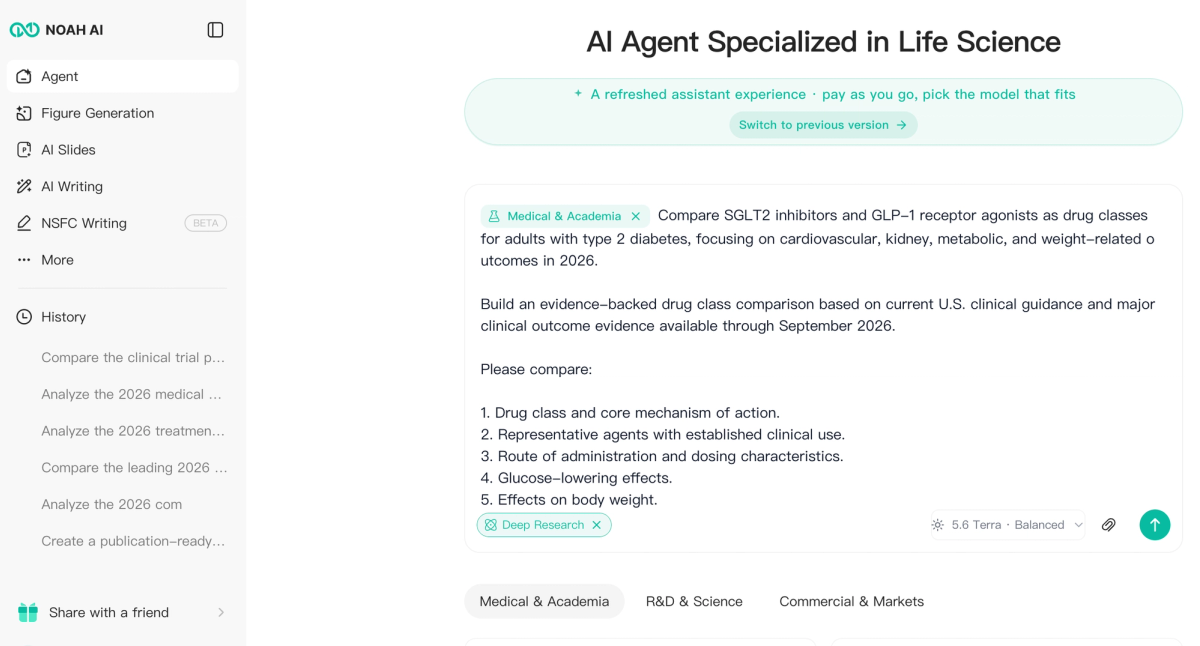
A drug-class comparison task entered into Noah AI using Medical & Academia and Deep Research.
The Most Useful Result Was the Bottom Line
Noah generated a much larger structured comparison, but the most useful summary was actually shorter.
It reduced the class comparison to three conclusions:
- SGLT2 inhibitors have especially strong and consistent evidence for heart-failure and CKD outcomes.
- GLP-1 receptor agonists generally provide stronger glucose lowering and weight reduction, while selected agents have established cardiovascular and kidney outcome evidence.
- The classes are not always mutually exclusive. Selected patients with overlapping cardiovascular, kidney, metabolic, and weight-related priorities may receive both.
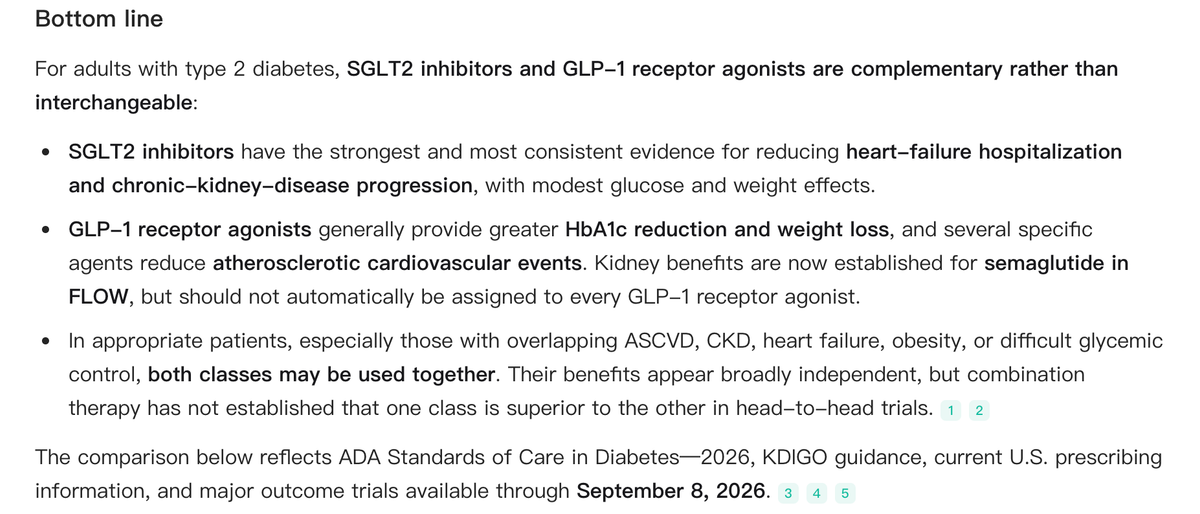
Noah AI summarizes the complementary roles of SGLT2 inhibitors and GLP-1 receptor agonists in type 2 diabetes.
Try Noah AI for Free
Use Noah AI to search, compare, and analyze biomedical evidence with AI-powered research workflows.
Free credits are available, and no credit card is required to get started.
[Sign Up and Try Noah AI →](https://www.noah.bio/signup?utm_source=blog)
Four Differences That Matter Clinically
- Heart failure is a major SGLT2 inhibitor strength — SGLT2 inhibitors have produced some of their most consistent clinical benefits in heart failure. The evidence extends beyond glucose lowering and includes reductions in heart-failure events in populations with reduced and preserved ejection fraction. This makes heart failure one of the clearest settings where the class-level therapeutic pattern is clinically meaningful.
- Kidney protection is established for SGLT2 inhibitors, but GLP-1 evidence is evolving — Dedicated kidney trials have established an important role for SGLT2 inhibitors in slowing CKD progression. GLP-1 receptor agonist kidney evidence has also become more important: the FLOW trial demonstrated a significant kidney-outcome benefit with semaglutide in people with type 2 diabetes and CKD. But the correct conclusion is not that every GLP-1 receptor agonist now has identical dedicated kidney-outcome evidence. The evidence belongs first to the agent and population actually studied.
- GLP-1 receptor agonists generally have the stronger weight effect — Weight reduction is one of the clearest practical differences between these two classes. SGLT2 inhibitors typically produce modest weight loss, whereas GLP-1 receptor agonists can produce larger effects, though the magnitude varies widely between molecules, doses, and diabetes versus obesity treatment settings. Researchers should therefore avoid turning "GLP-1 RA" into one universal weight-loss number.
- Reduced eGFR affects the two classes differently — The glucose-lowering effect of SGLT2 inhibitors declines as kidney function falls, because less glucose is filtered and available for urinary excretion. Importantly, cardiorenal benefits can remain clinically meaningful even when the glucose-lowering effect becomes modest. Long-acting GLP-1 receptor agonists can remain useful in patients with more advanced CKD, although individual drug labeling and tolerability still need to be verified.
The Classes Can Sometimes Be Used Together
Drug class comparison often assumes a binary choice — SGLT2 inhibitor or GLP-1 receptor agonist — but that framing can be incomplete.
A patient may have type 2 diabetes plus CKD, obesity, ASCVD, heart failure, and inadequate glycemic control at the same time. In such cases, the cardiorenal strengths of an SGLT2 inhibitor and the glucose, weight, and cardiovascular benefits of an appropriate GLP-1 receptor agonist may address different treatment priorities.
Meta-analyses have also found that cardiovascular and kidney benefits of the classes remain broadly consistent when the other class is used in the background. This does not prove that combination therapy is universally necessary, but it does show why the classes should not always be treated as substitutes.
Where Class-Level Comparison Breaks Down
Class-level summaries are useful for orientation, but they become misleading when they erase agent-specific evidence.
Not every SGLT2 inhibitor has the same outcome evidence — Empagliflozin has major cardiovascular mortality evidence from EMPA-REG OUTCOME. Dapagliflozin has extensive heart-failure and CKD data. Canagliflozin has important cardiovascular and kidney evidence from programs including CANVAS and CREDENCE. Those programs cannot simply be merged into one identical evidence profile.
Not every GLP-1 receptor agonist has the same outcome evidence — Semaglutide, liraglutide, and dulaglutide each have important cardiovascular outcome evidence, but the study populations, indications, doses, and individual results differ. FLOW adds dedicated kidney-outcome evidence for semaglutide, and that finding should not automatically be copied onto every GLP-1 receptor agonist.
Which Tool Fits Which Part of Drug Class Research?
| Research Task | Best-Fit Tool or Source | Role |
|---|---|---|
| Build a structured biomedical class comparison | Noah AI | Useful for connecting mechanism, clinical outcomes, guidelines, safety, and agent-level caveats. |
| Confirm current clinical recommendations | ADA / KDIGO | Primary sources for contemporary diabetes and kidney treatment guidance. |
| Verify agent-specific indication and dosing | FDA / DailyMed | Necessary when class-level summaries need to be translated into specific prescribing decisions. |
| Extract outcomes across many studies | Elicit | Useful for structured literature review and repeated field extraction. |
| Inspect individual outcome trials deeply | SciSpace | Useful for full-text trial methods, subgroup findings, endpoints, and supplementary data. |
| Explore academic evidence around a focused question | Consensus | Useful for literature-first evidence orientation and synthesis. |
| Broad multi-source research | ChatGPT Deep Research | Useful when drug-class research spans guidance, publications, regulatory documents, files, and other sources. |
What Researchers Still Need to Verify
- Whether a claimed benefit is truly class-wide or agent-specific
- The exact FDA indication for the individual drug
- Current eGFR thresholds and renal dosing requirements
- Whether the outcome came from a dedicated or exploratory analysis
- ASCVD, HF, and CKD characteristics of the studied population
- Whether the evidence applies to diabetes or obesity dosing
- Agent-specific gastrointestinal, cardiovascular, or infection risks
- Background therapies used in the pivotal trial
- Whether two outcome estimates come from directly comparable studies
Frequently Asked Questions
What is drug class comparison?
Drug class comparison evaluates two or more therapeutic classes across mechanism, outcomes, route, safety, clinical positioning, and evidence strength, rather than comparing only individual brands or molecules.
Are SGLT2 inhibitors better than GLP-1 receptor agonists?
Not universally. SGLT2 inhibitors have particularly strong heart-failure and CKD evidence, while GLP-1 receptor agonists generally offer stronger glucose lowering and weight reduction, with important cardiovascular evidence for selected agents.
Which class is better for heart failure?
SGLT2 inhibitors have the more established class role for reducing heart-failure hospitalization and treating heart-failure populations.
Which class is better for weight loss?
GLP-1 receptor agonists generally have the stronger weight effect, but results differ significantly by molecule and dose.
Can SGLT2 inhibitors and GLP-1 receptor agonists be used together?
Yes, in appropriate patients. The two classes have complementary mechanisms and may be combined when cardiovascular, kidney, weight, and glycemic priorities overlap.
Can one trial result be applied to an entire drug class?
Usually not without qualification. A class pattern may exist, but specific cardiovascular, kidney, dosing, and safety claims should remain linked to the individual drugs and populations that generated the evidence.
Final Takeaway
Drug class comparison is most useful when it explains differences rather than trying to manufacture a universal winner.
For adults with type 2 diabetes, SGLT2 inhibitors and GLP-1 receptor agonists address overlapping but not identical priorities. SGLT2 inhibitors have a particularly strong role in heart failure and CKD protection, while GLP-1 receptor agonists generally provide stronger weight and glycemic effects.
Noah AI is useful when researchers need to bring those mechanisms, outcome trials, guidelines, and agent-specific caveats into one structured comparison without flattening every drug into a class average.
Use the class-level pattern to identify the therapeutic priority, then verify that the individual drug has evidence that matches it.