Best AI Tools for Clinical Trial Landscape Analysis (2026)
Linda
Map the 2026 clinical trial landscape with Noah AI — trial status, population, strategy, endpoint, and evidence maturity, demonstrated on a ctDNA-guided colorectal cancer case.
If you were asked to map the 2026 clinical trial landscape for a fast-moving biomedical topic, a list of ClinicalTrials.gov records would not be enough.
Researchers usually need to know which trials already define the evidence, which studies failed or stopped early, which programs are still recruiting, what patient populations they study, what clinical question each trial is designed to answer, and which major gaps remain unresolved.
That is what makes clinical trial landscape analysis different from ordinary literature search. The real deliverable is a map of the field: trial status, population, strategy, endpoint, evidence maturity, and the role each study plays in the evolving evidence base.
To test that workflow, we used a real biomedical case: ctDNA-guided adjuvant treatment and postoperative surveillance after colorectal cancer surgery.
What the 2026 Landscape Looks Like
The ctDNA-guided colorectal cancer landscape is not a simple success story. The evidence differs substantially by disease stage, treatment strategy, assay context, and clinical question.
In stage II colon cancer, the randomized DYNAMIC trial showed that a ctDNA-guided strategy could reduce adjuvant chemotherapy use without violating the trial's recurrence-free survival noninferiority margin.
But that result does not automatically extend to stage III disease. DYNAMIC-III reduced oxaliplatin exposure in ctDNA-negative patients but did not meet its prespecified recurrence-free survival noninferiority criterion. Escalating conventional chemotherapy in ctDNA-positive patients also failed to improve recurrence-free survival.
Other studies add different types of evidence. COBRA stopped at its phase II futility checkpoint. CIRCULATE AIO/ABCSG was underpowered after early closure. Major programs such as CIRCULATE-US remain active and are still generating evidence rather than providing mature practice-changing outcomes.
So the key 2026 conclusion is not simply that “ctDNA works.” The more accurate conclusion is: ctDNA is strongly prognostic, but the clinical value of acting on ctDNA depends on the disease setting and the management strategy being tested.
The Trial Landscape at a Glance
| Trial | Population | Landscape Role | Evidence Status |
|---|---|---|---|
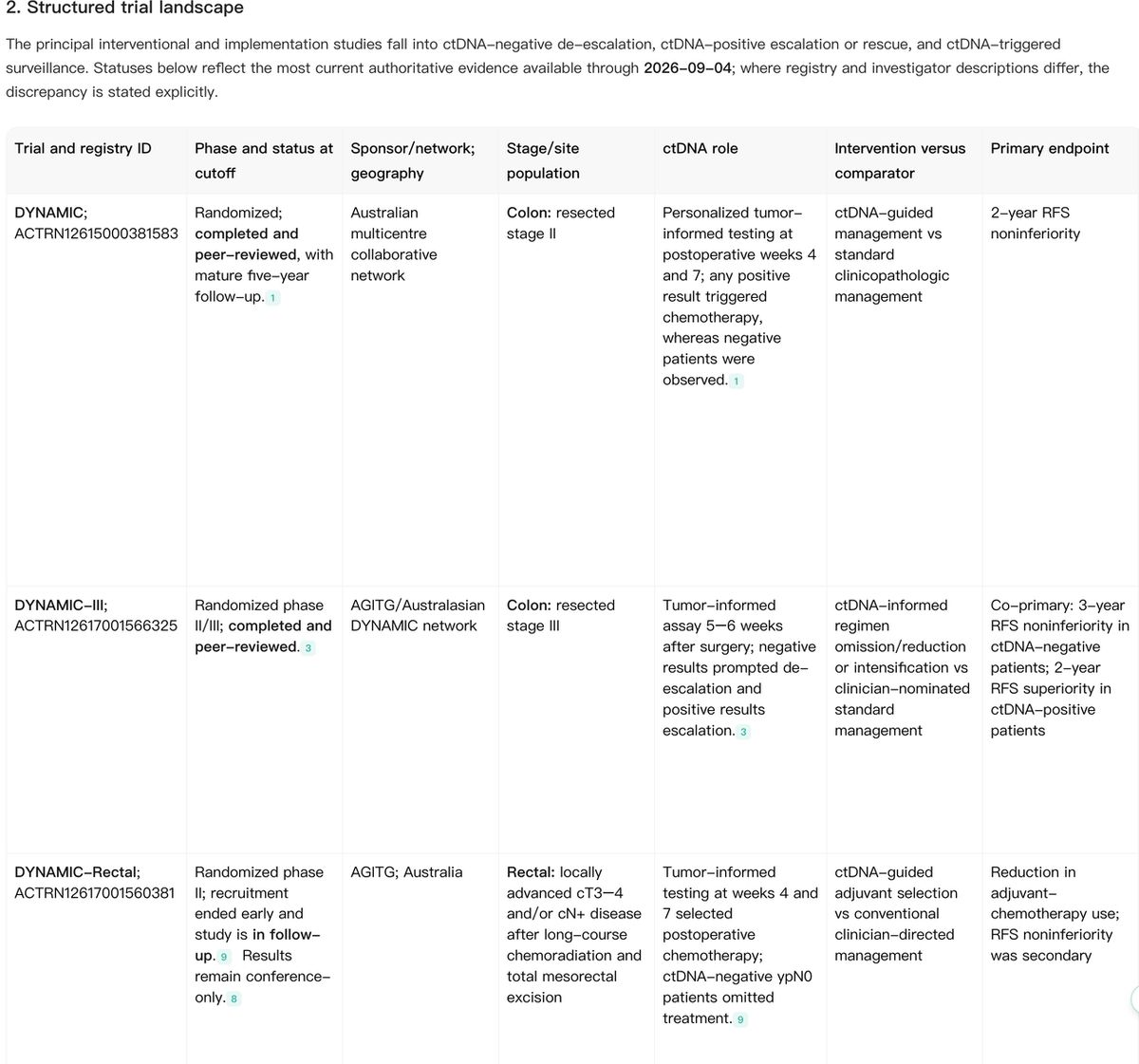
| DYNAMIC | Resected stage II colon cancer | Tests ctDNA-guided adjuvant treatment selection and chemotherapy sparing | Completed, peer-reviewed, mature follow-up |
| DYNAMIC-III | Resected stage III colon cancer | Tests de-escalation in ctDNA-negative disease and escalation in ctDNA-positive disease | Completed and peer-reviewed |
| DYNAMIC-Rectal | Locally advanced rectal cancer | Tests postoperative chemotherapy selection using ctDNA | Recruitment ended early; conference-reported results |
| COBRA / NRG-GI005 | Low-risk stage IIA colon cancer | Tested whether postoperative ctDNA could identify patients for chemotherapy | Halted for futility before phase III recurrence testing |
| CIRCULATE-US / NRG-GI008 | Selected stage II–III colon cancer | Major confirmatory program testing both de-escalation and escalation | Active / recruiting; no mature randomized outcome |
This is the first distinction a useful landscape should make: completed evidence, negative evidence, incomplete evidence, and ongoing evidence are not interchangeable.
Why This Is a Difficult Research Task
A clinical trial landscape usually has to reconcile several types of evidence at the same time.
Registry status is only one layer
ClinicalTrials.gov and other registries are essential for identifiers, recruitment status, enrollment, study design, sponsors, and planned endpoints. But they do not automatically tell you how the published results should be interpreted.
Publications may be more mature than registry summaries
A trial may have a published long-term analysis even when the registry page remains focused on the original study design. Conversely, an active registry record may have no mature clinical outcome.
Conference evidence needs a different label
Some important trials first appear as conference abstracts or authoritative readouts. They may belong in a current landscape, but they should not be presented as though they have the same evidence maturity as a full peer-reviewed publication.
A negative trial still belongs in the map
Trial landscapes become misleading when they include only successful studies. COBRA, early-closed programs, and unsuccessful treatment-escalation strategies are still important because they show where a hypothesis has not been validated.
Prognostic value is not the same as clinical utility
ctDNA can identify patients at substantially different risks of recurrence. That does not automatically prove that a given chemotherapy-escalation, de-escalation, or surveillance strategy improves outcomes.
How We Mapped the Landscape With Noah AI
Noah's updated Agent workflow changes how this kind of task begins.
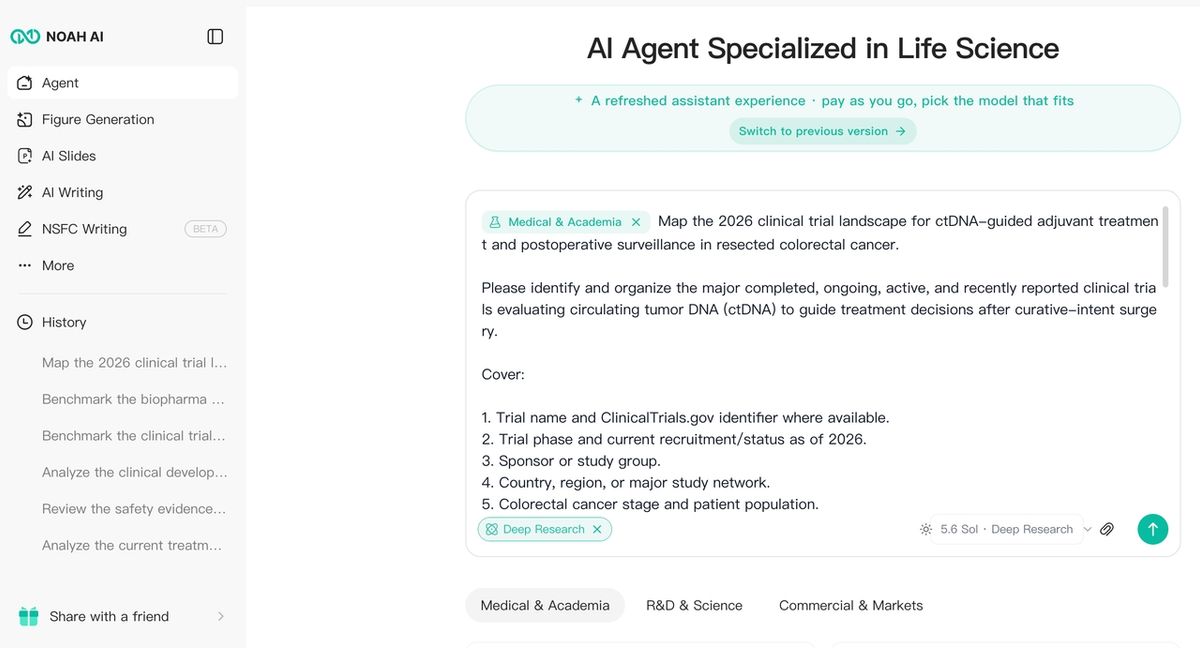
Instead of starting with the older Search / Medical Search interface, the current workflow can begin with a detailed research task and a Deep Research run.
For this case, we used:
- Agent
- Medical & Academia
- Deep Research
The research question asked Noah to map completed, active, recently reported, stopped, and ongoing trials while preserving the differences between colon and rectal cancer and between treatment-selection and surveillance studies.
Noah also asked clarification questions before running the research. We selected a global landscape, kept colon and rectal populations clearly labeled, used evidence available through September 4, 2026, and included both peer-reviewed publications and authoritative conference or press readouts when they were clearly identified as such.
That clarification step is useful for landscape research because the scope can materially change the answer.
From a Research Question to a Structured Trial Map
The useful result was not another narrative literature review. Noah generated a structured landscape that aligned the major trials across common fields.
Those fields included:
- trial and registry identifier,
- phase and status,
- sponsor or research network,
- geography,
- disease stage and population,
- the role of ctDNA,
- intervention and comparator,
- primary endpoint,
- evidence maturity and headline result.
That format matters because it turns a collection of trial records into a field-level research deliverable.
What the Case Does — and Does Not — Support
The RCC example supports several conclusions about the research workflow.Shown here:
- guideline version and geography can be defined before analysis,
- guideline position can be separated from FDA-label status,
- treatment options can be organized by IMDC and pivotal evidence,
- trial findings can be summarized without cross-trial ranking,
- evidence gaps and interpretation boundaries can remain visible.
Not established by this workflow:
- that one regimen is universally the best treatment,
- that the numerically highest response rate across separate trials identifies the preferred therapy,
- that a guideline recommendation automatically applies to every patient,
- or that AI output should replace clinical judgment.
Research Current Standard-of-Care Evidence with Noah AI
Use Noah AI to research treatment guidelines, regulatory evidence, pivotal trials, patient subgroups, and treatment positioning within a clearly defined clinical setting.Free to use · Free credits included · No credit card requiredResearch Standard-of-Care Evidence with Noah AI →
Elicit — Best for Larger Structured Evidence Reviews
Elicit is useful when standard-of-care analysis is part of a larger evidence-synthesis project.Its Research Agent can gather evidence across scientific literature and other sources, extract structured information, and organize findings into tables or reports.That makes Elicit useful when the research task involves many studies and repeated extraction of fields such as:
- population,
- intervention,
- comparator,
- study design,
- endpoints,
- effect estimates,
- and evidence limitations.
For a standard-of-care project, Elicit may be particularly useful when the team needs a larger reusable evidence dataset rather than one focused clinical landscape.Official documentation: Introducing Elicit Research Agent
Consensus — Best for Rapid Literature Orientation
Consensus is useful when the initial question is:
What does the peer-reviewed literature say about this treatment strategy?
Its Deep Review workflow can break a question into subquestions, search the academic literature, and synthesize a structured review.For standard-of-care research, that can help investigate questions such as:
- What evidence supports a specific first-line regimen?
- How strong is the evidence in a defined risk group?
- Which pivotal studies shaped current treatment practice?
- Where does published evidence disagree?
Consensus is more literature-centered than guideline-centered, so formal treatment-positioning statements should still be checked against the relevant current guideline and regulatory sources.Official documentation: Consensus Deep Review
SciSpace — Best for Guideline and Trial PDF Review
Standard-of-care analysis often requires reading details that are not visible in an abstract or search result.A treatment guideline, supplementary appendix, prescribing document, or pivotal trial publication may contain important information about:
- eligibility,
- subgroup definitions,
- endpoint hierarchy,
- dosing,
- contraindications,
- statistical analysis,
- and safety management.
SciSpace is useful when the main bottleneck is reading and extracting information from papers and PDFs.This makes it a practical companion for deeper source review after the relevant guideline or trial has already been identified.Official documentation: How to Conduct a Literature Review Using SciSpace
ChatGPT Deep Research — Best for Broad Multi-Source Research
Standard-of-care questions frequently extend beyond journal literature.A complete research task may require:
- professional guidelines,
- FDA labels,
- regulatory announcements,
- trial registries,
- publications,
- society materials,
- institutional sources,
- and uploaded documents.
ChatGPT Deep Research is useful when these different source types need to be researched together and synthesized into a documented report.Its role is particularly relevant when the research question is broader than conventional literature review and requires flexible source gathering.Official documentation: Deep research in ChatGPT
Perplexity Research — Best for Fast Current-Source Orientation
Perplexity Research can be useful at the beginning of a standard-of-care project.It can help identify:
- major current treatment options,
- recent guideline updates,
- regulatory changes,
- pivotal publications,
- and sources that deserve deeper verification.
That makes it useful for orientation.However, important claims such as “preferred,” “recommended,” “FDA approved,” or “standard of care” should still be verified against the original guideline, regulatory document, or pivotal publication rather than relying only on a synthesized search result.Official documentation: Perplexity Research
How to Build a Better Standard-of-Care Analysis
Define the Geography
Standard of care is not automatically global.FDA approval describes the U.S. regulatory environment. NCCN reflects a U.S.-centered guideline framework. ESMO, NICE, CSCO, and other organizations may produce different recommendations for other settings.Always state the geography explicitly.
Define the Disease and Treatment Setting
“Kidney cancer treatment” is not sufficiently specific.A useful question may need to specify:
- histology,
- stage,
- treatment line,
- resectability,
- prior treatment,
- biomarker,
- or risk group.
For this article, the scope is specifically:U.S. first-line treatment-naive advanced/metastatic clear-cell RCC.
Record the Guideline Version
Guidelines change.A statement such as:
NCCN recommends...
is incomplete if the relevant version is not clear in a fast-moving treatment area.For the RCC case here, the guideline reference is:NCCN Kidney Cancer Version 1.2027.
- Add an Evidence Cutoff Date
Standard-of-care analysis becomes stale quickly.New approvals, guideline updates, long-term trial follow-up, or label changes may alter the interpretation.This analysis uses evidence available through:September 4, 2026.
- Separate Guideline and Regulatory Evidence
Use separate fields for:
- guideline position,
- FDA indication,
- pivotal evidence,
- and population qualification.
Do not use one as a substitute for another.
- Do Not Rank Separate Trials as Though They Were Head-to-Head
A higher ORR or longer median PFS in one trial does not automatically prove that the regimen is superior to a different regimen studied in another trial.Differences in:
- population,
- risk distribution,
- follow-up,
- endpoint definition,
- control arm,
- subsequent treatment,
- and statistical design
can make naive cross-trial comparisons misleading.
- Keep Clinical Selection Separate From Evidence Description
A standard-of-care report can explain:
- which options guidelines list,
- how labels differ,
- which trials support them,
- and what factors may affect clinical selection.
It should not turn those findings into an unsupported instruction that one treatment is “best” for an individual patient.
Which Tool Should You Choose?
Choose Noah AI when the task starts with a biomedical standard-of-care question and needs to end with a structured, cited analysis connecting guidelines, regulatory evidence, pivotal trials, subgroups, and uncertainty.
Choose Elicit when the project involves a larger evidence set and repeated structured study extraction.
Choose Consensus when you need rapid orientation to what the academic literature says about a treatment question.
Choose SciSpace when the bottleneck is reading and extracting details from guidelines, publications, or PDFs.
Choose ChatGPT Deep Research when the research spans guidelines, regulatory sources, web material, publications, registries, and uploaded files.
Choose Perplexity Research when you need fast discovery of current public sources before deeper verification.
Frequently Asked Questions
What is standard-of-care analysis?
Standard-of-care analysis examines how current treatment is defined within a specific disease, geography, patient population, and treatment setting.A complete analysis may include guideline recommendations, regulatory indications, pivotal trials, treatment positioning, patient subgroups, and important evidence limitations.
Does FDA approval mean a treatment is preferred?
No.FDA approval establishes a regulatory indication.Terms such as preferred, recommended, or specific recommendation categories should be tied to an identifiable guideline source, version, clinical setting, and population.
Why does the evidence cutoff date matter?
Treatment landscapes change.New trial results, regulatory decisions, label updates, and guideline revisions can alter the standard-of-care interpretation. A dated evidence cutoff tells the reader when the analysis was current.
Why must geography be specified?
Treatment guidance and regulatory status vary across jurisdictions.A treatment approved or guideline-preferred in the United States may have different regulatory status, reimbursement, or guideline positioning in Europe, China, Japan, or other markets.
Can AI determine the best treatment for a patient?
Standard-of-care research tools can help organize guidelines, regulatory information, clinical evidence, and treatment-positioning context.They should not be used as a substitute for patient-specific clinical decision-making or qualified professional judgment.
Can FDA labels and guidelines disagree?
They can differ in scope.Guidelines may position treatments within broader clinical decision frameworks, while FDA labels define the authorized U.S. indication. A useful analysis should show both rather than assuming they are interchangeable.
Final Takeaway
The difficult part of standard-of-care analysis is not finding treatment names.It is keeping the evidence hierarchy intact.A reliable analysis should state:
- where the standard applies,
- which disease and treatment setting is being analyzed,
- which guideline and version support the recommendation,
- what the FDA label actually says,
- which pivotal evidence supports the treatment,
- and what the available evidence still cannot establish.
The U.S. first-line advanced/metastatic ccRCC example shows why this matters.NCCN Kidney Cancer Version 1.2027 provides the guideline basis for describing the four ICI-based combinations as preferred category 1 options. FDA labeling provides a separate regulatory layer, including the narrower intermediate/poor-risk indication for nivolumab + ipilimumab. The pivotal trials then provide a third layer of evidence.Those layers should be connected—but not collapsed into one claim.
Research Current Standard-of-Care Evidence with Noah AI
Use Noah AI to research current guidelines, regulatory evidence, pivotal trials, patient subgroups, and treatment positioning in a structured, source-traceable workflow.
Start for free with included usage credits — no credit card required.Create Your Free Noah Account →
Related Research Guides
- Best AI Tools for Clinical Trial Results Analysis (2026)
- How to Analyze Clinical Trial Results with AI Using Noah AI
- Best AI Tools for Turning Research Questions into Evidence Tables (2026)
- Best AI Tools for Medical Literature Search and Research Writing (2026)
- How to Build a Disease Landscape Report: A Complete Guide