Best AI Tools for Clinical Trial Endpoint Analysis (2026)
Linda
Compare the best AI tools for clinical trial endpoint analysis. We test Noah AI on the DAPA-CKD and EMPA-KIDNEY trials to show how endpoint definitions and cross-trial comparability shape interpretation.
Comparing clinical trials requires more than reading the headline efficacy result. Two studies can investigate the same disease area while using different primary endpoint definitions, composite components, disease-progression thresholds, secondary endpoints, and statistical testing strategies.
Those differences matter because a treatment-effect estimate from one trial should not automatically be compared with a treatment-effect estimate from another trial when the underlying endpoints are not defined in the same way.
AI research tools can help researchers find endpoint definitions, extract individual components, compare trial designs, and organize the evidence into a more reviewable format. The most useful tools also keep the supporting sources visible.
Evaluation note: We tested Noah AI directly using the DAPA-CKD and EMPA-KIDNEY workflow shown below. Other tools were evaluated from their current official documentation and published workflows.
What Is Clinical Trial Endpoint Analysis?
Clinical trial endpoint analysis examines not only the name of an outcome, but exactly how that outcome is defined and tested.
A useful analysis may need to identify:
- the exact primary endpoint definition,
- the individual components of a composite endpoint,
- disease-progression thresholds,
- kidney failure or other event definitions,
- key secondary endpoints,
- cardiovascular and mortality outcomes,
- the multiplicity or hierarchical testing strategy,
- which endpoints are directly comparable across trials.
This is especially important in cross-trial analysis. Two studies may use similar endpoint labels while defining the events differently.
Best AI Tools for Clinical Trial Endpoint Analysis
| Tool | Best For | Trial Evidence Search | Endpoint Extraction | Cross-Trial Synthesis | Source Traceability |
|---|---|---|---|---|---|
| Noah AI | Structured biomedical endpoint comparison | Strong | Strong | Strong | Strong |
| Elicit | Scientific evidence extraction and synthesis | Strong | Strong | Strong | Strong |
| Consensus | Rapid exploration of peer-reviewed evidence | Strong | Moderate | Moderate | Strong |
| SciSpace | Reading trial papers and extracting details | Strong | Strong | Moderate | Strong |
| ChatGPT Deep Research | Multi-source clinical research | Strong | Strong | Strong | Strong |
| Perplexity Research | Fast cross-source research and orientation | Moderate–Strong | Moderate–Strong | Strong | Strong |
Noah AI
Best for: structured clinical trial endpoint analysis with cited biomedical evidence.
Noah AI is useful when the task goes beyond locating a primary endpoint. A researcher can ask it to compare exact endpoint definitions, decompose composite endpoints, inspect secondary outcomes, and assess whether outcomes are actually comparable across trials.
This type of workflow is relevant to clinical development, medical affairs, competitive intelligence, and evidence synthesis because endpoint design directly affects how efficacy results should be interpreted.
For a broader Noah workflow focused on trial-result analysis, see Best AI Tools for Clinical Trial Results Analysis (2026).
Example: DAPA-CKD vs EMPA-KIDNEY
We tested Noah using DAPA-CKD and EMPA-KIDNEY, two major chronic kidney disease trials. The task was deliberately designed around endpoint definitions rather than headline hazard ratios.
The prompt asked Noah to compare:
- the primary endpoint and its exact definition in each trial,
- the individual components of each composite endpoint,
- key secondary endpoints,
- eGFR decline thresholds,
- kidney failure definitions,
- cardiovascular and mortality endpoints,
- statistical testing strategy,
- which endpoints are directly comparable and which require qualification.
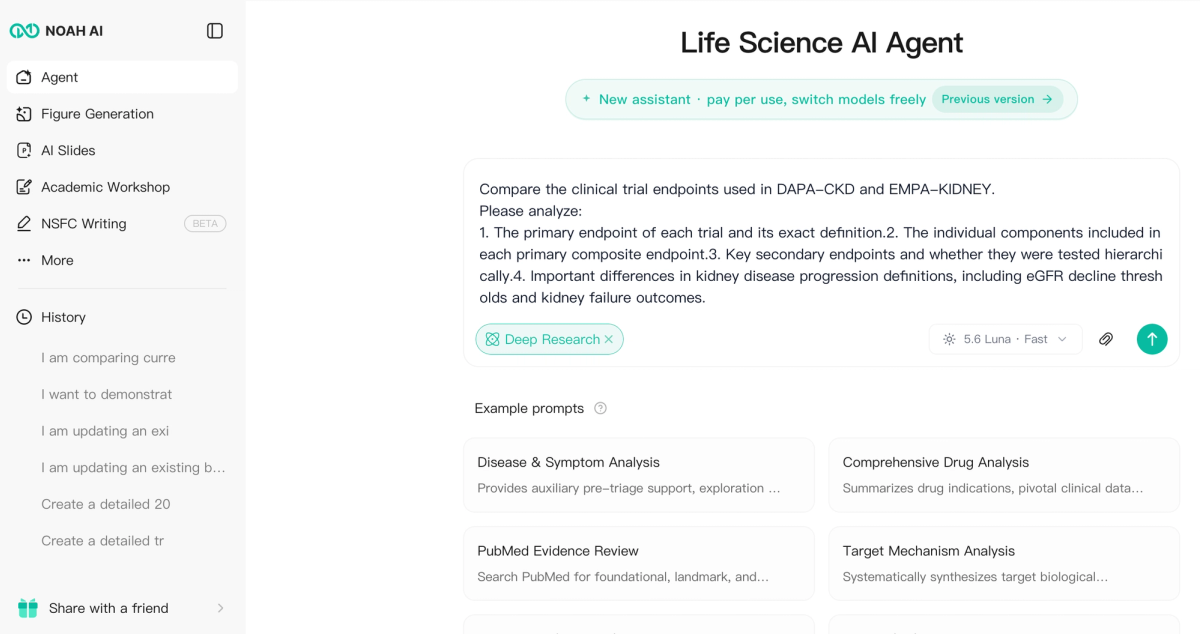
A clinical trial endpoint comparison prompt entered into Noah AI using DAPA-CKD and EMPA-KIDNEY as the test case.
What Noah Returned
Noah returned a structured comparison table with separate columns for DAPA-CKD, EMPA-KIDNEY, and endpoint comparability.
One of the clearest differences was the kidney-function threshold used in the primary outcome framework. DAPA-CKD used a sustained eGFR decline of at least 50% as part of its primary composite endpoint. EMPA-KIDNEY defined kidney disease progression to include a sustained decline in eGFR of at least 40%, along with kidney failure criteria.
This is why apparently similar cardiorenal composite endpoints should not be treated as automatically equivalent.
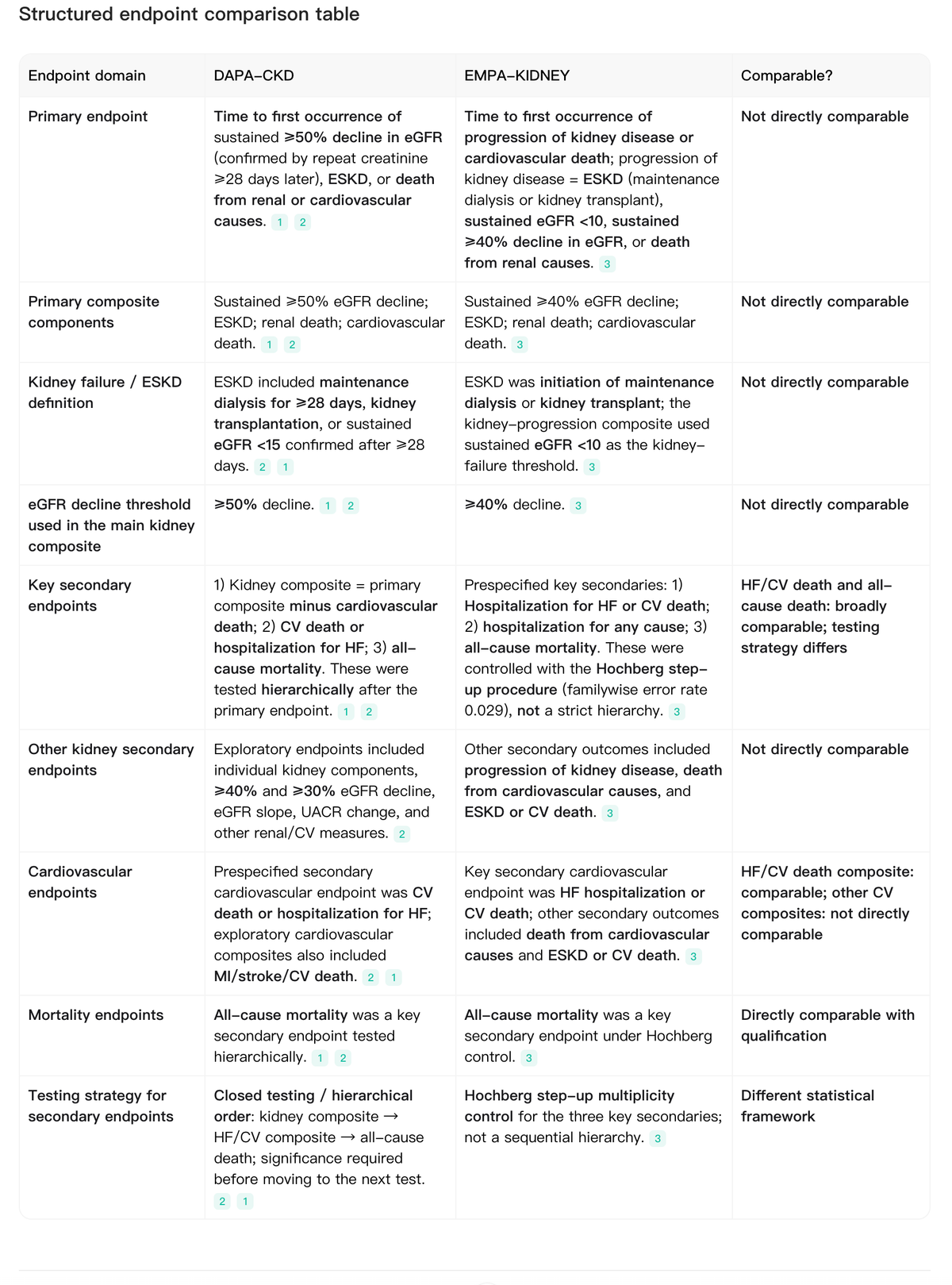
Noah AI compares DAPA-CKD and EMPA-KIDNEY by primary endpoint, composite components, kidney failure definitions, eGFR thresholds, secondary endpoints, and comparability.
Why These Endpoint Differences Matter
The primary DAPA-CKD publication defined the primary outcome as a composite of sustained eGFR decline of at least 50%, end-stage kidney disease, or death from renal or cardiovascular causes.
EMPA-KIDNEY used a primary composite of kidney disease progression or cardiovascular death. Kidney disease progression included end-stage kidney disease, a sustained eGFR below 10 mL/min/1.73 m², a sustained decline in eGFR of at least 40%, or death from kidney failure.
The difference in thresholds and event definitions means that a numerical treatment effect from one trial should not be interpreted as directly superior or inferior to the other based on the hazard ratio alone.
Elicit
Best for: scientific evidence extraction and larger evidence-synthesis workflows.
Elicit's current Research Agent can search scientific literature and other research sources, extract data, analyze evidence, and generate cited reports and tables. It is particularly useful when endpoint analysis forms part of a larger review involving many studies.
For example, a researcher could use Elicit to create a structured evidence set containing trial population, intervention, comparator, primary endpoint, secondary endpoints, and other study characteristics before synthesizing them across studies.
Official documentation: Elicit Research Agent.
Consensus
Best for: quickly exploring peer-reviewed evidence around a clinical question.
Consensus Deep Review decomposes a question into subquestions, runs multiple targeted searches, and synthesizes a structured review from relevant academic papers.
For endpoint work, it can be useful for questions such as which studies used a particular outcome definition, which trials reported a given cardiovascular outcome, or how a clinical endpoint has been used across a literature set.
Detailed endpoint definitions should still be checked against the underlying trial publication, protocol, or registry record.
Official documentation: Consensus Deep Review.
SciSpace
Best for: inspecting endpoint definitions inside individual trial papers.
Important endpoint details can be buried in the methods section, supplementary appendix, statistical analysis plan, or outcome-definition section of a publication.
SciSpace is useful when the researcher already has the relevant papers and needs to ask focused questions about the design, methods, endpoints, or study-specific details.
Typical questions include:
- What was the exact primary endpoint?
- Which events made up the composite endpoint?
- How was sustained eGFR decline defined?
- Which secondary endpoints were prespecified?
- Where in the paper is the endpoint definition described?
Official documentation: How to Conduct a Literature Review Using SciSpace.
ChatGPT Deep Research
Best for: clinical endpoint research across multiple source types.
Trial endpoint information may be distributed across journal publications, registries, regulatory documents, uploaded protocols, supplementary files, and other public sources.
ChatGPT Deep Research can work across the public web, specified sites, uploaded files, and supported connected sources, then produce a structured report with citations or source links.
For high-stakes clinical work, exact endpoint definitions should still be verified against the primary trial materials.
Official documentation: Deep research in ChatGPT.
Perplexity Research
Best for: rapid cross-source orientation and early-stage research.
Perplexity Research performs multi-step searching and source review before producing a synthesized report. This can help researchers quickly identify relevant trials, endpoint descriptions, publications, and supporting material.
It is useful for mapping the evidence landscape before a deeper endpoint review. Exact definitions should still be checked against primary trial sources.
Official documentation: What is Perplexity Research mode?.
Try Noah AI for Free
Use Noah AI to search, compare, and analyze biomedical evidence with AI-powered research workflows.
Free credits are available, and no credit card is required to get started.
Endpoint Extraction Is Not Enough
A useful endpoint-analysis workflow should do more than find a phrase such as “primary endpoint.”
Consider two kidney outcome frameworks that both include disease progression and cardiovascular events. If one uses a sustained 50% eGFR decline and another uses a sustained 40% decline plus a different kidney failure threshold, the events are related but not identical.
The analysis therefore needs to decompose the endpoint before deciding whether two trial results can be compared directly.
How to Analyze Clinical Trial Endpoints with AI
Identify the Exact Primary Endpoint
Do not stop at a shortened label such as “kidney disease progression.” Retrieve the full event definition from the primary source.
Decompose Composite Endpoints
List every component separately, such as:
- sustained eGFR decline,
- kidney failure or ESKD,
- renal death,
- cardiovascular death.
Compare Thresholds and Confirmation Rules
Similar components may use different thresholds, required durations, or confirmation rules. Those differences can affect event frequency and cross-trial interpretation.
Review Key Secondary Endpoints
Identify prespecified secondary outcomes such as heart failure hospitalization, cardiovascular death, all-cause mortality, kidney-specific composites, or hospitalization outcomes.
Check the Statistical Testing Strategy
Secondary endpoints may be tested under hierarchical procedures, multiplicity-adjusted methods, or other statistical frameworks. Prespecified does not necessarily mean that every secondary outcome carries the same inferential status.
Classify Comparability
For each endpoint, decide whether it is:
- directly comparable,
- broadly comparable with qualification,
- not directly comparable.
This is often more defensible than forcing every outcome into a simple numerical ranking.
Which Tool Should You Choose?
Choose Noah AI when you want to begin with a biomedical research question and produce a structured comparison of endpoint definitions, components, supporting evidence, and cross-trial comparability.
Choose Elicit when endpoint extraction is part of a larger evidence-synthesis or systematic-review workflow.
Choose Consensus when you need a fast review of peer-reviewed evidence around a focused endpoint question.
Choose SciSpace when the main task is interrogating individual papers and locating detailed endpoint definitions.
Choose ChatGPT Deep Research when endpoint evidence is distributed across publications, registries, websites, and uploaded files.
Choose Perplexity Research when you need rapid cross-source discovery before a more detailed endpoint review.
Frequently Asked Questions
What is clinical trial endpoint analysis?
Clinical trial endpoint analysis examines how a study defines and measures its primary and secondary outcomes, including composite components, thresholds, confirmation rules, statistical testing strategies, and cross-trial comparability.
Can AI extract primary and secondary endpoints from clinical trials?
Yes. AI tools can help identify and organize endpoint definitions from trial publications and related sources. Important definitions should still be verified against original trial documentation.
Can AI compare endpoints across clinical trials?
Yes. AI can organize endpoints side by side and identify differences in composite components, thresholds, definitions, and testing strategies.
Why are composite endpoints difficult to compare?
Two composite endpoints may contain different components or use different event definitions. Similar endpoint names therefore do not necessarily represent equivalent clinical outcomes.
Can hazard ratios from different clinical trials be compared directly?
Not reliably without qualification. Patient populations, endpoint definitions, follow-up duration, trial design, and statistical methods may differ, so direct numerical ranking can be misleading.
What sources should be used to verify clinical trial endpoints?
Prioritize primary trial publications, ClinicalTrials.gov or other official registries, protocols, supplementary appendices, statistical analysis plans, and relevant regulatory documents.
Final Takeaway
Clinical trial endpoint analysis is not simply an extraction task. The more important question is whether outcomes that appear similar are actually defined and tested in comparable ways.
Elicit, Consensus, and SciSpace are useful for different layers of literature discovery and evidence review, while general deep-research tools can help when evidence is spread across several source types.
Noah AI is particularly relevant when the goal is to move from a clinical research question to a structured endpoint comparison that keeps definitions, evidence, and comparability visible in the same workflow.
For cross-trial interpretation, the safest order is: compare endpoint definitions first, then compare treatment-effect estimates.