Best AI Tools for Clinical Guideline Recommendation Comparison (2026)
Linda
Compare the best AI tools for clinical guideline recommendation comparison in 2026, with a real AF anticoagulation case using ACC/AHA/ACCP/HRS, ESC, and NICE.
Comparing clinical guidelines is not the same as summarizing them. Two organizations can look as though they disagree simply because they use different risk scores, decision thresholds, recommendation language, or patient definitions. A useful AI workflow should preserve those differences and show when they could actually change implementation.
This guide compares five tools that can support different parts of a clinical guideline comparison workflow: Noah AI, Consensus, OpenEvidence, Elicit, and Scite.
For the real workflow, we tested Noah AI on atrial fibrillation anticoagulation guidance from the 2023 ACC/AHA/ACCP/HRS guideline, the 2024 ESC guideline, and NICE NG196.
Testing note: We tested Noah AI directly. Other tools are described based on their documented workflows and typical research use cases.
Guideline Versions Used in This Comparison
This comparison uses the following guideline versions:
- ACC/AHA/ACCP/HRS: 2023 ACC/AHA/ACCP/HRS Guideline for the Diagnosis and Management of Atrial Fibrillation, originally published November 30, 2023. Accessed October 9, 2026.
- ESC: 2024 ESC Guidelines for the Management of Atrial Fibrillation, published August 30, 2024. Accessed October 9, 2026.
- NICE: Atrial Fibrillation: Diagnosis and Management (NG196), published April 27, 2021 and last updated June 30, 2021. NICE records subsequent minor presentation changes, including changes in March 2025. Accessed October 9, 2026.
Recommendation wording, risk scores, treatment thresholds, and evidence grading should be interpreted within the version and framework of the issuing organization rather than treated as interchangeable across guidelines.
1. Why Clinical Guideline Comparison Is Hard
Guidelines often answer the same broad clinical question through different frameworks. In atrial fibrillation, an anticoagulation decision may depend on which stroke-risk score is used, whether female sex contributes to the score, whether the decision is based on a score threshold or estimated annual risk, how bleeding risk is handled, and whether the rhythm finding is clinical AF or device-detected AHRE.
Flattening all of those fields into a single “agreement” column can create false equivalence. The comparison has to align the clinical decision first.
2. What to Look for in an AI Tool for Guideline Comparison
| Capability | Why it matters |
|---|---|
| Current guideline retrieval | The workflow should distinguish current guidance from superseded recommendations. |
| Recommendation-level extraction | The tool should preserve scoring systems, thresholds, wording, exceptions, and population scope. |
| Source traceability | Important recommendation claims should remain connected to an official or clearly identified source. |
| Framework normalization | Comparable decisions should be aligned without forcing non-equivalent scoring systems into one scale. |
| Uncertainty handling | Unavailable fields should remain NR or uncertain rather than being inferred from another guideline. |
| Scenario application | A shared hypothetical patient can show whether differences are only terminological or could change the treatment pathway. |
3. AI Tools for Clinical Guideline Recommendation Comparison
Noah AI
Directly tested
Noah AI is useful when the final deliverable needs to be a structured biomedical comparison rather than separate guideline summaries. In this case, Noah aligned stroke-risk scoring, female-sex handling, oral-anticoagulation thresholds, bleeding risk, DOAC-versus-VKA selection, AHRE, and LAAO across three major frameworks.
Its most useful role in this workflow is turning recommendation text into a source-aware decision matrix while retaining NR where the retrieved official material does not expose a directly comparable field.
Noah AI can be used for free, includes free credits, and requires no credit card to get started.
Consensus
Consensus is useful at the discovery stage when the main bottleneck is finding medical guidelines, reviews, and supporting literature around a clinical question. For a custom multi-guideline matrix, the exact recommendation fields still need to be normalized carefully.
OpenEvidence
OpenEvidence is useful when the primary need is to move quickly from a clinical question toward guideline-informed medical evidence. The output needed here is different: a transparent multi-organization comparison that preserves wording and implementation logic.
Elicit
Elicit is useful when a guideline comparison needs to move beneath the recommendation layer and inspect the supporting evidence base through literature search, screening, extraction, and synthesis.
Scite
Scite is useful as a citation-context verification layer, helping researchers inspect how supporting studies are cited by later literature.
4. Real Case: Comparing AF Anticoagulation Guidelines
The real test compared anticoagulation recommendations from the 2023 ACC/AHA/ACCP/HRS AF guideline, the 2024 ESC AF guideline, and NICE NG196 (published 2021; last updated June 30, 2021) for adults with atrial fibrillation.
The comparison focused on recommendation wording, stroke-risk framework, treatment thresholds, recommendation strength or evidence grade where directly available, bleeding-risk assessment, DOAC-versus-VKA selection, device-detected AF or AHRE, and LAAO.
The task explicitly prohibited ranking the guidelines or translating one organization’s recommendation or grading system into another.
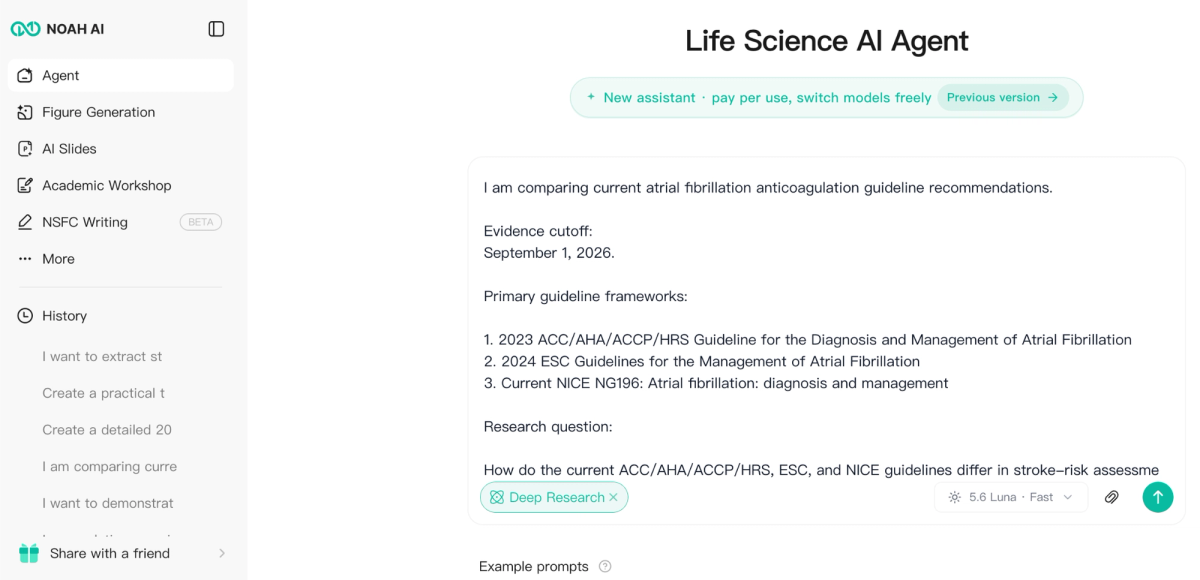
The prompt focused on CHA₂DS₂-VASc versus CHA₂DS₂-VA, the role of female sex, when anticoagulation should be considered or offered, bleeding-risk assessment, DOAC versus VKA selection, aspirin, device-detected AF or AHRE, and LAAO. The task explicitly prohibited ranking the guidelines or translating one organization’s grading system into another.
5. Apply the Same Patient to All Three Frameworks
The hypothetical patient was a 58-year-old woman with paroxysmal atrial fibrillation and hypertension, with no previous stroke or TIA, no diabetes, no heart failure, no vascular disease, no mechanical valve, no moderate-to-severe mitral stenosis, and no current anticoagulation.
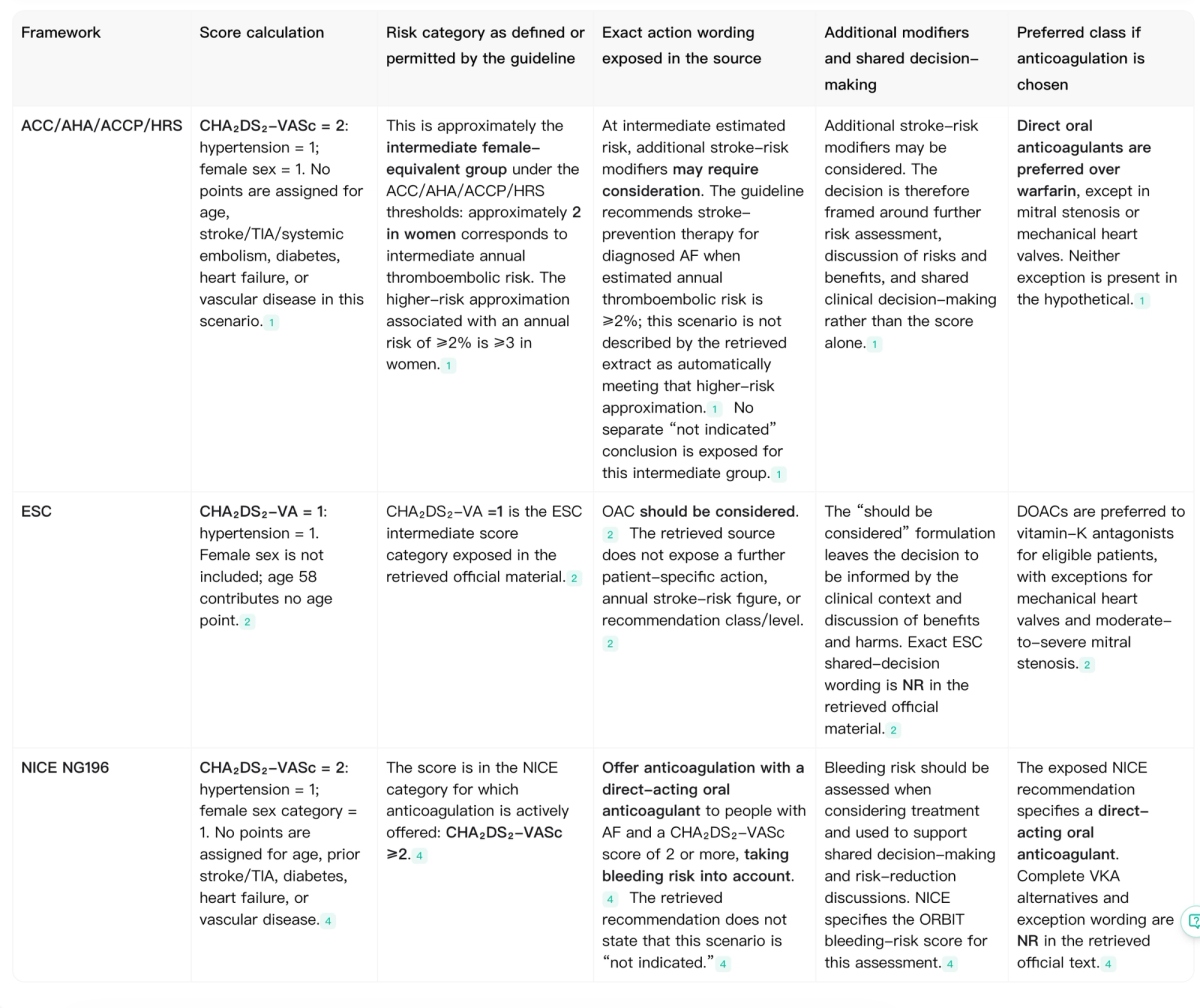
ACC/AHA/ACCP/HRS
The scenario produces a CHA₂DS₂-VASc score of 2: one point for hypertension and one for female sex. In the retrieved framework, that places the illustrative woman in an intermediate-risk range in which additional stroke-risk modifiers may need to be considered rather than making the score alone an automatic treatment mandate.
ESC
The same clinical facts produce CHA₂DS₂-VA = 1 because sex category is not included. At that score, oral anticoagulation should be considered.
NICE
NICE retains CHA₂DS₂-VASc. The same patient therefore has a score of 2, reaching the exposed threshold at which anticoagulation with a direct-acting oral anticoagulant is offered, taking bleeding risk into account.
Compare clinical guidelines with your own research question
Use Noah AI to compare recommendation frameworks, scoring systems, treatment thresholds, and source-traceable medical evidence.
Noah AI can be used for free, includes free credits, and requires no credit card.
6. The Same Patient Can Receive Different Numerical Scores
| Framework | Score | Why | Exposed action wording |
|---|---|---|---|
| ACC/AHA/ACCP/HRS | CHA₂DS₂-VASc = 2 | Hypertension = 1; female sex = 1 | Intermediate-risk setting; additional stroke-risk modifiers may be considered. |
| ESC | CHA₂DS₂-VA = 1 | Hypertension = 1; sex category excluded | OAC should be considered. |
| NICE | CHA₂DS₂-VASc = 2 | Hypertension = 1; female sex = 1 | Offer anticoagulation with a DOAC, taking bleeding risk into account. |
This is not evidence that one scoring system is better. It is evidence that a guideline comparison must preserve the scoring system and the action threshold together.
7. Recommendation Language Should Not Be Translated Into One Scale
The three organizations do not use interchangeable wording. ACC/AHA/ACCP/HRS emphasizes estimated annual thromboembolic risk and modifiers at intermediate risk; ESC uses “should be considered” and “is recommended”; NICE uses “offer” and “consider” within its own framework.
It would be misleading to turn “offer,” “recommended,” “should be considered,” and “reasonable” into a homemade universal strength hierarchy.
8. Compare Bleeding Risk Without Turning It Into a Veto
The retrieved ACC/AHA/ACCP/HRS wording states that bleeding-risk scores should not be used in isolation to determine OAC eligibility. They should instead help identify potentially modifiable factors and inform the decision.
NICE uses the ORBIT bleeding-risk score when anticoagulation is considered or reviewed and uses bleeding risk to support shared decision-making and risk reduction. Where the retrieved ESC material did not expose an equivalent detailed field, the comparison kept the result as NR rather than importing a tool from another guideline.
9. Compare DOAC and VKA Recommendations Carefully
| Framework | Preferred class | Important exception context |
|---|---|---|
| ACC/AHA/ACCP/HRS | DOACs preferred over warfarin | Mitral stenosis or mechanical heart valves are exceptions in the retrieved wording. |
| ESC | DOACs preferred to VKAs for eligible patients | Mechanical heart valves and moderate-to-severe mitral stenosis are exposed exceptions. |
| NICE | Exposed treatment thresholds specify a direct-acting oral anticoagulant | The complete VKA alternative and exception wording was not exposed in the retrieved material. |
A missing field in a retrieved source is not permission to borrow another organization’s exception wording.
10. Device-Detected AF Requires a Separate Framework
Clinical AF and device-detected atrial high-rate episodes should not be merged automatically. The retrieved ACC/AHA/ACCP/HRS recommendations expose a duration-and-risk framework for people without a previous AF diagnosis. Where parallel ESC or NICE AHRE thresholds were not exposed, the comparison left them unresolved rather than treating clinical-AF rules as substitutes.
11. Build a Final Guideline Decision Map
The final Noah output reorganized the comparison around the clinical decisions a researcher or reviewer actually needs to inspect.
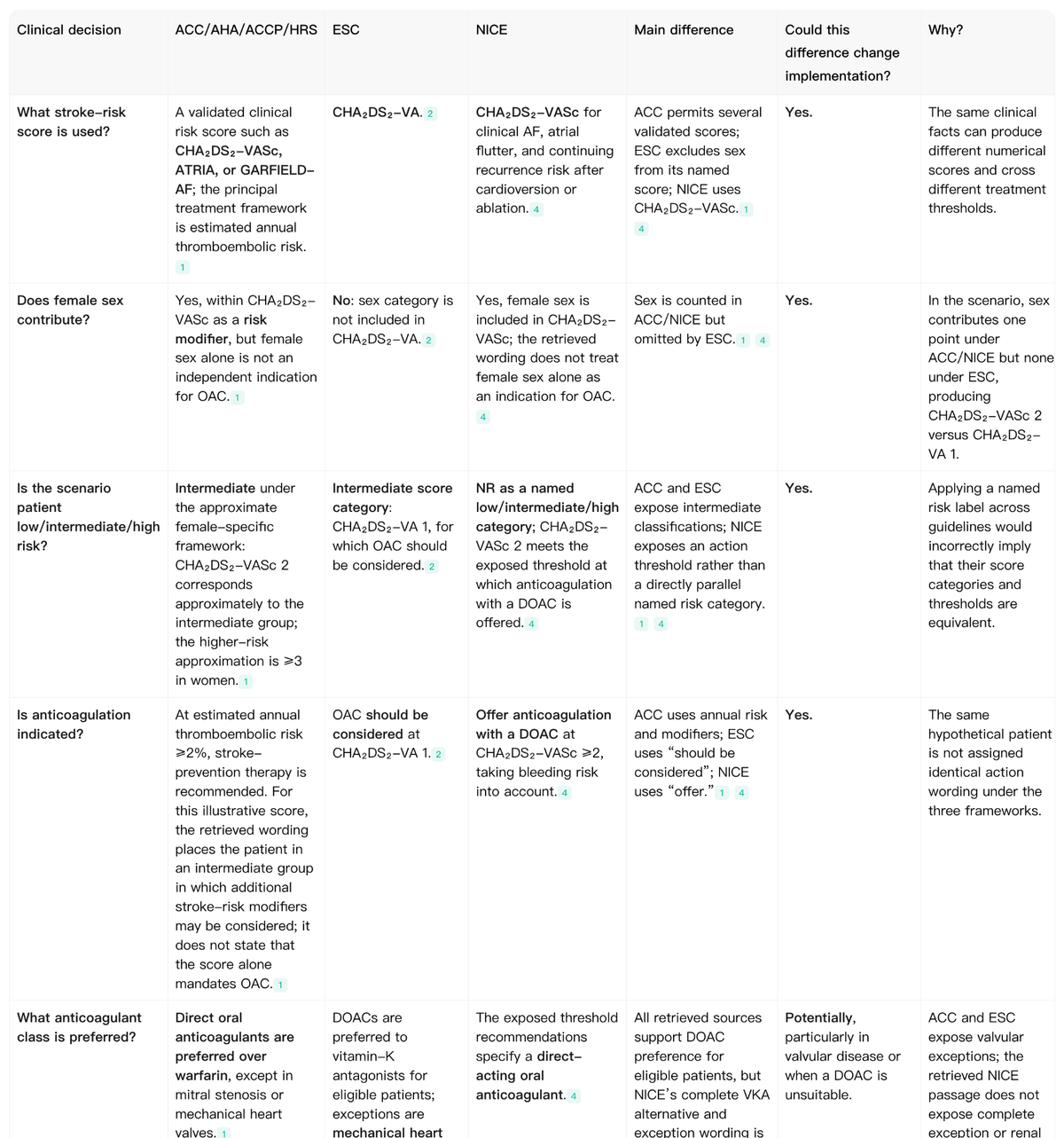
The strongest part of this format is the implementation column. It forces the comparison to ask not only whether guidelines differ, but whether that difference could plausibly change what happens in practice.
Compare Clinical Guideline Recommendations with Noah AI
Use Noah AI to compare recommendation wording, risk frameworks, treatment thresholds, and evidence grades across clinical guidelines while keeping each organization’s terminology and decision logic intact.
Build a source-linked comparison that shows not only where recommendations differ, but whether those differences could change clinical implementation.
Free to use · Free credits included · No credit card required
Compare Clinical Guidelines with Noah AI →
12. Apparent Versus Real Guideline Disagreement
Score Construction: Often an Apparent Difference
CHA₂DS₂-VASc and CHA₂DS₂-VA are not the same score. The numerical difference created by excluding sex category is partly structural rather than proof that the organizations disagree about every underlying risk factor.
Action Thresholds: Potentially an Implementation Difference
For the hypothetical patient, ACC, ESC, and NICE expose different decision wording. That can matter at the borderline because the same clinical facts can lead to different next-step framing.
AHRE Guidance: A Difference in Available Detail
ACC/AHA/ACCP/HRS exposes an explicit episode-duration and risk framework for device-detected AHRE in the retrieved material, while parallel thresholds were not exposed for ESC and NICE. This should not be restated as evidence that the other organizations oppose the ACC approach.
Incomplete Fields: Not a Disagreement
NR means that a field was not directly exposed in the retrieved official source. It does not mean that a guideline explicitly recommends the opposite position.
13. Common Mistakes When Comparing Guidelines with AI
Converting Different Scores Into One Common Number
CHA₂DS₂-VASc and CHA₂DS₂-VA should remain attached to their own recommendation thresholds.
Equating Recommendation Words
“Offer,” “recommended,” “should be considered,” and “reasonable” should not be translated into a homemade universal grade.
Filling Missing Guideline Fields by Inference
If the official material does not expose the requested wording, keep the field NR rather than importing another guideline’s recommendation.
Treating Bleeding Risk as an Automatic Reason to Withhold OAC
A bleeding-risk score and a stroke-prevention decision are related but not identical judgments.
Applying Clinical-AF Rules to Device-Detected AHRE
Device-detected episodes can have different duration and risk thresholds. The populations should remain separate.
Ranking Guidelines
The purpose of comparison is to explain documented framework differences and applicability, not to choose a winner.
14. Which Tool Fits Which Part of the Workflow?
| Workflow stage | Useful tool | Typical role |
|---|---|---|
| Guideline and literature discovery | Consensus | Find relevant medical guidance and supporting literature. |
| Clinician-facing evidence access | OpenEvidence | Move quickly from a clinical question to guideline-informed medical evidence. |
| Structured multi-guideline comparison | Noah AI | Align recommendation fields, preserve uncertainty, apply a common patient scenario, and produce a decision map. |
| Supporting-evidence review | Elicit | Search, screen, extract, and synthesize studies underpinning recommendations. |
| Citation-context verification | Scite | Inspect how supporting research has been cited in later literature. |
15. Related Research Guides
- Best AI Tools for PubMed Literature Review (2026)
- Best AI Tools for Turning Research Questions into Evidence Tables (2026)
- Best AI Tools for Clinical Trial Results Analysis (2026)
- PubMed Search with AI: How Life Science Professionals Find and Analyze Biomedical Evidence Faster
- How to Search PubMed with AI: A Step-by-Step Guide
16. FAQ
Can AI compare clinical guidelines?
Yes. AI can help identify current guidance, extract recommendation-level fields, align comparable decisions, and summarize meaningful differences. Important claims should still be traceable to official guideline sources.
Can CHA₂DS₂-VASc and CHA₂DS₂-VA be compared directly?
They can be described side by side, but they should not be treated as interchangeable scores. Their components differ, and each score should be interpreted using the threshold and terminology of the guideline that uses it.
Why use a patient scenario in a guideline comparison?
A shared scenario reveals whether different scoring or wording actually changes the pathway. It is often more informative than comparing isolated thresholds in separate paragraphs.
What does NR mean?
NR means that the requested information was not directly exposed or could not be verified in the retrieved source. It does not mean the guideline contains no recommendation on the topic.
Should AI decide which guideline is best?
No. A useful comparison explains documented differences, applicability, and implementation consequences without ranking guideline organizations.
17. Final Takeaway
Compare the decision framework, not just the score.
The ACC/AHA/ACCP/HRS, ESC, and NICE atrial fibrillation guidelines share a broad risk-based approach to stroke prevention, but they do not implement that approach through one interchangeable algorithm.
The same 58-year-old woman with atrial fibrillation and hypertension receives CHA₂DS₂-VASc 2 under ACC and NICE but CHA₂DS₂-VA 1 under ESC. The next-step wording also differs: ACC frames the example within an intermediate-risk setting where additional modifiers may matter, ESC states that OAC should be considered, and NICE exposes a threshold to offer a DOAC while taking bleeding risk into account.
That is the value of structured guideline comparison: it makes the source of the difference visible instead of collapsing everything into a generic summary.