Best AI Tools for Clinical Development Strategy Research (2026)
Linda
Compare the best AI tools for clinical development strategy research. We test Noah AI on T-DXd's expansion from metastatic into early-stage HER2-positive breast cancer.
Clinical development strategy is not a single literature-search problem. It is a sequence of decisions about where an asset should be studied next, which patients should be enrolled, what comparator makes sense, which endpoint matches the treatment setting, and whether the existing benefit-risk profile supports moving into a new stage of disease.
The evidence needed to answer those questions is rarely found in one document. Teams may need to connect earlier pivotal trials, current standards of care, regulatory decisions, biomarker definitions, endpoint precedents, safety constraints, and the design of newer development programs.
AI can make that research faster, but there is an important distinction: finding clinical evidence is not the same as making a clinical development decision. The useful output is an evidence-grounded set of strategic options and trade-offs, not an AI-generated recommendation presented as certainty.
Evaluation note: We tested Noah AI directly using the expansion of trastuzumab deruxtecan (T-DXd, Enhertu) from metastatic HER2-positive breast cancer into early-stage disease. Competitor descriptions are based on current official product documentation and published workflows.
What Does Clinical Development Strategy Research Actually Need to Answer?
A useful strategy review should connect the evidence to a set of development decisions. Depending on the asset, those decisions can include:
1. Where to expand: metastatic disease, earlier-stage disease, a new indication, or a biomarker-defined subgroup.
2. Who to study: broad population or higher-risk, treatment-resistant, or biomarker-selected patients.
3. What to compare against: placebo, active standard of care, or another established therapy.
4. What success should look like: response, pCR, PFS, IDFS, EFS, OS, or another clinically appropriate endpoint.
5. What safety threshold is acceptable: especially when moving from advanced disease into curative-intent settings.
6. What evidence is factual versus inferred: trial design and FDA decisions are facts; the strategic reasoning behind them may require interpretation.
That last distinction is especially important. Public evidence can show what was studied and what was approved. It does not always reveal the sponsor's internal decision process.
How the Leading AI Tools Fit This Workflow
| Tool | Where It Fits Best | Useful Strategy Task | Watch For |
|---|---|---|---|
| Noah AI | Biomedical evidence to structured strategy analysis | Connect trials, endpoints, populations, regulatory evidence, and strategic implications | Strategic interpretation should remain separate from established facts |
| Elicit | High-stakes evidence synthesis and decision support | Trial design research, clinical strategy, evidence comparison, and decision-ready reports | The research question and decision criteria still need careful definition |
| Consensus | Rapid peer-reviewed evidence exploration | Test assumptions and identify literature supporting specific development questions | Less naturally structured around an entire asset-development program |
| SciSpace | Deep reading of pivotal studies and PDFs | Inspect trial design, endpoints, eligibility criteria, methods, and limitations | Paper analysis still needs to be assembled into a broader strategy |
| ChatGPT Deep Research | Broad multi-source strategic research | Combine publications, regulatory sources, registries, websites, and uploaded material | Source selection and biomedical interpretation require review |
| Perplexity Research | Fast development-program orientation | Map major trials, regulatory events, competitors, and recent changes | Best used as orientation before deeper clinical verification |
Noah AI: From Clinical Evidence to Development Logic
Noah AI is useful for this type of task when the starting point is a specific biomedical development question rather than a request for a generic drug summary.
In our test, the question was: how did the T-DXd program expand from advanced HER2-positive breast cancer into early-stage disease, and what can the public evidence tell us about that development path?
The prompt explicitly asked Noah to separate established trial and regulatory facts from interpretation. That matters because an AI tool should not present an inferred strategic rationale as though it were an official company statement.
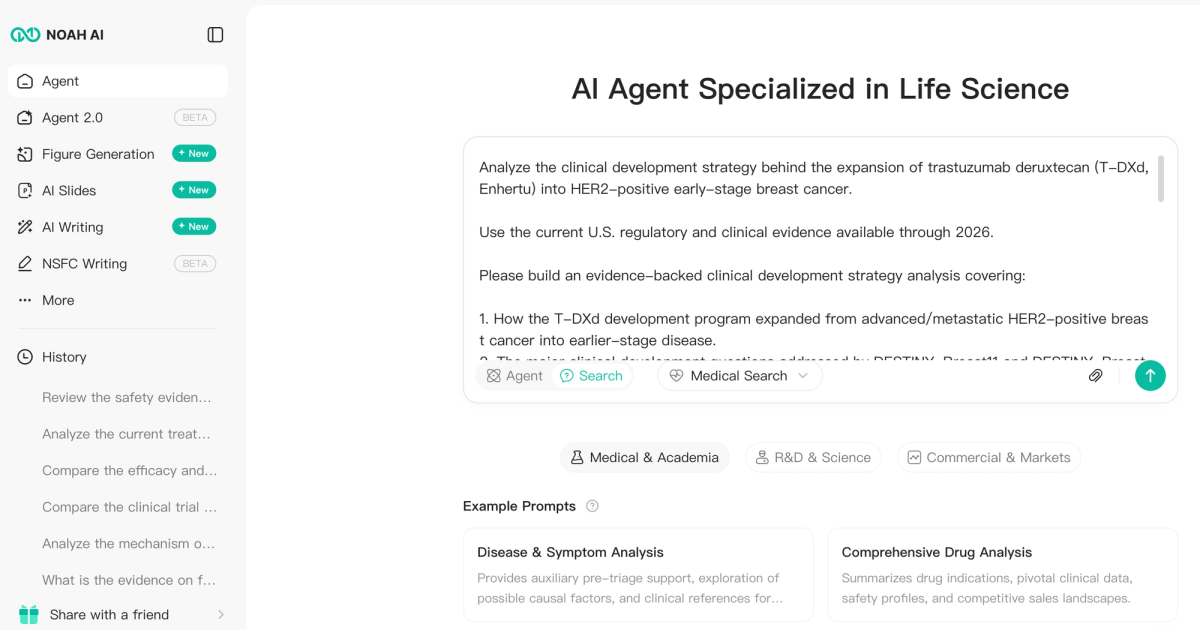
A clinical development strategy research prompt entered into Noah AI, focused on the expansion of T-DXd from metastatic into early-stage HER2-positive breast cancer.
A Real Development Case: Moving T-DXd Earlier in the Disease Course
Evidence from metastatic HER2-positive breast cancer established T-DXd as an important HER2-directed antibody-drug conjugate. In DESTINY-Breast03, T-DXd produced substantial improvements in progression-free survival compared with T-DM1, with updated analyses also showing an overall-survival benefit.
A reasonable strategic interpretation of the later development program is that this benefit-risk evidence created a foundation for testing the asset in earlier-stage, potentially curative settings. That interpretation should not be confused with an official statement of sponsor strategy.
By 2026, the early-stage program had produced two distinct FDA-approved uses built around two different clinical questions.
Question 1: Can Treatment Before Surgery Improve Response Depth?
DESTINY-Breast11 evaluated T-DXd in the neoadjuvant setting for high-risk HER2-positive early breast cancer.
The pivotal comparison used T-DXd for four cycles followed by paclitaxel, trastuzumab, and pertuzumab (THP), versus dose-dense doxorubicin and cyclophosphamide followed by THP.
The major efficacy endpoint was pathological complete response (pCR), a logical endpoint for a pre-surgical study because it measures whether invasive cancer remains in the breast and axillary lymph nodes after neoadjuvant therapy.
FDA reported pCR rates of 67.3% with T-DXd followed by THP and 56.3% with ddAC-THP.
Question 2: Can Treatment After Surgery Reduce Recurrence Risk?
DESTINY-Breast05 addressed a different problem.
It enrolled patients with HER2-positive breast cancer who still had residual invasive disease after neoadjuvant therapy and compared adjuvant T-DXd with T-DM1.
Here, pCR would no longer answer the clinical question because surgery had already occurred. The major efficacy endpoint was therefore invasive disease-free survival (IDFS).
The 3-year IDFS rate was 92.4% with T-DXd versus 83.7% with T-DM1, with a hazard ratio of 0.47.
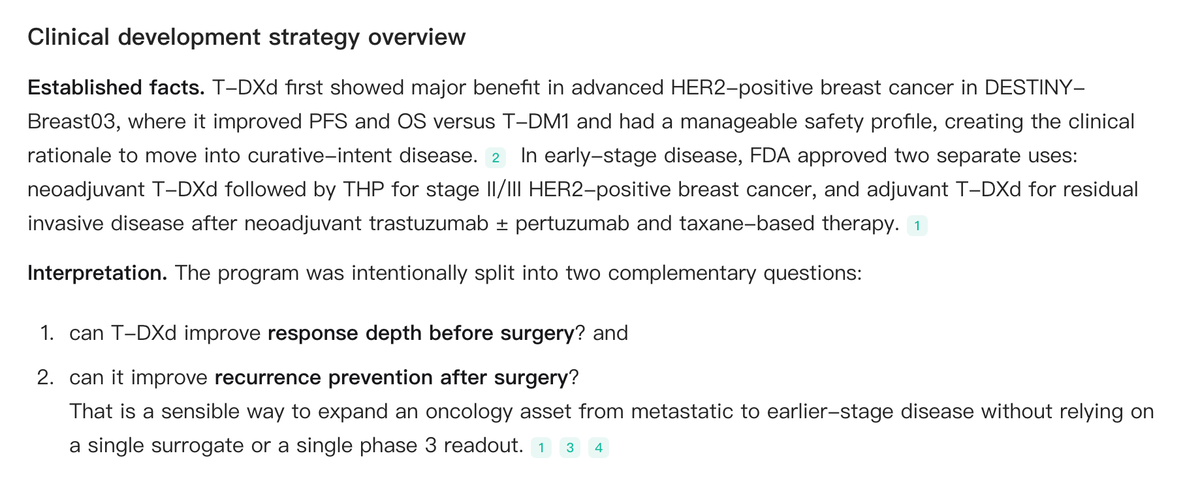
Noah AI separates established evidence from strategic interpretation and frames the early-stage T-DXd program around two complementary questions: response before surgery and recurrence prevention after surgery.
Research clinical development options with Noah AI for free. Start with free usage credits — no credit card required.
Research Clinical Development Options with Noah AI →
Why This Example Is More Than a Trial Comparison
If the task were only to compare DESTINY-Breast11 and DESTINY-Breast05, a standard clinical trial table would be enough.
The development-strategy question is different. The useful insight comes from understanding why the programs answer different clinical questions:
| Development Decision | Neoadjuvant Program | Adjuvant Program |
|---|---|---|
| Clinical problem | Improve depth of response before surgery | Reduce recurrence risk after residual disease remains |
| Patient selection | High-risk Stage II/III HER2-positive disease | HER2-positive residual invasive disease after neoadjuvant therapy |
| Development setting | Before definitive surgery | After neoadjuvant therapy and surgery |
| Comparator logic | Active chemotherapy plus established HER2-targeted therapy | T-DM1, an established post-neoadjuvant option |
| Primary clinical question | Can the regimen eradicate more invasive disease before surgery? | Can the regimen prevent more invasive recurrences? |
| Major endpoint | pCR | IDFS |
This is the type of structure that makes clinical development strategy research different from ordinary literature summarization.
Three Lessons This Development Program Illustrates
1. The Endpoint Should Follow the Clinical Question
The same asset does not need the same primary endpoint in every stage of development.
In a neoadjuvant program, response at surgery can answer an important development question. In an adjuvant residual-disease program, recurrence-free outcomes are more aligned with the clinical objective.
Strategy research should therefore benchmark endpoints by treatment setting, not just by drug class.
2. Moving Earlier Changes the Benefit-Risk Standard
A therapy used in metastatic disease is being deployed in a different context when it moves into curative-intent treatment.
Patients may have a longer expected lifespan and a different tolerance for serious toxicity. For T-DXd, ILD/pneumonitis therefore remains an important consideration when interpreting development in earlier-stage disease.
FDA's 2026 approval announcement continued to highlight the boxed warning for ILD/pneumonitis, together with warnings for neutropenia and left ventricular dysfunction.
3. Expansion Does Not Mean Repeating the Metastatic Trial
The population, comparator, endpoint, and treatment sequence all changed as T-DXd moved into early-stage breast cancer.
That is an important general principle for clinical development research: evidence from a successful later-stage program can support the rationale for expansion, but the new study still needs to answer the clinical question of the new setting.
Where Elicit Fits
Elicit has become particularly relevant to this category in 2026. Its Research Agent is explicitly positioned for high-stakes scientific decision support, including trial design, clinical strategy, indication prioritization, and evidence development.
It can search across scientific literature, clinical trials, regulatory sources, web material, and uploaded internal data, then generate cited reports, tables, analyses, and other decision-support outputs.
That makes Elicit a serious option when the clinical development problem requires a larger evidence base or formalized decision-support process rather than a narrower biomedical research brief.
Official documentation: Introducing Elicit Research Agent.
Where Consensus Fits
Consensus is useful earlier in the process when a team wants to test individual assumptions against peer-reviewed literature.
For example:
- Which endpoints have been used in neoadjuvant HER2-positive trials?
- What evidence links pCR with longer-term outcomes?
- What literature supports a particular biomarker subgroup?
- What safety concerns have been reported for a therapeutic class?
Its Deep Review workflow can decompose a question and synthesize multiple literature searches, making it useful for evidence exploration before a broader strategy is assembled.
Official documentation: Consensus Deep Review.
Where SciSpace Fits
SciSpace becomes useful when the challenge is buried inside the source documents themselves.
Clinical development research often requires checking protocol details, eligibility criteria, endpoint definitions, subgroup analyses, supplementary appendices, and safety tables.
SciSpace can help interrogate individual papers and PDFs, making it a practical tool for extracting the trial-level details that later feed into a development-strategy analysis.
Official documentation: How to Conduct a Literature Review Using SciSpace.
Where General Deep-Research Tools Fit
ChatGPT Deep Research
ChatGPT Deep Research is useful when the strategy question spans multiple source types: publications, FDA pages, trial registries, websites, and uploaded internal documents.
It is flexible for generating a broad source-documented research brief, especially when the research scope does not fit neatly inside a single academic database.
Official documentation: Deep research in ChatGPT.
Perplexity Research
Perplexity Research is useful for fast orientation: identifying the key trials, regulatory changes, competitors, and recent sources that should enter a deeper review.
It is less useful as a substitute for formal clinical-development judgment, but it can reduce the time required to map the initial evidence landscape.
Official documentation: What is Research mode?.
A Practical AI Workflow for Clinical Development Strategy Research
1. Define the development decision. Decide whether the real question concerns indication expansion, disease stage, patient selection, endpoint choice, comparator choice, or another development decision.
2. Reconstruct the existing evidence base. Identify the trials, regulatory milestones, safety findings, and current treatment precedents that constrain the decision.
3. Benchmark similar programs. Look at how comparable assets or previous successful programs selected populations, comparators, and endpoints.
4. Separate facts from strategy interpretation. Trial design and regulatory status can be stated as facts. The reason a sponsor chose that design may remain an inference unless publicly documented.
5. Identify trade-offs. A promising efficacy endpoint, faster development path, broader population, or earlier disease setting can each create different evidence and safety requirements.
6. Turn the research into options, not false certainty. AI should support strategic judgment by showing evidence and constraints rather than declaring a single development path to be correct.
Frequently Asked Questions
What is clinical development strategy research?
It is the process of gathering and interpreting evidence to support decisions about how a therapeutic asset should be developed, including population, treatment setting, comparator, endpoint, biomarker strategy, safety requirements, and potential expansion paths.
Can AI recommend a clinical development strategy?
AI can help identify precedents, structure evidence, compare options, and surface trade-offs. It should not replace regulatory, statistical, medical, operational, or commercial judgment in high-stakes development decisions.
Can AI help select clinical trial endpoints?
AI can research endpoint precedents and explain how endpoint choice varies by disease setting and clinical objective. Final endpoint selection still depends on regulatory strategy, statistical assumptions, clinical relevance, and the intended claim.
Why separate established facts from strategic interpretation?
Public trial evidence can show what a sponsor studied, but it does not necessarily show why every internal development decision was made. Keeping inference separate prevents plausible narratives from being presented as documented strategy.
Can AI benchmark one drug-development program against another?
Yes. AI can compare development settings, populations, biomarkers, comparators, trial phases, endpoints, regulatory milestones, and outcomes across programs. The comparisons still need to account for differences in disease biology and clinical context.
Why is T-DXd a useful clinical development strategy example?
Its program shows how an established metastatic asset can be investigated in earlier-stage disease using distinct patient populations, comparators, treatment sequences, and endpoints tailored to neoadjuvant and adjuvant clinical questions.
Final Takeaway
Clinical development strategy research sits between evidence review and decision-making. The goal is not to collect the largest number of papers; it is to understand which evidence changes the development decision.
Elicit is increasingly positioned around high-stakes scientific and clinical decision support. Consensus and SciSpace are useful for literature exploration and detailed source review, while general deep-research tools provide flexibility when the evidence spans many source types.
Noah AI is particularly useful when the task begins with a biomedical development question and needs to become a structured, cited analysis that keeps trial design, clinical setting, endpoints, regulatory evidence, and strategic interpretation connected.
The most useful AI output is not “the right clinical strategy.” It is a clearer evidence base for deciding which strategy deserves further evaluation.
Want to research a clinical development question with the same workflow? Use Noah AI to search medical evidence, compare development precedents, and turn the findings into a structured, cited research brief.