Best AI Tools for Biopharma Asset Benchmarking (2026)
Linda
Compare the best AI tools for biopharma asset benchmarking. We test Noah AI on sotorasib, adagrasib, and divarasib in KRAS G12C NSCLC to show how regulatory, clinical, and development evidence fit together.
Biopharma asset benchmarking is not simply a drug-comparison exercise. A useful benchmark needs to explain where an asset stands today, what evidence supports its position, how mature the development program is, and where meaningful differentiation may still emerge.
For BD, competitive intelligence, clinical strategy, and portfolio teams, that usually means connecting information across regulatory status, mechanism, trial evidence, treatment positioning, dosing, safety, development breadth, and upcoming catalysts.
AI can reduce the manual work involved in building that view, but the tools differ substantially in workflow. Some are strongest when the task begins with a biomedical question, some are optimized for systematic evidence extraction, and others are better for paper-level reading or broad web research.
Evaluation note: We tested Noah AI directly using a KRAS G12C NSCLC asset benchmark covering sotorasib, adagrasib, and divarasib. Other tools were evaluated based on their current official documentation and published workflows.
Quick Answer
Noah AI is a strong fit when the starting point is a specific biomedical asset question and the desired output is a structured, cited benchmark connecting clinical, regulatory, and development evidence.
Elicit is better aligned with larger evidence-review and structured extraction workflows.
Consensus is useful for rapidly investigating what peer-reviewed research says about an asset or mechanism. SciSpace is strongest when important information is buried inside papers and PDFs.
ChatGPT Deep Research and Perplexity Research are useful when the asset question spans publications, regulatory sources, company updates, trial information, and other public web material.
No single tool replaces expert BD, clinical, regulatory, or investment judgment. The useful distinction is which research workflow each tool shortens.
What Does a Biopharma Asset Benchmark Actually Need to Show?
A useful asset benchmark should make the most decision-relevant differences visible without pretending that every data point can be compared directly.
For a clinical-stage oncology asset, useful dimensions often include:
- company and development origin,
- target and modality,
- mechanism class,
- current regulatory status,
- approved or intended patient population,
- current treatment-line positioning,
- key monotherapy evidence,
- direct head-to-head evidence where available,
- dosing and administration,
- important tolerability considerations,
- development breadth,
- major evidence gaps and uncertainties.
The goal is not to turn all of these dimensions into one numeric asset score. The goal is to understand what kind of advantage is actually supported by evidence.
Which AI Tool Fits Which Asset Benchmarking Workflow?
| Tool | Strongest Workflow | Best Starting Point | Typical Output | Less Ideal When... |
|---|---|---|---|---|
| Noah AI | Biomedical question → multi-source asset benchmark | A defined asset, target, indication, or competitor set | Structured cited analysis, evidence table, research brief | You need proprietary transaction data or a dedicated commercial database |
| Elicit | Large-scale evidence review and structured extraction | A formal research question or evidence-review scope | Evidence tables, systematic reviews, structured reports | The task depends heavily on very recent non-literature market signals |
| Consensus | Fast academic evidence synthesis | A focused scientific or clinical question | Literature-based synthesis with citations | You need a full regulatory-commercial-development asset profile |
| SciSpace | Paper and PDF-centered research | A publication set or specific trial papers | Paper-level extraction and literature analysis | The primary task is tracking recent regulatory or company events |
| ChatGPT Deep Research | Broad multi-source investigation | An open-ended asset or competitive question | Documented research report across web and files | You need a biomedical-specific workflow without configuring the research scope |
| Perplexity Research | Rapid current-source orientation | A competitor, drug class, or emerging event | Cited web research report | You need deep trial-by-trial extraction from a controlled evidence set |
Real Case: Benchmarking Three KRAS G12C Assets in NSCLC
To make the comparison concrete, we benchmarked three KRAS G12C inhibitors: sotorasib, adagrasib, and divarasib in non-small cell lung cancer.
This is a useful case because the assets share the same molecular target but are not at the same stage of regulatory and clinical maturity.
Sotorasib and adagrasib are FDA-approved under accelerated approval for adults with KRAS G12C-mutated locally advanced or metastatic NSCLC after at least one prior systemic therapy.
Divarasib remains investigational in the United States as of September 3, 2026. Roche announced positive topline results from the phase III Krascendo 1 trial in July 2026, reporting statistically significant improvements in progression-free survival and overall survival versus approved KRAS G12C inhibitors. The company also stated that the data would be submitted to health authorities.
That difference makes the case useful for benchmarking: two commercially established assets can be compared with a later entrant showing potentially differentiating phase III evidence without incorrectly treating the investigational asset as already approved.
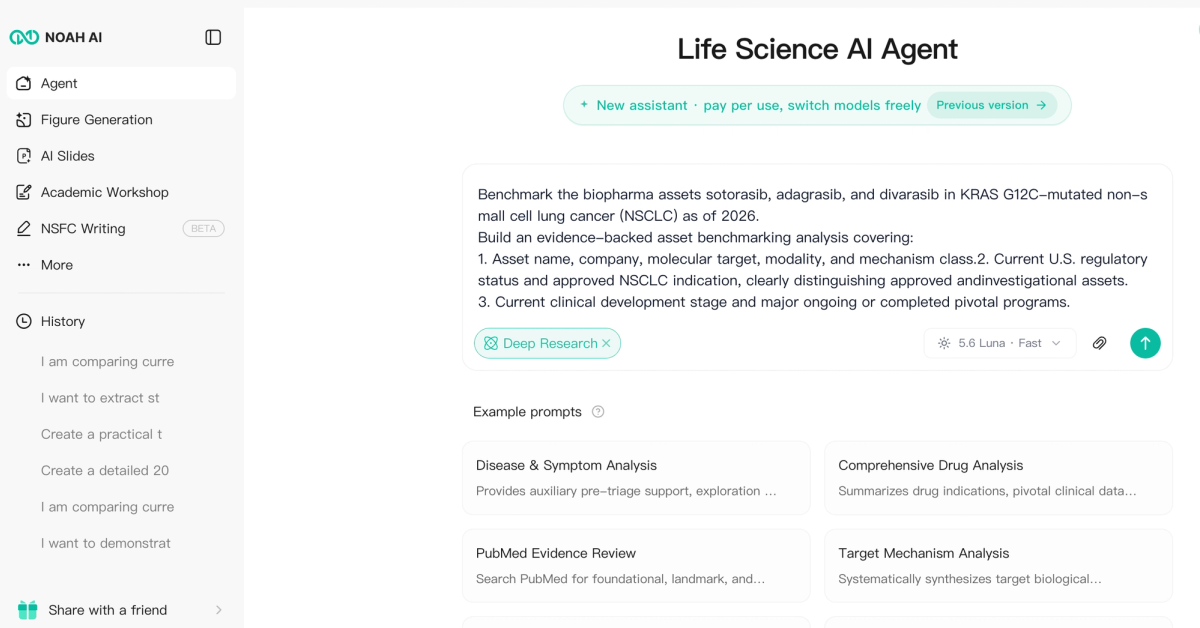
A biopharma asset benchmarking question entered into Noah AI for sotorasib, adagrasib, and divarasib in KRAS G12C-mutated NSCLC.
From Research Question to Structured Asset Benchmark
The Noah prompt did not simply ask which drug was better. It defined the benchmark dimensions first.
Noah was asked to separate regulatory facts, clinical trial evidence, company-reported topline information, and analyst-style interpretation. It was also instructed not to rank efficacy results from unrelated trials as though they came from a randomized head-to-head comparison.
The output organized all three assets across a consistent set of fields, including company, target, modality, regulatory status, current positioning, evidence base, head-to-head evidence, tolerability, development breadth, strategic strengths, and uncertainties.
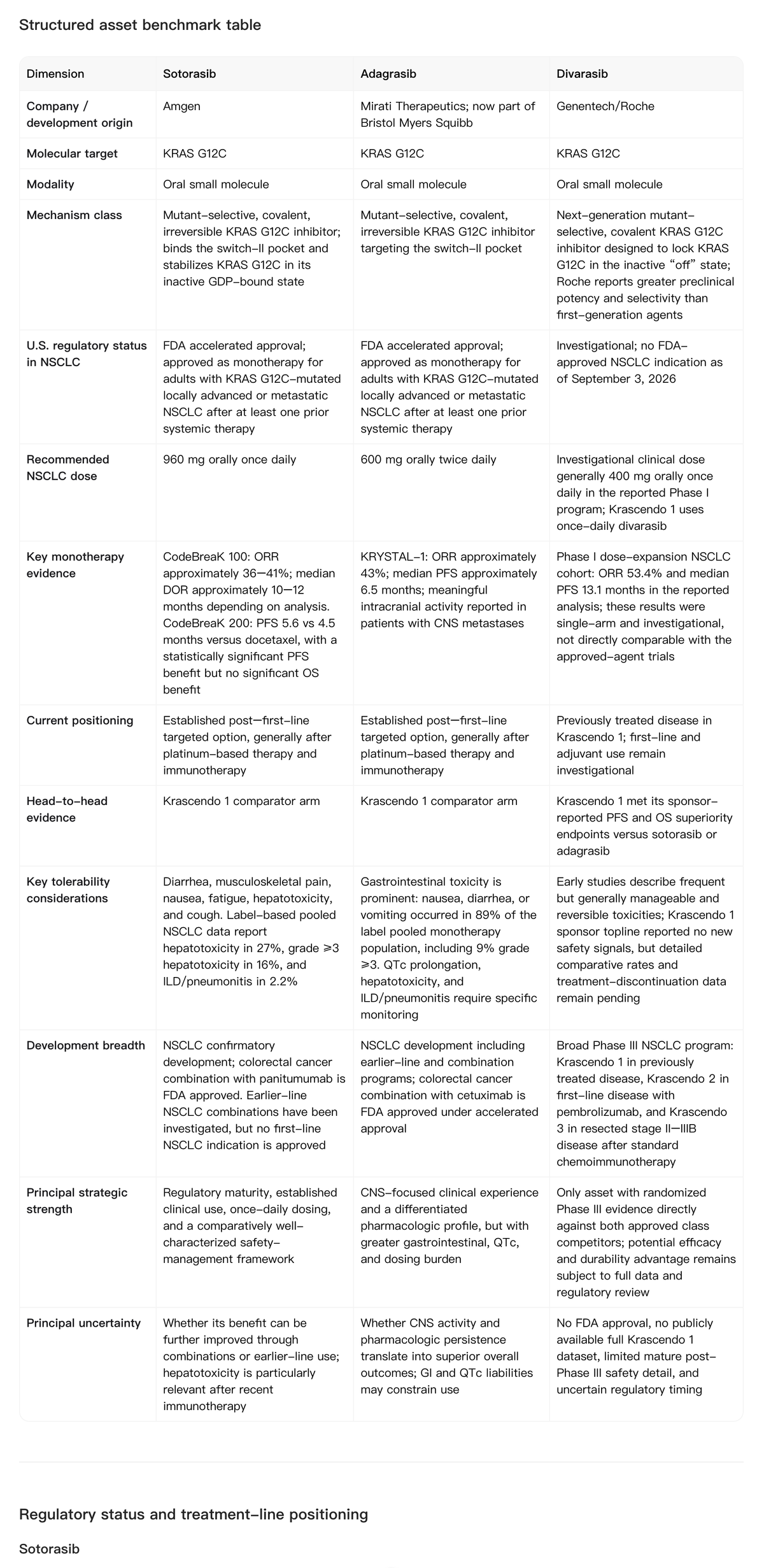
Noah AI organizes sotorasib, adagrasib, and divarasib into a structured asset benchmark covering regulatory maturity, clinical evidence, positioning, development breadth, and remaining uncertainty.
Try Noah AI for Free
Use Noah AI to search, compare, and analyze biomedical evidence with AI-powered research workflows.
Free credits are available, and no credit card is required to get started.
How to Read This Asset Benchmark
Regulatory Maturity Is Different From Clinical Promise
Sotorasib and adagrasib already have FDA-approved NSCLC indications. That gives them an established regulatory and commercial position that an investigational asset does not yet have.
Divarasib has a different evidence profile. Roche describes it as an investigational next-generation KRAS G12C inhibitor, and the FDA's orphan-drug database lists divarasib as designated for KRAS G12C-positive NSCLC but not FDA approved for that orphan indication.
This means a benchmark should not convert a positive phase III readout into an approval claim.
Direct Evidence Should Carry More Weight Than Naive Cross-Trial Ranking
Earlier single-arm studies can help describe activity, but response rates from separate trials should not automatically be used to rank assets.
Krascendo 1 is strategically important because divarasib was tested directly against sotorasib or adagrasib in previously treated KRAS G12C-mutated NSCLC.
Roche reported that the study met both PFS and OS superiority endpoints. However, as of this review, those July 2026 results are sponsor-reported topline data. Full data maturity, peer-reviewed presentation, and regulatory review remain relevant parts of the evidence picture.
Development Breadth Can Matter as Much as the Current Label
An asset benchmark should look beyond today's approved indication.
An established asset may have regulatory maturity and a known safety-management framework, while an investigational competitor may be pursuing first-line, earlier-stage, combination, or additional tumor programs that could change the competitive landscape later.
This is why pipeline breadth belongs in an asset benchmark even though pipeline activity is not the same as demonstrated clinical benefit.
Strategic Strength and Strategic Uncertainty Should Appear Together
A weak asset benchmark lists only advantages. A useful benchmark pairs each apparent strength with the question that still needs to be answered.
| Asset | Evidence Signal to Watch | Main Uncertainty |
|---|---|---|
| Sotorasib | Established FDA-approved NSCLC use, once-daily dosing, and substantial clinical experience | How future combinations or earlier-line development improve differentiation in an increasingly competitive KRAS landscape |
| Adagrasib | Established NSCLC approval and clinically relevant CNS experience | Whether its pharmacologic and CNS profile translates into durable differentiation while managing dosing and tolerability burden |
| Divarasib | Positive randomized phase III head-to-head topline evidence in Krascendo 1 | Full dataset, regulatory outcome, long-term safety detail, and eventual commercial positioning remain unresolved |
Why Noah AI Fits a Research-First Asset Benchmarking Workflow
The Noah workflow in this example starts with the research question rather than with a prebuilt asset database.
That matters when a life science team needs to answer a question such as:
How do these three KRAS G12C assets differ in regulatory maturity, clinical evidence, competitive positioning, and development breadth?
Noah's Search and Agent workflow is designed to move from medical evidence retrieval into structured, cited outputs. Its current product documentation describes Agent as a multi-step research workflow that can synthesize evidence across papers, guidelines, clinical trials, patents, databases, and other trusted sources.
For asset benchmarking, that makes Noah most useful when the desired deliverable is an evidence-backed research brief rather than only a list of documents.
It is not a substitute for proprietary commercial-intelligence platforms when a team needs confidential deal terms, subscription-only market forecasts, private company intelligence, or other non-public data.
How the Other Tools Differ
Elicit: Stronger When the Core Job Is Formal Evidence Review
Elicit has evolved beyond simple literature search. Its current Research Agent supports broader scientific research and structured evidence workflows.
Elicit is especially useful when the asset-benchmarking question requires a reproducible literature set, systematic screening, consistent extraction, or a large evidence table across many studies.
That is a different strength from a research-first asset brief. If the main deliverable is a rigorous literature-review process, Elicit may be the more natural workflow.
Official documentation: Introducing Elicit Research Agent.
Consensus: Useful for Fast Scientific Evidence Orientation
Consensus is useful when the first question is scientific rather than commercial.
For example:
- What evidence supports KRAS G12C inhibition in NSCLC?
- What resistance mechanisms are reported?
- What evidence exists for intracranial activity?
- How consistent are reported safety findings across the literature?
Its Deep Review workflow breaks a research question into subquestions, searches a large academic corpus, and synthesizes the literature.
That makes it useful for scientific context, though it is less naturally structured around regulatory status, development breadth, and current competitive positioning.
Official documentation: Consensus Deep Review.
SciSpace: Useful When the Benchmark Depends on Deep Paper Reading
Some asset differences cannot be understood from trial abstracts or press releases. Important details may sit inside full papers, methods sections, appendices, subgroup analyses, or supplementary safety tables.
SciSpace is useful when the main bottleneck is reading and interrogating those scientific documents.
In an asset benchmark, this can help verify patient selection, endpoint definitions, subgroup results, adverse-event details, and other paper-level evidence before those findings are added to the broader comparison.
Official documentation: How to Conduct a Literature Review Using SciSpace.
ChatGPT Deep Research: Useful for Broad Multi-Source Asset Questions
Asset benchmarking often requires information that does not live entirely in scientific literature.
FDA pages, company announcements, trial registries, uploaded internal materials, websites, and publications may all contribute to the final picture.
ChatGPT Deep Research is useful when the researcher wants to control those sources and receive a documented report spanning several information types.
Official documentation: Deep research in ChatGPT.
Perplexity Research: Useful for Current Signal Discovery
Perplexity Research is particularly useful early in an asset-benchmarking workflow when the team needs to identify recent events and relevant public sources quickly.
That could include new trial readouts, regulatory announcements, company updates, or newly published research.
It can be a useful orientation layer before the evidence is normalized into a more rigorous asset benchmark.
Official documentation: Perplexity Research.
A Practical Asset Benchmarking Workflow
1. Define the decision question. Are you evaluating current competitors, licensing candidates, development threats, or future market entrants?
2. Choose a common asset framework. Define the fields before searching so every asset is evaluated against the same questions.
3. Separate current status from future potential. Approved indications, completed trials, ongoing programs, and investigational hypotheses should not be treated as equivalent.
4. Prioritize direct comparative evidence. Head-to-head randomized evidence generally provides a stronger basis for differentiation than naive comparisons between unrelated single-arm studies.
5. Add development breadth. Review earlier-line, combination, additional tumor, and earlier-stage programs that could change future positioning.
6. Write the uncertainty next to the strength. Every apparent advantage should be paired with the evidence gap that could change the interpretation.
What Researchers Still Need to Verify
AI-generated asset benchmarks should be treated as research drafts, not final diligence conclusions.
Before using a benchmark for a formal decision, verify:
- the current FDA or other regulatory status,
- the latest prescribing information,
- trial phase and status,
- patient population and line of therapy,
- whether efficacy data are randomized or single-arm,
- whether results are peer-reviewed, conference-reported, or company topline only,
- follow-up maturity,
- safety denominators and exposure duration,
- the date of the evidence used in the benchmark.
Commercial conclusions may also require information that public research tools cannot provide, including deal economics, proprietary forecasts, internal probability assumptions, confidential competitive intelligence, and manufacturing or access constraints.
Frequently Asked Questions
What is biopharma asset benchmarking?
Biopharma asset benchmarking compares drug candidates or approved therapies across common dimensions such as target, modality, regulatory status, clinical evidence, treatment positioning, safety, development stage, and pipeline breadth.
Can AI benchmark competing drug assets?
Yes. AI can help retrieve evidence, align information across common fields, identify differences, and generate structured comparison tables. Important claims should still be verified against original regulatory, clinical, and company sources.
Should efficacy results from separate trials be ranked directly?
Usually not without qualification. Different populations, study designs, follow-up periods, endpoints, and assessment methods can make cross-trial numerical ranking misleading.
Why include development breadth in an asset benchmark?
Current regulatory status explains where an asset is today. Development breadth helps show where it may compete in the future, including new lines of therapy, combinations, tumor types, or disease stages.
Why separate company topline data from peer-reviewed evidence?
Topline results can be important and timely, but they may not contain the same level of methodological and subgroup detail as a full publication or regulatory review. The source type should remain visible.
Is divarasib FDA approved for KRAS G12C NSCLC?
As of September 3, 2026, divarasib remains investigational in the United States. Roche has reported positive phase III Krascendo 1 topline results and plans to submit the data to health authorities, but positive phase III results are not the same as regulatory approval.
Final Takeaway
A useful biopharma asset benchmark does more than place drug names and efficacy numbers in adjacent columns.
It explains the type and maturity of evidence behind each asset, distinguishes current regulatory position from future development potential, and keeps uncertainty visible alongside apparent differentiation.
Noah AI is a strong fit when the research begins with a specific biomedical or competitive question and needs to become a structured, cited asset brief. Elicit is better aligned with formal evidence-review workflows, Consensus with rapid academic synthesis, SciSpace with paper-centered research, and general deep-research tools with broader multi-source investigation.
Benchmark the evidence supporting the asset, not just the asset itself.
Related Research Guides
- How Noah AI Helps Life Science Teams Track Drug Pipelines, Clinical Trials, and Market Signals
- How to Build a Disease Landscape Report: A Complete Guide
- How to Analyze Clinical Trial Results with AI Using Noah AI
- Best AI Tools for Turning Research Questions into Evidence Tables (2026)
- Best Elicit Alternatives for Biomedical Literature Review (2026)