Best AI Tools for Biomedical Hypothesis Generation (2026)
Linda
Compare the best AI tools for biomedical hypothesis generation in 2026 and learn how to turn literature evidence into testable, falsifiable research hypotheses.
Compare AI tools for turning biomedical evidence patterns into mechanistic, testable, and falsifiable hypotheses—with a real Noah AI case on the IL-23/IL-17 paradox in axial spondyloarthritis.
Biomedical hypothesis generation is not the same as asking AI to brainstorm scientific ideas.
A useful hypothesis must explain an observation, remain consistent with the strongest available evidence, survive comparison with competing explanations, generate measurable predictions, and be capable of being disproved.
That makes hypothesis generation a more demanding task than simply identifying a research gap.
Observation → Evidence pattern → Competing explanations → Working hypothesis → Prediction → Falsification → Experiment
Testing note: We tested Noah AI directly. Other tools are described based on their documented workflows and typical research use cases.
What Is Biomedical Hypothesis Generation?
A biomedical hypothesis is a proposed explanation for an observed biological, clinical, or translational pattern.
A good hypothesis should do more than sound biologically plausible. It should make a specific claim about how the system works and produce predictions that can be tested.
For example:
Weak: IL-23 and IL-17 may have different roles in axial spondyloarthritis.
Stronger: IL-23 may be more important during disease initiation or early tissue conditioning, whereas established axial inflammation may be maintained by IL-23-independent IL-17-producing resident cells and downstream inflammatory circuits.
The second statement is more useful because it leads to measurable predictions about disease stage, tissue cells, cytokine dependence, and treatment response.
Hypothesis Generation vs Research Idea Generation
| Workflow | Main question | Typical output |
|---|---|---|
| Research gap identification | What important question remains unresolved? | Evidence gap |
| Research idea generation | What direction is worth studying? | Research direction |
| Hypothesis generation | What mechanism could explain the observation? | Testable mechanistic hypothesis |
| Feasibility assessment | Can the question realistically be studied? | Proceed, refine, or reconsider |
| Research plan | How should the hypothesis be tested? | Study plan |
What Makes a Good Biomedical Hypothesis?
- Evidence-grounded — It emerges from observations already present in the literature.
- Mechanistic — It proposes a biological explanation rather than restating the observation.
- Specific — The population, cells, pathway, state, or context should be identifiable.
- Testable — It should generate measurable predictions.
- Falsifiable — A possible experimental result should be able to weaken or reject it.
- Alternative-aware — Competing explanations should remain visible until evidence separates them.
Best AI Tools for Biomedical Hypothesis Generation
Different tools are useful at different points in the hypothesis-generation workflow. A literature discovery tool and a mechanistic synthesis workflow are not necessarily solving the same problem.
| Tool | Best use in hypothesis generation | Useful output |
|---|---|---|
| Noah AI | Multi-step biomedical evidence synthesis, competing-mechanism analysis, testable predictions, falsification criteria, and experiment planning. | Biomedical hypothesis blueprint |
| Elicit | Building a structured literature base around a proposed mechanism and checking what evidence already exists. | Evidence landscape and structured extraction |
| Consensus | Rapidly checking focused biomedical claims against a broad academic literature corpus. | Literature-grounded claim synthesis |
| Scite | Stress-testing influential findings by examining supporting, contrasting, and mentioning citation contexts. | Citation-context validation |
| ResearchRabbit | Discovering connected mechanistic literature through citation networks and adjacent research clusters. | Citation-network exploration |
Real Case: The IL-23/IL-17 Paradox in Axial Spondyloarthritis
To demonstrate the workflow, we used a biological and clinical paradox in axial spondyloarthritis.
IL-17 is an established therapeutic pathway in axial spondyloarthritis, yet inhibition of the upstream cytokine IL-23 has not shown comparable efficacy in established axial disease.
In the randomized Phase 2 risankizumab study in ankylosing spondylitis, the trial did not meet its ASAS40 primary endpoint and did not demonstrate clinically meaningful improvement over placebo.
At the same time, human enthesis research has identified tissue-resident immune-cell populations capable of producing IL-17A under conditions that do not require detectable IL-23 receptor expression.
This creates a useful mechanistic question:
Why can blocking IL-17 improve established axial disease when blocking IL-23 does not show comparable efficacy?
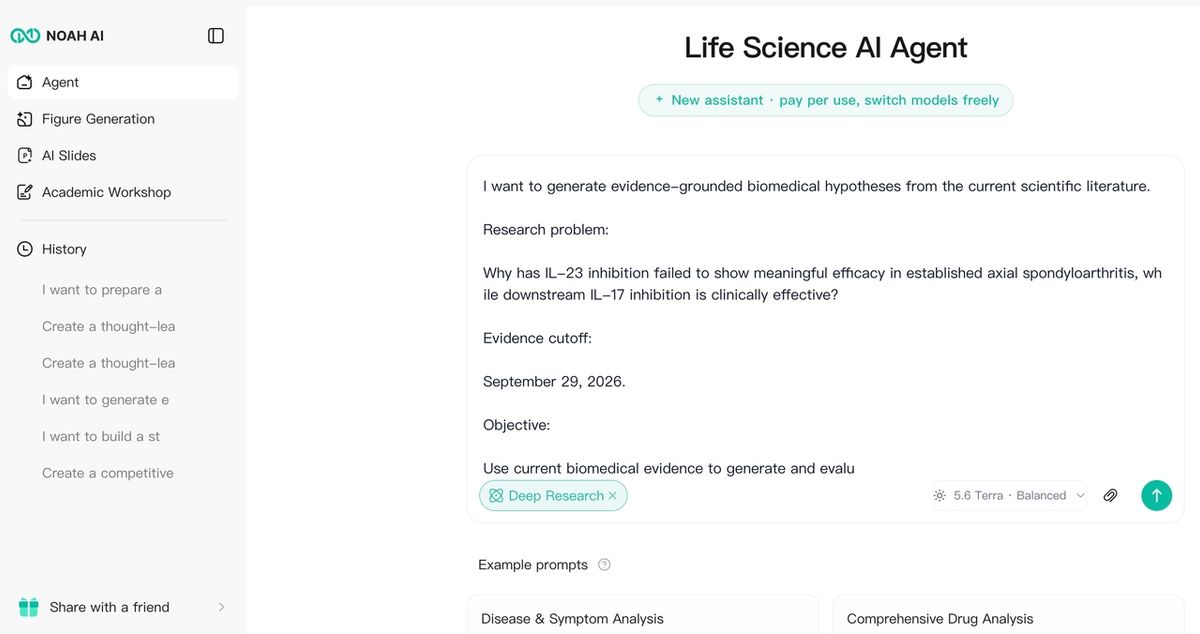
We ran this case in Noah AI using Medical & Academia, Deep Research, and 5.6 Terra · Balanced.
Step 1 — Start with the Observation, Not the Explanation
A common hypothesis-generation mistake is deciding on the mechanism before mapping the evidence.
The first stage should contain only the observations that need explanation.
| Observation | What it supports | What it does not prove |
|---|---|---|
| IL-23 blockade has not shown meaningful efficacy in established axial disease. | Continuous IL-23 signaling may not be sufficient as a dominant therapeutic dependency in established disease. | IL-23 has no role at any stage of disease. |
| IL-17 pathway inhibition is clinically active. | IL-17A/F-associated inflammatory biology remains therapeutically relevant. | All IL-17 in lesions is generated through the same upstream pathway. |
| Some human entheseal cells can produce IL-17 without detectable IL-23R expression. | An IL-23-independent route to IL-17 production is biologically plausible. | Those cells are proven drivers of active human axial disease. |
Keeping observation separate from explanation prevents the AI workflow from turning an interesting association directly into a causal mechanism.
Step 2 — Build a Multi-Layer Evidence Map
Biomedical hypotheses are stronger when they integrate evidence from several levels rather than relying on one paper.
For this case, the evidence map should cover:
- randomized clinical intervention evidence;
- human entheseal tissue biology;
- genetic evidence;
- cytokine and receptor biology;
- animal disease-stage experiments;
- stromal and myeloid signaling;
- cellular sources of IL-17A and IL-17F;
- differences between axial enthesis, skin, gut, and peripheral joints.
The goal is not to force all these evidence streams to agree. Differences between them may be exactly what produces the useful hypothesis.
Step 3 — Identify the Mechanistic Tension
A simple linear pathway model might be written as:
IL-23 → IL-17 → axial inflammation
If established disease depended strictly on this single pathway, sufficiently effective IL-23 blockade would be expected to reduce the downstream inflammatory program and produce clinical benefit.
The clinical evidence does not fit that simple model well.
That mismatch creates the hypothesis-generating opportunity.
Step 4 — Generate Multiple Competing Hypotheses
One of the most important safeguards in AI-assisted hypothesis generation is to require multiple plausible explanations.
In the Noah analysis, five competing hypotheses were retained:
- Temporal decoupling: IL-23 matters more during initiation than maintenance.
- Tissue-resident downstream bypass: resident cells sustain IL-17A/F through IL-23-independent signals.
- Network redundancy and inflammatory lock-in: multiple downstream cytokine and stromal circuits maintain established disease.
- Tissue-compartment divergence: axial enthesis has different pathway dependence from skin, gut, or peripheral synovium.
- Patient-state heterogeneity: a subset of patients may remain more IL-23 dependent than the average trial population.
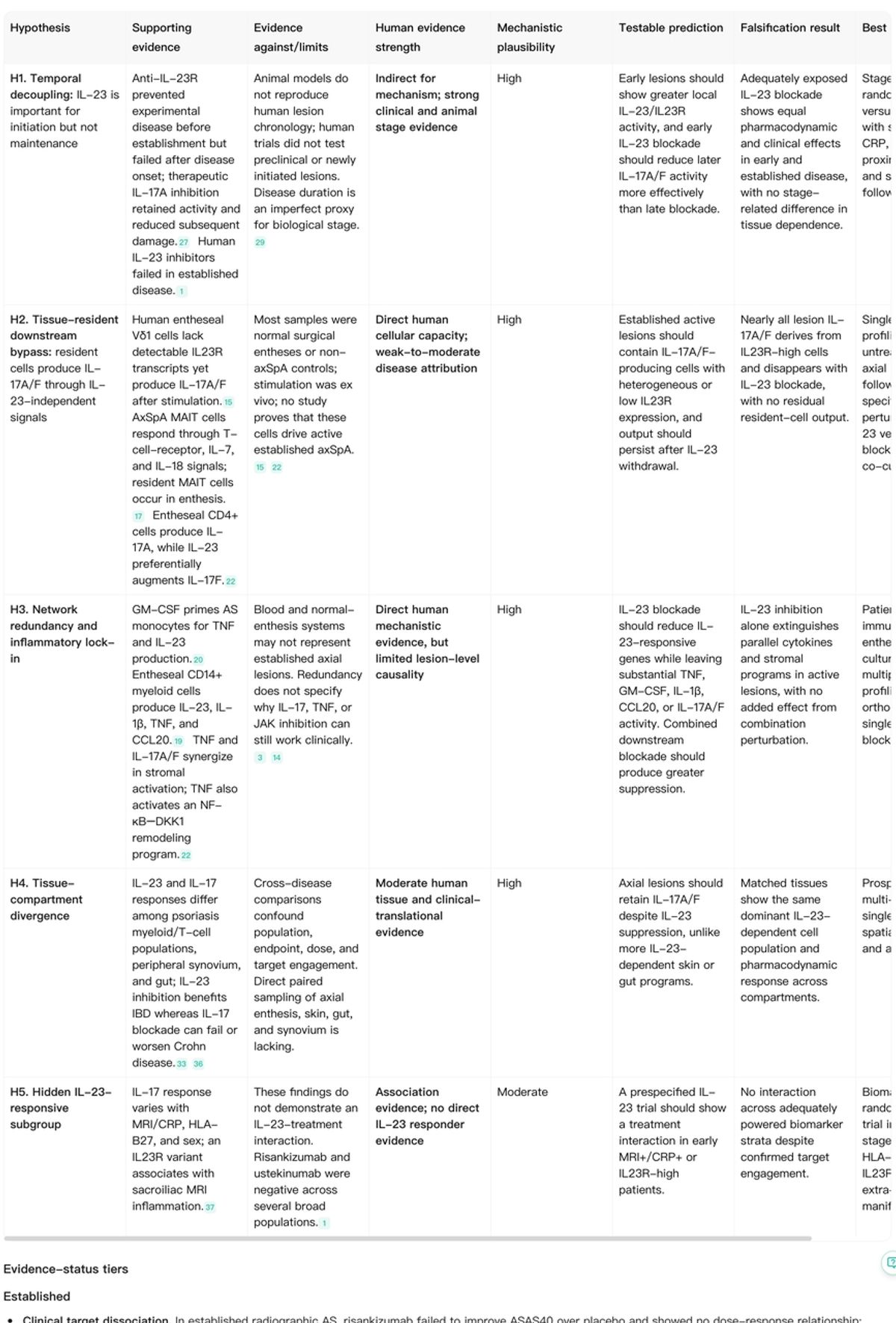
This matrix is more useful than a list of creative mechanisms because each candidate explanation must survive the same questions:
- What supports it?
- What argues against it?
- How direct is the human evidence?
- What should be observed if it is true?
- What result would make it substantially less credible?
Competing Hypotheses and Falsification Criteria
The IL-23/IL-17 paradox should not be reduced to one preferred mechanism. Each competing explanation must generate a measurable prediction and identify an experimental result that would substantially weaken it.
| Competing Hypothesis | Testable Prediction | What Would Weaken or Falsify It? |
|---|---|---|
| 1. Temporal decoupling | Early axial disease shows greater IL-23 dependence than established disease. | Stage-stratified experiments show comparable IL-23 dependence in early and established lesions, with no meaningful temporal difference. |
| 2. Tissue-resident downstream bypass | Established axial lesions contain IL-17-producing resident cells that remain active despite verified IL-23 inhibition. | Adequate IL-23 blockade consistently suppresses the relevant IL-17-producing populations, leaving no evidence of an independent maintenance pathway. |
| 3. Network redundancy and inflammatory lock-in | Multiple downstream cytokine or stromal circuits sustain inflammation when upstream IL-23 signaling is inhibited. | Controlled perturbation experiments show that the proposed alternative circuits do not contribute to residual inflammatory activity after IL-23 blockade. |
| 4. Tissue-compartment divergence | Axial enthesis and peripheral tissues differ in their dependence on IL-23 and downstream IL-17 signaling. | Matched tissue experiments find no meaningful compartment-specific differences under comparable disease states and validated target engagement. |
| 5. Patient-state heterogeneity | A defined patient subgroup retains greater IL-23 dependence despite weak average responses in established axial disease. | Adequately powered, biomarker-stratified analyses fail to identify reproducible differences in IL-23 dependence or treatment response across the proposed subgroups. |
These are proposed discriminating tests, not completed experimental findings.
A result that weakens one hypothesis does not automatically prove another. Before interpreting negative results, researchers must verify target engagement, assay sensitivity, disease stage, tissue context, and experimental power.
Key principle: Hypothesis generation becomes scientifically useful when researchers can specify not only what should happen if a mechanism is correct, but also what observation would make that mechanism less credible.
Step 5 — Separate Human Evidence from Mechanistic Inference
Mechanistic hypothesis generation often combines evidence of very different maturity.
A randomized human trial can establish that an intervention did or did not produce a clinical effect in a defined setting. It does not automatically reveal why.
A human tissue study may demonstrate that a cell population has the capacity to produce a cytokine. It does not automatically prove that the same population drives clinical disease.
An animal model can provide stronger perturbational evidence about mechanism, but species differences, disease induction, anatomical context, and treatment timing may limit translation.
The workflow should therefore label findings as:
Established — Directly supported in the relevant context.
Supported but incomplete — Multiple findings point in the same direction but do not establish the full mechanism.
Hypothetical — A plausible explanation that still requires direct testing.
Step 6 — Select a Working Hypothesis Without Calling It Proven
After comparing the alternatives, the Noah workflow synthesized the evidence into a working model:
IL-23 may be more important for initiation or early tissue conditioning than for maintenance of established axial disease, in which resident IL-17-capable cells and downstream inflammatory or stromal circuits can bypass continuous IL-23 signaling.
This is not equivalent to saying that IL-23 is irrelevant.
The same analysis retained contradictory evidence, including IL-23-responsive cell populations and evidence of strong IL-23 dependence in some experimental systems.
The working hypothesis is therefore a framework for testing the evidence—not a final causal conclusion.
Step 7 — Turn the Hypothesis into a Prediction
A mechanistic hypothesis becomes scientifically useful when it predicts what should be observed.
Under the working model, one prediction is:
Active established axial lesions should contain IL-17A/F-producing resident populations that remain active despite suppression of IL-23 signaling, while earlier disease states should show greater local IL-23 or IL-23R dependence.
This is more informative than the general statement that "IL-23-independent IL-17 may exist," because it specifies:
- which disease stage should differ;
- which tissue should be examined;
- which cytokine program should remain;
- what should happen after IL-23 perturbation.
Step 8 — Define What Would Falsify the Hypothesis
AI-generated hypotheses often fail here.
If every possible result can be reinterpreted as supporting the hypothesis, it is not sufficiently falsifiable.
For this case, a strong falsification condition would be:
In adequately exposed, pharmacodynamically verified studies, lesion IL-17A/F production is confined to IL-23R-high cells, disappears after IL-23 blockade, and shows no meaningful difference between early and established disease.
Such a result would directly weaken the proposed temporal-decoupling and downstream-bypass model.
Step 9 — Define the Critical Experiment
The next step is not automatically a large clinical trial.
The first experiment should directly discriminate between the competing biological explanations.
For this case, the analysis proposed a staged approach involving:
- longitudinal, stage-stratified human axial-lesion profiling;
- single-cell and spatial analysis of cytokine-producing populations;
- IL-23R and IL-17A/F measurement;
- ex vivo perturbation of IL-23, IL-17A/F, TNF, GM-CSF, and IL-1-related signaling;
- only then, if justified, prospective biomarker-stratified clinical evaluation.
This matters because a good experiment should test the mechanism itself rather than simply repeat the original clinical observation.
Step 10 — Build a Final Biomedical Hypothesis Blueprint
A final hypothesis output should preserve the complete reasoning chain in one place.
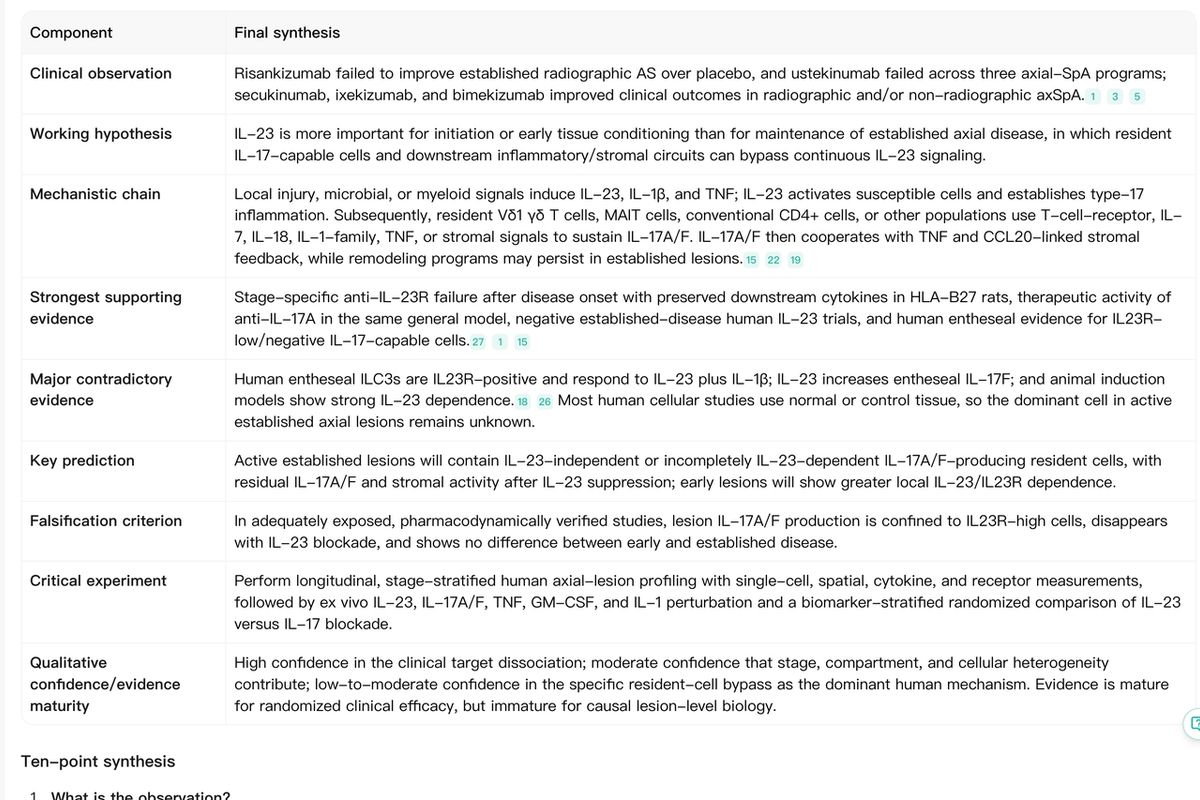
The value of this format is that it prevents the final hypothesis from becoming detached from the evidence that produced it.
| Component | Case interpretation |
|---|---|
| Clinical observation | IL-23 blockade failed to show comparable efficacy while IL-17 blockade is active in established axial disease. |
| Working hypothesis | Disease maintenance becomes partly uncoupled from continuous IL-23 signaling. |
| Major uncertainty | The dominant human lesion-level IL-17-producing populations remain incompletely established. |
| Key prediction | Established lesions retain IL-17A/F-producing cells and downstream activity despite IL-23 suppression. |
| Falsification criterion | Adequate IL-23 blockade eliminates the relevant lesion IL-17 program without evidence of an independent downstream source. |
| Critical experiment | Stage-stratified human lesion profiling combined with pathway perturbation. |
Generate Evidence-Grounded Biomedical Hypotheses with Noah AI
Use Noah AI to compare biomedical evidence, evaluate competing mechanisms, generate testable predictions, define falsification criteria, and turn a literature pattern into a structured hypothesis workflow.
Noah AI can be used for free, includes free credits, and requires no credit card.
When to Use Each Tool
Noah AI: From Evidence Pattern to Testable Hypothesis
Noah AI is useful when hypothesis generation requires several linked research steps rather than a single literature query.
In the workflow shown above, Noah was used to map clinical, human-tissue, translational, and mechanistic evidence; compare alternative explanations; distinguish direct evidence from inference; generate predictions; define falsification conditions; and propose the experiment most likely to separate the competing models.
Learn more about Noah AI's research workflow: Explore Noah AI Human-in-the-Loop →
Elicit: Build the Evidence Base Around a Mechanism
Elicit is useful when researchers need to identify, screen, extract, and synthesize literature surrounding one proposed mechanism.
This is particularly valuable after a candidate hypothesis has been generated and the next task is to determine which parts are already supported directly and which depend on extrapolation.
Consensus: Check Focused Scientific Claims
Consensus is useful for rapid academic search around a focused question.
For hypothesis generation, it can help test intermediate claims such as whether a particular immune population has been associated with a pathway, phenotype, treatment response, or disease compartment.
Scite: Stress-Test Foundational Findings
A hypothesis can become fragile when it depends heavily on one influential paper.
Scite's citation-context workflow is useful for checking whether later publications support, contrast with, or simply mention that finding.
This does not establish whether the mechanism is true, but it can reveal whether a key premise has already been challenged.
ResearchRabbit: Discover Adjacent Mechanistic Literature
ResearchRabbit is useful when the relevant papers are spread across different terminology or research communities.
Citation-network exploration can surface upstream mechanistic work, downstream clinical papers, and adjacent evidence streams that may not appear together in a keyword search.
A Practical AI Workflow for Biomedical Hypothesis Generation
| Stage | Question | Output |
|---|---|---|
| 1 | What observation needs explaining? | Defined biological or clinical paradox |
| 2 | What evidence streams are relevant? | Evidence map |
| 3 | Where does the simple model fail? | Mechanistic tension |
| 4 | What competing explanations could account for it? | Candidate hypotheses |
| 5 | Which explanation best integrates the evidence? | Working hypothesis |
| 6 | What should be observed if it is true? | Predictions |
| 7 | What result would make it wrong? | Falsification criteria |
| 8 | Which experiment best separates competing explanations? | Critical experiment |
Common Mistakes When Using AI for Biomedical Hypothesis Generation
- Turning correlation directly into mechanism — If two variables are associated, the relationship may reflect causation, reverse causation, confounding, mediation, selection, or measurement effects. AI should expose those alternatives rather than select the most biologically attractive story.
- Generating only one hypothesis — A single explanation encourages confirmation bias. Competing hypotheses make it easier to identify the experiment that genuinely discriminates between mechanisms.
- Treating animal evidence as human proof — Animal perturbation experiments can be extremely informative, but disease induction, tissue context, timing, dose, and species biology may differ from human disease.
- Ignoring contradictory evidence — Contradictory findings may reveal disease-stage effects, biological heterogeneity, assay differences, alternative pathways, or flaws in the working model.
- Writing a hypothesis without a prediction — "Pathway X may contribute to disease" is often too vague. A stronger hypothesis states what measurable result should occur if the proposed mechanism is correct.
- Creating a hypothesis that cannot fail — If every result can be explained after the fact, the statement functions more like a narrative than a scientific hypothesis.
- Treating a treatment-response difference as proof of mechanism — Drug efficacy can reveal biological dependencies, but differences in exposure, pharmacology, target engagement, disease stage, patient selection, and network redundancy may also contribute.
- Calling a mechanism novel without checking the literature — Novel wording is not scientific novelty. The closest existing mechanistic studies should be identified before making a novelty claim.
- Jumping directly from hypothesis to a full proposal — Before designing a large study, determine which smaller experiment most directly tests the mechanistic assumption.
Where Human Scientific Review Is Still Essential
AI can accelerate evidence organization and make possible mechanistic connections easier to inspect, but it should not determine by itself that a causal biological mechanism is established.
Researchers still need to judge:
- whether the biological model is coherent;
- whether the evidence streams are genuinely comparable;
- whether a negative study represents biological failure or inadequate target engagement;
- whether the proposed measurement actually captures the mechanism;
- whether the experiment can distinguish the main competing explanations;
- whether key primary-source findings have been verified.
Frequently Asked Questions
Can AI generate biomedical hypotheses?
AI can help identify evidence patterns, contradictions, mechanistic connections, and testable explanations. The resulting hypotheses still require source verification, scientific review, and experimental testing.
What is the difference between a hypothesis and a research question?
A research question asks what should be investigated. A hypothesis proposes an explanation or expected relationship that can be tested.
Does a biomedical hypothesis need a mechanism?
Not every scientific hypothesis must specify a complete molecular mechanism, but mechanistic biomedical hypotheses should identify a plausible causal chain or biological dependency that produces measurable predictions.
Why generate competing hypotheses?
Competing hypotheses reduce confirmation bias and help researchers design experiments that distinguish between alternative explanations rather than simply collect more supportive evidence.
What makes a hypothesis falsifiable?
A falsifiable hypothesis identifies a realistic result that would substantially weaken or reject the proposed explanation.
Can AI determine which hypothesis is correct?
Literature synthesis can show which explanation is currently better supported, but experimental or clinical evidence is still required to determine whether the underlying mechanism is correct.
What should happen after hypothesis generation?
The next step is usually to identify the most discriminating experiment, assess whether the required samples and measurements are feasible, and then convert the hypothesis into a structured research plan.
Related Research Guides
- Best AI Tools for Biomedical Research Question Feasibility Assessment (2026)
- Best AI Tools for Biomedical Research Proposal Development (2026)
- How to Use AI for Literature Review in Biomedical Research (2026)
- Best AI Tools for Medical Literature Review and Evidence Synthesis (2026)
Final Takeaway
The most useful role for AI in biomedical hypothesis generation is not to produce the largest number of possible mechanisms.
It is to make the reasoning chain inspectable:
Observation → Evidence → Competing explanations → Working hypothesis → Prediction → Falsification → Experiment
In the axial spondyloarthritis case, the clinical difference between IL-23 and IL-17 blockade creates the starting observation. Human tissue data, intervention trials, translational biology, and disease-stage evidence then support several possible explanations rather than one proven mechanism.
The most defensible working hypothesis is that IL-23 may contribute more strongly to disease initiation or early tissue conditioning, while established axial inflammation can become partly maintained through IL-23-independent IL-17-capable resident cells and downstream inflammatory circuits.
The value of the hypothesis is not that it sounds plausible. Its value is that it generates predictions, identifies evidence that could contradict it, and points toward an experiment capable of proving the model wrong.
A useful biomedical hypothesis is not just plausible. It must explain the evidence, make predictions, and be capable of being wrong.
Generate Testable Biomedical Hypotheses with Noah AI
Use Noah AI to generate testable hypotheses with predictions, competing explanations, and falsification tests.
Connect biomedical evidence, compare plausible biological mechanisms, identify contradictory findings, and build a source-linked hypothesis framework that makes uncertainty and the next discriminating experiment explicit.
Move from a literature observation to a reviewable scientific hypothesis—without treating mechanistic plausibility as proof of causation.
Free to use · Free credits included · No credit card required