BCMA Target Intelligence 2026: Approved Therapies, Late-Stage Pipeline and Competitive Questions
Linda
A 2026 BCMA target intelligence brief covering approved therapies, late-stage challengers, treatment-line differences, clinical evidence, safety, sequencing, and competitive questions in multiple myeloma.
Investigating a drug target means connecting its biology to assets, indications, clinical stages, competitors, and unresolved evidence. Using BCMA in multiple myeloma as a worked example, this tutorial shows how to build a bounded competitive pipeline view without treating stage as a proxy for superiority.
Updated September 2026 · Evidence cutoff: September 10, 2026
This example maps approved reference therapies and representative late-stage BCMA programs in multiple myeloma. It establishes the competitor set for deeper review without ranking clinical performance.
Sample output · Target intelligence brief
BCMA Competitive Pipeline Brief
Executive finding
BCMA in multiple myeloma is primarily a differentiation question for an established target, not a simple entry question. Approved CAR-T, bispecific and ADC therapies now compete across different treatment lines, while labels, populations, endpoints, follow-up and prior-BCMA exposure remain non-equivalent.
Target and scope
BCMA / TNFRSF17 · Multiple myeloma focus. The selected set includes publicly documented approved BCMA-directed products plus representative non-approved late-stage challengers through September 10, 2026.
Comparison objective
Define the approved and late-stage competitor set first, then normalize treatment line, modality, prior BCMA exposure, comparator, efficacy, safety, durability, sequencing and treatment burden before deeper comparison.
Established Competition
Representative Approved Reference Assets
The following two products are representative approved BCMA reference assets, not an exhaustive list of approved BCMA-directed therapies. Ciltacabtagene autoleucel (Carvykti) and teclistamab (Tecvayli) illustrate different BCMA modalities and treatment pathways. Carvykti is an autologous CAR-T with individualized manufacturing and specialized monitoring, while Tecvayli is an off-the-shelf, subcutaneous BCMA×CD3 T-cell engager used in repeat-dose treatment settings. Their labels and evidence cannot be interpreted as directly interchangeable.
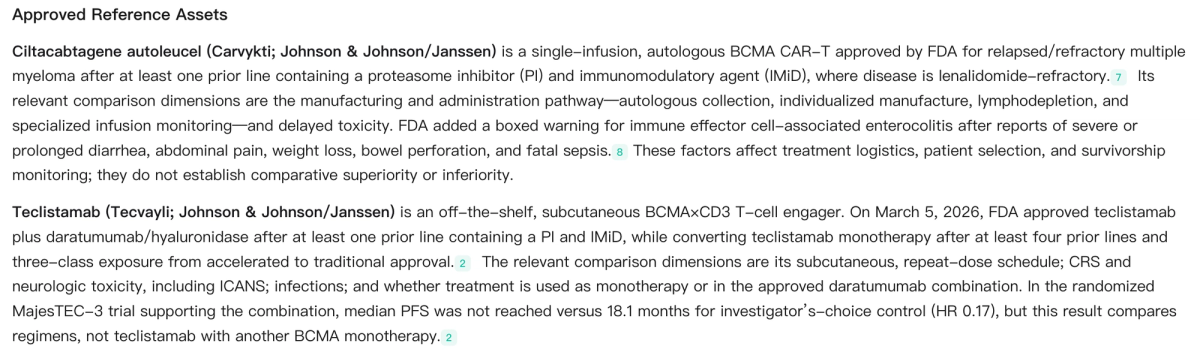
Also in the approved set: idecabtagene vicleucel (Abecma), elranatamab (Elrexfio), linvoseltamab (Lynozyfic), belantamab mafodotin (Blenrep), and jurisdiction-specific BCMA CAR-T approvals such as equecabtagene autoleucel and zevorcabtagene autoleucel. These labels differ by treatment line, combination requirements, regulatory pathway, prior-therapy population and safety obligations.
Near-Term Competition
Representative Late-Stage Challengers
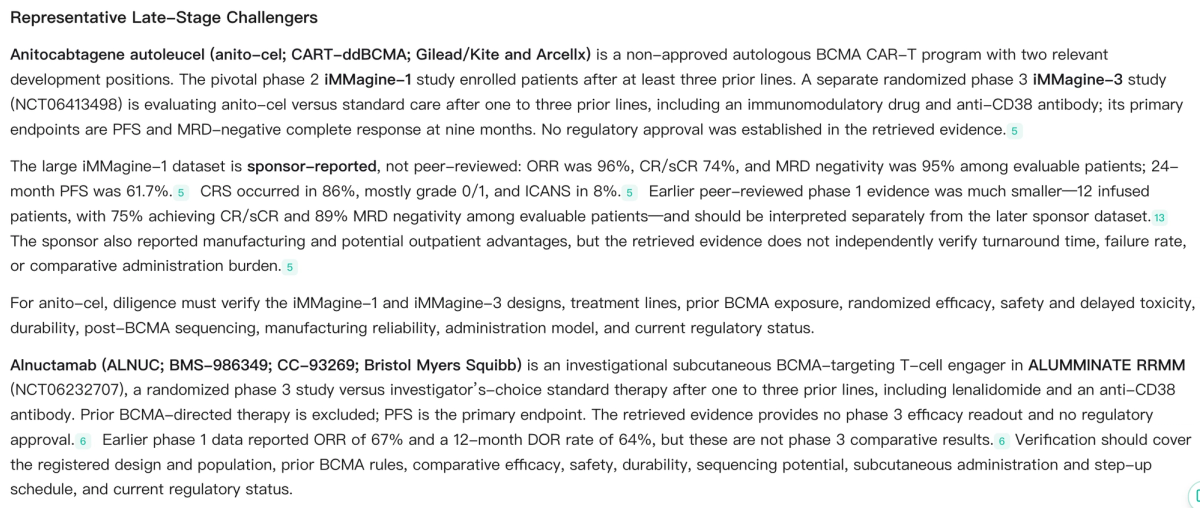
Anitocabtagene autoleucel (anito-cel) and alnuctamab illustrate why late-stage mapping should separate current development position from established comparative performance. Anito-cel has pivotal and randomized development across different prior-line settings, while alnuctamab is being evaluated in randomized Phase III development after one to three prior lines. Neither stage alone establishes competitive advantage.
Build a Bounded Target-Intelligence Brief with Noah AI
Build a bounded target-intelligence brief with approved benchmarks and late-stage challengers. Use Noah AI to map competing assets, clinical development stages, regulatory status, supporting evidence, and unresolved competitive questions without inferring superiority from trial stage alone.
Free to use · Free credits included · No credit card required
Build Your Target-Intelligence Brief →
Comparison Agenda
Normalize comparisons by indication and treatment line, prior BCMA exposure, geography, and current regulatory status before interpreting outcomes. Separate randomized from single-arm evidence. Compare comparator, ORR, CR/sCR, MRD, PFS, OS maturity, durability, CRS, ICANS, cytopenias, infections and ocular toxicity where relevant. Add manufacturing burden and monitoring for CAR-T, dosing frequency and route for repeat-dose therapies, sequencing after prior BCMA treatment, and whether evidence is regulatory, peer-reviewed, trial-registry or sponsor-reported.
Supports
Defining the approved and late-stage BCMA competitor set for deeper review and identifying which evidence streams need normalization.
Does not prove
Best-in-class efficacy, safety superiority, preferred sequencing, commercial leadership, or manufacturing advantage.
What Target Intelligence Should Help a Team Decide
A useful target-intelligence brief connects BCMA/TNFRSF17 biology → BCMA-directed assets → modality → developer → indication and treatment line → clinical evidence → remaining competitive questions. Target association defines the asset universe; it does not identify a winner. The deeper questions are comparative efficacy, durability, safety, sequencing after prior BCMA therapy, administration burden and operational differentiation.
Why a Pipeline Count Is Not a Competitive Conclusion
A pipeline count measures activity, not advantage. Development stage indicates maturity, not superiority. A Phase III asset may still be investigational, while approved products may have materially different labels, treatment lines, comparators and safety obligations. Cross-trial comparisons can also mislead when populations, prior therapy, follow-up and study design differ.
Before naming a leader, normalize asset identity, current status, treatment line, comparator, response depth, PFS and OS maturity, toxicity, sequencing and treatment burden. A target-linked record is a starting point for research, not evidence of comparative clinical benefit.
How Noah Builds Target Intelligence
Noah can define the target and disease scope, identify representative assets across modalities, map development stages, trace pivotal and supporting clinical evidence, distinguish regulatory evidence from sponsor-reported evidence, and surface missing efficacy, safety, sequencing or status information for deeper review.
This specific brief establishes the competitor set and the questions that should be normalized next. It does not make a best-in-class judgment.
For more information about Noah's research workflow, see Noah AI research workflows.
Prepare and Run
Before running a target-intelligence analysis, define the exact target, disease or indication, decision to support, geography, asset types, development stages, companies of interest and evidence cutoff. For BCMA, treatment line and prior BCMA exposure are especially important because they materially change the populations being compared.
Research Prompt
Identify [target] in [disease] through [evidence cutoff]. Map approved reference assets and representative late-stage competitors by modality, developer, stage, label and geography. For each asset, report trial design, treatment line, prior target exposure, efficacy, safety, durability, administration and manufacturing burden, sequencing evidence, and regulatory status. Separate regulatory, peer-reviewed, trial-registry, and sponsor-reported evidence. Do not rank products or infer superiority from approval, stage, or cross-trial results. Identify evidence gaps and specify the next comparisons needed for decision-making.
How to Use the Result
Use the stage map to define the competitor set, not to select a winner. Review next:
- Comparable clinical endpoints, including response, MRD, PFS, OS and durability.
- Adverse events, treatment burden, prior therapy, biomarkers, resistance and sequencing.
- Current regulatory geography and the status of ongoing pivotal studies.
The next step is direct head-to-head evidence where available, or a carefully normalized comparison where it is not.
Build a Competitive Map for Your Target
Use Noah AI to define the competitor set, trace supporting evidence, and identify the next questions that matter. Noah can be used for free, includes free credits, and requires no credit card to get started.
Frequently Asked Questions
Does the most advanced drug become the most competitive?
No. Development stage indicates maturity, not competitive performance. It does not normalize the treated population, comparator, efficacy endpoint, follow-up, safety profile, treatment burden, manufacturing, or administration requirements.
Why separate approved and late-stage assets?
Approval establishes regulatory availability and label context. Late-stage assets remain investigational and may be studied in different populations, treatment lines and comparator settings. They should not be treated as equivalent evidence categories.
Does a target-linked drug record prove clinical efficacy?
No. A target-linked record identifies an asset and mechanism. Clinical efficacy requires appropriate trial evidence, and early-phase or single-arm results should not be upgraded into comparative proof.
Can stage alone establish best-in-class performance?
No. A defensible comparison requires compatible evidence on efficacy, safety, durability, sequencing, treatment burden and regulatory context. Approval status or a later stage does not resolve those dimensions.
Related Research Guides
- How Noah AI Helps Life Science Teams Track Drug Pipelines, Clinical Trials, and Market Signals
- Best AI Tools for Clinical Trial Results Analysis (2026)
- Best AI Tools for Turning Research Questions into Evidence Tables (2026)
Try Noah AI for Free
Search, compare, and analyze biomedical evidence with Noah AI. Free credits are available, and no credit card is required.