How to Analyze Clinical Trial Results with AI Using Noah AI
Linda
Learn how Noah AI helps life science and biopharma teams search, review, and analyze clinical trial results using structured filters, trial detail views, and AI-powered summaries.
Clinical trial results are one of the most important evidence sources in biopharma decision-making. Teams use trial data to evaluate drug efficacy, understand safety findings, compare competitors, prepare medical briefings, and support clinical or commercial strategy. But analyzing clinical trial results is rarely simple. Data may be scattered across trial registries, publications, press releases, labels, conference updates, and internal databases.The challenge is not only finding a trial. Teams also need to understand trial design, patient population, endpoints, enrollment, phase, current status, efficacy outcomes, safety results, and the clinical meaning of the data. When multiple trials are involved, the work becomes even more complex.Noah AI helps life science teams move from clinical trial result search to structured analysis. With the Clinical Results database, users can filter trial records by drug, target, indication, company, phase, and other attributes. They can inspect individual trial details and then use AI-powered analysis to summarize selected records, compare endpoints, identify safety signals, and generate research-ready insights.
Why Clinical Trial Results Are Hard to Analyze
Clinical trial result analysis is difficult because every trial needs to be interpreted in context. A phase III trial in first-line metastatic disease is not directly comparable to an adjuvant trial, a biomarker-selected study, or an early-stage safety study.Teams often need to answer questions such as:
- What population was studied?
- What was the treatment setting?
- Which comparator was used?
- What were the primary and secondary endpoints?
- Were the efficacy outcomes clinically meaningful?
- What safety findings should be reviewed?
- How does this trial compare with other studies in the same drug class or indication?
Without a structured workflow, teams may spend hours moving between databases, publications, and spreadsheets before they can form a clear view of the evidence.
What Is Noah AI Clinical Results?
Noah AI Clinical Results is a structured database workflow designed to help users search and review clinical trial result data. Instead of relying on a single keyword search box, users can filter results by structured fields such as drug, target, indication, company, phase, route of administration, and other clinical trial attributes.For example, a user analyzing immuno-oncology trial data can search for pembrolizumab and PD-1 to identify relevant clinical trial result records. This allows users to begin with a focused clinical question and quickly narrow the dataset to records that matter for drug evaluation or competitive intelligence.
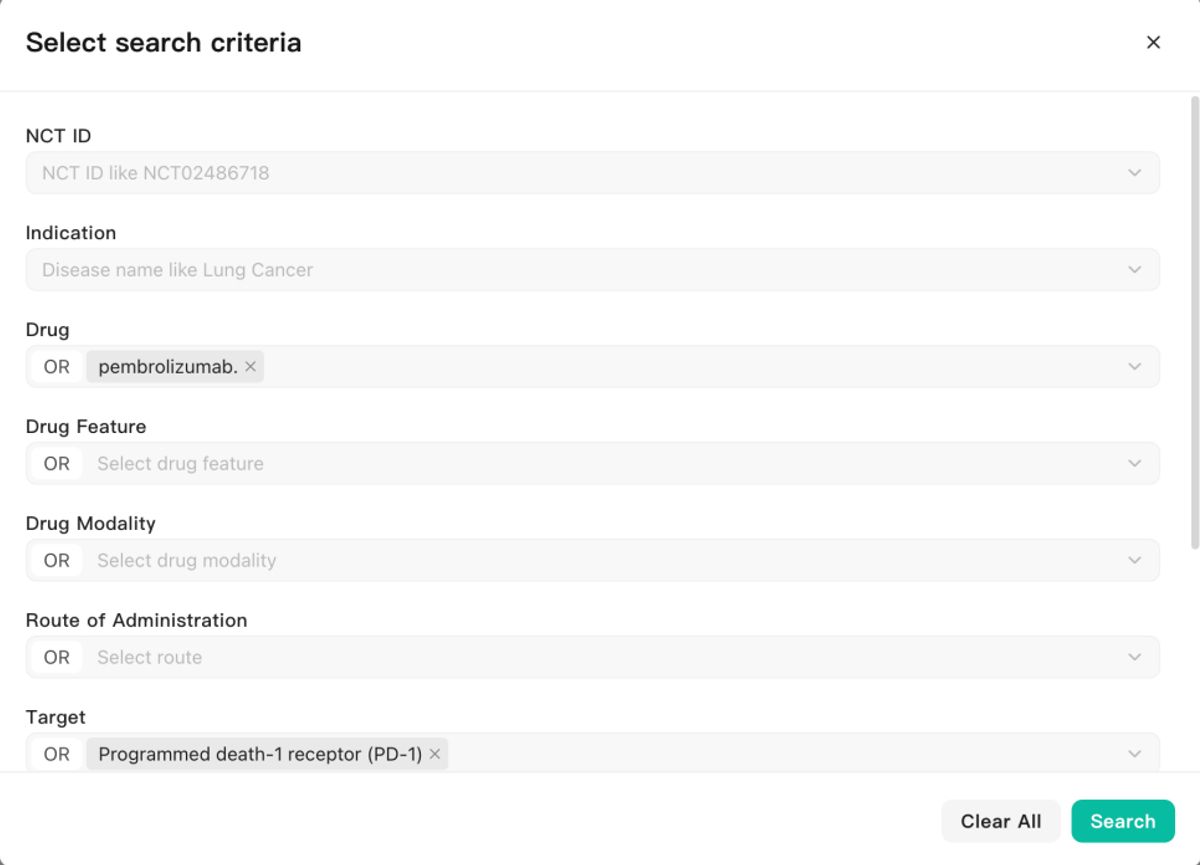
Figure 1. Noah AI Clinical Results supports structured filtering by drug, target, indication, company, phase, and other clinical trial attributes.
Step 1: Search Clinical Trial Results by Drug, Target, or Indication
The first step is to identify relevant trial records. In Noah AI Clinical Results, users can search by drug name, target, disease area, company, phase, or other criteria. This is useful when teams need to investigate a specific asset, drug class, tumor type, therapeutic area, or competitor program.In the example below, the search uses pembrolizumab and PD-1 as structured criteria. Noah AI returns a set of related clinical trial result records, including phase III studies across different tumor types and treatment settings. Users can scan trial titles, sponsors, phases, and result status before deciding which records to inspect more closely.
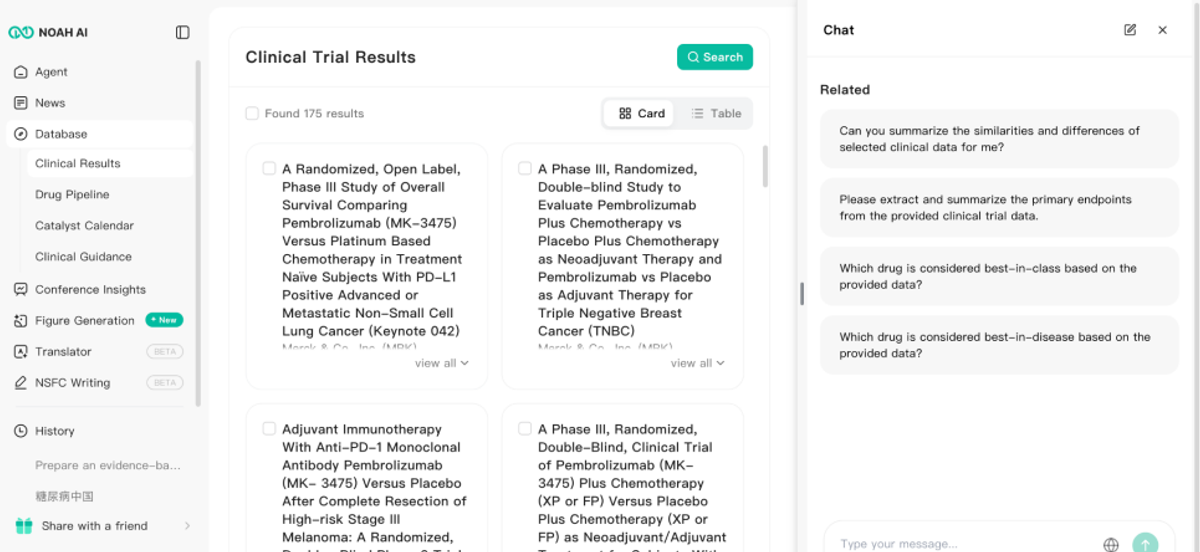
Figure 2. Noah AI returns structured clinical trial result records, allowing users to scan trial titles, sponsors, indications, phases, and result status in one view.
Step 2: Review Structured Clinical Result Data
After finding relevant records, users can inspect individual trial details. This step is important because a trial title alone is not enough for analysis. Teams need to review structured fields such as NCT ID, current status, phase, drug name, indication, enrollment, study design, treatment arms, and safety or efficacy information.For example, in the KEYNOTE-042 record, Noah AI surfaces key trial metadata and study design information, including NCT ID, final data status, phase III designation, Keytruda as the drug name, non-small cell lung cancer as the indication, and enrollment size. The page also summarizes study design and safety information, allowing users to review the clinical context before making any interpretation.
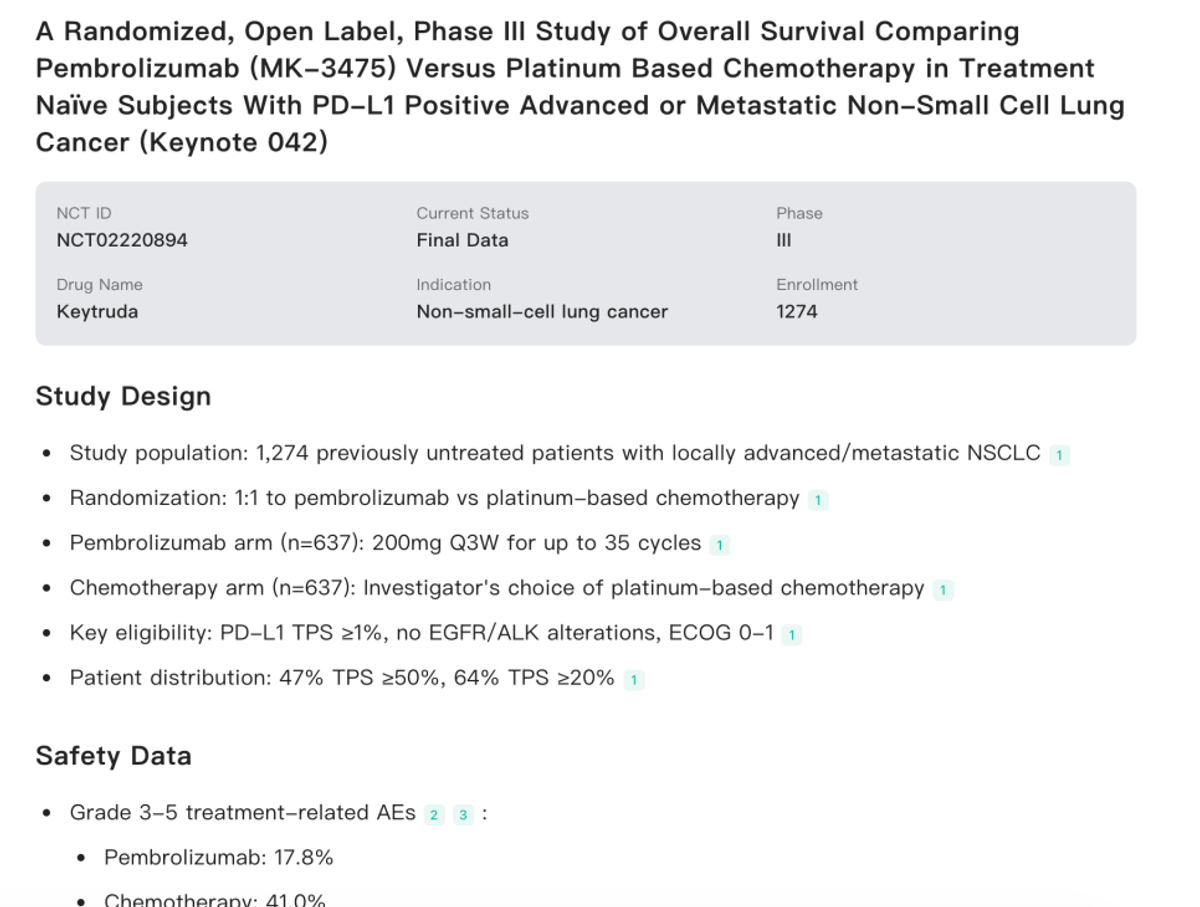
igure 3. Noah AI provides a structured trial detail view with key fields such as NCT ID, phase, indication, enrollment, study design, and safety data.
Step 3: Turn Trial Data into AI-Powered Research Insight
The value of clinical trial data increases when teams can compare records and interpret differences. Noah AI supports this step by allowing users to select clinical trial records and ask follow-up questions in the AI chat panel.For example, users can ask Noah AI to compare selected clinical trial results and summarize trial design, primary endpoints, efficacy outcomes, safety findings, and implications for drug evaluation. This helps transform trial records into a comparative summary that can support drug assessment, competitive intelligence, or internal discussion.
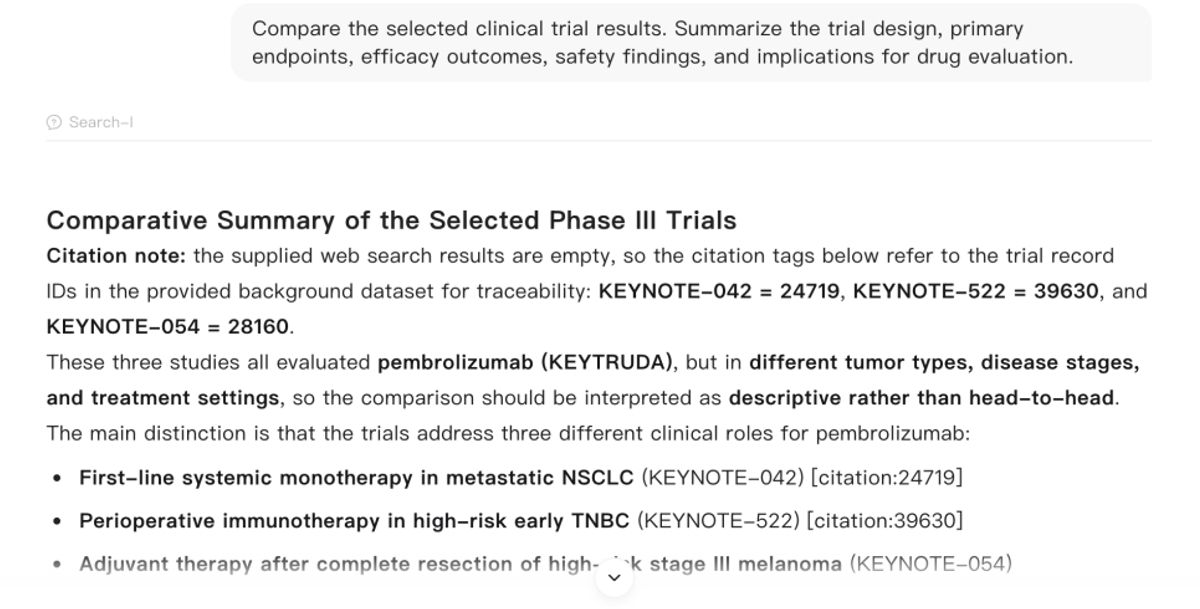
Figure 4. Noah AI compares selected clinical trial results and summarizes differences in trial design, endpoints, efficacy outcomes, safety findings, and clinical implications.
Common Clinical Trial Analysis Tasks
| Analysis Task | What Teams Need to Know | How Noah AI Can Help |
|---|---|---|
| Trial design review | Phase, population, intervention, comparator, treatment setting | Organize trial design elements into a structured view |
| Efficacy analysis | Primary endpoints, secondary endpoints, survival outcomes, response measures | Summarize key efficacy signals and compare across selected trials |
| Safety review | Adverse events, serious adverse events, discontinuation, tolerability | Highlight safety findings and potential risk areas |
| Competitor comparison | How one drug compares with other assets or treatment settings | Compare trial records across drugs, indications, or sponsors |
| Indication analysis | Which disease areas and patient populations are being studied | Map results by indication, phase, and treatment setting |
| Medical briefing | Key messages for internal or field medical discussion | Generate briefing-ready summaries from structured clinical data |
| BD and strategy review | Whether clinical results support investment, licensing, or pipeline decisions | Connect trial outcomes with development and competitive context |
Use Cases for Life Science and Biopharma Teams
Drug Evaluation
Clinical teams and business development teams can use Noah AI to review trial design, endpoints, efficacy signals, and safety findings for a specific drug. This helps teams form an initial evidence view before deeper expert review.
Competitive Intelligence
Teams can compare clinical trial records across competing drugs, targets, indications, or companies. This is useful for understanding how a product is positioned relative to others in the same therapeutic area.
Medical Affairs Briefing
Medical Affairs and MSL teams can use clinical result analysis to prepare internal briefing materials, KOL discussion preparation, disease area updates, or field medical education.
Clinical Strategy
Clinical development teams can review past trial designs, endpoints, populations, and result patterns to support future study planning or trial benchmarking.
Market and Commercial Insight
Market research and strategy teams can use clinical trial result analysis to understand where evidence is strongest, where gaps remain, and which products may have meaningful differentiation.
Why AI Helps Clinical Trial Result Analysis
AI is useful in this workflow because clinical result analysis involves both structured data and interpretation. A database can help users find records, but teams still need to compare them, summarize differences, and translate findings into decision-ready insights.Noah AI helps connect these steps. Users can start with structured search, inspect trial records, select relevant data, and then ask AI to summarize endpoints, efficacy results, safety findings, or strategic implications.This does not replace expert review. Instead, it helps teams reduce manual work and create a more organized starting point for clinical, medical, or business analysis.
When Should Teams Use Noah AI Clinical Results?
Noah AI Clinical Results is especially useful when teams need to:
- Search trial results by drug, target, indication, company, or phase
- Review structured trial metadata
- Compare multiple clinical trial records
- Summarize endpoints and outcome patterns
- Support drug evaluation or competitive intelligence
- Prepare Medical Affairs or MSL briefing materials
- Generate research-ready summaries from trial data
- Move from clinical result records to AI-powered interpretation
It is less suitable for situations where users need final regulatory conclusions or clinical decision recommendations without expert review. Clinical trial result interpretation should always be reviewed by qualified professionals before formal use.
Final Takeaway
Clinical trial results are central to drug evaluation, competitive intelligence, medical strategy, and biopharma decision-making. But trial data is only useful when teams can find, structure, compare, and interpret it.Noah AI helps users move from clinical trial result search to structured analysis. With Clinical Results, users can filter by drug, target, indication, company, and phase, inspect individual trial details, and use AI to compare selected records. For life science and biopharma teams, this can shorten the path from raw trial data to research-ready insight.Ready to analyze clinical trial results with AI? Try Noah AI.
FAQ
What is clinical trial results AI?
Clinical trial results AI refers to AI tools that help users search, summarize, compare, and interpret clinical trial result data. These tools can support drug evaluation, competitive intelligence, medical briefing, and clinical strategy workflows.
How does Noah AI help analyze clinical trial results?
Noah AI helps users search clinical trial result records using structured filters, review trial details, and generate AI-powered summaries of selected trial data, including trial design, endpoints, efficacy outcomes, safety findings, and implications.
Can Noah AI compare multiple clinical trials?
Yes. Users can select clinical trial records and ask Noah AI to compare them. Noah AI can help summarize similarities and differences in study design, patient population, endpoints, outcomes, and potential clinical implications.
Who can use Noah AI Clinical Results?
Noah AI Clinical Results can be useful for biopharma research teams, Medical Affairs, MSL teams, BD teams, competitive intelligence teams, clinical strategy teams, and pharma market research teams.
Can Noah AI replace clinical or regulatory expert review?
No. Noah AI can help organize and summarize clinical trial result data, but outputs should be reviewed by qualified clinical, medical, regulatory, or scientific experts before being used in formal decision-making.
Research and Compliance Disclaimer
This article is for research workflow education only. AI-generated clinical trial summaries should not be used as clinical, regulatory, investment, or medical decision-making advice without review by qualified professionals.Users should verify trial records, endpoints, data sources, safety findings, and interpretation before using any output in formal reports, external communications, or strategic decisions.