
Best AI Tools for Clinical Trial Results Analysis (2026)
Linda
Compare the best AI tools for clinical trial results analysis in 2026, with a real Noah AI case covering trial search, comparison, and review-ready output.
Clinical trial results analysis is not one task. A researcher may need to find registered trials, locate result publications, extract endpoint data from PDFs, compare selected studies, or turn the evidence into a report. The best AI tool depends on which of those steps is slowing the work down—and what the final output must look like.For this guide, the target deliverable is a review-ready cross-trial comparison brief. It should align trial design, population, treatment arms, primary endpoints, efficacy outcomes, safety findings, limitations, and source identifiers across the studies being compared. A fluent summary without those distinctions is not enough.We used a real Noah AI case to evaluate that final-product question. The test compares three phase 3 pembrolizumab trials—KEYNOTE-042, KEYNOTE-522, and KEYNOTE-054—across different cancer settings. Competitor positioning is based on current public product information rather than pretending that every platform was run through the same deep hands-on benchmark.
Quick Answer
Noah AI is the strongest fit here when the work starts with structured clinical trial records and needs to end in a selected-trial comparison that preserves design, endpoint, efficacy, safety, and source context. Elicit is a stronger fit for systematic-review-led search, screening, and extraction. SciSpace is useful when the evidence is already collected as research PDFs. Consensus is useful for fast question-to-literature synthesis. Rayyan is built for collaborative, auditable screening and extraction. ChatGPT Deep Research is flexible for broad, source-documented report generation when the user supplies or carefully constrains the evidence base.
| Tool | Strongest role | Typical starting point | Most useful output |
|---|---|---|---|
| Noah AI | Structured clinical-results search → selected-trial analysis | Clinical research question or trial criteria | Review-ready biomedical comparison |
| Elicit | Systematic review search, screening, and extraction | Review protocol or focused evidence question | Extraction table and review report |
| SciSpace | PDF-level extraction and comparison | Existing papers or trial publications | Structured extraction from PDFs |
| Consensus | Fast medical literature search and synthesis | Natural-language research question | Evidence-backed literature synthesis |
| Rayyan | Collaborative screening and human-verified extraction | Imported review library | Auditable review dataset and reports |
| ChatGPT Deep Research | Broad research and report generation | Web, files, or prepared data | Documented narrative report |
What Counts as Clinical Trial Results Analysis?
The phrase can refer to several different layers of work. Separating them prevents a tool with excellent search from being mistaken for a tool that produces an excellent comparison.
Trial and publication discovery
The first layer is finding the relevant registered trials and result publications. Search quality matters, but a registry record, journal article, conference abstract, and regulatory document may each contain different parts of the result story.
Structured extraction
The next layer is turning each source into comparable fields: NCT ID, phase, population, intervention, comparator, endpoint definition, analysis population, follow-up, effect estimate, adverse events, and limitations. This is where PDF extraction and systematic-review tools are often strongest.
Cross-trial comparison
The third layer is aligning multiple trials without flattening away important differences. Two studies may investigate the same drug but differ in disease stage, biomarker threshold, treatment setting, comparator, endpoint hierarchy, or follow-up. A useful AI output makes those differences easier to inspect before anyone interprets efficacy.
Interpretation and report generation
The final layer is a narrative or table that explains what the studies collectively show, what cannot be compared directly, where evidence conflicts, and which sources support each statement. This is the layer most likely to create a reusable deliverable—and the layer where unsupported AI prose is most dangerous.
How We Compared the Tools
We evaluated the tools by the part of the workflow they are best positioned to handle, using six criteria:
| Criterion | What we looked for |
|---|---|
| Evidence access | Can the tool reach trial records, publications, uploaded PDFs, or other relevant sources? |
| Structured trial context | Does it preserve population, design, endpoint, efficacy, and safety fields? |
| User control | Can the researcher define or select which studies should be analyzed? |
| Cross-trial synthesis | Can it organize similarities and differences across studies? |
| Source traceability | Can important claims be checked against identifiable records or publications? |
| Final-output usability | Does the result resemble a comparison brief, extraction table, or report that can be reviewed and reused? |
This is a workflow-fit comparison, not a claim that one tool wins every clinical research task. It also does not evaluate statistical programming, patient-level data analysis, survival modeling, or formal meta-analysis. Those require validated datasets, prespecified methods, and specialist statistical review.
Noah AI — Best for Structured Clinical Results to Selected-Trial Analysis
Noah is the most relevant option when a life-science user wants to search structured clinical results, inspect individual trial records, select the studies that belong in the comparison, and ask AI to analyze that bounded set.The distinction matters. Broad AI search can return trial registrations, papers, news, and sponsor pages together. Noah's Clinical Results workflow lets the user begin inside a structured database, narrow the records, and keep the analysis attached to the selected clinical data.
A real Noah AI case: three phase 3 KEYNOTE trials
The case uses three pembrolizumab studies:
- KEYNOTE-042 (NCT02220894): first-line pembrolizumab versus platinum-based chemotherapy in PD-L1-positive advanced or metastatic non-small-cell lung cancer.
- KEYNOTE-522 (NCT03036488): neoadjuvant pembrolizumab plus chemotherapy followed by adjuvant pembrolizumab in high-risk early triple-negative breast cancer.
- KEYNOTE-054 (NCT02362594): adjuvant pembrolizumab after complete resection of high-risk stage III melanoma.
These are deliberately not interchangeable studies. They test the same drug in different tumor types, disease stages, and treatment settings. That makes them a good stress test for whether an AI comparison preserves clinical context or collapses everything into a generic statement about pembrolizumab.
Step 1: define the clinical-result set with structured filters
The Noah interface shows structured criteria including NCT ID, indication, drug, drug feature, modality, route of administration, and target. In this case, the search uses pembrolizumab and the programmed death-1 receptor (PD-1) target to narrow the result set.
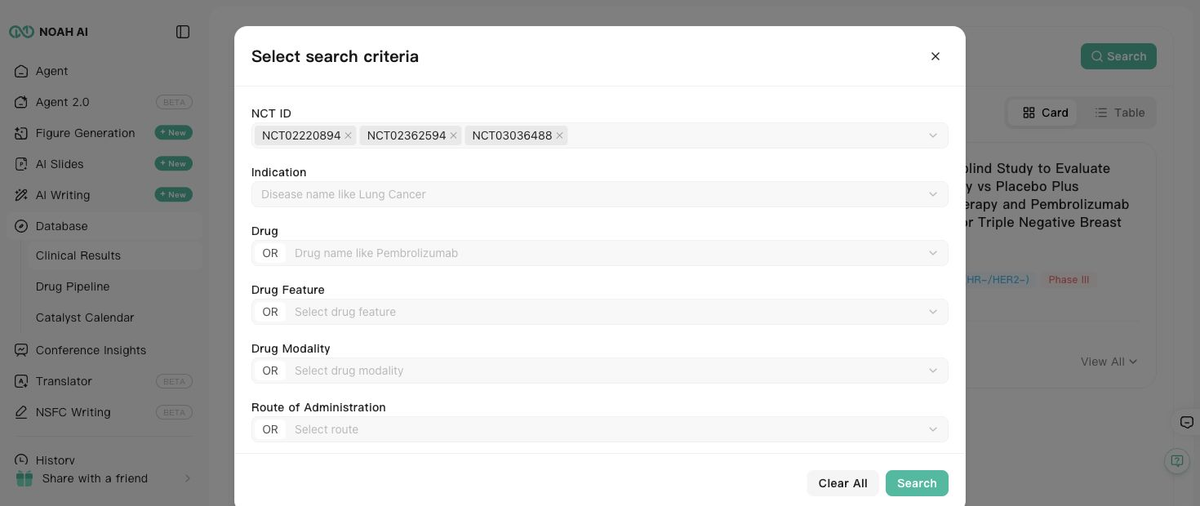
Figure 1. Noah Clinical Results uses structured filters for a bounded clinical trial search.
This screenshot does not prove that filtering alone produces good analysis. It proves something more basic but necessary: the evidence set can be defined inside a clinical-results workflow before synthesis begins.
Step 2: screen and select the records that should inform the answer
Noah returns matching Clinical Trial Results in card or table view. The user can review titles, open records, and select only the trials relevant to the comparison question.
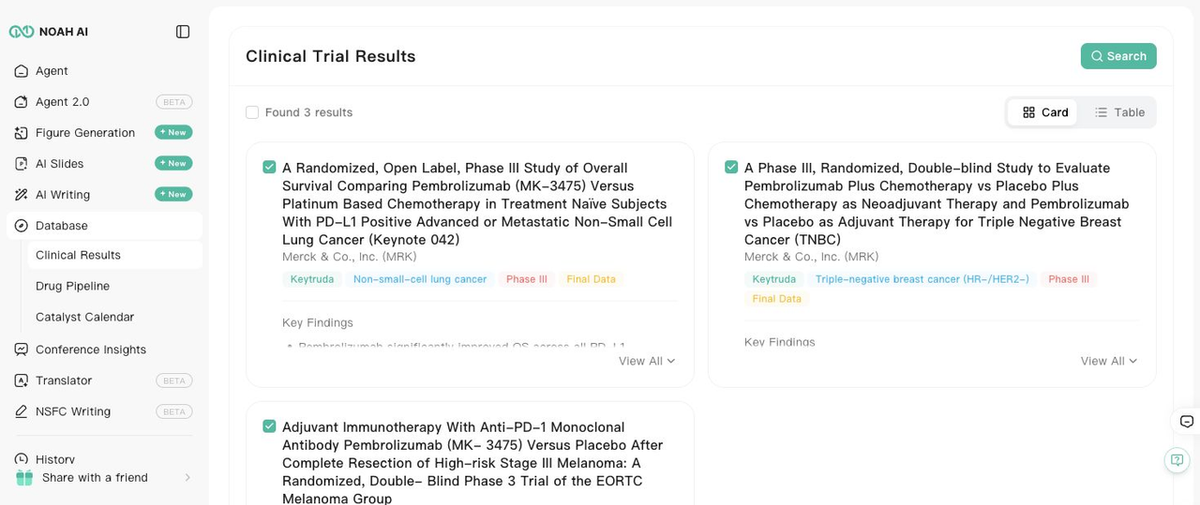
Figure 2. Matching trial records remain visible and selectable before AI analysis.
This selection step reduces a common failure mode in general AI research: the model silently deciding which trials belong in the answer. Here, the researcher defines the comparison set.
Step 3: inspect a trial before comparing it
The KEYNOTE-042 record in Noah displays the NCT ID, current status, phase, drug, indication, enrollment, study design, and available safety data. The underlying ClinicalTrials.gov record identifies the study as a randomized, open-label phase 3 trial with 1,274 participants.
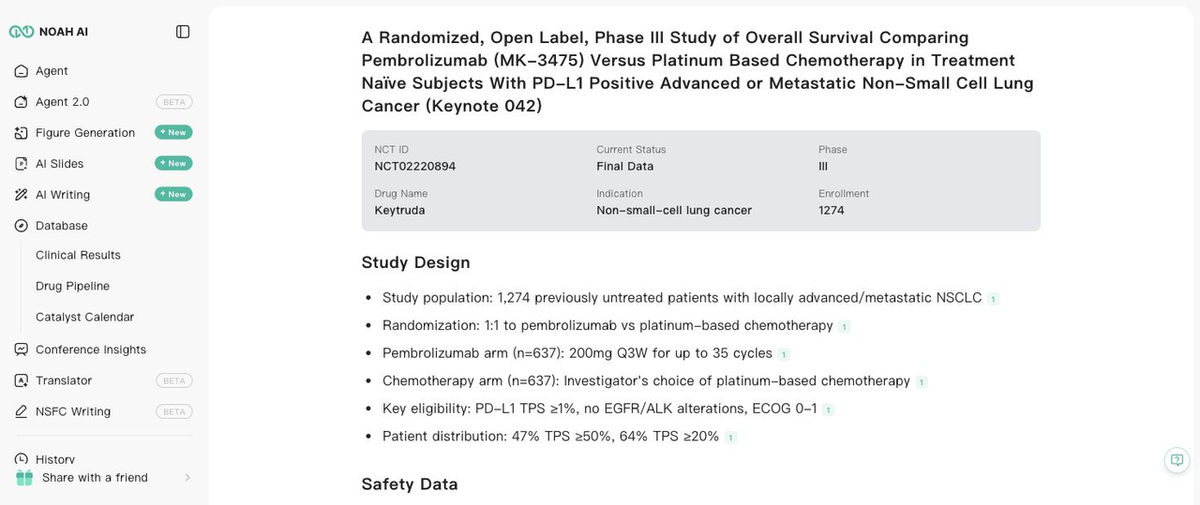
Figure 3. Record-level trial context can be reviewed before the cross-trial comparison.The practical benefit is not that every field is automatically correct forever. It is that the user can inspect the structured record, notice missing or surprising values, and verify material details against the original registry and publication before synthesis.
Final output: a comparison that preserves the clinical role of each trial
We then asked Noah:Compare the selected clinical trial results. Summarize the trial design, primary endpoints, efficacy outcomes, safety findings, and implications for drug evaluation.The visible output begins with a “Comparative Summary of the Selected Phase III Trials.” It identifies all three studies as pembrolizumab trials but immediately states that they involve different tumor types, disease stages, and treatment settings. It therefore frames the comparison as descriptive rather than head-to-head.
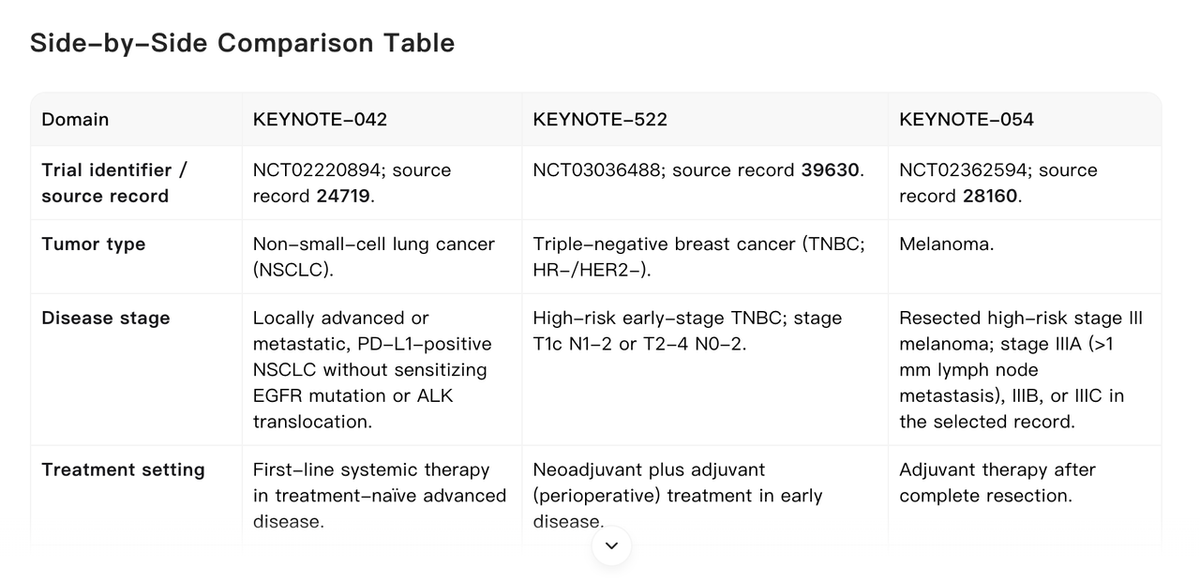
Figure 4. Noah's final output separates the clinical roles of KEYNOTE-042, KEYNOTE-522, and KEYNOTE-054 and preserves trial-record identifiers for traceability.The output then distinguishes the three clinical roles:
- first-line systemic monotherapy in metastatic NSCLC;
- perioperative immunotherapy in high-risk early TNBC; and
- adjuvant therapy after complete resection of high-risk stage III melanoma.
That distinction is the useful result. The case does not prove that Noah can declare which trial or cancer treatment is universally “best,” and it does not turn separate trials into head-to-head evidence. It proves that Noah can take a researcher-selected set of structured trial records and produce a reviewable comparison that keeps major clinical-context differences visible in the final answer.For researchers who need a broader evidence-table workflow from literature search, see AI tools for turning research questions into evidence tables. For a wider clinical-trial and pipeline monitoring use case, see drug pipeline and clinical trial signal monitoring.
Where Noah fits best
Choose Noah when the central task is biomedical and the user wants to move from structured trial discovery to selected-record analysis without manually rebuilding the trial set in a separate chat or spreadsheet.Noah is less appropriate when the actual goal is a protocol-driven systematic review, validated statistical synthesis, or patient-level analysis. Those are different deliverables.
Elicit — Best for Systematic-Review-Led Trial Search and Extraction
Elicit is a strong fit when clinical trial results analysis sits inside a formal evidence-review process. Its current public product information covers semantic search across academic papers and registered clinical trials, systematic-review stages such as screening and extraction, and report generation.Choose Elicit when the work begins with a review protocol, explicit inclusion criteria, large-scale screening, and repeated extraction across many studies. Its advantage is methodological workflow depth rather than a direct database-record-to-comparison experience.Compared with Noah, Elicit is more systematic-review-process-first. Noah is more direct when a biomedical user already knows the clinical-result question and wants to select trial records and compare them in one domain-specific workflow.
SciSpace — Best for Extracting and Comparing Trial Publications in PDFs
SciSpace is useful when the evidence has already been gathered as journal articles, supplementary files, or other research PDFs. Its public Data Extractor can identify tables, statistics, citations, and section-level findings, apply comparison parameters across papers, and export structured data.Choose SciSpace when the bottleneck is buried inside full-text documents: locating outcome definitions, extracting numeric results, comparing methods, or tracing an answer to a specific PDF section.Compared with Noah, SciSpace is more document-centered. Noah's Clinical Results workflow is more direct when the starting point is structured trial records and the final task is a selected-trial biomedical comparison.
Consensus — Best for Fast Medical Literature Search and Synthesis
Consensus is well positioned for researchers who want to ask a clinical question in natural language and rapidly understand what peer-reviewed literature says. Its Medical Mode focuses search on clinical and biomedical research, and its deeper synthesis workflows can organize evidence into structured answers.Choose Consensus when the first need is fast evidence discovery and an accessible synthesis of the medical literature. It is useful for orienting a question, identifying relevant findings, and deciding which studies deserve closer review.Compared with Noah, Consensus is literature-search-and-synthesis-first. Noah becomes more differentiated when the user wants a structured clinical-results database, record selection, and an analysis scoped to those chosen records.
Rayyan — Best for Collaborative Screening and Human-Verified Extraction
Rayyan is built around systematic and literature review workflows. Its current platform covers deduplication, title and abstract screening, full-text screening, structured data extraction, risk-of-bias work, PRISMA reporting, and auditable team decisions. AI features can assist prioritization, screening, PICO identification, and extraction while keeping human verification in the workflow.Choose Rayyan when multiple reviewers need transparent include/exclude decisions, conflict resolution, standardized extraction forms, and a defensible audit trail across a review project.Compared with Noah, Rayyan is review-operations-first. Noah is the more direct fit for a user who wants to search structured clinical results and generate a selected-trial analysis rather than manage an end-to-end collaborative systematic review.
ChatGPT Deep Research — Best for Flexible, Broad Report Generation
ChatGPT Deep Research can search the web, work with uploaded files, analyze prepared data, and produce a documented report with citations or source links. It is flexible when the source mix includes registry pages, publications, regulatory documents, spreadsheets, and internal material.Choose it when the user needs a broad research report and can carefully constrain the sources, define the extraction schema, and verify the final claims. It can also analyze structured CSV or spreadsheet exports when calculations and charts are needed.Compared with Noah, ChatGPT is general-purpose and depends more heavily on the user to assemble or constrain the clinical evidence set. Noah provides a more opinionated life-science workflow around clinical-result records and selected-trial comparison.
Which Tool Should You Choose?
Start with the final deliverable, not the feature list.
- Choose Noah AI if you want to search structured clinical results, inspect records, select trials, and generate a review-ready biomedical comparison.
- Choose Elicit if the output must emerge from a formal systematic-review workflow with screening and structured extraction.
- Choose SciSpace if you already have trial publications and need to extract or compare evidence buried in PDFs.
- Choose Consensus if you need fast medical literature discovery and an evidence-backed synthesis around a clinical question.
- Choose Rayyan if a review team needs collaborative screening, human-verified extraction, and an auditable project history.
- Choose ChatGPT Deep Research if you need a flexible report across mixed web and file sources and can define strong source controls.
Some projects will use more than one tool. For example, a systematic review team may screen in Rayyan or Elicit, inspect difficult PDFs in SciSpace, and then use a reporting tool for a stakeholder brief. The workflow is only defensible if study selection, extracted values, and source-to-claim relationships remain reviewable across those handoffs.
What AI Should Not Be Asked to Conclude From Separate Trials
Cross-trial summaries can support orientation and hypothesis generation, but they do not automatically establish comparative effectiveness. Differences in eligibility criteria, baseline risk, comparator arms, endpoint definitions, follow-up, analysis populations, treatment setting, and calendar time can all change the apparent result.Before using an AI-generated comparison for clinical development, medical affairs, regulatory, investment, or treatment decisions, verify at least:
- the current registry status and version history;
- the prespecified primary and secondary endpoints;
- the analysis population and follow-up duration;
- effect estimates, confidence intervals, and multiplicity controls;
- adverse-event definitions and exposure time;
- whether the cited source is a registry result, abstract, full publication, or secondary review; and
- whether any comparative statement is supported by a head-to-head study or an appropriate formal synthesis.
AI can reduce the work required to organize evidence. It does not remove the need for statistical, clinical, methodological, and regulatory judgment.
FAQ
Can AI analyze clinical trial results?
AI can help find trials, extract structured fields, compare selected studies, summarize efficacy and safety findings, and generate review-ready drafts. It should not replace validated statistical analysis, formal meta-analysis, or expert interpretation.
What is the best AI tool for comparing clinical trial results?
It depends on the source and deliverable. Noah AI is a strong fit for structured clinical-result records to selected-trial comparison. Elicit and Rayyan are stronger when comparison follows a systematic-review process. SciSpace is useful for PDF-centered extraction, while Consensus is useful for fast literature synthesis.
Can AI compare efficacy across separate trials?
AI can describe reported outcomes side by side, but separate trials are not automatically comparable. Unless the evidence comes from a head-to-head design or a valid indirect comparison or meta-analysis, the output should be treated as descriptive.
Is ClinicalTrials.gov an AI analysis tool?
No. ClinicalTrials.gov is an official trial registry and results database, not an AI comparison platform. It remains an important primary source for checking study records, submitted results, update history, and NCT identifiers.
Should I trust an AI-generated clinical trial report without checking the sources?
No. Verify trial identifiers, populations, endpoints, effect estimates, safety data, limitations, and citation-to-claim relationships against the original registry records and publications.
Final Takeaway
The best AI tools for clinical trial results analysis solve different parts of the evidence workflow. Search tools help find relevant research. Extraction tools turn PDFs into structured fields. Systematic-review platforms make screening and decisions auditable. General research agents can assemble broad reports.The Noah case demonstrates a narrower, conversion-relevant advantage: a user can define a structured Clinical Results set, inspect the underlying records, select the trials that belong in the analysis, and receive a comparison that preserves their different clinical roles and the boundary between descriptive and head-to-head evidence.
Turn your next clinical trial question into a structured, review-ready analysis with Noah AI.