AI PubMed Search with Citations — Best Tools in 2026
Linda
Not all AI citations are equal. We evaluate AI PubMed search tools on four citation quality dimensions: existence, granularity, accuracy, and accessibility. See how Noah AI, Consensus, Elicit, and ChatGPT compare.
Citations are the most important quality signal in AI-powered literature search. An AI tool that provides a summary without verifiable citations is difficult to use for evidence-based research because you need to be able to check whether the cited studies exist and whether they support the claims being made.
This article evaluates AI PubMed search tools specifically on citation quality. We define four dimensions of citation quality and assess how each tool performs on each dimension.
How We Evaluated
We tested Noah AI directly by running the demo query below and examining the citation output in detail. Other tools were evaluated based on their official documentation, published descriptions of citation handling, and known behavior patterns. Citation quality assessments reflect documented capabilities — actual results may vary by query.
Four Dimensions of Citation Quality
Dimension 1: Citation Existence
Does the cited paper actually exist? A useful research workflow should let you verify each cited source directly.
What to look for: Does the tool link directly to the paper on PubMed or another verifiable database? Can you click the citation and confirm the paper exists?
Dimension 2: Citation Granularity
Is the citation attached to a specific claim within the summary, or just listed at the end as a general reference?
What to look for: Are citations inline next to specific claims, and does each citation point to the paper supporting that claim?
Dimension 3: Citation-Claim Accuracy
Does the cited paper actually support the claim the AI attaches to it? A citation can exist and still be used incorrectly.
What to look for: Open the cited paper and check whether the abstract supports the population, intervention, outcome, effect size, and conclusion summarized by the AI.
Dimension 4: Citation Accessibility
Can you easily access the cited paper to verify it? Direct PubMed links make biomedical source checking much easier.
What to look for: Does clicking the citation take you directly to the paper? Is a PMID or PubMed link available?
Tool Comparison on Citation Quality
| Dimension | Noah AI | Consensus | Elicit | ChatGPT | Perplexity |
|---|---|---|---|---|---|
| 1. Existence | Linked to PubMed papers | Linked to papers | Linked to papers | Depends on search workflow | Links to web sources |
| 2. Granularity | Inline citations | Paper-level citations | Extraction-level citations | Varies by workflow | Inline source links |
| 3. Claim accuracy | Verify via linked papers | Verify via linked papers | Verify via linked papers | Requires verification | Requires verification |
| 4. Accessibility | Direct PubMed links | Paper links | Paper links | Varies | Direct web links |
Key finding: Citation quality is strongest when the tool makes the relationship between a specific claim and its supporting source easy to inspect and verify.
Why Citation Quality Matters More Than You Think
In biomedical research, a citation is not just decoration. It is the path back to the original evidence.
Nonexistent reference: The paper cannot be found or verified.
Misattributed finding: The paper exists but does not support the AI's claim.
End-listed bibliography: References are present, but it is difficult to tell which source supports which statement.
Inline citations linked to real papers reduce these problems by making source verification faster.
Demo: Fecal Microbiota Transplant for C. difficile Infection
Query to enter in Noah AI (Agent → Search → PubMed Search)
What is the evidence on fecal microbiota transplantation (FMT) for recurrent Clostridioides difficile infection, including cure rates, comparison with vancomycin, and long-term safety data from randomized trials?
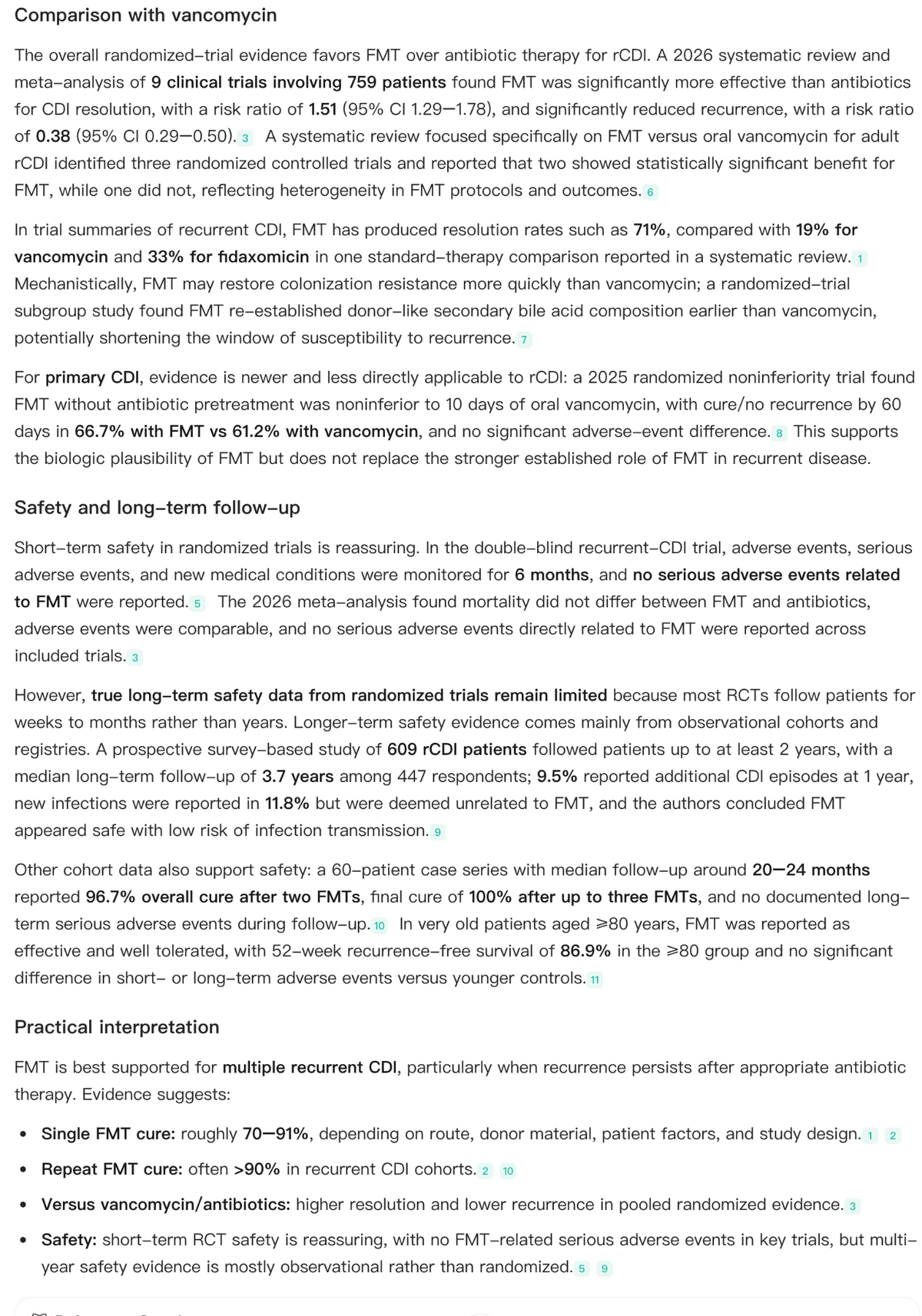
Figure 1. Noah AI evidence brief on FMT for recurrent C. difficile infection, showing cited findings on FMT versus vancomycin, recurrence, and safety.
How to Verify AI Citations: A Quick Checklist
Step 1 — Existence check: Click the citation link. Does the paper exist on PubMed?
Step 2 — Claim match: Read the paper's abstract. Does it support the specific claim the AI made?
Step 3 — Completeness check: Did the AI accurately represent the paper's findings, including limitations, confidence intervals, and caveats?
For high-stakes research, citations should still be checked against the original papers.
Try Noah AI for Free
Use Noah AI to search, compare, and analyze biomedical evidence with AI-powered research workflows.
Free credits are available, and no credit card is required to get started.
FAQ
Can I trust AI citations without checking them?
No. For research or clinical use, important citations should be verified against the original paper.
Why can AI citation errors happen?
AI systems can misattribute findings, summarize a paper too broadly, or in some workflows generate references that are difficult to verify. Direct source links reduce verification friction but do not remove the need to check critical claims.
Is Perplexity useful for citations?
Perplexity provides source links, but its sources are broader web sources rather than exclusively PubMed literature. For PubMed-specific evidence questions, dedicated biomedical research tools may offer a more focused workflow.
Which tool has the best citation quality overall?
The strongest workflow is the one that links specific claims directly to verifiable papers and makes source checking easy. Noah AI provides inline citations within structured biomedical evidence briefs; Consensus and Elicit also link users back to source papers.
Related Articles in This Series
Best AI Tools for PubMed Literature Review (2026)
Free AI Tools for PubMed and Biomedical Literature Search in 2026
PubMed Search with AI: How Life Science Professionals Find and Analyze Biomedical Evidence Faster
Best AI Tools for Turning Research Questions into Evidence Tables (2026)