How AI Evidence Workflows Support Portfolio Decisions
Linda
Learn how AI evidence workflows support pharma portfolio decisions by structuring TPP evidence, competitive benchmarks, uncertainty, and cross-functional review.
Structured, source-linked evidence workflows that help R&D teams spend more time on judgment and less time rebuilding the evidence base.
The higher-value role of AI in pharmaceutical portfolio decisions is not to decide which programs advance. It is to assemble, organize, compare, and challenge evidence so accountable teams can make better-informed judgments. A well-designed workflow can support indication prioritization, Target Product Profile (TPP) development, portfolio review, and go/no-go preparation by linking claims to sources, surfacing uncertainty and conflicts, and preserving the rationale behind each decision.
This role aligns with the FDA's description of the TPP as a tool for structured discussion and development planning across stages—not a substitute for sponsor–FDA interaction or clinical review. It also reflects benefit–risk approaches that consider benefits, risks, uncertainties, mitigation options, and patient experience rather than efficacy alone. AI can make that evidence layer more complete and reviewable; it should not replace experts, governance committees, or accountable decision-makers.
Why Faster Evidence Generation Is Not Enough
Early AI adoption in pharmaceutical organizations often focuses on reducing research time: building competitive landscapes, characterizing targets, analyzing unmet need, and reviewing literature. These are valuable activities, particularly when teams must assemble a large evidence base under time pressure. But faster retrieval and synthesis do not automatically produce better portfolio decisions.
The higher-value question is whether that evidence can support indication prioritization, TPP development, portfolio review, and go/no-go preparation. Those decisions require explicit criteria, transparent trade-offs, uncertainty representation, and structured review across functions. A rapid summary may identify relevant programs or publications while leaving unresolved which evidence is reliable, how populations and treatment settings differ, what assumptions drive the conclusion, and which risks could change the decision.
Portfolio choices are not reducible to ranking projects by apparent probability of success or evidence volume. A program may have encouraging efficacy evidence but remain unattractive if its intended indication is crowded, its safety-management burden is high, its comparator has strengthened, or its development assumptions are poorly supported. Conversely, an uncertain program may merit continued investigation when it offers strategic differentiation or addresses an important unmet need. These are judgments about portfolio value, not just search performance.
The output therefore needs to be more than a faster report. It should be structured around decision criteria and evidence claims, linked to the underlying sources and populations, explicit about uncertainty and missing support, and reviewable by clinical, regulatory, commercial, and medical stakeholders.
When a Generic AI Research Output Stops Being Enough
The methodology is decision-specific
The workflow should begin with the decision, not with an undifferentiated search. A portfolio review may require a different evidence hierarchy, inclusion and exclusion rules, competitive benchmark, efficacy threshold, safety threshold, evidence cutoff date, and uncertainty framework than an indication-prioritization exercise or a TPP review.
The output must travel across functions without losing integrity
Portfolio evidence has to move across Clinical, Commercial, Regulatory, and Medical Affairs without becoming four incompatible narratives. The goal is not to eliminate functional interpretation, but to maintain one shared evidence base while making the questions and implications for each function explicit.
The output feeds a formal governance moment
A research report becomes decision support when it is prepared for a defined governance moment: a portfolio review, development gate, TPP review, indication-prioritization discussion, or go/no-go preparation. The evidence packet should preserve the sources, assumptions, evidence maturity, unresolved gaps, decision criteria, and cutoff date used to produce it.
The question depends on internal context
Public evidence establishes external benchmarks, but it cannot by itself define an organization's required differentiation or the attractiveness of a particular investment. That judgment depends on context such as asset characteristics, prior studies, internal observations, manufacturing constraints, commercial assumptions, and previous governance decisions. When internal material is supplied for analysis, it should remain clearly distinguished from public evidence and reviewed by accountable teams.
What a Portfolio-Ready Evidence Workflow Requires
A portfolio-ready workflow is not simply a search interface or a generated report. It is a structured chain from the decision question to a documented governance output, with evidence and assumptions preserved at each step.
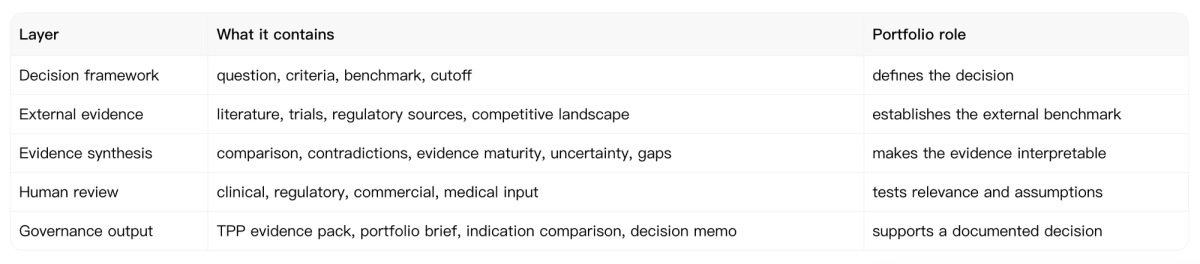
Auditability means retaining sources, versions, timestamps, and review status where appropriate. Logging alone does not validate an AI interpretation; the workflow still requires proportionate controls, source checking, and accountable human judgment.
Where AI Evidence Workflows Add the Most Value
AI evidence workflows add the most value where two dimensions intersect: evidence intensity and judgment complexity. Evidence intensity reflects the volume, diversity, and updating burden of material that must be found, screened, extracted, and compared. Judgment complexity reflects how much the decision depends on competing objectives, uncertainty, cross-functional trade-offs, and consequences that cannot be resolved by retrieval alone.
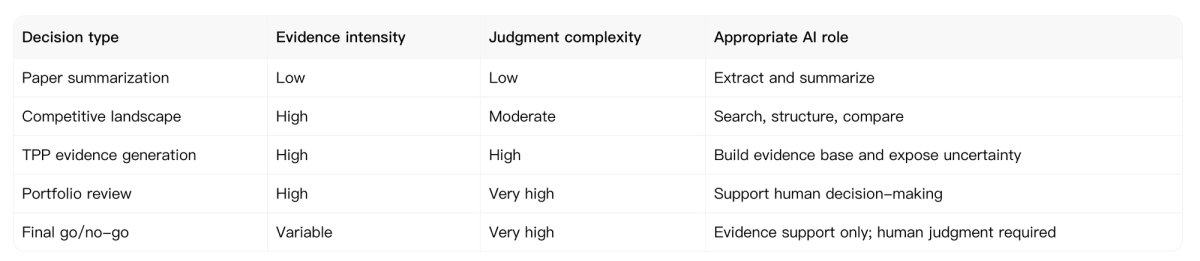
The distinction matters because evidence-intensive work is often suitable for automation or acceleration, while high-judgment decisions are not. AI can help retrieve public evidence, organize findings into consistent fields, compare populations and endpoints, identify conflicting results, and show where support is weak or missing. It can reduce repetitive evidence assembly without turning a complex decision into an unexplained score.
A final go/no-go decision may use an AI-generated evidence pack, but the decision remains with the accountable cross-functional governance process.
Target Product Profile Evidence Generation
Target Product Profile evidence generation is a strong example of where an AI-assisted workflow can create value without becoming a decision-maker. A TPP should be treated as an evidence-linked decision instrument, not a static list of aspirations. An AI workflow can help populate its fields, connect each claim to its source, distinguish observed results from assumptions, identify conflicts, and flag evidence that is immature or missing.
Illustrative case: Next-generation EGFR therapy in EGFR-mutant NSCLC
This case is illustrative, not a recommendation for a particular asset or launch strategy. The evidence workflow would separate the intended mutation-defined population, disease setting, treatment line, comparator, CNS-evaluable population, efficacy endpoints, safety-management requirements, biomarker context, and development timing.
| TPP dimension | Evidence needed | Example decision question |
|---|---|---|
| Target population | Mutation definition, disease setting, biomarker testing, baseline CNS status | Which EGFR-mutant population and line of therapy is intended? |
| Efficacy | Randomized comparator data, PFS, OS, response and duration | What clinically meaningful benefit is demonstrated versus the current benchmark? |
| CNS activity | Intracranial response, CNS progression, brain-metastasis assessment | Does the profile address CNS disease and how robust is the evidence? |
| Safety | Adverse events, serious events, discontinuations, monitoring and mitigation | What safety burden is acceptable and manageable? |
| Treatment line | First-line or post-progression setting, prior therapies and resistance | Where can the therapy compete credibly? |
| Regulatory precedent | Approved indications, endpoints, comparator and review context | What evidence and design choices align with precedent? |
| Competitive landscape | Current standards, combinations, pipeline and launch-window context | What differentiation could remain at launch? |
| Evidence gaps | Immature OS, subgroup limitations, missing CNS or safety data, cutoff date | Which uncertainties require new data or explicit assumptions? |
Public benchmarks should not be collapsed into one number. First-line randomized evidence, post-progression single-arm studies, regulatory precedents, and biomarker subgroup analyses answer different questions. A portfolio-ready TPP workflow should preserve those differences instead of treating every efficacy figure as directly comparable.
Why Public Evidence Alone Is Not the Final Portfolio Answer
Public evidence defines the external benchmark: what has been demonstrated in relevant populations, against which comparators, with what level of uncertainty, and within which regulatory and competitive context. It does not determine what "differentiated," "clinically meaningful," or "achievable" mean for a particular asset.
No access to internal company data is assumed. A public-evidence workflow should therefore avoid presenting an external benchmark as a complete portfolio recommendation. When authorized internal context is supplied, the workflow should preserve whether a conclusion rests on published evidence, an internal observation, an assumption, or a cross-functional judgment.
Real Portfolio Go/No-Go Case: Trodelvy in Second-Line Metastatic NSCLC
A real-world example of portfolio decision-making is Gilead Sciences' 2024 decision to discontinue development of Trodelvy (sacituzumab govitecan) for second-line metastatic non-small cell lung cancer (NSCLC).
This case illustrates how clinical evidence, regulatory considerations, competitive expectations, and portfolio assumptions can inform an indication-specific development decision.
1. Decision Question
Should Trodelvy continue development for previously treated metastatic NSCLC after the Phase III EVOKE-01 results?
2. Source-Linked Evidence Package
Clinical evidence: In January 2024, Gilead reported that the Phase III EVOKE-01 study did not meet its primary endpoint of overall survival in previously treated metastatic NSCLC.
Exploratory signal: A prespecified subgroup showed a numerical survival improvement, but this analysis was not alpha-controlled for formal statistical testing. It could generate a hypothesis without overriding the unsuccessful overall primary endpoint.
Regulatory and strategic context: Gilead subsequently evaluated the results and held discussions with regulators and external opinion leaders.
Portfolio assumptions: The company reported revised commercial expectations and impairment charges associated with the NSCLC development opportunity. Its public disclosures do not reveal every internal decision threshold or governance discussion.
3. Documented Go/No-Go Outcome
NO-GO — Second-line metastatic NSCLC development.
In September 2024, Gilead made a strategic decision to discontinue the clinical development program for Trodelvy in this specific indication.
This was an indication-specific decision, not evidence that Trodelvy had failed across all diseases or that the underlying TROP2 ADC approach was invalid.
4. What a Portfolio Evidence Pack Should Make Explicit
A structured AI-assisted review of this case should distinguish:
- Evidence: The Phase III primary endpoint was not met.
- Uncertainty: Whether the subgroup signal could be confirmed in an appropriately designed study.
- Risk: Additional development requirements, competitive positioning, regulatory feasibility, and commercial assumptions.
- Decision criteria: The clinical-benefit threshold, evidence needed for registration, strategic fit, and investment requirements.
- Outcome: The publicly documented decision to discontinue this indication.
These are evidence-review dimensions, not a claim that Gilead used this exact checklist internally.
5. What Evidence Could Change a Future Assessment?
A subsequent portfolio review could revisit the scientific rationale if compelling new evidence established a reproducible treatment benefit in a clearly defined population, supported an acceptable benefit–risk profile, and justified the additional development investment.
That is a hypothetical future reassessment criterion, not a reported Gilead plan to restart the discontinued program.
What the case demonstrates: A decision-ready evidence pack should connect clinical findings to explicit assumptions, risks, decision criteria, and a documented outcome while preserving the boundary between public evidence and internal governance judgment.
Public sources:
The Pattern AI Evidence Workflows Can Help Break
Many portfolio processes still treat each decision as a new research project. Teams rebuild evidence packages from scratch, repeat searches that other functions have already performed, apply inconsistent benchmarks, maintain separate evidence versions, and revisit decisions without a clear record of the original assumptions or cutoff date.
A structured AI-assisted workflow can replace this episodic pattern with a reusable evidence structure. It can define decision criteria, preserve links to source documents, distinguish observed findings from assumptions, record uncertainty and evidence maturity, and show the review status of each claim. When important evidence changes, the workflow can be rerun or refreshed. This is refreshable decision support, not autonomous or continuous monitoring.
How Noah AI Can Support the Evidence Layer
Noah AI can be positioned as a human-in-the-loop biomedical research workflow that supports the evidence layer of portfolio work. Teams can use it to organize literature, clinical trials, regulatory evidence, competitive landscapes, evidence gaps, conflicts, and source-linked research outputs.
The appropriate claim is about workflow support, not decision autonomy. Noah can help organize the evidence needed for a portfolio discussion; it does not make the portfolio decision. Clinical, regulatory, commercial, medical, and executive leaders remain responsible for determining how evidence, risk, strategic fit, timing, and organizational priorities should be weighed.
Learn more about Noah AI's human-in-the-loop approach →
Conclusion
AI creates the most value in portfolio decision support when it reduces the burden of evidence assembly while preserving the structure, provenance, uncertainty, and cross-functional context required for human judgment. It can help teams search more efficiently, compare evidence consistently, expose conflicts and gaps, and maintain reviewable decision records.
The final portfolio decision remains a human governance responsibility. AI is most useful when it makes that deliberation better informed, more transparent, and easier to revisit—not when it is presented as a substitute for accountable experts or governance committees.
Build a Portfolio Evidence Pack with Noah AI
Use Noah AI to build a source-linked portfolio evidence pack with explicit assumptions, risks, and decision criteria.
Connect clinical evidence, competitive benchmarks, Target Product Profile requirements, regulatory considerations, and unresolved uncertainties to support go/no-go preparation, indication prioritization, and cross-functional portfolio reviews.
Keep the supporting evidence traceable and the final portfolio decision with accountable R&D teams and governance committees.
Free to use · Free credits included · No credit card required